Archived: 7 October 2026
Abstract
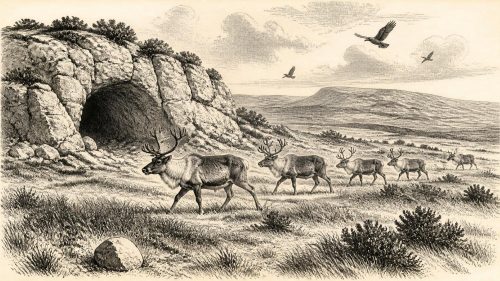
30,153 BCE is an approximate modern waypoint within Ireland’s climatically unstable Late Pleistocene, not a recordable historical year. Castlepook Cave, County Cork, preserves the island’s richest vertebrate assemblage from the period, though disturbed deposits and revised radiocarbon dates require caution. Reindeer, mammoth, giant deer, hyaena and lemmings indicate predominantly open, cold, variable landscapes. A reindeer femur from Hyenahall bears a possible stone-tool butchery cut, suggesting limited Upper Palaeolithic human activity, but not settlement, hunting, or continuous occupation. Later glaciation reshaped landscapes and destroyed evidence. Ireland’s deep prehistory is therefore understood through fragmentary surviving remains, calibrated dating ranges, and cautious interpretation.
Read Article

Archived: 18 September 2026
Abstract
Although 31,242 BCE is a modern filing date rather than a datable Irish event, evidence from surrounding millennia depicts a volatile Late Pleistocene environment. Derryvree, County Fermanagh, preserves tundra wetland deposits between tills, proving an ice-free interval with freshwater habitats, plants and insects before later glaciation. Castlepook Cave, County Cork, contains Ireland’s richest cold-stage vertebrate assemblage, including mammoth, giant deer, reindeer, hyaena and wolf, but accumulated over thousands of years. A marked reindeer femur may indicate brief human butchery around 33,000 years ago, though disturbed context prevents stronger claims. No evidence supports permanent settlement, institutions, agriculture or continuous population there.
Read Article
Archived: 15 September 2026
Abstract
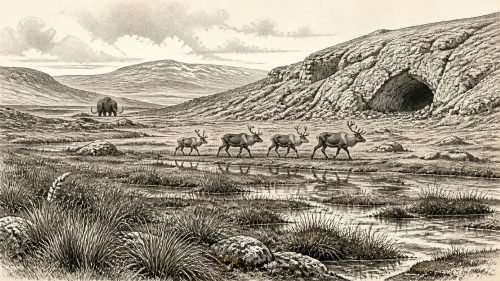
Approximately 31,647 BCE, Ireland formed a climatically unstable, partly ice-free frontier during Marine Isotope Stage 3, rather than a recognisable island or society. Derryvree, County Fermanagh, preserves freshwater sediments between tills, indicating cold, open, wet tundra-like habitats before renewed glaciation. Castlepook Cave, County Cork, contains a long accumulated fauna including mammoth, reindeer, giant deer, hyaena and Arctic species, demonstrating ecological links with glacial north-west Europe. A marked reindeer femur, dated about 33,000 years ago, may indicate human butchery, but remains inconclusive. Later ice-sheet expansion eroded evidence. No settlement, polity, agriculture or continuous human occupation can be securely established for Ireland.
Read Article
Archived: 15 September 2026
Abstract
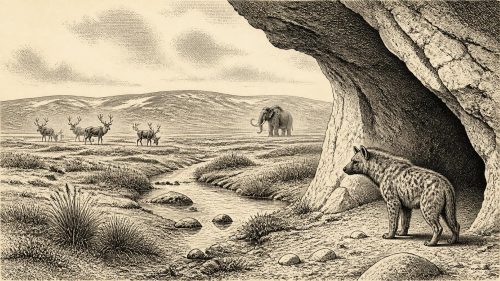
Labelled 31,707 BCE, this period in Ireland belongs broadly to fluctuating Marine Isotope Stage 3, rather than a precisely datable year. Sparse, disturbed evidence indicates that some open, cold landscapes supported mammoth, reindeer, giant deer, lemmings, Arctic foxes, wolves, bears and spotted hyaenas before extensive later glaciation. Castlepook Cave in County Cork accumulated bones over millennia and uniquely records Irish spotted hyaena, revealing overlapping animal activity rather than a single fauna. Fermanagh deposits confirm cold freshwater tundra conditions. A possibly cut-marked reindeer bone suggests human presence, but no secure evidence demonstrates sustained settlement, population, culture or institutions. Ice obscured evidence.
Read Article
Archived: 14 September 2026
Abstract
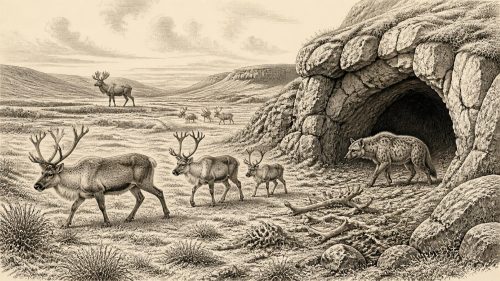
About 33,700 calibrated years before 1950, Ireland lay in a cold, unstable MIS 3 landscape preceding maximum glaciation, with some ice-free ground, periglacial conditions and lower sea levels. Derryvree deposits in Fermanagh preserve tundra-like wetland vegetation, demonstrating locally habitable terrain. Castlepook Cave, Cork, contains Ireland’s richest pre-glacial vertebrate archive, including mammoth, reindeer, giant deer, hyaena, wolf and bear, though its time-mixed, carnivore-modified deposits demand caution. A possibly tool-marked reindeer bone suggests, but cannot prove, brief human presence. No political, cultural or settled community is recoverable; fauna instead reveal changing ecological links with north-west Europe during favourable intervals before extensive ice.
Read Article




