Hyenahall’s Reindeer Bone30153 BCE
30,153 BCE is an approximate modern waypoint within Ireland’s climatically unstable Late Pleistocene, not a recordable historical year. Castlepook Cave, County Cork, preserves the island’s richest vertebrate assemblage from the period, though disturbed deposits and revised radiocarbon dates require caution. Reindeer, mammoth, giant deer, hyaena and lemmings indicate predominantly open, cold, variable landscapes. A reindeer femur from Hyenahall bears a possible stone-tool butchery cut, suggesting limited Upper Palaeolithic human activity, but not settlement, hunting, or continuous occupation. Later glaciation reshaped landscapes and destroyed evidence. Ireland’s deep prehistory is therefore understood through fragmentary surviving remains, calibrated dating ranges, and cautious interpretation.
Dateline
Modern calendar-year precision cannot responsibly be applied to Ireland in 30,153 BCE. The label is a retrospective point on a modern timescale, not a date recorded by people then, nor a date that can be matched to a known Irish event. It falls roughly 32,100 years before AD 1950, the conventional ‘present’ used in archaeological dating, within the later part of Marine Isotope Stage 3, a long and climatically unstable phase of the Late Pleistocene. The evidence is too sparse to describe a particular year. It can, however, illuminate the changing landscapes, animals and possible human presence of Ireland during the broad interval surrounding it.
A Date Without a Chronicle
There were no written records, named communities, political institutions or recoverable calendar systems in Ireland at this depth of time. Accordingly, there is no responsible basis for narrating a ruler, battle, treaty, migration or religious observance in 30,153 BCE. Archaeology works instead with layers, bones, cave deposits, sedimentary sequences and laboratory dates, each normally representing spans of time rather than moments. Radiocarbon determinations must also be calibrated against changing atmospheric carbon levels; a radiocarbon age and a calendar age are not interchangeable.
The number 30,153 BCE should therefore be read as an approximate waypoint within a much larger Ice Age story. It precedes the global Last Glacial Maximum, conventionally dated to about 26,500–19,000 calibrated years BP, when the British–Irish Ice Sheet was at or near its greatest extent. Later ice advance profoundly reshaped Ireland, eroding older land surfaces, moving sediment and limiting the survival of open-air archaeological sites. That loss helps explain why the island’s record for this period is so fragmentary, but it does not turn absence of evidence into evidence for a settled population.
Castlepook’s Deep Archive
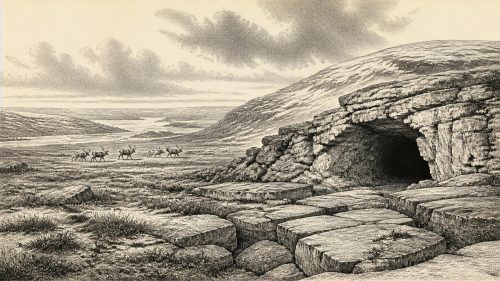
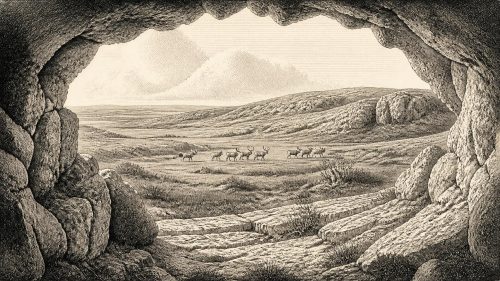
The most important Irish locality for the period is Castlepook Cave, also called Mammoth Cave, near Doneraile in north County Cork. Its narrow limestone passages and chambers include evocatively named spaces such as Hyenahall and Elephant Hall. Excavations directed by Richard J. Ussher and colleagues in the early twentieth century recovered a large and mixed assemblage of animal remains. Geological Survey Ireland describes Castlepook as Ireland’s richest known site for vertebrate evidence from the period leading towards the Last Glacial Maximum.
Its importance comes with a warning. The cave was used and disturbed over a very long time. Carnivores carried material into it; water moved deposits; early excavators removed much sediment; and bones from different episodes can occur close together. Modern re-excavation has sought surviving undisturbed deposits, but has also demonstrated how little intact material remains in parts of the system. Castlepook is not a neatly preserved camp floor. It is a complicated repository of remains accumulated by natural processes, predators and, perhaps on one occasion, people.
Older dating programmes placed elements of the Irish fauna broadly between about 45,000 and 20,000 years ago. More recent work using improved bone pretreatment showed that some earlier Castlepook radiocarbon determinations were too young by roughly 5,000 to 12,000 radiocarbon years. The revision suggests that some mammals, especially giant deer and spotted hyaena, may have disappeared locally before about 40,000 calibrated years BP. This is precisely why an apparently exact date should not be assigned to every Castlepook bone or to the landscape of a numbered BCE year.
Reindeer, Hyenas and Open Country
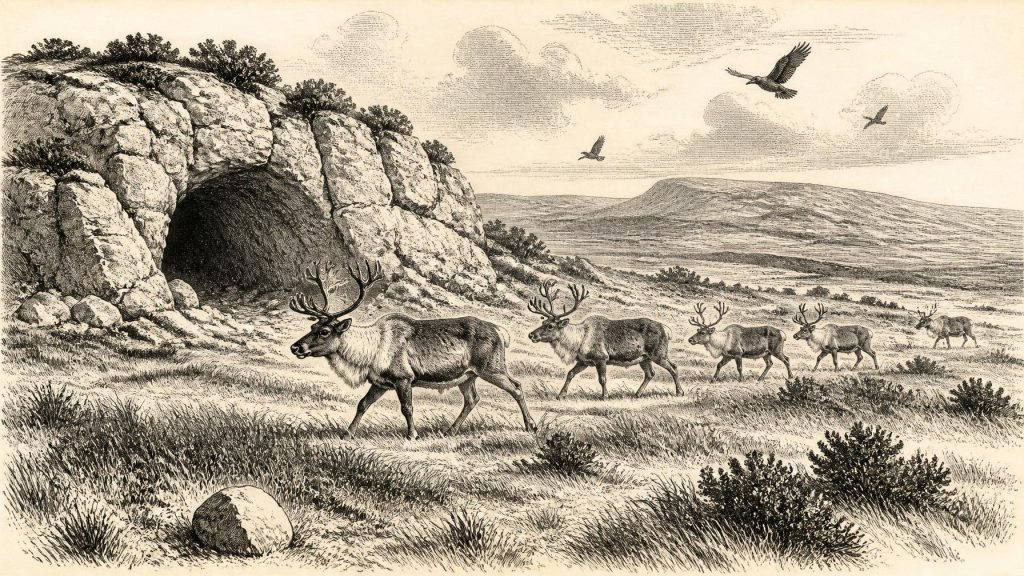
Even with these chronological cautions, the fauna offers a vivid, evidence-based picture of Ireland in the wider interval. Castlepook has yielded remains attributed to reindeer, woolly mammoth, giant deer, brown bear, wolf, Arctic fox, spotted hyaena, collared lemming and Norwegian lemming, alongside birds and smaller animals. Not every species need have lived there simultaneously, and the cave’s deposits cannot be treated as a single snapshot. Yet the assemblage establishes that, during phases of the Late Pleistocene, Ireland supported a fauna very different from that of the present island.
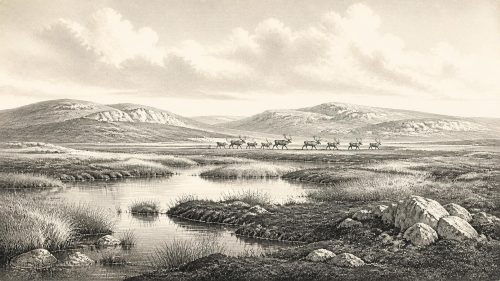
Reindeer and lemmings particularly suggest cold, largely open habitats. Mammoth, giant deer and reindeer would have required extensive feeding grounds, while large predators and scavengers followed the food opportunities created by herbivore herds and carcasses. This does not mean that every view was a featureless ‘mammoth steppe’. Local ground conditions could vary sharply between exposed slopes, river valleys, marshy hollows, limestone uplands and sheltered patches of shrub. Climate during Marine Isotope Stage 3 repeatedly fluctuated, so vegetation and animal ranges were likely mobile rather than fixed.
At this date Ireland was not the green, wooded island familiar today. Forest cannot be assumed for this cold phase. The safest reconstruction is of predominantly open, treeless or sparsely shrubby country, interrupted by wet ground and local refuges where terrain, water and season created different conditions. Such landscapes were productive but demanding: wind, cold, seasonal food shortage and unstable weather would have shaped the movements of every animal using them.
The Mark on a Femur
A reindeer femur from Castlepook is the most intriguing possible evidence for people in Ireland at this immense antiquity. Zooarchaeologist Ruth Carden has interpreted a deep linear incision on the bone as a mark made by a sharp stone tool while the carcass was fresh. A County Cork heritage publication presents the object, now in the National Museum of Ireland – Natural History collection, as broadly c. 31,000 BC. That public-facing date is useful as an indication of the proposed period, but it should not be mistaken for calendar-year certainty or for a complete archaeological horizon.
If the incision is correctly identified as a butchery cut, it indicates a remarkably limited but significant act: somebody used a stone edge on a reindeer limb in Ireland during the Upper Palaeolithic. It does not demonstrate that the animal was hunted rather than scavenged, that butchery happened inside the cave, or that a resident community occupied north Cork. Carnivores may have transported discarded remains into Hyenahall; the absence of a securely associated tool kit, hearth, shelter, human burial or occupation surface leaves the scale and duration of any visit unknown.
The distinction matters. The bone may push possible human activity in Ireland far earlier than the better documented post-glacial record, but it cannot support claims about a named people, language, ethnicity or continuous settlement. Nor should modern ideas of an ‘Irish’ population be projected backwards. At most, the evidence opens the possibility that highly mobile hunter-gatherers reached the island or its then-changing western European margins during a favourable interval, perhaps following animal movements. How they travelled, how often they came and whether they returned remain unanswered questions.
Society Beyond Recovery
For this reason, political affairs, diplomacy and organised conflict are archaeologically invisible here. A small hunting party may have made decisions, maintained social ties and exchanged knowledge, as all human groups do, but no Irish evidence permits a reconstruction of leadership, territory or relations between groups. Likewise, there is no direct evidence for houses, clothing, language, ritual, art, teaching or formal burial practices in Ireland at this time. The practical knowledge needed to survive cold open country—reading tracks, processing carcasses, maintaining cutting tools and navigating changing terrain—is plausible in general Upper Palaeolithic terms, but cannot be assigned specifically to Castlepook visitors.
Economy and trade must be treated with the same restraint. The reindeer femur, if humanly modified, implies access to meat, hide, sinew, marrow or other carcass materials, but it does not reveal a regular economy. No contemporary Irish stone-tool assemblage identifies where any implement was made or what raw materials circulated. There is no evidence for farming, herding, permanent villages, managed fields, metalwork or maritime trade. This was long before those later developments in Ireland.
Routes, Water and Isolation
Regional change is nevertheless central to understanding the evidence. Ice sheets and sea level repeatedly altered the relationship between Ireland, Britain and continental Europe. At some colder times lowered seas reduced water barriers; at others expanding ice and dangerous marine conditions could obstruct movement. The precise availability of a usable route around 30,153 BCE cannot be demonstrated from the Castlepook bone. Animal occurrences prove that some species reached Ireland during the wider period, but they do not establish one simple, permanently open land bridge or a single route used by humans.
The approach of the Last Glacial Maximum is the large environmental development against which this moment must be set. Research offshore west of Ireland shows that grounded ice later extended across the continental shelf, reaching the outer shelf by around 26,800 calibrated years BP and beginning retreat only later. In southern Ireland, revised stratigraphic work likewise indicates extensive last-glacial ice cover. Those later advances did not merely make life difficult; they reworked the physical archive through which earlier lives might otherwise have been known.
What Can Be Said
Ireland around this notional year was part of a cold, variable north-west European world, not an empty stage outside history. Its caves preserve proof of large mammals and carnivores, and Castlepook preserves a contested but potentially transformative trace of human handling of a reindeer. The evidence supports open cold-country environments and episodic animal movement. It supports neither a year-specific event nor a settled prehistoric society.
That limitation is itself historically important. Hyenahall’s reindeer bone is valuable not because it supplies a ready-made origin story, but because it shows how a single object can alter the questions historians ask. Future work on surviving cave sediment, bone dating, microscopic surface damage, ancient DNA and Ice Age geography may clarify the picture. For now, 30,153 BCE belongs to the deep prehistory of Irish landscapes: a period known through fragments, calibrated ranges and carefully stated possibilities rather than a conventional annual chronicle.
Primary Sources
- A Reconsideration of the Radiocarbon Dating of the Marine Isotope Stage 3 Fauna from Southern Ireland
- Castlepook Cave: County Geological Site Report
- Heritage Artefacts of County Cork
- Castlepook Cave, Co. Cork, 2022 Excavation Report
- The Irish Quaternary Fauna Project
- Occurrence of Mammalia Relicts at Site Castlepook Cave
- Pleistocene Vertebrates in the British Isles
- Pleistocene Rodents of the British Isles
- The Exploration of Castlepook Cave, County Cork
- The Dungarvan Valley Caves Project: Second Interim Report
- Dimensions and Chronology of the Last Ice Sheet in Western Ireland
- Late Pleistocene Chronostratigraphy and Ice Sheet Limits, Southern Ireland
- Trimlines, Blockfields and the Vertical Extent of the Last Ice Sheet in Southern Ireland
- Maximum Extent and Dynamic Behaviour of the Last British-Irish Ice Sheet West of Ireland
- Timing and Pace of Ice-Sheet Withdrawal Across the Marine-Terrestrial Transition West of Ireland During the Last Glaciation
- Oscillating Retreat of the Last British-Irish Ice Sheet on the Continental Shelf Offshore Galway Bay, Western Ireland
- Deglaciation Chronology of the Donegal Ice Centre, North-West Ireland
- BRITICE Glacial Map, Version 2: A Map and GIS Database of Glacial Landforms of the Last British-Irish Ice Sheet
- The Deglaciation of the Western Sector of the Irish Ice Sheet From the Inner Continental Shelf to its Terrestrial Margin
- Pattern and Timing of Retreat of the Last British-Irish Ice Sheet