Hyenahall’s Open-Country Fauna31707 BCE
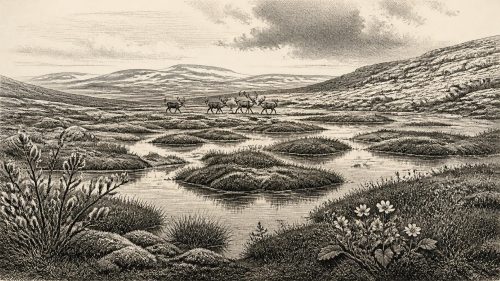
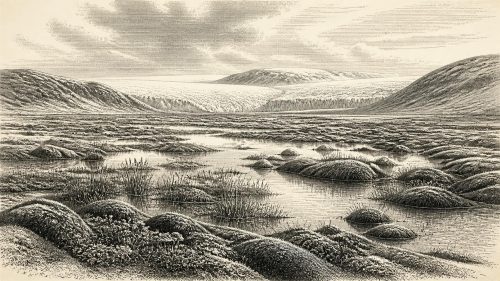
Labelled 31,707 BCE, this period in Ireland belongs broadly to fluctuating Marine Isotope Stage 3, rather than a precisely datable year. Sparse, disturbed evidence indicates that some open, cold landscapes supported mammoth, reindeer, giant deer, lemmings, Arctic foxes, wolves, bears and spotted hyaenas before extensive later glaciation. Castlepook Cave in County Cork accumulated bones over millennia and uniquely records Irish spotted hyaena, revealing overlapping animal activity rather than a single fauna. Fermanagh deposits confirm cold freshwater tundra conditions. A possibly cut-marked reindeer bone suggests human presence, but no secure evidence demonstrates sustained settlement, population, culture or institutions. Ice obscured evidence.
Dateline
31,707 BCE is a modern, proleptic calendar label, not a date that people in prehistoric Ireland could have recognised or recorded. It corresponds only approximately to 33,656 years before AD 1950, the conventional “present” of radiocarbon chronology. At this depth of time, modern calendar-year precision is unavailable. Evidence is dated in broad calibrated ranges, and even well-tested samples can carry uncertainties of centuries or more. The responsible subject, therefore, is not an event in a single Irish year, but Ireland during the later part of Marine Isotope Stage 3: a fluctuating cold phase of the last Ice Age, well before the Last Glacial Maximum.
For this broad period, Ireland is illuminated by a sparse and uneven archive: animal bones from caves, organic deposits buried beneath later glacial sediments, pollen, insect remains, cave mineral formations, landforms, and radiocarbon measurements. These do not provide a continuous national narrative. They do, however, show that parts of Ireland could support cold-adapted animal communities before the expanding British–Irish Ice Sheet transformed much of the island. The richest single window is Castlepook Cave, also called Mammoth Cave, near Doneraile in north County Cork. Its galleries include the evocatively named Hyenahall, a reminder that the evidence is not solely of a frozen wilderness but of a living, contested animal landscape.
A Date Within a Broad Cold Age
The label “31,707 BCE” should not be treated as a pin fixed precisely into a sediment layer. Radiocarbon dates measure the decay of carbon-14 and must be calibrated against changing atmospheric carbon levels before they can be expressed as calendar-age ranges. IntCal20, the internationally used Northern Hemisphere calibration framework, reaches back to 55,000 calibrated years before present, but its older sections rely on several kinds of natural archive rather than annually resolved tree rings. This makes it especially important not to convert a prehistoric date into an imagined day, season, or political generation.
In climatic terms, the nominal date falls within MIS 3, conventionally spanning roughly 57,000 to 29,000 years ago. This was not a single unchanging “Ice Age climate”. Greenland ice-core records and European environmental archives show repeated swings between relatively milder interstadials and colder stadials. Ireland’s local record is poorer and has frequently been disturbed or removed by later ice, so it cannot simply be assigned the weather of a particular Greenland oscillation. What can be said is that the island lay in a northern Atlantic world of severe seasonal conditions, open vegetation and advancing or recurrent ice margins, not in the wooded and agriculturally transformed landscape familiar today.
The full Last Glacial Maximum came later. Ice-sheet syntheses generally place its most extensive phase in the British–Irish region around 26,000–21,000 years ago, while the newer BRITICE-CHRONO reconstruction models ice-sheet growth and retreat from 31,000 to 15,000 years ago. That chronology warns against a simple map of Ireland either wholly ice-covered or wholly ice-free at 31,707 BCE. Ice extent changed through time and differed by region; evidence for significant earlier ice cover in MIS 3 also survives in parts of Britain and Ireland. At the broad date considered here, the best interpretation is of an environmentally unstable interval before the later maximum, when at least some Irish landscapes and cave entrances remained available to animals.
Castlepook and the Animal World
Castlepook Cave is central because it has yielded more than 2,000 bones and is Ireland’s most important known repository of vertebrate remains from the period leading towards the Last Glacial Maximum. Individual bones have produced dates ranging broadly from about 45,700 to 19,950 radiocarbon years before present. That very span is a warning: Castlepook is an archive accumulated across many millennia, not a sealed deposit representing one moment. Water movement, earlier excavation and the habits of carnivores have mixed or obscured parts of its history. A bone from the cave can illuminate the wider era, but need not describe conditions in every part of Ireland or precisely in 31,707 BCE.
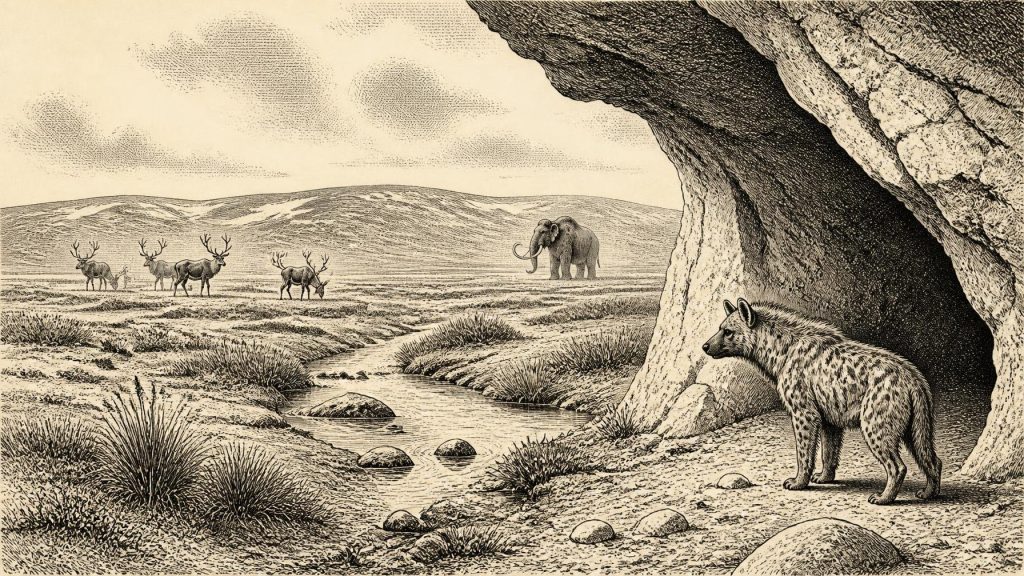
Nevertheless, the faunal list is remarkable. Finds attributed to the older cold-stage assemblage include woolly mammoth, reindeer, giant deer, brown bear, wolf, Arctic fox, spotted hyaena and both collared and Norwegian lemmings. The combination indicates open country capable, at intervals, of supporting large grazing and browsing mammals, smaller cold-adapted mammals and formidable scavengers or predators. It bears little resemblance to modern Ireland’s fauna. Mammoth and reindeer suggest wide feeding grounds rather than closed woodland; lemmings and Arctic fox reinforce the conclusion that cold, exposed habitats occurred. Yet such a list should not be turned into an illustrated procession of animals all present together on one day. Species have separate dates, and the cave received bones by different routes.
Hyenahall is particularly significant because spotted hyaena is represented at Castlepook, the only Irish site known to have yielded this animal. Hyaenas may have used caves as dens, dragging in prey or scavenged carcasses; gnawing, breakage and the spatial distribution of bones can therefore reveal animal behaviour as much as climate. A cave is not automatically a hunting camp, and a concentration of bones is not automatically a human food store. The cave’s evidence instead evokes overlapping animal territories: reindeer and mammoth moving through open ground, carnivores exploiting carcasses, and bones becoming trapped in a limestone maze over a long period.
People: A Possibility, Not a Population
The most consequential human question is also the least secure. A reindeer femur from Castlepook has been reported as about 33,000 years old and bears a deep modification interpreted by zooarchaeologist Ruth Carden as a cut or chopping mark made with a sharp stone implement during carcass processing. If that interpretation is confirmed, it would indicate a human visit to Ireland in the broad era represented by this article, vastly earlier than the long-established Mesolithic settlement record. Research funded through the Royal Irish Academy has described modified bones from several phases of the last glacial cycle as the best documented evidence so far for a Pleistocene hominin presence on the island.
But the limits of the claim matter as much as its excitement. The bone came from an old cave collection, not a newly excavated, intact occupation floor. No securely associated lithic assemblage, hearth, built shelter, burial, cave art panel or repeated settlement sequence of this age has been recovered at Castlepook. The National Museum of Ireland accordingly still characterises the Palaeolithic human record as lacking clear evidence of sustained human presence. The careful conclusion is that a brief Upper Palaeolithic visit, hunt or episode of carcass processing is plausible on the present evidence; permanent occupation, a named community, or an island-wide population cannot responsibly be asserted.
That distinction governs every social question. There is no evidence for a polity, leaders, territorial diplomacy, formal conflict between human groups, farming households, villages or any enduring exchange system in Ireland at this time. Nor is there Irish evidence from which to infer language, kinship rules, religious practice, ritual monuments, formal learning or artistic traditions. If hunters did reach the island, they would have belonged to wider Upper Palaeolithic worlds known elsewhere in north-west Europe; that is a reasonable regional context, not proof that Irish visitors carried any particular tool-kit, belief or custom.
Everyday Survival and Movement
The landscape itself imposed the decisive conditions of life. Open, low-growing vegetation would have offered forage for herbivores, while exposed ground, frost, wind and rapidly changing weather limited shelter and food security. The Fermanagh record is valuable here, though it should not be forced into exact synchrony with Castlepook. At Derryvree near Maguiresbridge, organic-rich freshwater layers trapped between glacial tills preserve mosses, sedges and a cold-climate insect fauna. A conventional radiocarbon age of 30,500 years before present was obtained from the organic layers. The deposits demonstrate that northern Ireland experienced cold, non-glacial, freshwater and tundra-like conditions during part of Middle Midlandian time; they do not provide a diary for the numbered BCE year.
For animals, rivers, wetlands and cave mouths were important elements in a broken landscape of feeding grounds and refuge. For any people, the practical economy would necessarily have been one of movement, observation and opportunism: following game, finding fuel and water, using animal fat, hides, bone and meat where available, and seeking shelter from wind and cold. Yet this is an inference from Ice Age hunter-gatherer lifeways elsewhere, not direct evidence for an Irish camp. There is no basis for claiming regular trade, long-distance commerce or a maritime economy within Ireland. Lower global sea levels altered the shape of the surrounding seas, but the precise availability of a usable route between Ireland, Britain and the continent remains debated and changed with ice, sea level and local topography.
An Ireland Without Later Ireland
At this point in deep time, none of the familiar institutions or cultural markers of Irish history existed: no Gaelic kingdoms, fields, monuments, churches, towns or written memory. Even Ireland’s later insularity should not be projected backwards uncritically. Glacial cycles repeatedly remodelled coastlines, drainage and ecological routes. The later ice sheet eroded and buried evidence, helping to explain why the archaeological record is so fragmentary. What survives is therefore unusually precious but also unusually difficult to interpret.
The strongest historical picture is one of ecological possibility under pressure. Around the broad interval denoted by 31,707 BCE, Ireland was part of a changing north-west European cold-stage environment. Its open landscapes could, at least intermittently, sustain reindeer, mammoth and predators. Castlepook Cave preserved traces of those animals; Fermanagh sediments preserve evidence of cold freshwater vegetation; ice-sheet research shows that more extensive glaciation was still to come. A potentially cut-marked reindeer bone holds out the prospect that people briefly entered this world. It does not yet allow us to write a conventional human history. The real story is the survival of clues: bones, silts and cave passages that make an otherwise silent Ireland faintly visible.
Primary Sources
- Castlepook Cave
- The Irish quaternary fauna project
- A reconsideration of the radiocarbon dating of the Marine Isotope Stage 3 fauna from southern Ireland
- Growth and retreat of the last British–Irish Ice Sheet, 31,000 to 15,000 years ago: the BRITICE-CHRONO reconstruction
- Growth and retreat of the last British–Irish Ice Sheet, 31,000 to 15,000 years ago: the BRITICE-CHRONO reconstruction
- Pattern and timing of retreat of the last British-Irish Ice Sheet
- Dimensions and chronology of the last ice sheet in Western Ireland
- Extent and deglacial chronology of the last British–Irish Ice Sheet: implications of exposure dating using cosmogenic isotopes
- Late Pleistocene chronostratigraphy and ice sheet limits, southern Ireland
- A Middle Midlandian fresh-water series at Derryvree, Maguiresbridge, County Fermanagh, Northern Ireland
- Palaeoecology
- Prehistoric Details
- Spotted Hyena Skull
- 2022:564 – Castlepook Cave, Castlepook South, Cork
- Archaeology Research Excavation Grant 2022
- The IntCal20 Northern Hemisphere radiocarbon age calibration curve (0–55 cal kBP)
- Recent Developments in Calibration for Archaeological and Environmental Samples
- The IntCal20 Approach to Radiocarbon Calibration Curve Construction: A New Methodology Using Bayesian Splines and Errors-in-Variables
- The problem of a late quaternary landbridge between Britain and Ireland
- Deglaciation, Earth crustal behaviour and sea-level changes in the determination of insularity: A perspective from Ireland
- Britain and Ireland: Glacial landforms prior to the Last Glacial Maximum
- Irish Cave Exploration
- The mammoth caves of Castlepook, near Doneraile