Hyenahall’s Open Range31242 BCE
Although 31,242 BCE is a modern filing date rather than a datable Irish event, evidence from surrounding millennia depicts a volatile Late Pleistocene environment. Derryvree, County Fermanagh, preserves tundra wetland deposits between tills, proving an ice-free interval with freshwater habitats, plants and insects before later glaciation. Castlepook Cave, County Cork, contains Ireland’s richest cold-stage vertebrate assemblage, including mammoth, giant deer, reindeer, hyaena and wolf, but accumulated over thousands of years. A marked reindeer femur may indicate brief human butchery around 33,000 years ago, though disturbed context prevents stronger claims. No evidence supports permanent settlement, institutions, agriculture or continuous population there.
Dateline
31,242 BCE is a modern filing date, not a year that anyone in prehistoric Ireland could have named, recorded or experienced as a fixed point in a calendar. No archaeological method can isolate events in Ireland to that single year. In conventional archaeological terms it falls roughly 33,200 calibrated years before present (cal BP, where “present” is 1950), within the Late Pleistocene, Marine Isotope Stage 3. The responsible subject is therefore not a supposed event of 31,242 BCE, but the evidence for an Irish Ice Age landscape in the surrounding millennia: a cold, changeable country, at times ice-free and capable of supporting an unexpectedly varied mammal fauna.
A Date Within a Long Climate Cycle
The broad interval around 33,000–32,000 cal BP was part of the last glacial cycle, long before the Last Glacial Maximum reached its greatest extent. Greenland ice-core chronologies describe rapid alternations between relatively milder interstadials and colder stadials across the North Atlantic world. On that framework, the notional date lies late in Greenland Stadial 5.2, but this should not be mistaken for a weather report from Ireland: a Greenland climatic division cannot simply be transferred, year for year, to a particular Irish valley. Its value is to show that this was an age of abrupt environmental instability rather than one unchanging “Ice Age”.
Ireland was not yet the familiar Atlantic island of modern maps. Much water was locked in global ice sheets, lowering sea level and exposing extensive shelves around Britain and Ireland. Yet lower sea level does not automatically prove a continuous, easily passable land route into Ireland. Local sea depth, changing coastlines, glacial loading of the land and the shifting behaviour of the British–Irish Ice Sheet all affected possible passages. The evidence allows the conclusion that animal movement into Ireland was possible during suitable intervals; it does not identify a specific route, crossing or coastline for 31,242 BCE.
Derryvree’s Tundra Wetland
The most informative Irish environmental sequence close to this deep timescale lies at Derryvree, near Maguiresbridge in County Fermanagh. A road cutting exposed organic silts and fine sands trapped between two thick tills in a drumlin. The deposit produced the radiocarbon determination Birm-166, 30,500 radiocarbon years BP, with a substantial uncertainty. When calibrated using modern curves, this broadens to approximately 36,900–31,700 cal BP. It cannot date one year, but it overlaps the chronological horizon of this article and demonstrates an ice-free interval between glacial advances.
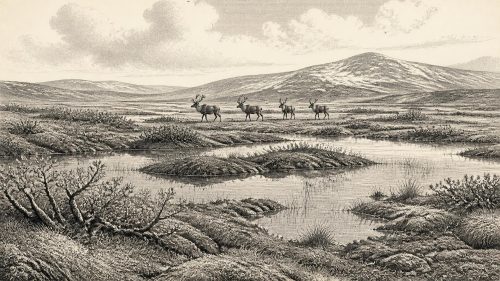
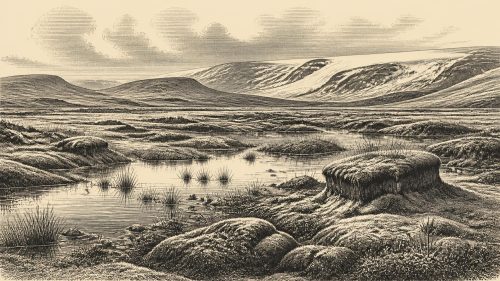
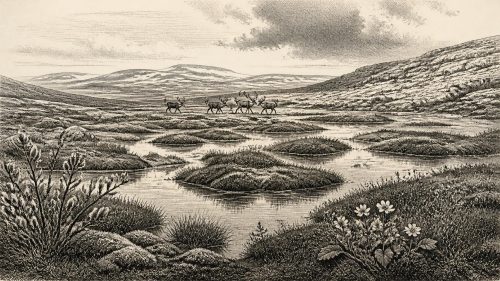
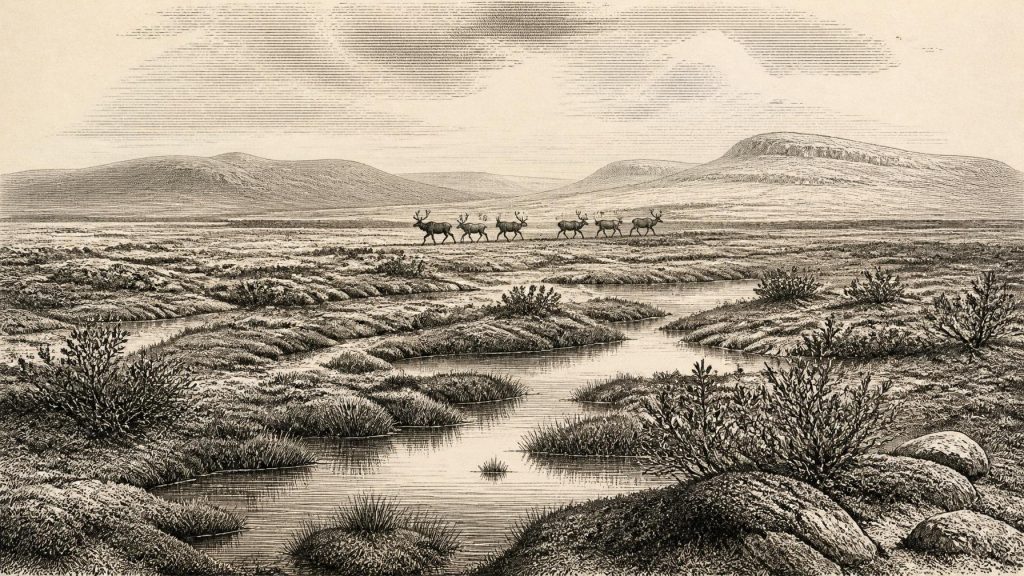
Plant macrofossils, pollen and fossil insects from Derryvree indicate open tundra vegetation and a periglacial regime. The site was not simply a dry, featureless plain: its sediments describe a wetland or muskeg with open pools, abundant plant material and mossy margins. Cold-adapted plants and insects point to severe winters and short growing seasons, while freshwater conditions show that liquid water and productive local habitats persisted in sheltered places. Derryvree is evidence from one locality, not a complete map of Ireland; nevertheless, it decisively complicates any picture of the island as either wholly ice-covered or wholly lifeless throughout the period.
Its position between tills is equally important. The lower till records an earlier episode of glaciation; the organic bed records an interval in which vegetation, insects and freshwater sediments accumulated; the upper till records later ice advance. Thus the Irish landscape around this wider period was subject to regional change on a formidable scale. Wet ground that supported pond life and tundra vegetation could eventually be overridden, buried and preserved beneath ice-laid sediment. Much evidence for open-air activity, if it ever existed, was likely eroded, reworked or concealed by those subsequent glacial processes.
The Castlepook Faunal Archive
For animal life, Castlepook Cave near Doneraile in north County Cork is the key Irish site. Also known as Mammoth Cave, it is a limestone maze whose passages acquired names such as Hyenahall and Elephant Hall during early exploration. Excavations between 1904 and 1918 recovered more than 2,000 bones. Geological Survey Ireland describes it as Ireland’s richest vertebrate-fauna site for the period leading towards the Last Glacial Maximum. Its reported fauna includes woolly mammoth, giant deer, reindeer, brown bear, wolf, Arctic fox, mountain hare, lemmings and spotted hyaena.
This assemblage establishes an important environmental fact: at various points in the middle and later Ice Age, parts of Ireland were within the range of a far richer cold-stage mammal community than the later island fauna might suggest. Large grazing animals imply open country with enough vegetation to support them; predators such as wolf and spotted hyaena imply wider food webs, not isolated specimens in a vacuum. Reindeer, lemmings and Arctic fox are especially consistent with cold, open conditions. Mammoth and giant deer reveal the capacity of some Irish landscapes to sustain, or at least receive, large herbivores during favourable phases.
But Castlepook is an archive, not a single scene. Its bone-bearing deposits accumulated across many thousands of years. Carnivores could drag carcass parts into caves; animals could die there; water could move sediment and bone; and early excavators worked before modern standards of fine-grained stratigraphic recording. Later re-dating has also shown that some older radiocarbon determinations from southern Irish caves were too young because earlier bone-treatment methods were less reliable. A list of species from Castlepook must therefore never be recast as a claim that mammoths, hyaenas, reindeer and people all stood together in the Awbeg valley in 31,242 BCE.
The Reindeer Femur Question
One Castlepook object makes the human question unusually significant. A fragment of reindeer femur from the old collection has been presented in County Cork heritage material as roughly 33,000 years old and as bearing a deep mark interpreted by zooarchaeologist Ruth Carden as damage made with a sharp stone tool during carcass processing. If that interpretation is sustained, it would indicate that one or more Upper Palaeolithic people handled a reindeer in Ireland during this broad interval: a potentially remarkable extension of the island’s human story.
The qualifications are essential. The dated bone came from an old, disturbed cave assemblage, not from a modern excavation of an intact campsite. Radiocarbon dates the death of the animal, rather than independently dating the incision or revealing where the carcass was processed. Identifying a surface modification as a stone-tool cut is a separate taphonomic judgement, requiring distinction from carnivore damage, breakage, trampling, weathering and excavation marks. No securely associated lithic assemblage, hearth, dwelling floor, burial, art object or concentration of butchered bones has been published from Castlepook for this period. The 2022 excavation located surviving sediments but recovered no cultural artefacts.
Accordingly, the femur can support a deliberately narrow conclusion: it is possible evidence for a brief human episode of reindeer processing in Palaeolithic Ireland. It cannot prove a permanent population, a village, a named people or an uninterrupted ancestry leading to later Irish communities. If people were present, they may have been a small and highly mobile party. Hunting is plausible, but scavenging or processing an animal killed elsewhere cannot be excluded. Meat, hide, sinew, fat, bone and antler would all have been useful resources, yet the single femur does not demonstrate precisely which were taken or how.
No Polities, No Proven Institutions
There is no basis for describing political affairs, diplomacy, territorial lordship, organised warfare, trade networks, formal religion or learning in Ireland at this date. Nor is there evidence for agriculture, domesticated herds, pottery, metalworking, fields or permanent settlements. Those absences are not merely gaps in a written record; they reflect the absence so far of securely dated archaeological features that could demonstrate such activities. Comparisons with Upper Palaeolithic societies elsewhere in Europe can show what human groups were capable of—fire use, sophisticated stone technologies, tailored clothing, symbolic expression and long-distance social ties—but none of these should be imported into Ireland without Irish evidence.
The central development around this chronological horizon was environmental opportunity constrained by volatility. In Fermanagh, freshwater tundra wetlands briefly accumulated organic evidence between ice advances. In north Cork, cave deposits preserve traces of an animal world that linked Ireland to wider north-west European ecosystems. The possible marked reindeer femur raises the prospect that people, too, reached this western edge of Europe. It remains a prospect, not a settled narrative. For 31,242 BCE, Ireland’s history is best told through sediments, bones, insects, plants and the disciplined limits of what they can say.
Primary Sources
- A Middle Midlandian Freshwater Series at Derryvree, Maguiresbridge, County Fermanagh, Northern Ireland
- Freshwater Organic Deposits and Stratified Sediments Between Early and Late Midlandian (Devensian) Till Sheets, at Aghnadarragh, County Antrim, Northern Ireland
- The Irish Quaternary Fauna Project
- A Reconsideration of the Radiocarbon Dating of the Marine Isotope Stage 3 Fauna from Southern Ireland
- Late Pleistocene Chronostratigraphy and Ice Sheet Limits, Southern Ireland
- Growth and Retreat of the Last British–Irish Ice Sheet, 31,000 to 15,000 Years Ago: The BRITICE-CHRONO Reconstruction
- BRITICE-CHRONO Maps and GIS Data of the Last British-Irish Ice Sheet 31 to 15 ka
- Castlepook Cave: Cork County Geological Site Report
- 2022:564 – Castlepook Cave, Castlepook South, Cork
- Archaeology Research Excavation Grant 2022: Castlepook Cave Final Report
- Occurrence of Mammalia Relicts at Site Castlepook Cave
- The Exploration of Castlepook Cave, Co. Cork. With 3 Plates.
- Spotted Hyena Skull
- Heritage Artefacts of County Cork
- Archaeological Heritage of County Cork
- The Last Irish Ice Sheet: Extent and Chronology
- A Stratigraphic Framework for Abrupt Climatic Changes During the Last Glacial Period Based on Three Synchronized Greenland Ice-Core Records: Refining and Extending the INTIMATE Event Stratigraphy
- The IntCal20 Northern Hemisphere Radiocarbon Age Calibration Curve (0–55 cal kBP)
- First Evidence of a Late Upper Palaeolithic Human Presence in Ireland
- New Insights on the Fauna of Ireland’s Younger Dryas and Early Holocene from Alice & Gwendoline Cave
- Phylogeographic, Ancient DNA, Fossil and Morphometric Analyses Reveal Ancient and Modern Introductions of a Large Mammal: The Complex Case of Red Deer (Cervus elaphus) in Ireland
- The Mesolithic in Ireland: When Was It?
- Anthropogenic Changes to the Holocene Nitrogen Cycle in Ireland