Hyenahall’s Carnivore Archive31735 BCE
About 33,700 calibrated years before 1950, Ireland lay in a cold, unstable MIS 3 landscape preceding maximum glaciation, with some ice-free ground, periglacial conditions and lower sea levels. Derryvree deposits in Fermanagh preserve tundra-like wetland vegetation, demonstrating locally habitable terrain. Castlepook Cave, Cork, contains Ireland’s richest pre-glacial vertebrate archive, including mammoth, reindeer, giant deer, hyaena, wolf and bear, though its time-mixed, carnivore-modified deposits demand caution. A possibly tool-marked reindeer bone suggests, but cannot prove, brief human presence. No political, cultural or settled community is recoverable; fauna instead reveal changing ecological links with north-west Europe during favourable intervals before extensive ice.
Dateline
The label 31,735 BCE cannot identify an event in Ireland in the way that a later historical year can. There were no written records, named polities or calendar-keeping communities from which an annual narrative survives. Indeed, modern calendar-year precision is unavailable at this depth of time. The date is best treated as a convenient point within a broad Late Pleistocene window, approximately 33,700 calibrated years before AD 1950, during Marine Isotope Stage 3 (MIS 3). Evidence from Ireland must therefore be read in ranges: dated animal bones, deposits beneath glacial sediments, cave stratigraphy, pollen, plant remains and landforms. These illuminate an Ice Age environment, not the business of one particular year.
A Landscape Before Maximum Ice
Around this point in the late Ice Age, Ireland was approaching, but had not yet reached, the most extensive phase of the last British–Irish Ice Sheet. Scholarship has revised the timing and pattern of ice growth repeatedly as new dates have become available. The broad conclusion is clear: substantial parts of Ireland could still be ice-free during parts of MIS 3, while conditions were cold, unstable and increasingly severe. The later maximum ice expansion belongs principally to the period after this broad horizon, rather than to a single sudden island-wide advance.
This distinction matters. Ireland at roughly 33.7 thousand calibrated years ago was not simply an island buried beneath uniform ice. It was a changing north-west European landmass of exposed ground, valleys, uplands, watercourses and caves, subject to periglacial conditions. Frost action disturbed soils and shattered exposed rock; seasonal thaw could feed streams, pools and marshy hollows. Sea level was lower globally than today, changing coastlines and the extent of the surrounding shelf. Yet neither the exact outline of every shoreline nor a continuous land route into Ireland can responsibly be reconstructed for this precise date. Movement by animals, and perhaps people, depended on shifting combinations of sea, ice, terrain and climate.
Derryvree’s Cold-Climate Wetland
The strongest environmental evidence close to this broad period comes from deposits at Derryvree near Maguiresbridge in County Fermanagh. Roadworks exposed organic silts and fine sands lying between glacial tills: a rare survival of a landscape interval later overridden or enclosed by ice-related deposits. The material produced a radiocarbon age of 30,500 radiocarbon years BP, with a published calibrated range of approximately 36,900–31,700 calibrated years BP. That is not an exact date for the nominal year considered here, but it overlaps its wider chronological setting and demonstrates that north-central Ireland retained ice-free terrain during part of the preceding cold stage.
Pollen, mosses, plant macrofossils and invertebrate evidence from Derryvree indicate open tundra-like vegetation and a periglacial regime. Sedges, grasses, dwarf shrubs and hardy herbs could grow where short summers permitted, while trees were absent or extremely restricted locally. Such evidence should not be translated into a photographic reconstruction of the entire island. It represents one locality and one sedimentary sequence. Nevertheless, it establishes that an Irish landscape capable of sustaining wet ground and cold-adapted plant communities existed within the relevant time range, rather than a featureless wasteland.
Castlepook and the Cave Record
For animal life, Castlepook Cave near Doneraile in north County Cork is indispensable. Its maze of limestone passages includes chambers given evocative names by early investigators, among them Hyenahall and Elephant Hall. Excavations in the early twentieth century recovered a large and complicated assemblage of bones. Geological Survey Ireland regards Castlepook as Ireland’s richest known site for vertebrate fauna in the period leading towards the Last Glacial Maximum. The cave is consequently a central archive for what could live in Ireland before the most severe later glaciation.
Its importance is matched by its difficulty. The assemblage accumulated over a long span, and cave deposits were affected by water movement, excavation and repeated use by animals. Individual bones cannot automatically be treated as belonging to one moment, one hunting episode or even one undisturbed layer. Modern redating has shown that some older radiocarbon determinations from Castlepook and other southern Irish caves were too young by several thousand radiocarbon years. The reassessment places important elements of the Castlepook fauna firmly within MIS 3, but it also reinforces the need to date particular specimens rather than rely on a general label for the cave.
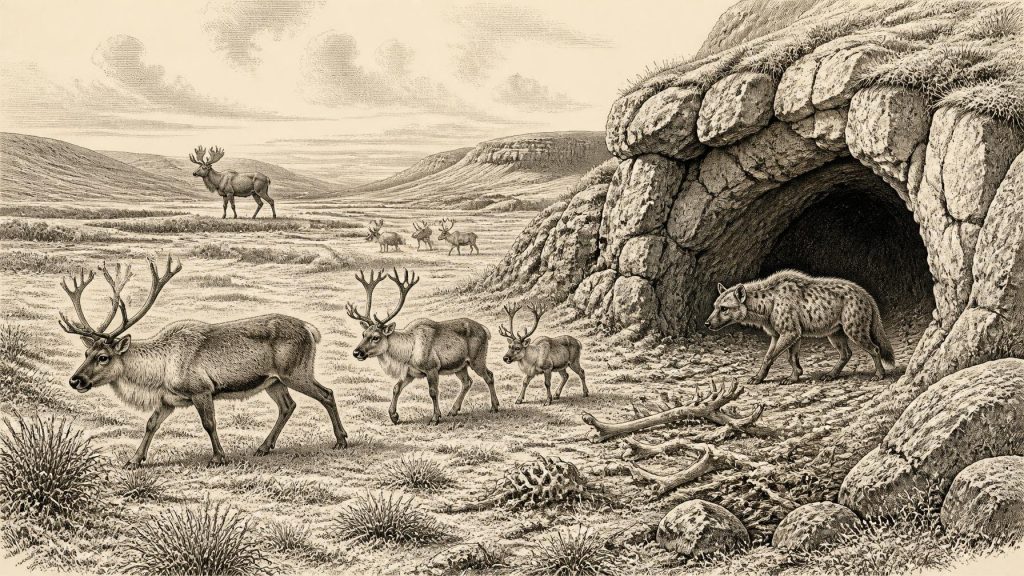
The fauna represented at Castlepook and comparable Irish cave collections includes woolly mammoth, reindeer, giant deer, brown bear, wolf, Arctic fox, mountain hare, lemmings and spotted hyaena. Not every species is securely contemporary with every other, nor can every record be assigned to 31,735 BCE. The responsible conclusion is narrower and more valuable: during favourable cold-stage intervals, Ireland supported a varied community of large herbivores, smaller mammals and formidable predators. Reindeer and lemmings point towards cold, open habitats; mammoth and giant deer demonstrate the potential richness of grazing landscapes; hyaenas, wolves and bears remind us that carcasses and shelter sites were contested resources.
Carnivores, Carcasses and Caution
Hyenahall is a useful corrective to simplistic stories of human beginnings. Spotted hyaena was a Pleistocene European predator, not an exotic curiosity accidentally transported from its modern African range. At Castlepook, hyaena remains, coprolites and bone damage indicate that carnivores helped create the archive. A cave could serve as a den, a refuge, a place where prey was dragged, or a trap into which material was washed. Tooth marks, breakage and displacement can resemble the traces that archaeologists seek when identifying human butchery. Cave bones therefore record ecological processes before they record human acts.
A reindeer femur fragment from Castlepook has been publicised as bearing a deep mark consistent with butchery using a stone tool and as dating to about 33,000 years ago. If the mark is confirmed as human-made and contemporary with the animal’s death, it would be remarkably early evidence that Upper Palaeolithic people reached Ireland. It would fit broadly with the presence of Homo sapiens and specialised big-game hunters elsewhere in north-west Europe. But the claim remains much less secure than a site containing a dated hearth, stone-tool assemblage, occupation surface and several independently modified bones. A single marked specimen raises a serious possibility; it does not demonstrate a settled population.
No Politics Yet Recoverable
There is no evidence from Ireland at this date for political authority, diplomacy, organised warfare, ethnic names, law or territorial boundaries. Nor can historians identify a language, a religion, a seasonal festival, a formal artistic tradition or a system of teaching on the island. It would be misleading to call any possible visitors “Irish” in a later national, linguistic or ancestral sense. There are no farms, livestock, cereal crops, villages, monuments or trade goods from which to reconstruct an economy. The familiar categories of historical writing simply exceed the archive.
Even so, the absence of direct Irish evidence does not mean that possible human visitors, if present, lacked society or knowledge. Upper Palaeolithic groups elsewhere in Europe possessed sophisticated stone-working skills, intimate environmental knowledge and extensive social connections. A party able to reach an Ice Age Ireland would have required practical competence in travel, shelter, clothing, food-sharing and risk management. Those are reasonable inferences from wider human prehistory, not observations made at Castlepook. Ireland has not yielded the tools, campsites or burials needed to describe such people’s social organisation here.
The difference between a brief visit and enduring settlement is especially important. A hunter group might have followed or intercepted migrating game, processed a carcass and departed, leaving very little behind. Conversely, the lack of finds may partly reflect destruction: later ice sheets eroded much of the older terrestrial record, while rising seas altered or submerged former coastal landscapes. These processes explain why caves and buried wetland deposits carry so much evidential weight. They do not permit archaeologists to replace missing evidence with certainty.
An Island of Ecological Connections
The animals themselves show that Ireland was connected ecologically to the wider European north-west during suitable phases. Mammals did not develop in isolation within a permanently sealed island ecosystem. Their presence implies episodes of dispersal across changing landscapes and seaways, although the routes, timing and frequency differed by species. The Irish record is patchy, and the cave assemblages may preserve predators and den occupants disproportionately well. Still, it shows that Ireland’s prehistory was shaped long before human settlement by movements of fauna responding to climate, vegetation and ice margins.
At 31,735 BCE, then, the principal Irish story is not one of kings, communities or recorded conflict. It is the story of an unstable Ice Age environment with open cold-climate ground in some regions, wetland vegetation in Fermanagh, and a rich but time-mixed animal archive in the limestone caves of north Cork. Castlepook’s carnivore-modified bones and Derryvree’s buried silts make the period intelligible precisely because they impose limits on imagination. They show a habitable, changing landscape and leave open—without yet proving—the possibility that people briefly entered it before the great ice expansion transformed the island again.
Primary Sources
- Castlepook Cave, County Cork: Geological Site Report
- The Irish Quaternary Fauna Project
- A Reconsideration of the Radiocarbon Dating of the Marine Isotope Stage 3 Fauna from Southern Ireland
- A Middle Midlandian Freshwater Series at Derryvree, Maguiresbridge, County Fermanagh, Northern Ireland
- The Last Irish Ice Sheet: Extent and Chronology
- Growth and Retreat of the Last British–Irish Ice Sheet, 31,000 to 15,000 Years Ago: the BRITICE-CHRONO Reconstruction
- The Timing and Magnitude of the British–Irish Ice Sheet Between Marine Isotope Stages 5d and 2: Implications for Glacio-Isostatic Adjustment, High Relative Sea Levels and ‘Giant Erratic’ Emplacement
- Extent and Timing of the Last Glacial Maximum (LGM) in Britain and Ireland: a Review
- Maximum Extent and Dynamic Behaviour of the Last British–Irish Ice Sheet West of Ireland
- Exploring Controls of the Early and Stepped Deglaciation on the Western Margin of the British Irish Ice Sheet
- Pattern and Timing of Retreat of the Last British-Irish Ice Sheet
- New Data for the Last Glacial Maximum in Great Britain and Ireland
- Irish Cave Exploration
- First Evidence of a Late Upper Palaeolithic Human Presence in Ireland
- New Insights on the Fauna of Ireland's Younger Dryas and Early Holocene from Alice & Gwendoline Cave
- Revisiting Alice and Gwendoline Cave, Co. Clare: New Light on the 1902 Excavations
- Castlepook Cave, Castlepook South, Cork
- Archaeological Heritage of County Cork
- Our Ancient Landscapes: Hunter-Gatherers in Ireland
- Palaeoecology
- The IntCal20 Northern Hemisphere Radiocarbon Age Calibration Curve (0–55 cal kBP)
- A North-Western Habitat: the Paleoethology and Colonisation of a European Peninsula