
Hyenahall’s Mammoth Archive31647 BCE
Approximately 31,647 BCE, Ireland formed a climatically unstable, partly ice-free frontier during Marine Isotope Stage 3, rather than a recognisable island or society. Derryvree, County Fermanagh, preserves freshwater sediments between tills, indicating cold, open, wet tundra-like habitats before renewed glaciation. Castlepook Cave, County Cork, contains a long accumulated fauna including mammoth, reindeer, giant deer, hyaena and Arctic species, demonstrating ecological links with glacial north-west Europe. A marked reindeer femur, dated about 33,000 years ago, may indicate human butchery, but remains inconclusive. Later ice-sheet expansion eroded evidence. No settlement, polity, agriculture or continuous human occupation can be securely established for Ireland.
Dateline
31,647 BCE is not a year that can be recovered from the Irish archaeological record in the ordinary historical sense. It is a modern calendar label, equivalent to roughly 33,600 years before AD 1950, the conventional origin of “BP” dating. No excavated Irish layer can identify a particular season, person or occurrence in this precise year. Radiocarbon measurements have laboratory margins of error and must be calibrated against changing atmospheric carbon; deposits also form over spans of time. The responsible approach is therefore to place this nominal date within broad, calibrated Late Pleistocene ranges, and to separate physical evidence from the interpretations built upon it.
Around this point Ireland belonged to Marine Isotope Stage 3 (MIS 3), a climatically unstable part of the last Ice Age, before the fullest expansion of the last British–Irish Ice Sheet. The landmass of modern Ireland was not yet a nation, an island in its present form, or a landscape of fields, roads and woodland. It was a changing north-west European glacial frontier. The essential story is environmental: cold, open habitats existed in places; large mammals reached them; and later ice growth would bury, scour and rearrange much of the evidence.
An Interval, Not a Date
It is tempting to turn a numbered BCE year into a scene with an exact temperature, coastline or migration route. The evidence does not allow that. The closest useful chronological framework comes from stratigraphy, radiocarbon dating, palaeobotany, animal bones and the study of glacial landforms. These sources describe windows of time rather than annual entries. In Ireland, even the best surviving MIS 3 archives are fragmentary: deposits were later overridden by ice, shifted by water, or recovered in early excavations whose recording standards fall far below those expected today.
The nominal date falls within a wider cold-stage phase conventionally called the Middle Midlandian in Irish Quaternary studies. It preceded the Last Glacial Maximum, generally placed at roughly 26,000–19,000 years ago, when ice was at its greatest extent. The precise onset, thickness and limits of Irish ice remain subjects of active research, but large dating programmes and coastal, offshore and upland evidence agree that the ice sheet expanded substantially after the period considered here. In other words, the Ireland of about 33,600 calibrated years BP was not simply “under ice”; it contained at least some non-glacial landscapes, though these were vulnerable to a major climatic deterioration.
Freshwater Beneath a Drumlin
The most valuable northern record lies at Derryvree near Maguiresbridge, County Fermanagh. Roadworks in 1969 cut through a drumlin and exposed organic-rich freshwater silts and fine sands between two distinct layers of till, sediment left by glacier ice. This sequence gives a simple but powerful relative history: an earlier glaciation, then an ice-free interval with freshwater sediment accumulating, followed by renewed glaciation that sealed the deposit beneath the upper till.
A conventional radiocarbon determination from the Derryvree organic series was approximately 30,500 radiocarbon years BP, with a large uncertainty. Published calibrations place its likely age broadly at about 36,900–31,700 calibrated years BP. Thus 31,647 BCE falls within the outer range of the archive, but it cannot be treated as the date of the freshwater pool or any organism found in it. Nearby Fermanagh sites, including Greenagho and Hollymount, likewise show that cold, non-glacial conditions occurred in parts of the region during the Middle Midlandian, although their dates and correlations demand caution.
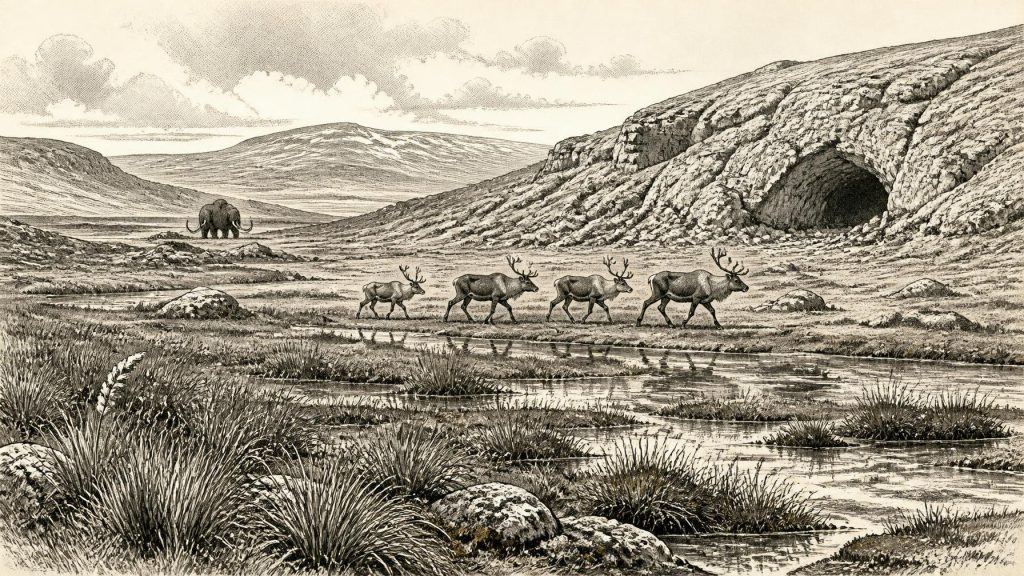
Derryvree’s biological remains indicate open ground rather than a wooded Ireland. Freshwater mosses, sedges, pollen, plant macrofossils and insects with northern or Arctic affinities point towards a tundra or muskeg-like setting: wet hollows and shallow water bordered by low vegetation, set amid exposed terrain. Grasses, herbs, sedges, mosses and low shrubs could exploit brief growing seasons; seasonally frozen ground, wind and poor soils restricted more luxuriant vegetation. A few traces of tree pollen cannot by themselves demonstrate a local forest, because pollen may travel long distances or be redeposited. The evidence supports a patchy, cold and locally wet environment, not an unbroken snowy waste and not the green temperate island familiar today.
This matters for everyday life in the broad ecological sense. Water margins would have concentrated plant growth and attracted animals, while dry ridges, gravelly slopes and frozen ground offered different routes and hazards. Yet Derryvree is a local archive, not a weather station for all Ireland. Conditions on the limestone lowlands of Cork, Atlantic-facing uplands or eastern plains may have differed in snowfall, exposure and vegetation. The record establishes environmental possibility, not a complete map.
Castlepook’s Cave Fauna
For animal life, Castlepook Cave near Doneraile in north County Cork is indispensable. Known also as Mammoth Cave, its narrow galleries and chambers include Hyenahall and Elephant Hall. Excavations from the early twentieth century onwards produced more than 2,000 bones. Geological Survey Ireland describes it as Ireland’s richest vertebrate archive for the period leading up to the Last Glacial Maximum, with dated individual remains extending broadly from about 45,700 to 19,950 years BP.
The assemblage includes woolly mammoth, reindeer, giant deer, brown bear and spotted hyaena, with wolf, Arctic fox, mountain hare and lemmings also represented in Ice Age deposits. These are direct evidence that such animals occupied, or in some cases were transported into, Irish cave systems during portions of the Late Pleistocene. They make clear that Ireland was connected ecologically to the wider north-west European world. Low sea levels exposed substantial areas of the surrounding shelf, and modelling indicates that land connections between Ireland, Britain and continental Europe existed during parts of the glacial period. But lower seas do not prove a broad, stable, dry route at this particular moment: ice margins, rivers, glacial lakes and unstable ground mattered as much as a lowered shoreline.
The cave should not, however, be read as a single animal census for 31,647 BCE. Its deposits accumulated over many millennia. Carnivores dragged prey into cavities; water disturbed parts of the sequence; and antiquarian excavators recovered material from deposits whose original relationships were not always securely recorded. A hyaena bone or mammoth bone proves neither that every listed species was alive together nor that the cave was a human camp. Castlepook is a long-term repository, not a photograph of one day.
The Reindeer Femur Question
One Castlepook object has particular historical importance: a reindeer femur reported to bear a deep mark consistent with processing by a sharp stone tool. In 2021, zooarchaeologist Ruth Carden publicised a radiocarbon result of about 33,000 years for this bone and interpreted the mark as possible evidence that Upper Palaeolithic people butchered reindeer in Ireland. If confirmed, it would extend evidence for human activity in Ireland very far beyond the securely dated terminal-Pleistocene butchered brown-bear bone from Alice and Gwendoline Cave, County Clare, dated to around 12,810–12,590 calibrated BP.
That conditional language is essential. The Castlepook specimen came from an old collection rather than a newly excavated, intact occupation floor. No securely associated hearth, stone-tool assemblage, dwelling, human remains, repeated food waste or art of comparable age has been recovered there. Earlier dating of southern Irish cave fauna has also been reassessed as analytical methods improved, demonstrating why legacy results must be revisited rather than repeated uncritically. The femur may preserve an extraordinarily early human encounter with a reindeer; it does not establish a permanent population, a settlement at Castlepook, or continuous occupation of Ireland.
No Polity, No Proven Community
Accordingly, political affairs, diplomacy and organised warfare cannot responsibly be supplied for this year. There are no names, leaders, territories, tribal institutions, fortifications or weapons securely tied to this horizon in Ireland. “Ireland” is used here only as a convenient geographical term for the modern island, not as a state or cultural unit. Nor is there evidence for farming, villages, domestic animals, crops, formal trade, pottery, monuments, writing, schools or a developed religious institution. Such things belong to much later chapters of Irish prehistory.
If people did briefly reach the land, they were mobile hunter-gatherers, not an identifiable Irish society. The possible processing of one reindeer would speak to subsistence: meat, marrow, hide, sinew and bone could all have been valuable. It would not demonstrate trade or a routine seasonal economy. Likewise, caves may have provided shelter or landmarks to people, but at Castlepook the evidence much more securely attests animal and carnivore activity. Beliefs, language, kinship and ritual remain wholly beyond recovery. Silence here is not a deficiency to be filled by analogy with later Celtic, medieval or modern Ireland; it is the central fact.
Before the Ice Advanced
The lasting significance of this remote horizon lies in its precariousness. Sediments under a Fermanagh drumlin show cold freshwater habitats and open vegetation before renewed ice cover. Bones from a Cork limestone cave reveal a varied fauna adapted to, or capable of using, the exposed western edge of Late Pleistocene Europe. The disputed reindeer femur raises the possibility—no more than that at present—of a human presence within that world.
Subsequent ice-sheet growth transformed the stage, eroding older surfaces and enclosing fragments of biological evidence beneath till. That destructive history explains why the record is so thin. Around 31,647 BCE, the most defensible picture is neither an empty land nor a settled homeland: it is a fluctuating cold landscape, biologically active in places, whose mammals and waterlogged sediments survive as rare witnesses to an Ireland before the maximum ice advance.
Primary Sources
- A Middle Midlandian Freshwater Series at Derryvree, Maguiresbridge, County Fermanagh, Northern Ireland
- Middle Midlandian Interstadial Deposits at Greenagho, Near Belcoo, County Fermanagh, Northern Ireland
- Early Midlandian–Middle Midlandian, Pleistocene, Northern Ireland
- A Reconsideration of the Radiocarbon Dating of the Marine Isotope Stage 3 Fauna from Southern Ireland
- The Irish Quaternary Fauna Project
- Castlepook Cave
- Occurrence of Mammalia Relicts at Site Castlepook Cave
- The Exploration of Castlepook Cave, Co. Cork. With 3 Plates.
- The Island of Ireland: Drowning the Myth of an Irish Land-Bridge?
- Deglaciation, Earth Crustal Behaviour and Sea-Level Changes in the Determination of Insularity: A Perspective from Ireland
- Growth and Retreat of the Last British–Irish Ice Sheet, 31,000 to 15,000 Years Ago: the BRITICE-CHRONO Reconstruction
- Last Glacial Maximum Cirque Glaciation in Ireland and Implications for Reconstructions of the Irish Ice Sheet
- Dimensions and Chronology of the Last Ice Sheet in Western Ireland
- Trimlines, Blockfields and the Vertical Extent of the Last Ice Sheet in Southern Ireland
- Late Pleistocene Chronostratigraphy and Ice Sheet Limits, Southern Ireland
- Radiocarbon Constraints on the Age of the Maximum Advance of the British-Irish Ice Sheet in the Celtic Sea
- First Evidence of a Late Upper Palaeolithic Human Presence in Ireland
- New Insights on the Fauna of Ireland's Younger Dryas and Early Holocene from Alice & Gwendoline Cave
- Phylogeographic, Ancient DNA, Fossil and Morphometric Analyses Reveal Ancient and Modern Introductions of a Large Mammal: the Complex Case of Red Deer (Cervus elaphus) in Ireland
- Irish Quaternary Association: Outreach and Education Resources
- The Geological Heritage of County Leitrim