

Related Archive: James II
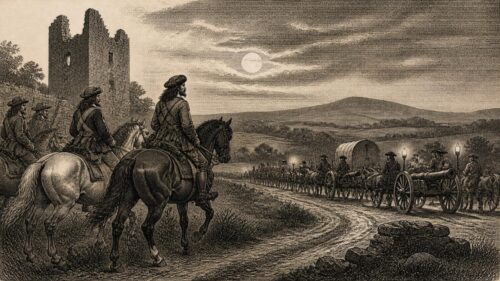
Ballyneety and the Broken Siege
In 1690 Ireland became central to the war between James II and William III, linked to the wider European struggle against France. William’s multinational army defeated the Jacobites at the Boyne, prompting James’s flight to France and William’s occupation of Dublin. Administrative measures followed, affecting coinage, property and allegiance. However, Jacobite forces withdrew towards the Shannon, where Limerick resisted William’s siege. Patrick Sarsfield’s Ballyneety raid disrupted the Williamite artillery train, while a later assault failed amid worsening conditions. William lifted the siege. Williamite victories at Cork and Kinsale secured southern ports, but Limerick’s survival ensured the conflict continued into 1691.
View Record
Dundalk’s Fevered Camp
In 1689, deposed James II made Ireland the central theatre of his struggle against William of Orange, supported by Tyrconnell, Catholics and French aid. While Jacobite forces advanced, Protestant resistance at Derry and Enniskillen endured. James’s Dublin parliament funded war, asserted Irish legislative independence, repealed land settlements and passed an extensive Act of Attainder, alongside liberty of conscience. Naval relief ended Derry’s 105-day siege, while Enniskillen’s victory at Newtownbutler weakened Jacobite control in Ulster. Schomberg’s multinational Williamite army landed in August, but its autumn camp at Dundalk suffered devastating disease, exposure and supply failures, leaving the war unresolved that winter.
View Record
Ferryquay Gate Closes
In 1688, James II’s Irish government under Tyrconnell expanded Catholic influence in administration and the army, intensifying Protestant fears over religion, land and political security. William of Orange’s invasion of England destabilised royal authority, while troop movements heightened anxiety in Ireland. On 7 December, Derry’s apprentice boys shut Ferryquay Gate against Antrim’s Catholic regiment, defying James’s government without yet declaring for William. Negotiations temporarily admitted Protestant troops and excluded Antrim’s men. Enniskillen also resisted a Jacobite garrison. These Ulster actions exposed weakening government control, encouraged Protestant defence, and established strategic, sectarian and political divisions that developed into the Williamite–Jacobite war.
View Record
Tyrconnell’s New Charters
In 1687 Richard Talbot, earl of Tyrconnell, became Ireland’s lord deputy and reshaped government under James II. Although instructed not to remove Protestants solely for religion or overturn land settlements, he promoted Catholics to judicial, administrative, military and local offices. New sheriffs and judges challenged Protestant dominance and intensified fears over legal security. Through charter surrenders and renewals, municipal corporations were reorganised to expand Catholic influence and prepare a favourable parliament. James’s Declaration of Liberty of Conscience widened religious freedoms, though Anglican suspicion persisted. Trade continued, while army recruitment increased. By year’s end, Catholic hopes and Protestant anxieties transformed politics.
View Record
Nagle’s Coventry Letter
In 1686, James II’s government rapidly reshaped Ireland’s confessional political order. Lord Lieutenant Clarendon’s administration was increasingly challenged by Richard Talbot, earl of Tyrconnell, whose influence advanced Catholic participation in government and the army. Royal payments to Catholic bishops, appointments of Catholic judges and officials, and military recruitment signalled a reversal of longstanding exclusion. These changes alarmed Protestant proprietors, whose security depended on Restoration land settlements. Richard Nagle’s Coventry Letter linked Catholic political advancement to restitution of confiscated estates, intensifying fears of property redistribution. Despite revenue and commerce, uncertainty affected confidence. Swift’s Trinity degree marked the year’s life amid tensions.
View Record
Bedell’s Irish Old Testament
In 1685 James II’s accession raised Catholic hopes and Protestant fears in Ireland, although laws and land settlements remained unchanged. Richard Talbot, created earl of Tyrconnell, gained authority to reshape the army, admitting Catholic officers and weakening the exclusively Protestant military establishment. Security measures in Ulster coincided with tensions over religion, land and memories of 1641. Henry Hyde, earl of Clarendon, was appointed lord lieutenant, signalling divided governance. Economic life continued amid political uncertainty. Cultural developments included publication of Bedell’s Irish Old Testament, the first Irish newspaper, and Ó Flaithbheartaigh’s Ogygia. Francis Harold’s death in Rome reflected continental Catholic networks.
View Record