
Bedell’s Irish Old Testament1685 CE
In 1685 James II’s accession raised Catholic hopes and Protestant fears in Ireland, although laws and land settlements remained unchanged. Richard Talbot, created earl of Tyrconnell, gained authority to reshape the army, admitting Catholic officers and weakening the exclusively Protestant military establishment. Security measures in Ulster coincided with tensions over religion, land and memories of 1641. Henry Hyde, earl of Clarendon, was appointed lord lieutenant, signalling divided governance. Economic life continued amid political uncertainty. Cultural developments included publication of Bedell’s Irish Old Testament, the first Irish newspaper, and Ó Flaithbheartaigh’s Ogygia. Francis Harold’s death in Rome reflected continental Catholic networks.
Dateline
In 1685 Ireland entered a new reign whose consequences were not yet settled, but whose direction was already unmistakable. Charles II died on 6 February and his brother succeeded as James II of England and Ireland, and James VII of Scotland. The accession was lawful and initially unopposed in Ireland. Yet it mattered unusually deeply because James was openly Catholic, while the established Church of Ireland, the army, civic corporations and the greater part of political office were controlled by Protestants. For Irish Catholics, excluded from much public power and still burdened by the memory of confiscation, the new king offered hope that long-closed avenues might reopen. For Protestants, especially those whose property and position rested on the post-war land settlement, he raised an immediate question: would royal favour alter the balance secured after Cromwell and the Restoration?
A King Whose Faith Changed Expectations
The succession did not itself repeal any Irish law, redistribute an acre, or overturn the established church. Nor should the year be read backwards from the Williamite war which began in 1689. In 1685 James’s authority was recognised across the island, and the administrative machinery built under his brother remained functioning. The duke of Ormond’s long influence over Irish government still framed the political world in which landlords, bishops, judges, merchants and county gentry operated. But confidence in continuity was weakened by the identity of the new monarch and by the men closest to him.
Among those men was Richard Talbot, a Catholic gentleman of Old English descent from County Dublin and a longstanding associate of James. Talbot had spent years pressing the interests of Catholics who believed that the Restoration land settlement had treated them harshly. The Acts of Settlement and Explanation of the 1660s had confirmed many Cromwellian and Protestant purchasers in possession, while limiting the ability of Catholic claimants to recover estates. That dispute was not reopened in 1685. It nevertheless remained the great unspoken issue behind the new reign: land was wealth, political influence and social security, not merely a legal argument about titles.
In March James gave Talbot command of a regiment, dispensing with the oath of supremacy that normally presented an obstacle to a Catholic officer. In late April Talbot was sent to Ireland with authority to remove army officers judged “disaffected”; he arrived towards the end of May. In June he was made earl of Tyrconnell. These are firmly dated markers of a transfer of confidence from the established Protestant interest towards a Catholic royal servant. They did not make Tyrconnell viceroy—that would come later—but they gave him an exceptional role in military affairs.
Arms, Allegiance and Ulster
The immediate official language was security rather than religious revolution. The governments of the three Stuart kingdoms were alarmed by rebellion: the earl of Argyll’s rising in Scotland and the duke of Monmouth’s invasion of England unfolded during 1685. Before Tyrconnell reached Ireland, the lords justices, Archbishop Michael Boyle and the earl of Granard, had orders to disarm people regarded as disaffected in Ulster, to enquire after privately held firearms and to call in militia weapons. Such precautions formed part of a wider Stuart response to unrest, and it would be misleading to describe every measure as uniquely directed at Irish Protestants.
Yet in Ireland security policy and confessional politics overlapped. The standing Irish army had been entirely Protestant in its officer corps when Talbot arrived. He brought commissions for Catholic officers and began replacing men whom he and his allies associated with the Cromwellian interest. By January 1686, more than 800 Catholic soldiers were serving in the army. This was an opening movement, not the completed transformation sometimes imagined from later events: the much swifter Catholic remodelling of the army belongs principally to 1686 and after. But the precedent established in 1685 was decisive. Military service, long a symbol of Protestant ascendancy within the restored state, was now visibly becoming available to Catholics through the king’s favour.
The change stirred fears that were at once local and historical. In Ulster, where Scottish and English Protestant settlement had been particularly important since the early seventeenth century, arms, militia service and landholding were intimately connected. Memories of the violence of 1641 were politically potent, even though conditions in 1685 were very different and no general rising occurred. Catholic expectations of advancement and Protestant fears of dispossession therefore grew together, fed by rumours as much as by proclamations. The year’s central development was not war in Ireland, but the alteration of who could plausibly expect to command, serve and be trusted by the Crown.
Government in Transition
James did not immediately entrust all civil government to Tyrconnell. The division of authority itself was important. The army was increasingly handled from London through the king and secretary of state rather than left wholly to the lord lieutenant. This reduced the freedom of Ireland’s existing governors and created a rival centre of influence around Tyrconnell. A Protestant office-holder might thus find that the law had not changed, yet that access to patronage and the likely interpretation of royal wishes had.
Late in the year Henry Hyde, second earl of Clarendon, was chosen to succeed Ormond as lord lieutenant; Clarendon would be sworn in at Dublin in January 1686. His selection was a reminder that James still wished to reassure the Protestant establishment and did not yet place Tyrconnell at the head of the civil administration. It also foreshadowed a contest rather than a settled programme. Clarendon, an Anglican and the king’s brother-in-law, was expected to govern Ireland; Tyrconnell possessed the king’s personal confidence and influence over the army. Their uneasy coexistence would shape the next two years.
For most people, the effects of high politics arrived indirectly. Tenants still owed rents; labourers and smallholders still faced the seasonal demands of tillage, livestock and fuel; townspeople dealt in markets, workshops, quays and courts. Ireland’s economy remained predominantly rural, but it was connected to wider Atlantic and European routes. Restrictions on direct cattle exports to England, imposed in earlier decades, had encouraged a provision trade in beef, butter, hides, tallow and other goods to foreign markets and the plantations. Sheep and wool were also significant, though raw-wool export was tightly regulated and Irish manufacturers faced English commercial constraints. These were durable conditions rather than innovations of 1685, but they explain why political stability mattered so much to ports, graziers, merchants and consumers.
Print, Language and Religious Culture
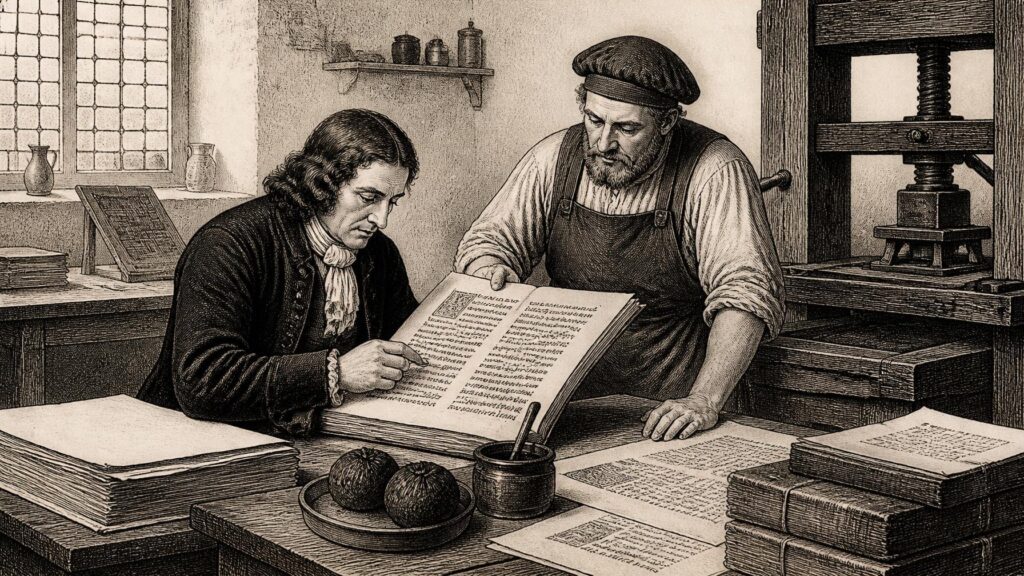
Amid the uncertainty of the succession, 1685 produced two notable works of Irish learning and print. The most consequential was the publication in London of the Irish Old Testament traditionally associated with William Bedell, the former Church of Ireland bishop of Kilmore who had died in 1642. It was the first printing of the Old Testament in Irish. Bedell had initiated the project, but the translation owed much to Murtagh King and James Nangle; its eventual appearance was enabled by the efforts of Narcissus Marsh and supporters including Robert Boyle.
The book was a Protestant undertaking, intended in part to make scripture available in the vernacular for religious instruction. But it was also a major event in the history of Irish prose and printing. Its Irish type and dense biblical text recognised the continued importance of the language among the people whom the established church hoped to reach. The volume did not mean that the Church of Ireland had overcome the religious divide, nor that Irish-speaking Catholics would readily accept its authority. Its significance lies instead in the survival and public circulation of a substantial Irish-language biblical text at a time when political power, religious allegiance and language could not be neatly separated.
Dublin also saw the appearance of The News-Letter, printed by Joseph Ray for Robert Thornton. Earlier wartime news sheets had circulated in Ireland, but this publication is commonly identified as the first genuine Irish newspaper. Its arrival should not be overstated as the birth of a free press: printing remained closely watched, and the politically charged years ahead would demonstrate how narrow the room for independent publication could be. Even so, a regular printed news sheet speaks to a capital linked by post, shipping, official intelligence and commerce to England and beyond.
Another 1685 publication looked in the opposite direction, towards the island’s ancient past. Ruaidhrí Ó Flaithbheartaigh’s Latin Ogygia, a learned chronology of Irish history, was printed in London. Ó Flaithbheartaigh, a Galway scholar working with Gaelic historical traditions, sought to order Ireland’s past through manuscripts, genealogies and chronology. Its method and conclusions belong to seventeenth-century scholarship rather than modern historical criticism, but the book was a remarkable assertion that Irish materials deserved sustained learned treatment within the Republic of Letters.
Irish Lives Beyond Ireland
Irish religious and intellectual life also extended far beyond the island. On 18 March Francis Harold, the Franciscan scholar from County Limerick, died at St Isidore’s College in Rome. Harold had taught in central Europe, served as an Irish Franciscan procurator and worked as a historian of his order. His death is a small but precisely dated reminder that Catholic Ireland retained institutions, scholars and networks abroad even where domestic political power was restricted. Rome, Louvain, Prague and other continental centres remained places of education, archival labour and clerical connection for Irish Catholics.
By the end of 1685, therefore, Ireland had not entered civil war and no new land settlement had been enacted. The year’s importance lay in changed prospects. James II’s accession, Tyrconnell’s elevation and his first interventions in the army made Catholic advancement seem possible in a way it had not for decades. Protestant property-holders and officials had reason to watch closely, but not yet reason to know where policy would end. Alongside this political rearrangement, the Irish Old Testament, a Dublin newspaper and Ogygia show an island whose public life was not exhausted by government: it was also a place of language, books, trade, memory and far-reaching religious connections.
Primary Sources
- Talbot, Richard
- Harold, Francis
- The Earl of Tyrconnel and James II's Irish Policy, 1685–1688
- Jacobite Ireland 1685–91: Studies in Irish History
- The War of the Two Kings, 1685–91
- Economic Trends, 1660–91
- Act of Settlement [1662] and Act of Explanation [1665]
- History of the Commercial and Financial Relations Between England and Ireland from the Period of the Restoration
- The Irish Parliament of James II
- The Journal of John Stevens, Containing a Brief Account of the War in Ireland, 1689–1691
- William Bedell, Venice and the Irish Language
- Leabḣuir na Seintiomna ar na ttarrvʻng go gaiḋlig
- Irish Gaelic Bedell Bible
- Early Dublin Newspapers
- Ogygia: seu, Rerum Hibernicarum chronologia
- Manuscript Copy of ‘Ogygia, seu rerum Hibernicarum chronologia’ by Ruaidhrí Ó Flaithbheartaigh
- The State Letters of Henry, Earl of Clarendon, Lord Lieutenant of Ireland
- The Earl of Tyrconnell and James II's Irish Policy, 1685–1688
- A Short History of Ireland, 1500–2000
- Louis XIV, James II and Ireland
- The ‘Glorious Revolution’
- Ireland Under the Stuarts, Volume III