Archived: 13 October 2026
Abstract
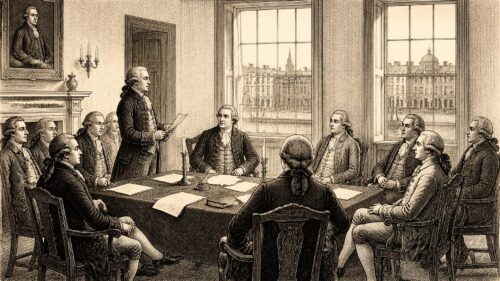
In 1725, Ireland’s significance lay in institutional and political tensions rather than a single decisive event. Lord Carteret suspended William Wood’s contested halfpence patent, demonstrating the force of opposition mobilised by Jonathan Swift while leaving Ireland subordinate to Westminster. His administration exposed a treasury deficit and renewed reliance on parliamentary patronage. The Synod of Ulster created the Presbytery of Antrim for non-subscribing ministers, deepening Presbyterian divisions over conscience and confessional authority. Dublin’s first surviving Grand Lodge meeting recorded freemasonry’s organisation. These developments unfolded within a rural, unequal Protestant state, where Catholics and Presbyterians faced disabilities and economic life remained vulnerable.
Read Article

Archived: 13 October 2026
Abstract
In 1721, Ireland’s proposed public bank collapsed amid post-South Sea Bubble distrust, disputes over credit, land, religious exclusion and dependence on Westminster, recently reinforced by the Declaratory Act. Although supporters sought cheaper loans and retained capital, the Commons rejected the scheme, first narrowly in October and decisively in December, preserving fragmented private finance. Land and influence remained central: Charles Butler regained Ormond estates under British sanction, William Ponsonby became Baron Bessborough, and Luke Gardiner acquired land developed as Henrietta Street. Linen exports linked rural households to imperial markets, while Catholic institutions endured restrictions. Government pursued disorder and imposed plague precautions.
Read Article
Archived: 13 October 2026
Abstract
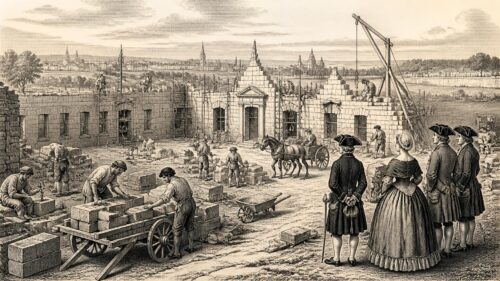
In 1720, Westminster's Sixth of George I asserted Britain's power to legislate for Ireland and made the British Lords Ireland's final appellate court, deepening dependency. Ireland's Anglican ascendancy governed a population restricted by penal laws; James Cotter's execution heightened sectarian tensions. Jonathan Swift's Irish Manufacture pamphlet urged consumers to reject English goods, articulating economic patriotism amid mercantilist constraints. A proposed national bank reflected commercial ambition, but the South Sea Bubble's collapse brought banking panic. Construction began on Dr Steevens' Hospital, promoted by Grizelda Steevens, while Cork Harbour's Water Club was founded. Together they exposed dependence, inequality, charity and elite sociability.
Read Article
Archived: 13 October 2026
Abstract
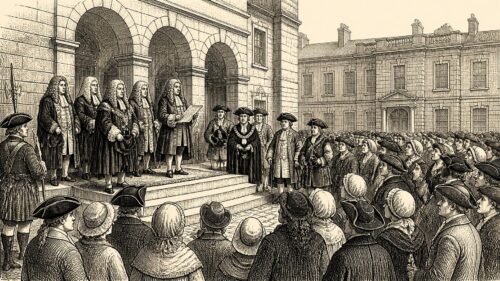
William III’s death brought Queen Anne to the thrones of England, Scotland and Ireland, proclaimed in Dublin on 18 March. Her accession preserved a Protestant administration founded after Williamite war, while Catholics remained politically excluded and Jacobite legitimacy persisted. Ireland was governed by lords justices after Rochester’s departure, with Thomas Erle combining military and civil responsibilities amid War of Spanish Succession. Protestant elites resented Westminster’s resumption of forfeited estates and restrictions on woollen exports. December consultations at Dublin Castle addressed parliament, taxation and war costs without resolution. Michael Boyle died; Portarlington Huguenots gained lease security; Swift received his Trinity doctorate.
Read Article

Archived: 14 October 2026
Abstract
In 1694, Ireland’s post-Williamite settlement advanced through administration rather than warfare. Commissioners began hearing claims under the Articles of Limerick, determining Jacobites’ rights to property, livelihoods and legal protection. Dublin’s Lords Justices managed revenue, including hearth-money exemptions, while debating a parliament whose supply might secure Protestant interests; no parliament met. Government fasts, Trinity College’s centenary celebration and Jonathan Swift’s diaconal ordination reflected Protestant public culture. Portarlington’s French Reformed register documented an emerging Huguenot community. Rewards for robbers and alleged rebels showed continuing insecurity. Queen Mary II’s death made William III sole monarch, leaving Ireland’s constitutional, religious and property settlement unfinished.
Read Article

Archived: 14 October 2026
Abstract
In 1686, James II’s government rapidly reshaped Ireland’s confessional political order. Lord Lieutenant Clarendon’s administration was increasingly challenged by Richard Talbot, earl of Tyrconnell, whose influence advanced Catholic participation in government and the army. Royal payments to Catholic bishops, appointments of Catholic judges and officials, and military recruitment signalled a reversal of longstanding exclusion. These changes alarmed Protestant proprietors, whose security depended on Restoration land settlements. Richard Nagle’s Coventry Letter linked Catholic political advancement to restitution of confiscated estates, intensifying fears of property redistribution. Despite revenue and commerce, uncertainty affected confidence. Swift’s Trinity degree marked the year’s life amid tensions.
Read Article
Archived: 14 October 2026
Abstract
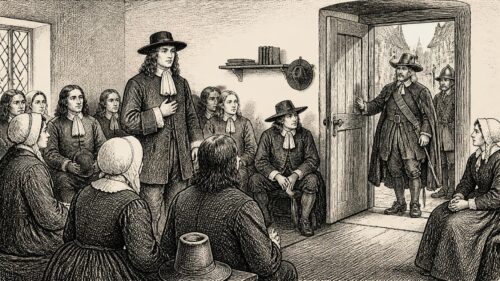
In 1667, Restoration Ireland experienced postwar settlement as courts and officials resolved contested land claims under the Acts of Settlement and Explanation. Ormond’s administration stressed legal procedure, military discipline and strained finances, while English restrictions on Irish cattle threatened trade and exposed Ireland’s dependence on Westminster. Dutch naval successes prompted defensive preparations at Kinsale before the Treaty of Breda ended the war. Protestant institutions strengthened, yet religious conformity was enforced: William Penn was arrested with Friends at a Cork meeting. Jeremy Taylor died, Jonathan Swift was born, and Alice Barry’s death marked elite change. The year revealed a fragile order.
Read Article




