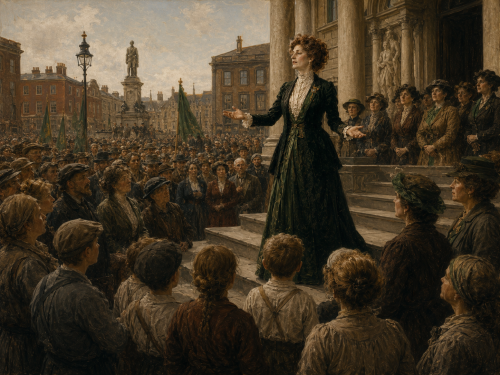
Nationalist Defiance

Maud Gonne and other advanced nationalists have organised determined opposition to Queen Victoria’s visit, rejecting official claims that the royal ceremonies represent the will of the Irish people. Gonne’s article “The Famine Queen,” published immediately before the monarch’s arrival, condemns the visit as an imperial and military demonstration conducted during the South African War. Her supporters have challenged loyal addresses, public decorations and attempts to present cheering crowds as evidence of national contentment. In Limerick, where nationalist opinion is strong, the campaign will attract attention among readers who regard Home Rule as insufficient and seek complete Irish independence.
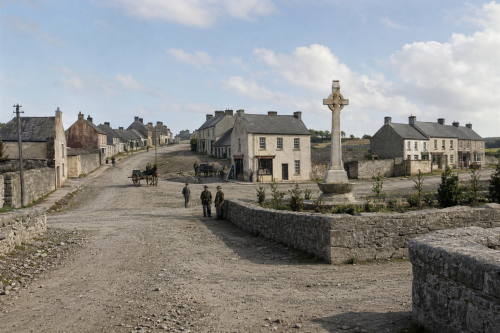
Shanagolden Through the Ages

Shanagolden, whose Irish name Seanghualainn means “old shoulder,” possesses a history stretching from early medieval warfare to plantation settlement and modern political struggle. Nearby lands witnessed Mahon’s victory over Norse forces in 968, while Shanid Castle later became a major FitzGerald stronghold. St Katherine’s Abbey reflects the district’s medieval religious heritage. Following the Desmond conflicts, the village was reshaped as an Elizabethan plantation settlement, leaving its broad street, square and central green. During the nineteenth century, policing, trade, farming and creamery production shaped local life. Shanagolden also played a remembered role during Ireland’s War of Independence in the twentieth century.

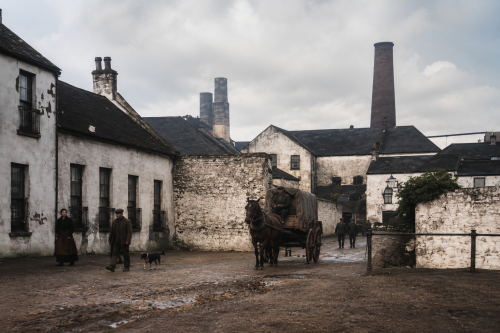
Thomond Gate Distillery

Thomond Gate Distillery stood beside the River Shannon from 1809 until 1919, forming an important part of Limerick’s industrial and distilling heritage. During the nineteenth century, the complex operated three copper pot stills and produced traditional Irish whiskey under several owners, including Stein Brown & Co. and Archibald Walker’s Limerick Distillery. These reconstructed scenes imagine the surrounding streets, workers, carts, buildings and towering chimneys during the distillery’s active years. Although production eventually ceased, the Thomond Gate name has been revived through an independent Limerick whiskey brand dedicated to preserving the memory and traditions of the original enterprise for future generations.

Headlines Divided

Dublin newspapers published extensive political and military coverage on 25 January 1900, placing Ireland’s internal nationalist divisions beside the continuing conflict in South Africa. Reports on the recent Mansion House conference examined attempts to reunite the parliamentary factions separated since the fall of Charles Stewart Parnell. In adjoining columns, readers encountered military dispatches, troop movements and casualty information from a war involving thousands of Irish soldiers. The combination revealed the conflicting pressures shaping Irish public life: demands for national political unity existed alongside intense concern for men serving throughout the British Army and widespread nationalist sympathy for Britain’s Boer opponents.

Shannon Bridge Under Construction (1987)

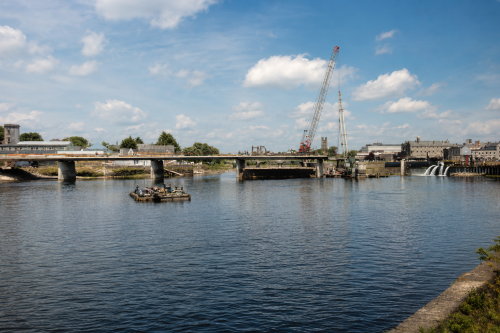
Shannon Bridge, opened on 30 May 1988, remains widely known in Limerick as the “New Bridge”, despite now being several decades old. This four-lane concrete girder crossing connects the Dock Road and Mallow Street area with the North Circular Road and Clancy Strand, providing an important inner-city relief route across the River Shannon. Soon after opening, it acquired another memorable nickname, the “Whistling Bridge”. Strong winds travelling up the Shannon Estuary passed through gaps in the original railings, producing a loud, eerie shrill sound. The problem was later reduced by fitting mesh grilles over the railings along the exposed crossing.

Elm Hill, Co Limerick

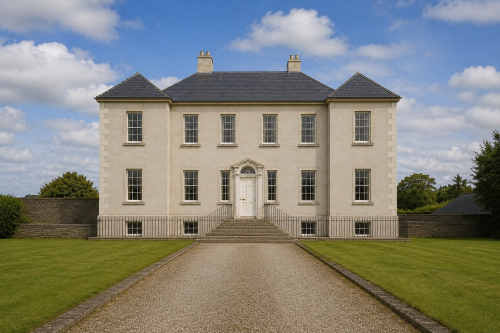
Elm Hill, County Limerick, was built around 1790 for the Studdert family as an elegant Georgian country residence. The six-bay, two-storey house stood over a raised basement and contained spacious reception rooms, nine bedrooms, servants’ quarters, kitchens, cellars and service rooms. Following the Great Famine, it was offered for sale and described as being in excellent repair. The property remained substantial for generations but gradually fell vacant and deteriorated. A 2008 architectural survey praised its limestone doorcase, carved timber entrance, slate-hung elevations, fireplaces and decorative plasterwork. Its recognised importance led to designation as a protected structure under Irish planning legislation.

A Busy Day On George Street

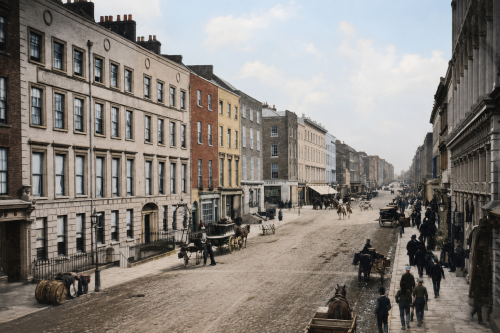
George Street, now O’Connell Street, formed the bustling commercial and social heart of Limerick around 1900. Elegant Georgian and Victorian façades lined the thoroughfare, their ornate shopfronts illuminated by gaslight and filled with goods for local shoppers. Horse-drawn carriages, jaunting cars and merchant carts crowded the roadway, while pedestrians in heavy coats and hats moved between businesses and hotels. The grand Cruises Royal Hotel stood among the street’s most prominent landmarks, welcoming merchants, travellers and visitors. This scene reflects the energy of late-Victorian Limerick before motor traffic transformed the city’s principal shopping street and historic urban centre during a changing era.

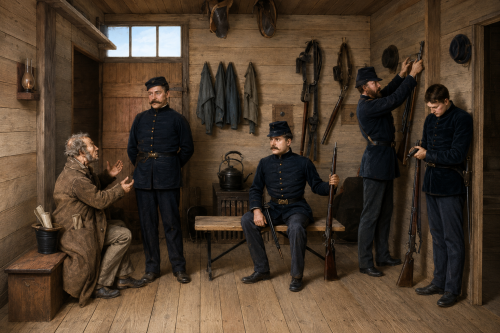
Inside Gurranmore Police Cabin

Around 1880, the interior of a police cabin at Gurranmore, near Pallas in County Limerick, reveals the modest conditions in which rural constables lived and worked. The small room is sparsely furnished, with simple wooden fittings, basic household utensils and few comforts. Uniformed officers occupy the cramped space, suggesting that the cabin served as both workplace and living quarters. Published in The Graphic in 1880, the image offers a rare glimpse of everyday policing in nineteenth-century Ireland. It preserves not only the appearance of the station, but also the disciplined, isolated life experienced by men posted in rural communities nearby.

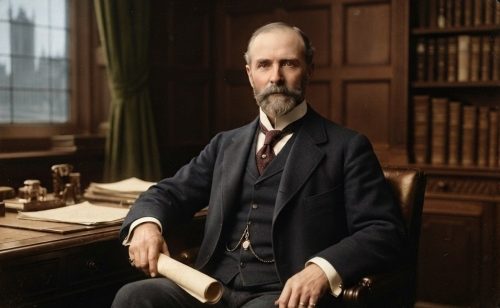
Difficult Ally

Tim Healy remained one of the most influential yet troublesome figures involved in the effort to reunite Ireland’s divided parliamentary nationalists during January 1900. A formidable barrister, experienced Member of Parliament and devastating political speaker, Healy possessed an authority that could not easily be ignored. He had opposed Charles Stewart Parnell during the leadership crisis of 1890 and subsequently quarrelled with leading anti-Parnellites, particularly John Dillon. By the end of the decade, Healy commanded his own following of MPs and local activists. Any credible agreement restoring nationalist unity therefore required his cooperation, even though many former colleagues distrusted his intentions and feared his independence.

Now Sharing: Articles (154) Images (455) Total Items Archived (609)
Our Mission: 100,000 Items Total Percentage Achieved (0.61%)