Membership is completely free, giving members unlimited access to all available resources, services, features, and benefits without any restrictions or fees.
Welcome back. Sign in to continue enjoying unlimited access to all available resources, services, features, and member benefits at no cost.
George I had succeeded Queen Anne in August 1714, under the Protestant succession established by the Act of Settlement. His accession was contested by Jacobites, who regarded the Catholic James Edward Stuart as the rightful king. Ireland had been central to the earlier Williamite–Jacobite war of 1689–91, and the memory of that conflict remained sharp. Dublin Castle therefore treated rumours of a Stuart restoration not as distant British politics but as a possible prelude to invasion, rebellion and a renewed struggle for land, office and religion.
Queen Anne was monarch, while James Butler, second duke of Ormond, served as lord lieutenant of Ireland. Appointed in 1703 partly because of his powerful Irish connexions and influence in both houses, Ormond presided over the 1705 session at a time when the crown required dependable revenue and political calm. The Irish parliament was not a national representative assembly in any modern democratic sense. Its electorate and office-holding structure were restricted by property, religion and the post-1691 political order; Catholics, who formed the large majority of the population, were excluded from the legislature.
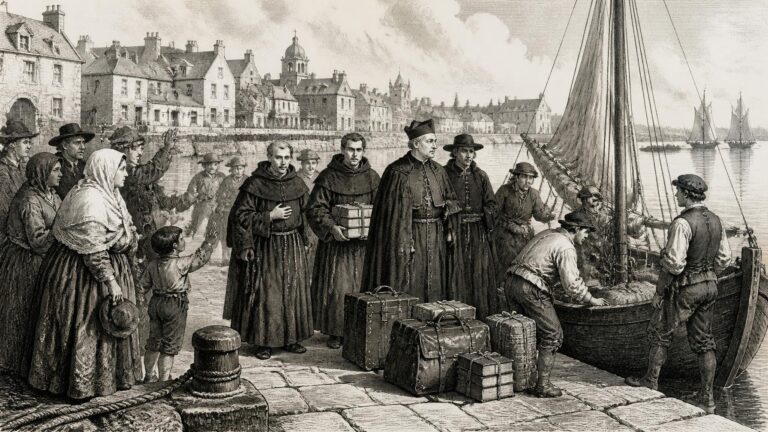
The statute generally known as the Bishops’ Banishment Act targeted a defined, though crucial, part of Catholic religious life. It ordered archbishops, bishops, vicars-general, deans, Jesuits, monks, friars and other regular clergy, together with Catholics exercising ecclesiastical jurisdiction, to leave Ireland. Those still present after 1 May 1698 faced imprisonment and transportation; a person transported under the act who returned could be treated as guilty of high treason. The law also penalised those who sheltered prohibited clergy. Its language was calculated to dismantle the Catholic Church’s leadership and religious orders, rather than immediately remove every secular parish priest.