Clerical Banishment1698 CE
In 1698, enforcement of the Bishops’ Banishment Act required Catholic bishops, regular clergy and religious superiors to leave Ireland by 1 May, weakening Catholic leadership while secular priests often continued clandestine ministry. Hundreds of regular clergy were transported, though enforcement varied. The policy entrenched Protestant rule after the Williamite war without creating religious equality. In April, Protestant lawyer and parliamentarian William Molyneux published The Case of Ireland, challenging Westminster’s authority to bind Ireland and linking constitutional autonomy to disputes over appeals and trade. English concern over Irish woollens foreshadowed restrictions. Thomas Molyneux’s Giant’s Causeway observations connected Ireland to scientific inquiry.
Dateline
In 1698 Ireland was not at war, yet the settlement created by the Williamite victory was becoming more intrusive in daily life. The decisive event of the year was not a battle or a parliamentary sitting but a deadline: 1 May, the day by which Roman Catholic bishops, religious superiors and members of regular orders were required to have left the kingdom. The measure had been enacted in the previous parliamentary session, but 1698 was the year of its enforcement. It revealed the character of the new order more clearly than any victory monument could have done: Protestant authority was to be secured not only by land, office and military power, but by reshaping the institutional life of the Catholic majority.
A Deadline for the Clergy
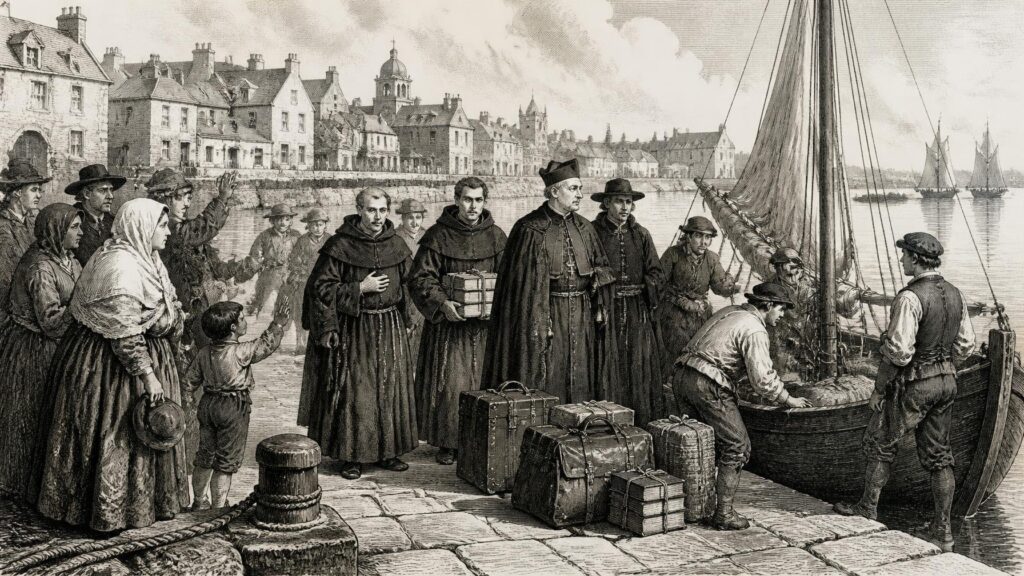
The statute generally known as the Bishops’ Banishment Act targeted a defined, though crucial, part of Catholic religious life. It ordered archbishops, bishops, vicars-general, deans, Jesuits, monks, friars and other regular clergy, together with Catholics exercising ecclesiastical jurisdiction, to leave Ireland. Those still present after 1 May 1698 faced imprisonment and transportation; a person transported under the act who returned could be treated as guilty of high treason. The law also penalised those who sheltered prohibited clergy. Its language was calculated to dismantle the Catholic Church’s leadership and religious orders, rather than immediately remove every secular parish priest.
That distinction mattered. A parish priest who was not a member of a religious order could, in principle, remain, while the bishops who ordained priests, confirmed the faithful and governed dioceses were singled out for removal. The policy therefore aimed at attrition. If bishops could not remain or enter the country, ordinations would eventually become difficult; if friars and Jesuits were expelled, networks of preaching, education and pastoral work would be diminished. It was a long-term scheme to weaken an enduring religious community without pretending that its people would vanish.
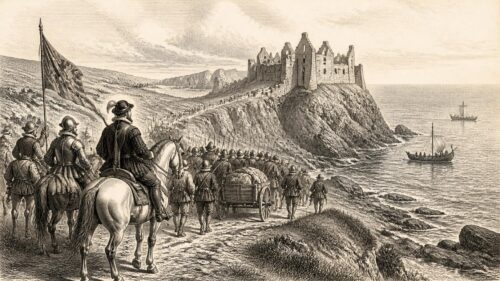
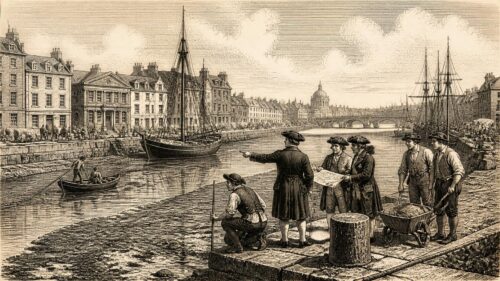
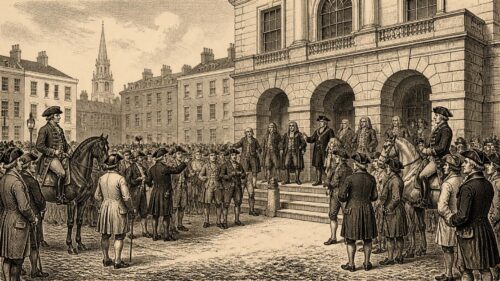
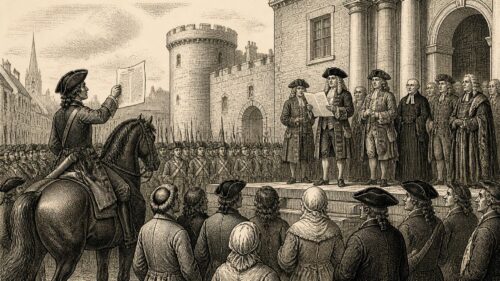
Dublin Castle did not leave implementation to chance. Proclamations in January and February 1698 called attention to the banishment legislation and to attempts to evade it. Ports became places of anxious departure, negotiation and concealment. A frequently cited official total records the transportation of 424 regular clergy in 1698, principally towards France. The figure should not be treated as a complete census of those who left: some departed by other routes, some concealed their status, and some later returned. Contemporary and later estimates differ markedly. What is firm is that the removal of religious personnel was substantial, organised and deeply unsettling for Catholic communities across the island.
The human geography of the measure was varied. Galway, whose mercantile and Catholic connections reached across the Atlantic coast and into continental Europe, was one important point of departure. In April and June, the Dominican historian John O’Heyne was in Galway attending the enclosed Dominican nuns as enforcement approached. His presence is a reminder that the law did not concern abstract categories alone. It affected convent communities, households that offered help, lay patrons who safeguarded books or vestments, and congregations wondering whether familiar clergy would remain available.
Faith Under a Protestant Settlement
The deadline did not make Catholic worship disappear. Ireland remained overwhelmingly Catholic in population, and secular priests continued to minister, sometimes openly enough to be known locally and sometimes with great discretion. The persistence of Patrick Donnelly, newly associated with the see of Dromore, illustrates the limits of state capacity. Rather than leave, he remained in Ireland and was remembered as living in the difficult terrain around Slieve Gullion. Such cases do not show that the law was harmless; they show why enforcement could be uneven outside the administrative reach of towns, courts and principal roads.
For Catholic laypeople, 1698 reinforced a world already shaped by the post-war restrictions of the 1690s: exclusion from political power, constraints on arms and education, and dependence upon a Church whose leadership was now vulnerable. The pressure was religious, but it also had social consequences. Priests mediated family rites, charity, schooling, local reputation and links with relatives abroad. Their removal or insecurity altered the texture of ordinary life. Meanwhile, members of the established Church of Ireland and other Protestants held the offices that administered the kingdom, collected revenues and staffed its legal institutions. The settlement was thus confessional as well as political.
It is important not to project the fully developed eighteenth-century penal code backwards into this particular year. Some of the most extensive restrictions on Catholic property, inheritance and education belonged to later legislation. Yet 1698 was a formative moment. The banishment policy made plain that the treaty ending the Williamite war had not produced a settled equality of religion. Peace after Limerick had ended organised Jacobite resistance in Ireland; it had not ended official fear that Catholic clergy might sustain a future restoration of James II and his heirs.
Molyneux’s Constitutional Challenge
While Catholic ecclesiastical authority was being constrained, a Dublin Protestant intellectual gave voice to a different anxiety: whether Ireland’s own legislature possessed any meaningful security against intervention from England. In April 1698 William Molyneux published The Case of Ireland’s Being Bound by Acts of Parliament in England, Stated, dedicating it to King William III. The work emerged from an immediate dispute over trade and appellate jurisdiction, but its argument reached further. Ireland, Molyneux maintained, was a distinct kingdom under the same monarch as England, not a territory automatically bound by every act passed at Westminster.
Molyneux was no outsider to the political world he criticised. A Dublin lawyer, landowner, scientist and member of the Irish parliament, he spoke from within the Protestant governing class created and protected by the Revolution settlement. His demand was not democratic in a modern sense. The Irish parliament he defended was restricted by property, religion and Poynings’ Law, which required proposed Irish legislation to pass through English supervision before being introduced in Dublin. Catholics had no share in its deliberations. Nevertheless, his pamphlet set out a potent constitutional proposition: government required the consent of the community governed through its own legislature.
The immediate background gave the argument urgency. The Irish Society’s appeal to the English House of Lords in a dispute involving Derry raised the question of whether English peers could hear appeals from Ireland. At the same time, English manufacturers complained that Irish woollen production competed with theirs. To Irish Protestant landowners, merchants and urban interests, these controversies were not separate matters. A parliament in London that could adjudicate Irish cases or dictate Irish commerce appeared capable of reducing Ireland’s legislature to a subordinate body.
Molyneux died in Dublin on 11 October 1698, only months after publishing the work that would secure his historical reputation. His death lends the year an unusual sense of compression: a pamphlet written amid a specific quarrel became, after its author’s death, a foundational text for later Protestant constitutional patriotism. It did not speak for the whole island, particularly not for Catholics living under tightening disabilities. But it exposed a contradiction within the Protestant settlement. Its beneficiaries sought protection from English parliamentary power even as they upheld a political order that denied representation and security to most Irish people.
Wool, Markets and Unequal Union
The woollen controversy was more than an argument among pamphleteers. Wool linked pasture, landlords, spinners, weavers, dyers, merchants, ports and overseas buyers. Ireland’s recovering manufacture alarmed English producers, who pressed for protection from Irish competition. Early in 1698 the English Commissioners of Trade and Plantations reported that the continued growth of Irish woollens would injure English manufacture. That reasoning converted commercial rivalry into imperial policy.
The famous statutory prohibition on Irish woollen exports to foreign markets was not yet in force during 1698: the English legislation received royal assent in 1699. Yet its approach was already unmistakable during this year’s disputes. The prospect was serious precisely because it threatened a sector capable of supporting employment and export earnings. The argument made by Molyneux therefore joined constitutional principle to material concern. Who could regulate Ireland’s trade was also a question about the livelihoods of people well beyond the chambers of Dublin and Westminster.
Knowledge, Landscape and a Dublin Network
1698 also offers a quieter view of Irish intellectual life. William Molyneux’s brother, Thomas, physician and natural historian, contributed observations on the Giant’s Causeway in County Antrim to the Philosophical Transactions of the Royal Society. Such work formed part of an international exchange of letters, specimens and measurements. The Causeway’s interlocking basalt columns had long invited explanation; late seventeenth-century investigators increasingly sought natural causes rather than simply repeating tales of giant builders or ancient artifice.
This was not a broad popular scientific movement. It depended on educated correspondents, print, travel and institutions concentrated in Dublin and London. Yet it connected an Antrim shore to a wider republic of letters and demonstrates that Ireland in 1698 was not only a place acted upon by laws made elsewhere. It was also observed, described and debated by people trying to place its landscapes, resources and constitutional position within a changing Atlantic and European world.
Thus the year’s most consequential developments ran in opposite directions. Catholic religious leadership was driven into exile, concealment or precarious survival. At the same time, Molyneux argued publicly for the legislative dignity of the Irish kingdom, while economic pressure from England showed how limited that dignity might be. The May deadline and the Dublin pamphlet were linked by a single uncomfortable fact: Ireland’s future was being contested through institutions in which much of its population had little recognised voice.

Primary Sources
- Statute Law Revision Act 2015
- By the Lords Justices and Council, a proclamation
- Religion
- Penal Laws
- The bishops’ banishment act of 1697 (9 Will. III, c. 1)
- The Penal Laws: Origins, Purpose, Enforcement and Impact
- Discovery Programme Reports: Report 9
- O’Heyne, John
- Donnelly (O'Donnelly), Patrick (Pádraig Ó Donnghaile)
- Molyneux (Molyneaux), William
- William Molyneux’s The Case of Ireland’s Being Bound by Acts of Parliament in England, Stated
- The Case of Ireland in Context: William Molyneux and His Critics
- Oireachtas Library and Research Service Display Case: William Molyneux
- Conquest versus consent as the basis of the English title to Ireland in William Molyneux’s Case of Ireland … Stated (1698)
- Constitutional Differences
- SOMERS, John (1651–1716)
- Part 5 of History of the Commercial and Financial Relations between England and Ireland from the Period of the Restoration
- Molyneux, Sir Thomas
- A Letter from Dr Thomas Molyneux … containing some additional observations on the Giant’s Causeway in Ireland
- The Case of Ireland’s Being Bound by Acts of Parliament in England, Stated
- Pre-Union Irish Statutes