
Sandys’s Authorised Gazette1705 CE
In 1705, Dublin Castle established the Dublin Gazette, printed by Edwin Sandys under official scrutiny, to circulate authorised news and restrain rumour. Ormond’s parliament, meeting from February to June under Queen Anne, imposed consumption duties and regulated tolls, measures, horse theft, debtors and mineral property amid wartime pressures. It strengthened penal supervision of Catholic clergy, restricting unregistered priests while the established Church of Ireland retained political privilege. Westminster permitted direct exports of specified Irish linen to English American plantations, encouraging linen while preserving English commercial control. Together, these measures expanded Protestant government through taxation, surveillance, economic regulation and controlled publicity.
Dateline
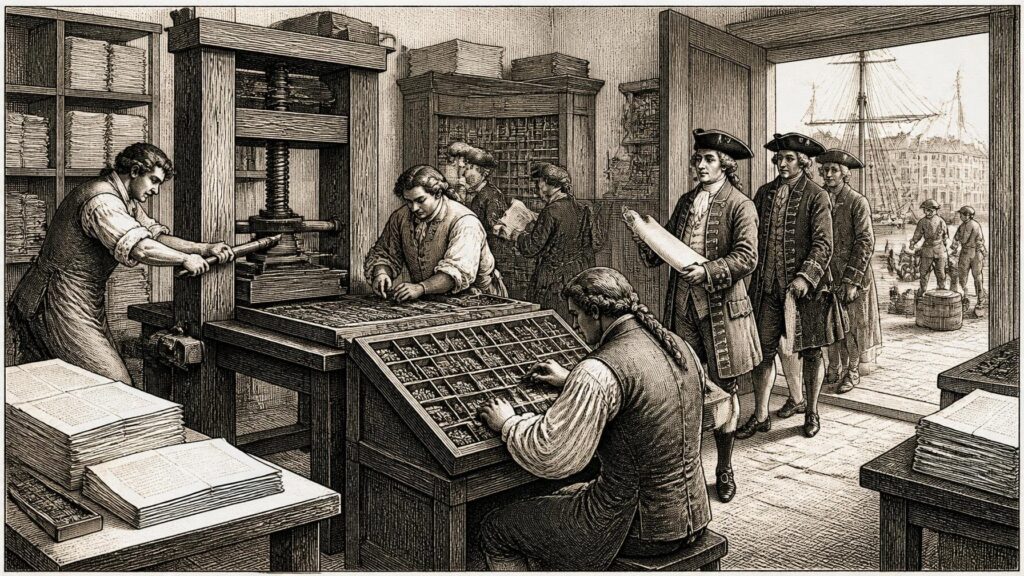
In 1705, Ireland acquired a new instrument of government communication: the Dublin Gazette. Its appearance in November did not create a free press in the modern sense. Rather, it made visible a state determined to regulate information in a kingdom still marked by the Williamite settlement, religious exclusion and wartime taxation. The Gazette’s first printer, Edwin Sandys, worked from the Custom House printing office under Dublin Castle supervision. A proclamation of 25 October announced that the paper was to appear by authority and that Sandys would submit it for official scrutiny before printing. Standard chronologies place its first number on 5 November.
That tightly managed publication was the year’s most conspicuous cultural development, but it belongs beside other firmly dated measures. The Irish parliament sat from 10 February to 16 June. Its legislation addressed clerical control, consumption taxes, trade, market practice, debtors, theft and mineral property. In March, meanwhile, a Westminster statute allowed Irish linen cloth to be exported directly to the English plantations in America. These measures did not transform life overnight. Together, however, they show a government attempting to make Ireland more legible, taxable and economically useful within a Protestant Atlantic monarchy at war.
Ormond’s Managed Parliament
Queen Anne was monarch, while James Butler, second duke of Ormond, served as lord lieutenant of Ireland. Appointed in 1703 partly because of his powerful Irish connexions and influence in both houses, Ormond presided over the 1705 session at a time when the crown required dependable revenue and political calm. The Irish parliament was not a national representative assembly in any modern democratic sense. Its electorate and office-holding structure were restricted by property, religion and the post-1691 political order; Catholics, who formed the large majority of the population, were excluded from the legislature.
The session’s dates matter. Parliament met on 10 February, and the public acts received royal assent on 16 June. A surviving state-paper summary records its opening day. The business was varied, a reminder that parliamentary government reached beyond high politics. There were measures concerning tolls, weights and measures, the sale of horses, prisoners held for debt, local parishes and royal mines. An additional-duty act taxed beer, ale, strong waters, tobacco, calicoes, linens, muslins and other commodities. Such indirect taxation entered ordinary transactions: drink sold in towns, imported goods, cloth and household consumption all became points where the demands of the state met daily life.
These fiscal measures belonged to the wider pressure of the War of the Spanish Succession, in which Anne’s kingdoms were engaged against France and its allies. Ireland was not a principal battlefield in 1705, and it would be wrong to invent one. Yet the war was present in administration. Proclamations ordered a general fast in May, extended the English Mutiny Act’s provisions to Ireland on 31 July, and directed a public thanksgiving later in the summer. Fast days and thanksgivings translated European conflict into parish observance; military law and recruitment concerns connected Irish institutions, ports and garrisons to the crown’s wider war effort.
Registering the Catholic Clergy
The most consequential Irish statute of the session for religious life was the act of 1705 explaining and amending the 1704 law for registering the Catholic clergy. The earlier statute had required secular Catholic priests then resident in Ireland to register at quarter sessions, giving their names, ages, residences, parishes and ordination particulars, and to produce sureties for peaceable behaviour. It permitted a limited, supervised legal existence for those who complied, while bishops, members of religious orders and unregistered priests faced banishment and severe penalties.
The 1705 amendment closed an obvious gap. It declared that any Catholic priest found in Ireland after 24 June 1705, other than one registered under the earlier act, would be liable to the penalties imposed on Catholic bishops and regular clergy. In effect, the state tried to prevent the Catholic Church from replenishing its secular clergy through new ordinations or arrivals. The law’s language was hostile and sectarian, routinely describing Catholic clergy as “popish”; its practical purpose was surveillance, containment and attrition rather than an immediate universal prohibition on Catholic worship.
This is a point at which broader context needs care. The 1705 statute was one stage in the developing penal system, not its culmination. Enforcement varied considerably by locality and period, and registered priests continued to minister. Nevertheless, the registration returns produced in this period exposed priests and their lay guarantors to the civil authorities, fixing them to named places and creating a valuable, if coercively assembled, record of Catholic organisation. For Catholic households, religious practice depended upon an ageing and officially monitored secular clergy, alongside networks of family, parish and patronage that the statute could not simply erase.
The Church of Ireland, by contrast, remained established, endowed and closely entwined with civil authority, despite representing only a minority of the population. The death on 29 July of Richard Tenison, bishop of Meath, illustrated the importance of its episcopal leadership. A Carrickfergus-born cleric educated at Trinity College Dublin, Tenison had served as bishop of Killala, Clogher and then Meath; he had also been a privy councillor and vice-chancellor of Trinity. In the 1690s he had worked with other bishops to reform and strengthen the established church. His death removed an experienced figure from the church and from the political world in which bishops sat in the Irish House of Lords.
Linen, Empire and Constraint
On 14 March 1705, the English parliament enacted a measure permitting the export of Irish linen cloth directly to the English plantations. This was a meaningful concession. Linen was increasingly promoted as the industry suited to Ireland after restrictions had crippled the export trade in Irish woollens. The new law opened an Atlantic outlet for specified Irish linens, particularly white and brown cloth, while also prohibiting Scottish linen imports into Ireland. It was an opportunity for merchants, bleaching grounds, weavers, spinners and flax growers, especially in areas where linen production was beginning to acquire lasting importance.
Yet the concession should not be mistaken for commercial equality. Irish trade remained bounded by the Navigation Acts and by English commercial priorities. Irish merchants could not generally trade directly with the colonies in the same way as English merchants; many manufactured goods still had to pass through England, and colonial products could not normally be imported directly into Ireland. Even the linen permission was selective rather than a general opening of Atlantic commerce. In 1705, therefore, linen offered a route towards growth, but one designed to complement English interests, not to establish an independent Irish trading system.
The Irish parliament’s own repeal on 16 June of an earlier act for advancing the linen manufacture may look contradictory beside this encouragement. It is better understood as a sign that policy was being reshaped around newer arrangements and imperial permissions, rather than evidence that linen itself had lost importance. Indeed, Ormond watched closely the Westminster handling of linen matters and their possible effects upon Ireland. The year is best seen as an early moment in a long reorientation: woollen manufacture remained constrained, while flax cultivation, spinning and weaving were increasingly treated as Ireland’s approved path to employment and export.
Markets, Measures and Minerals
Several June statutes reveal the practical concerns beneath grand constitutional and religious divisions. The Tolls Act regulated the taking of tolls throughout the kingdom and sought to prevent the engrossing, or monopolising, of coal in Dublin. Coal mattered to an expanding capital dependent upon imported fuel. Controlling toll collectors and market manipulation was intended to make movement and sale more predictable, though legislation alone could not ensure fair prices or honest dealing.
The Weights and Measures Act addressed another basic difficulty. It regulated weights and required salt and meal to be sold by weight. In a country of local customs and uneven enforcement, standard measurement affected customers and traders alike: a household buying meal, a farmer selling produce, a shopkeeper, a carter and a market official all had an interest in what a pound or measure meant. The Act against horse-stealing and against buying or selling stolen horses likewise shows the value of horses in transport, farming, status and trade. Its concern with receivers as well as thieves acknowledged that rural crime depended on markets where stolen animals could be converted into cash.
The Royal Mines Act of 1705 addressed property and investment. It confirmed that mines yielding copper, tin, iron or lead were not to be treated as royal mines merely because gold or silver could also be extracted. Owners and proprietors could hold, work and enjoy such mines. The statute did not announce a mining boom, and no dramatic national rush can responsibly be assigned to 1705. Its significance was legal: it reduced uncertainty over the crown’s claim to minerals and encouraged proprietors to consider extracting commercially useful ores. That mattered in an economy where iron, lead and other materials had strategic as well as commercial value.
A Castle Paper for a Divided Kingdom
The new Dublin Gazette brought these different strands together. Its pages could carry proclamations, official appointments, legal notices and foreign intelligence, making Dublin Castle’s priorities available in a regular printed form. The decision to vet its contents expressly aimed to prevent the circulation of “false news”. That phrase signals both anxiety and ambition: anxiety that rumour might unsettle a confessional and politically fragile kingdom, and ambition to make authority speak in a consistent public voice.
For most people in Ireland, literacy, distance and poverty limited direct access to a printed gazette. News still travelled by sermon, market talk, letters, travellers, local officeholders and oral report. But printed authority could be read aloud, copied, discussed and acted upon far beyond its purchasers. In 1705 the Gazette was therefore not merely a Dublin curiosity. Alongside the registration of priests, new taxes, commercial permissions and rules for markets, it marked a state increasingly committed to governing through records, regulation and controlled publicity. The year’s lasting importance lies less in a single dramatic event than in that accumulating machinery of Protestant rule.
Primary Sources
- The Dublin Gazette
- Bringing the past to life with the Oireachtas Library and the Virtual Record Treasury of Ireland
- Summary of the proceedings of Parliament of 10 February 1705
- Pre-Union Irish Statutes Affected: 1705
- Royal Mines Act (Ireland) 1705
- Short Titles Act, 1962
- Statute Law Revision Act 2015
- STATUTES BY SUBJECT — CLERGY AND SCHOOLMASTER
- Introduction: Irish Penal Laws
- List of registered priests and priests' lay sureties in Ireland, 1705
- Religion: Background to Statutes of the Irish Parliament
- Clergy: The Penal Era
- Fairs and Markets: Background to Statutes of the Irish Parliament
- Butler, James
- Tenison, Richard
- BUTLER, James (1665-1745)
- John Locke and Irish linen manufacture: a new manuscript
- History of the Commercial and Financial Relations between England and Ireland from the Period of the Restoration, Part 6
- The Navigation Laws
- The Penal Laws: Origins, Purpose, Enforcement and Impact
- Securing the Protestant Interest: The Origins and Purpose of the Penal Laws of 1695
- Acts of the Pre-Union Parliament of Ireland
- Statute Law Revision (Ireland) Act 1878
- Egerton MS 1631: Minutes of military commissions granted by James Butler, Duke of Ormond, Lord Lieutenant of Ireland, 1705-1707