Membership is completely free, giving members unlimited access to all available resources, services, features, and benefits without any restrictions or fees.
Welcome back. Sign in to continue enjoying unlimited access to all available resources, services, features, and member benefits at no cost.
The inquiry belonged to the long aftermath of war. Peace after 1815 brought falling agricultural prices and discharged soldiers into an economy already short of secure employment. Population continued to grow, while the unusually cold, wet weather of 1816 and subsequent scarcity had exposed the vulnerability of households dependent on small plots, casual labour and the potato. It is important not to project the catastrophe of the 1840s backwards: 1819 was not the Great Famine. Yet it was a year in which hunger, unemployment and epidemic disease combined on a devastating scale, and contemporaries understood that combination clearly.
The most consequential national issue was Catholic emancipation. Irish Catholics had obtained important civil rights in the late eighteenth century, including the parliamentary franchise for qualifying men, but remained excluded from Parliament and many major offices. The Union of 1801 had not removed those disabilities. Since Irish representation had been transferred to Westminster, the question of political equality was now debated there, though its pressure and consequences were felt intensely in Ireland.
On 5 February, parliamentary machinery placed George, Prince of Wales, in the office of Regent because George III was unable to exercise royal authority. This applied to the United Kingdom of Great Britain and Ireland, but it did not produce a new Irish constitutional settlement. Ireland had lost its own parliament at the Union a decade earlier. Government still operated from Dublin Castle through the lord lieutenant, Charles Lennox, fourth Duke of Richmond, and the chief secretary, William Wellesley-Pole, while Irish questions were decided ultimately at Westminster.
Ireland had no longer possessed its own parliament since 1801. Irish affairs were managed through the Lord Lieutenant in Dublin Castle, the Chief Secretary and the Westminster parliament, where Ireland returned members but where Catholics could not sit. The Lord Lieutenant in 1810 was Charles Lennox, fourth Duke of Richmond; William Wellesley-Pole was Chief Secretary. Decisions affecting Irish religion, security and trade were thus made within a United Kingdom framework, while day-to-day administration still depended heavily on local magistrates, grand juries, landlords, clergy and municipal corporations.
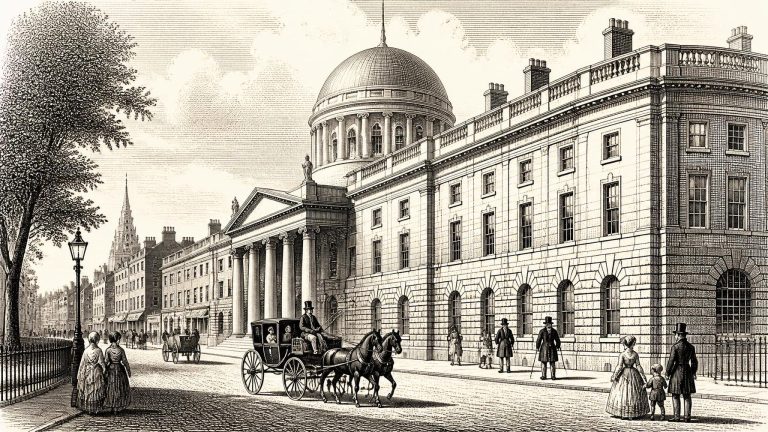
The most eloquent architectural symbol came at College Green. In June, the Bank of Ireland opened its banking hall in the former Irish Houses of Parliament. The bank had acquired the building in 1803; its public opening as a bank in 1808 transformed the working home of the pre-Union legislature into a financial institution. The change did not erase the building’s political associations. Its great chambers, designed for Lords and Commons, continued to proclaim the scale and confidence of the eighteenth-century parliament that had disappeared in 1801. But their new purpose demonstrated a hard fact of the Union: Dublin’s former national legislature had no legislative successor within Ireland.
The petition was presented to both Houses of Parliament on 25 March. In the Commons, Charles James Fox introduced it; in the Lords, Lord Grenville did so. The manner mattered. After the violence of the 1798 rebellion and Robert Emmet’s abortive rising of 1803, the petitioners deliberately pursued a constitutional, public and peaceful route. They addressed Parliament as loyal subjects seeking redress, not as a body challenging the Crown or the Union.
The final parliamentary struggle began when the Irish parliament reassembled on 15 January. The previous year’s ministerial attempt to secure support for a union had failed. The government returned with greater preparation, led in Ireland by Lord Cornwallis, the lord lieutenant, and by the chief secretary, Lord Castlereagh. Their task was to persuade – and, critics charged, to purchase – sufficient support among peers and members of the Commons for a measure that would abolish their own legislature.
In 1795 the Kingdom of Ireland remained constitutionally separate from Great Britain, with its own parliament in Dublin, but it was governed within the British imperial state and during a European war against revolutionary France. The year was not yet one of general rebellion. Rather, it was a year in which hopes of reform were dramatically raised, then withdrawn; in which a new Catholic college was legally founded; and in which local violence in County Armagh gave institutional form to a durable Protestant association. These developments did not cause every later crisis by themselves, but together they made the political atmosphere markedly more fearful, divided and combustible.
The Kingdom of Ireland possessed its own parliament at College Green, a fact of great importance in political argument after the constitutional changes of 1782. Yet legislative independence did not make the parliament representative of the island’s population. Executive influence still flowed through Dublin Castle, office, pensions and the management of borough seats. The political nation was overwhelmingly Protestant and propertied. Roman Catholics could not vote in parliamentary elections or sit at Westminster or College Green; the franchise and the structure of constituencies also excluded most poorer Protestants and Presbyterians. The country’s constitutional life therefore rested on a narrow social base.
The Irish parliament assembled on 5 February 1789 under the lord lieutenant, George Nugent-Temple-Grenville, marquess of Buckingham. Its immediate business was overshadowed by the unresolved question of the king’s health. Since George III could not personally direct government, politicians in Britain and Ireland had to decide whether the prince of Wales possessed an automatic right to act, or whether parliament should define and confer the regency.
The Irish parliament sat from 17 January to 18 April. It was a legislature with greater formal autonomy than it had possessed before 1782, but it was not representative in a modern sense. Its members were drawn from a restricted Protestant political nation, shaped by property, patronage and borough influence; Roman Catholics remained excluded from parliament and from the parliamentary franchise. The lord lieutenant was George Nugent-Temple-Grenville, Marquess of Buckingham, who had returned as viceroy in November 1787. His administration governed through Dublin Castle while remaining closely connected to William Pitt’s ministry in London.
The immediate issue was an unequal trading relationship. Earlier concessions had opened important avenues for Irish commerce, yet Irish producers still faced exclusions and duties in Britain, especially in relation to colonial goods and particular manufactures, while British goods entered Irish markets freely. Irish manufacturers worried about competing with better-capitalised British firms; consumers and traders also operated amid smuggling, boycotts of British imports and commercial uncertainty. These were not merely abstract questions of tariffs. They bore on employment for urban artisans, the prospects of linen, woollen and other manufacturers, and the price and availability of everyday goods.
A firmly dated landmark came on 17 April. Westminster passed the Irish Appeals Act 1783, commonly called the Renunciation Act. Its language was unusually emphatic: it declared that Ireland’s claimed right to be bound only by laws made by the king and the Irish parliament, and to have cases finally decided in Irish courts, was established permanently. It also ended appeals from Irish courts to courts in Great Britain.
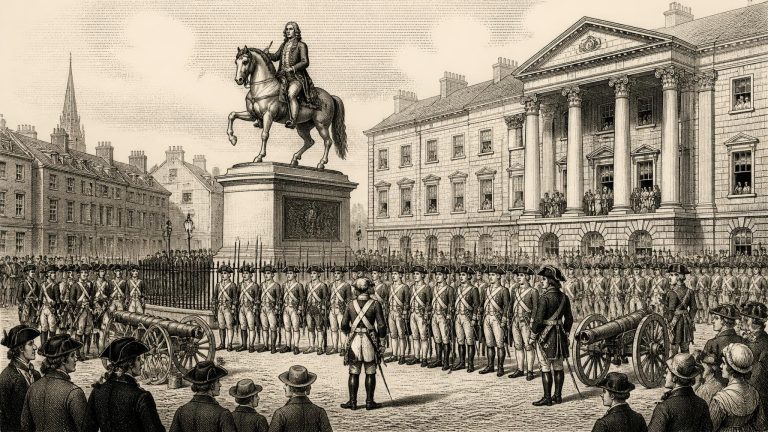
The immediate pressure behind the year’s changes came from the Irish Volunteers. These locally raised corps had first formed amid the military strains of the American war, when regular troops were drawn away and fears of a French or Spanish attack sharpened. By 1782 they were no longer merely a defensive expedient. Predominantly Protestant, often led by gentry and merchants, and drilled in military fashion, the Volunteers had become a formidable extra-parliamentary public force. Their parades, reviews, uniforms, artillery and published resolutions made political opinion visible in towns and counties in a manner that Dublin Castle could neither simply ignore nor safely suppress.
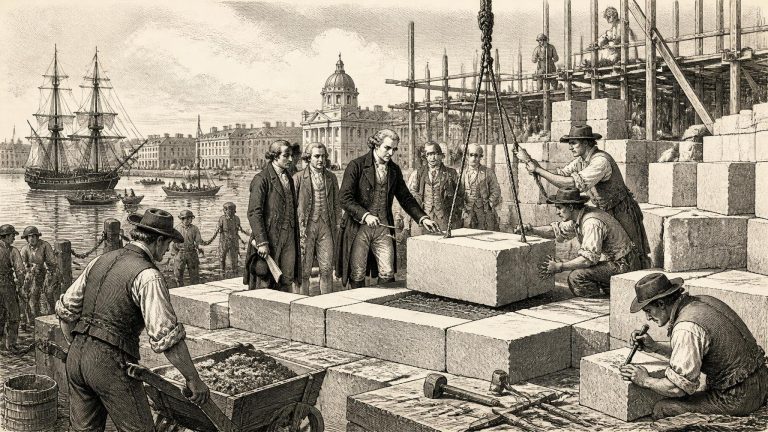
James Gandon, the English-born architect who would make Dublin his adopted home, arrived in the city in April 1781 to oversee the proposed new Custom House. The scheme was promoted by John Beresford, chief commissioner of Irish revenue. It was never merely an architectural exercise. Customs duties mattered enormously to the administration, while the location of the new building, farther east on the north bank of the Liffey, was intended to pull mercantile activity and official supervision towards the developing lower river.
The immediate background was the commercial agitation of 1779. Ireland had long been constrained by legislation made at Westminster: restrictions bore especially heavily on overseas trade and manufacturing, while war disrupted customary markets and shipping. Under pressure from Irish merchants, parliamentary Patriots and Volunteer corps, the British government began removing particular restrictions late in 1779. Further measures followed during 1780. On 24 February, an Act permitted trade between Ireland and the British colonies and plantations in America and the West Indies on terms comparable to those available from Britain; another March measure widened Irish access to imports and exports available to British merchants in the Levant trade.
The Volunteers had begun to form in 1778, initially from Protestant property holders and middle-class townsmen concerned by the possibility of a French landing. During 1779 their numbers, geographical spread and public confidence increased sharply. They were not a national army directed by the state. Companies elected or accepted local officers, obtained arms and uniforms through local initiative, and cultivated civic prestige through reviews, dinners and ceremonies. Their character varied by district, but their public face was overwhelmingly Protestant, and the movement did not erase the political and legal divisions of eighteenth-century Ireland.
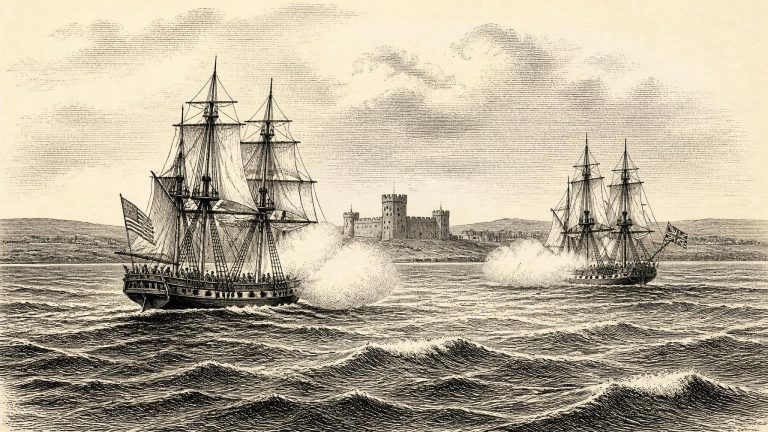
Jones had sailed from France in April in the eighteen-gun Ranger, taking the war into waters normally regarded as Britain’s own. France’s alliance with the United States in February, followed by open Franco-British war later that year, transformed the strategic position of Ireland. Its long coastline, valuable harbours and proximity to Britain made it both a potential base and a potential target. Regular troops had already been drawn away from Ireland for imperial service, while coastal communities had reason to fear privateers as well as a major enemy landing.
The outbreak of armed conflict in North America was not a distant spectacle. Ireland was an important military base within the British Empire and a trading society with substantial links to the American colonies. Contemporary government correspondence and military returns show the urgency of the problem. In January, there were 12,636 effective soldiers in Ireland; regiments were already under orders to leave, and the government worried that the garrison would fall below the establishment it was expected to maintain. Between 6 April and 11 May, 3,619 officers and men embarked from Ireland. By 1 June, the number of effective troops remaining had fallen to 10,736.