English Market1788 CE
In 1788, Ireland’s post-1782 settlement revealed both reforming ambition and entrenched exclusion. Parliament, dominated by Protestant property and patronage, rejected Henry Grattan’s proposal to regularise tithes, while considering compensation for clergy whose payments had been withheld amid agrarian unrest. It also supported linen, hemp, transport, courts, gaols and urban works, reflecting practical governmental intervention. Cork Corporation opened the English Market, improving organised food provisioning. Belfast tradesmen founded the subscription-based Reading Society, later Linen Hall Library, promoting shared learning. George III’s illness created a regency crisis, foreshadowing constitutional conflict between Ireland and Britain in 1789 and exposing limits of parliamentary representation.
Dateline
In 1788, Ireland’s most consequential developments did not arrive as one decisive battle, election or statute. They appeared instead in places where power and ordinary life met: at the Dublin parliament’s debate over tithes, in a Belfast subscription society founded by working townsmen, and in the opening of a new municipal food market in Cork. By the year’s end, the illness of George III had also introduced a constitutional uncertainty whose specifically Irish consequences would emerge only in 1789. Together, these events exposed both the ambitions and the narrow limits of the Irish kingdom’s post-1782 political order.
Parliament and the Tithe Question
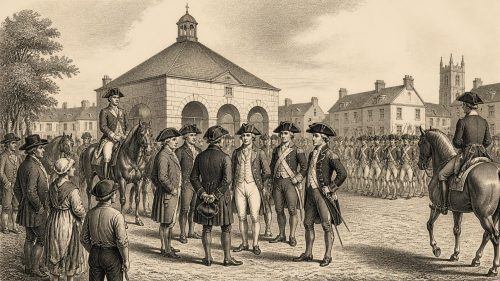
The Irish parliament sat from 17 January to 18 April. It was a legislature with greater formal autonomy than it had possessed before 1782, but it was not representative in a modern sense. Its members were drawn from a restricted Protestant political nation, shaped by property, patronage and borough influence; Roman Catholics remained excluded from parliament and from the parliamentary franchise. The lord lieutenant was George Nugent-Temple-Grenville, Marquess of Buckingham, who had returned as viceroy in November 1787. His administration governed through Dublin Castle while remaining closely connected to William Pitt’s ministry in London.
One of the session’s sharpest disputes concerned tithes. On 14 February Henry Grattan moved for an inquiry and advanced a remedy intended to make the burden more predictable: a uniform assessment on tillage rather than payments fluctuating with the harvest. His published speech argued that uncertainty, tithe-proctors’ charges and unequal treatment made the existing system especially oppressive to poorer cultivators. The proposal was defeated by 121 votes to 49. That firm parliamentary result is important: it marked not merely an eloquent complaint, but the failure of a concrete attempt to alter a source of intense rural grievance.
The issue had an immediate social setting. Agrarian protest associated with the Rightboys had spread through parts of Munster and beyond in the later 1780s. Their grievances were not reducible to one charge: rents, labour, church payments and local exactions could overlap. But tithes were particularly divisive because they were owed to the established Church of Ireland by occupiers who were overwhelmingly not members of it. This did not make every dispute a religious confrontation, nor every farmer a protester. It did mean that a payment taken from a precarious holding could carry questions of class, denomination and local authority at once.
The government’s response revealed the imbalance of power. Two days after Grattan’s motion, MPs considered a measure to enable ecclesiastical persons and bodies in specified districts to recover compensation for tithes withheld during 1787. Critics objected in particular to provisions that could dispense with jury trial in certain cases. Thus, in the same session in which reform of collection was rejected, the machinery for recovering arrears received official attention. For rural households, the argument over tithes was not an abstraction about constitutional liberty; it concerned crops, cash, credit, livestock and the risk of legal pursuit.
Linen, Roads and Public Authority
Parliament’s routine legislation also shows a state concerned with commerce, communications and control. On 20 March it passed an act to promote linen and hempen manufacture by increasing the supply of Irish flax seed and encouraging the export of linens and sailcloth. Linen was central to Ulster’s economy, but its production connected spinners, weavers, bleachers, merchants, seed suppliers and exporters across much wider districts. The statute did not create that economy in 1788; rather, it was an intervention in an established and expanding trade whose success depended on quality raw materials, credit, transport and access to overseas markets.
Other measures dealt with revenue, the post, courts, gaols, roads and urban works. Their individual provisions could be technical, yet they point to the practical reach of eighteenth-century government. A post-office act simplified proof of the Irish postal establishment in prosecutions. Legislation concerned courthouses and gaols in counties of cities; separate acts addressed a Cork gaol, a canal near Malahide, and water and roads in Dublin. Such measures should not be mistaken for a coordinated national programme of modern public services. They nevertheless show towns, local elites and parliament using statute to manage movement, confinement, taxation, trade and improvement.
Cork’s New Food Market
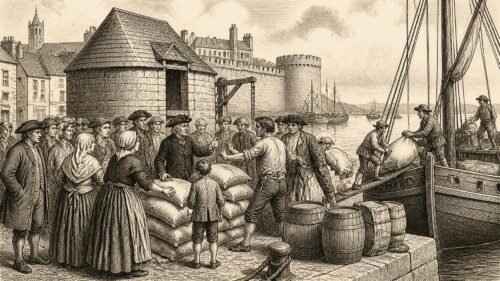
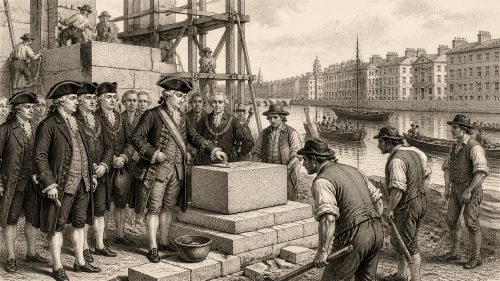
On 1 August, Cork Corporation opened the market now known as the English Market. Its creation was a clearly dated civic development in a port city whose commercial life depended on the surrounding countryside as well as Atlantic connections. The market stood in the developing commercial centre and offered a designated place where food producers, traders and purchasers could meet under municipal oversight. Its opening was therefore part of the everyday infrastructure of provisioning: a setting for the sale and purchase of meat, fish, butter, vegetables and other produce brought into the city.
The name requires care. The market was created by Cork’s Protestant or ‘English’ corporation, and its familiar title belongs to that institutional origin. It was not, despite later popular explanations, a place where English alone was spoken or where only people defined as English could trade. Nor did the later distinction between an ‘English Market’ and an ‘Irish Market’ yet describe the city in 1788: St Peter’s Market was established only after municipal reform in 1840. What can properly be said for this year is that Cork acquired a prominent new municipal market, an enduring piece of its urban fabric.
A Belfast Society for Knowledge
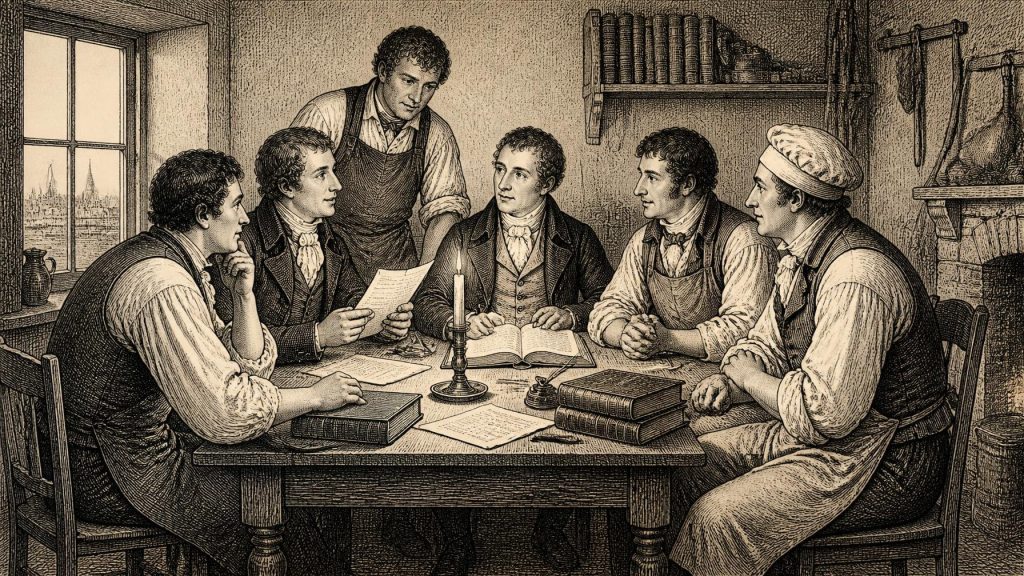
On 13 May, a group in Belfast established the Belfast Reading Society, the institution from which the Linen Hall Library developed. This was a modest beginning with large cultural promise. It was a subscription society intended to acquire books and other materials for its members, not a free public library in the modern sense. Yet its founders were conspicuously drawn from the town’s middling and artisan world: among them were a builder, tanner, gunsmith, printer, baker and other tradesmen. Roger Mulholland was its first president and Robert Cary its first librarian.
The society’s early rules give a glimpse of disciplined collective self-improvement. Members paid subscriptions, could be fined for absence from committee business, and held transferable interests in the library. These arrangements made books expensive but shared resources rather than private possessions alone. Belfast’s commercial and manufacturing growth, especially its linen connections, provided the setting; expanding print and literacy provided the opportunity. The society should not be romanticised as a democratic institution open to all, but its artisan base made it a striking expression of Enlightenment-era associational culture in Ireland.
Its foundation also belongs to a wider intellectual landscape. The Royal Irish Academy, established in Dublin in 1785, promoted learning in science, literature and antiquities among a far more elite constituency. Belfast’s Reading Society worked at a different social scale, but both reflected the value attached to collecting knowledge, discussion and improvement. In later decades, the Belfast institution would become associated with the White Linen Hall and take the name by which it is now widely known. In 1788, however, it was simply a new reading society, dependent on the commitments and subscriptions of its members.
An Unsettled Crown
Late in the year, events beyond Ireland placed the constitutional relationship with Britain under strain. George III’s serious illness became unmistakable in the autumn of 1788, producing a regency crisis at Westminster. The question was not merely medical: if the king could not exercise royal functions, who could do so, on what authority and with what restrictions? Pitt’s government and the opposition disagreed sharply over the position of George, prince of Wales.
For Ireland, the problem carried unusual force because the crown was understood as the central constitutional bond between two kingdoms with separate parliaments. It is essential not to bring the later drama back into 1788. The Irish houses did not offer the prince the Irish regency during this calendar year; that celebrated confrontation belonged to February 1789. What 1788 supplied was the originating crisis: an incapacitated monarch, competing theories of authority, and the prospect that Dublin and Westminster might act independently.
By year’s end, then, Ireland stood between improvement and exclusion. Cork’s new market organised urban provisioning; Belfast readers pooled money for books; legislators encouraged linen and considered roads, canals and prisons. Yet the same parliament refused a tithe inquiry and upheld a political system from which most of the population was absent. The king’s illness had not yet forced an Irish constitutional decision, but it had made the fragility of the settlement after 1782 impossible to ignore.

Primary Sources
- Henry Grattan, the Regency Crisis and the emergence of a Whig party in Ireland, 1788–9
- Grattan, Henry | Dictionary of Irish Biography
- Grenville, George Nugent Temple | Dictionary of Irish Biography
- Hobart, Robert | Dictionary of Irish Biography
- Proceedings and Debates of the Irish House of Commons: Friday, 25 January 1788
- Irish Legislation Database: Browse Regnal Years
- Irish Legislation Database: Help on Regnal Years and Statute Numbers
- An Appendix to the Abridgment of the Statutes of Ireland, 1788
- Statute Law Revision Act 2007, Schedule 1
- Statute Law Revision Act 2007, Schedule 2
- 28 Geo 3 c.13 (Irish Parliament, 20 February 1788)
- A Full Report of the Speech of the Right Hon. Henry Grattan in the House of Commons, 14 February 1788
- Henry Grattan Collection
- The Speeches of the Right Honourable Henry Grattan
- The Irish Parliament from the Year 1782 to 1800
- History of the Linen Hall
- Linen Hall Library, Belfast
- President Visits Linenhall Library
- History of the English Market
- The English Market
- A Guide to Protected Structures in Cork City
- Parliamentary Union
- Chapter I: On Local Disturbances in Ireland and on the Irish Church Question