Patriot Autonomy1782 CE
In 1782, Irish Patriots, supported by the predominantly Protestant Volunteer movement, secured major constitutional concessions during Britain’s wartime weakness. Dungannon resolutions, Henry Grattan’s parliamentary campaign and public mobilisation helped win repeal of the Declaratory Act, weakening British legislative supremacy, while Yelverton’s Act reformed Poynings’ Law and expanded Irish parliamentary initiative. The Catholic Relief Act eased property, educational and worship restrictions but withheld political equality. The settlement, later termed Grattan’s Parliament, preserved crown, empire, patronage and a narrow Protestant electorate. Meanwhile, poor harvests, rising prices and an export embargo revealed widespread insecurity. Ireland gained qualified legislative autonomy, not fully democratic self-government.
Dateline
In 1782 the Kingdom of Ireland acquired a degree of legislative autonomy not enjoyed for generations. The achievement was real, dramatic and loudly celebrated: the parliament meeting in Dublin was freed from the most overt claims of British parliamentary supremacy, and the machinery that had long restricted Irish law-making was altered. Later generations called the settlement the Constitution of 1782 and the ensuing legislature “Grattan’s parliament”. Yet the year’s triumph belonged to a narrow political nation. Catholics remained shut out of parliament and the franchise; most people had no vote; borough patronage and landlord influence still distorted representation. At the same time, a difficult harvest and rising food anxiety exposed how little constitutional excitement could shelter households dependent on precarious local supplies.
An Armed Political Nation
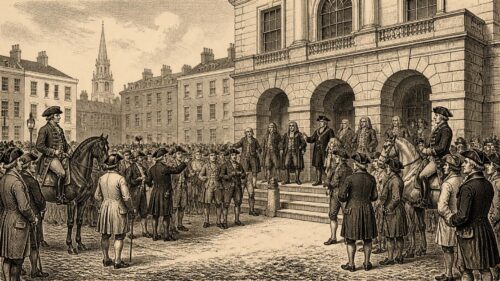
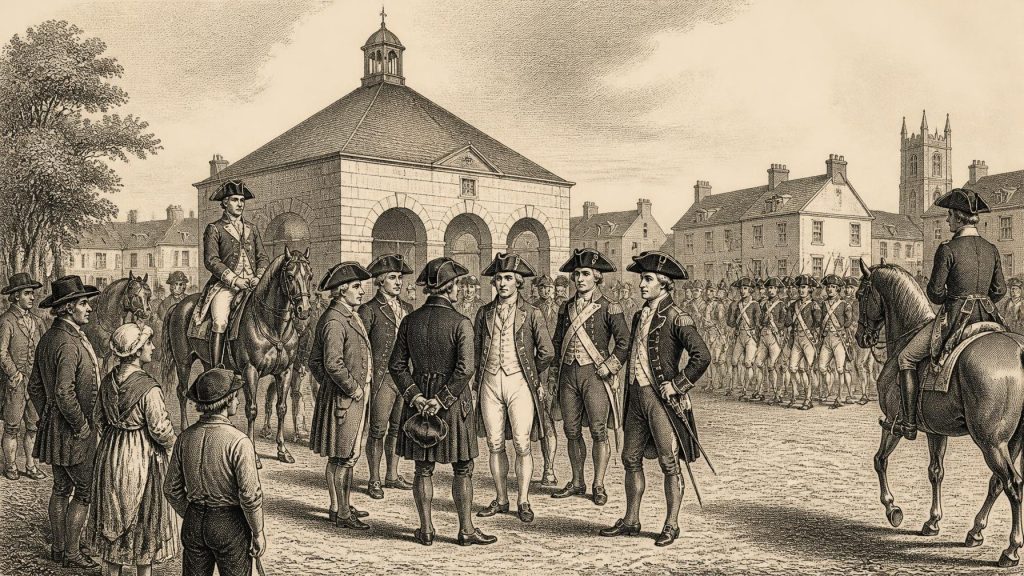
The immediate pressure behind the year’s changes came from the Irish Volunteers. These locally raised corps had first formed amid the military strains of the American war, when regular troops were drawn away and fears of a French or Spanish attack sharpened. By 1782 they were no longer merely a defensive expedient. Predominantly Protestant, often led by gentry and merchants, and drilled in military fashion, the Volunteers had become a formidable extra-parliamentary public force. Their parades, reviews, uniforms, artillery and published resolutions made political opinion visible in towns and counties in a manner that Dublin Castle could neither simply ignore nor safely suppress.
On 15 February, delegates from Ulster Volunteer companies assembled at Dungannon, County Tyrone. Their resolutions supplied the clearest programme of the moment. They rejected the claim that the British parliament possessed a right to legislate for Ireland, criticised the control exercised through Poynings’ Law, and supported relief for Roman Catholics. Dungannon did not speak for all Ireland: its delegates were Protestants, its language assumed loyalty to the crown, and it did not propose Catholic political equality. Nonetheless, the meeting connected an armed provincial movement with the parliamentary Patriots in Dublin and made constitutional change seem urgent.
Lord Charlemont, commander-in-chief of the Volunteers, helped keep the movement respectable in elite eyes while encouraging its political weight. His Dublin circle assisted in preparing the Dungannon resolutions. Henry Flood, a formidable parliamentary critic of government, was important in shaping the more uncompromising argument that Ireland required not favours from Westminster but recognition of rights. The Volunteer movement was therefore neither a democratic national army nor a mere ceremonial militia. It was an armed Protestant association whose existence altered the balance between Irish politicians, Dublin Castle and ministers in London.
Grattan’s Demand
The imperial context was decisive. Britain’s war against the American colonists had gone badly; the surrender at Yorktown in October 1781 had transformed the wider conflict, and Britain also faced France and Spain. Ministers had strong reasons to avoid provoking a fresh crisis in Ireland, particularly where thousands of armed Volunteers claimed to be defending the island. Earlier agitation had already won substantial relaxation of restrictions on Irish trade. In 1782 the argument moved from commerce to constitutional authority.
On 16 April Henry Grattan moved in the Irish House of Commons for a declaration that Ireland was a distinct kingdom with its own parliament, the sole legislature for Irish affairs. The wording was bold, but Grattan’s object was not separation from the crown or withdrawal from the British imperial connection. He sought a rebalanced relationship: king, Lords and Commons of Ireland legislating for Ireland, while sharing the monarch and remaining within the empire. The Commons endorsed the claim, and an address was carried to the crown. Grattan’s parliamentary eloquence became inseparable from the occasion, but it drew strength from the political mobilisation beyond College Green.
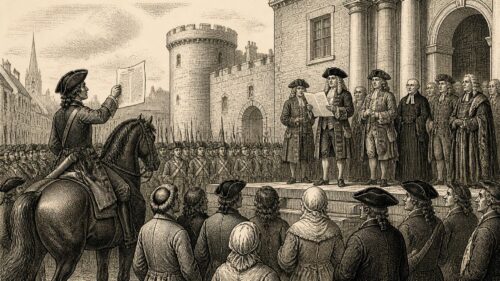
The crucial British statute was the repeal of the Declaratory Act of 1719, commonly known as the Sixth of George I. That earlier law had asserted the authority of the British parliament to make laws binding Ireland and affirmed a final appellate jurisdiction over Irish cases. The repeal measure received royal assent on 21 June 1782. It removed the statutory declaration that had become the principal symbol of Irish legislative dependence. In Dublin, the concession was received as a constitutional victory; illuminations, addresses and Volunteer celebrations gave it a public, almost civic-revolutionary character.
But repeal did not by itself answer every practical question. Henry Flood insisted that Britain should not merely repeal a particular act but explicitly renounce any right to legislate for Ireland. Grattan and his allies believed the 1782 settlement sufficient and feared that pressing further might endanger it. This disagreement was already politically significant by the close of the year. The fuller British renunciation sought by Flood would not come until 1783. It is therefore misleading to present 1782 as a neat, final legal severance: it was a decisive settlement, but one whose meaning and security were still contested.
Changing the Route of Legislation
The second major achievement concerned Poynings’ Law, the late fifteenth-century framework governing Irish legislation. In its long-established form, proposed bills had to be certified through the Irish and British privy councils before the Irish parliament could consider them. This gave executives outside the two houses extensive capacity to control, alter or prevent legislation. Barry Yelverton, lawyer and MP, had pursued a remedy before the April breakthrough. The resulting measure, later known as Yelverton’s Act, received royal assent on 27 July 1782.
The act required Irish draft legislation to pass from the Irish privy council to Britain without alteration, reducing the scope for executive remodelling. Its new procedures took effect with the 1783 session, so contemporaries in 1782 were celebrating a reform whose full parliamentary operation lay just ahead. Even so, it marked a profound change in principle. The Irish houses would henceforth initiate and debate bills with far greater freedom, rather than receive legislative proposals pre-shaped by councils. The parliament had not become democratic, but it had become much more independent in its legislative practice.
This was also a year of administrative re-alignment. The Duke of Portland arrived as lord lieutenant in April with a conciliatory ministry, and Barry Yelverton became attorney general in July. Their appointments reflected an effort to govern through accommodation with leading Patriots rather than confrontation. That accommodation had limits. The executive, crown patronage, the established church and a highly restricted electorate remained integral to the Irish political order. Legislative independence did not transfer power to the rural poor, urban artisans, women, or the Catholic majority.
Relief Without Equality
Religion illustrated both the advance and the limitation. The Roman Catholic Relief Act of 1782 came into operation on 1 May. It removed important restrictions on Catholic property and inheritance, and eased aspects of Catholic education and worship subject to continuing controls. Catholic clergy and lay leaders had repeatedly demonstrated loyalty during the invasion scares of the late 1770s; the Dungannon Volunteers also declared against religious persecution. The act recognised that treating Catholic subjects as permanently suspect was politically costly as well as unjust.
Yet it was not emancipation. Catholics could not sit in parliament, vote in parliamentary elections, hold the principal offices of state or enjoy equal civic standing. Catholic schooling remained regulated through licensing, and the Church of Ireland retained its privileged legal and financial position. The constitution proclaimed in 1782 was thus principally a Protestant constitutional achievement. It created room for later arguments about inclusion, but it did not resolve them. Presbyterians and other Protestant dissenters, though politically more advantaged than Catholics, also lived within an Anglican state whose representative institutions were far from broadly based.
Food, Trade and Uneven Security
Constitutional pageantry did not erase material insecurity. The harvest of 1782 was poor, beginning a wider subsistence crisis that continued into 1783 and 1784. Such crises did not necessarily produce a single nationwide famine experience, and evidence varies by locality, but bad crops, higher prices and fear of scarcity bore especially heavily on labourers, cottiers and smallholders with little cash or stored grain. Ireland’s expanding commercial agriculture linked ports, towns and hinterlands, yet that connection could make the movement of food politically explosive when supplies tightened.
On 13 November a proclamation placed an embargo on exports from Ireland. The measure shows that food supply had become a matter of state concern. It also gives a necessary counterpoint to the rhetoric of legislative freedom. The same government and political class that celebrated a stronger Irish parliament faced the immediate business of regulating grain and provisions, responding to rural vulnerability and preventing scarcity from becoming disorder. For many inhabitants, the year was remembered less through constitutional vocabulary than through the price and availability of bread, oats, potatoes and other necessities.
The new constitutional confidence nevertheless mattered for Ireland’s commercial future. Patriots had tied free trade and legislative authority together: an Irish parliament, they argued, should be able to protect and develop Irish interests. Dublin remained the political centre, but Volunteer networks and commercial opinion gave Belfast, Dungannon, Cork and many county towns a stronger role in public debate. Newspapers, pamphlets, petitions, dinners and reviews carried arguments between parliament, provincial society and the Atlantic world. The American conflict had shown that imperial structures could be challenged; Ireland’s Patriots sought constitutional equality within the monarchy rather than an American-style break.
A Victory With Boundaries
By December 1782 Ireland possessed a more autonomous legislature, a reformed legislative process waiting to operate, and a political vocabulary of national rights that would endure long after the parliament itself disappeared in 1800. The Volunteers had demonstrated that organised public pressure could compel concessions. Grattan had become the great parliamentary voice of the settlement; Flood had ensured that its inadequacies remained visible; Charlemont and Yelverton had helped translate agitation into political action and legal machinery.
Still, the year should not be reduced to a founding myth. The Irish parliament was independent in an important but qualified sense, tied to the crown and empire, shaped by patronage and property, and unrepresentative of the population it governed. The Catholic Relief Act softened persecution without delivering equality. Food shortage exposed social fragility beneath elite celebration. What 1782 achieved was not modern national self-government, but a consequential reconfiguration of the old order: Ireland’s Protestant parliament gained a voice it had long demanded, while the larger question of who counted within the Irish political nation remained unanswered.

Primary Sources
- Constitutional Change, Law and Grattan’s Parliament
- Grattan, Henry
- Flood, Henry
- Caulfeild, James
- Yelverton, Barry
- Butler, James (‘James Butler II’)
- O’Leary, Arthur
- Part 1 of The Speeches of Grattan
- Grattan: The Speeches of the Right Honorable Henry Grattan in the Irish and Imperial Parliament
- Irish Legislation Database: Help — Statutes
- Poynings’ Law and the Making of Law in Ireland, 1660–1800
- The Constitutional Position
- Statute Law Revision Act 2015
- Pre-Union Irish Statutes
- Pre-Union British Statutes
- The Catholic Question in the Eighteenth Century
- The Catholic Relief Act, 1782
- Grattan’s Parliament
- Crawford: History of Ireland
- History of Parliament in Ireland
- Public Buildings
- The History of the Irish Famine
- Learn | Ireland’s Great Hunger Museum
- The Eighteenth Century