Membership is completely free, giving members unlimited access to all available resources, services, features, and benefits without any restrictions or fees.
Welcome back. Sign in to continue enjoying unlimited access to all available resources, services, features, and member benefits at no cost.
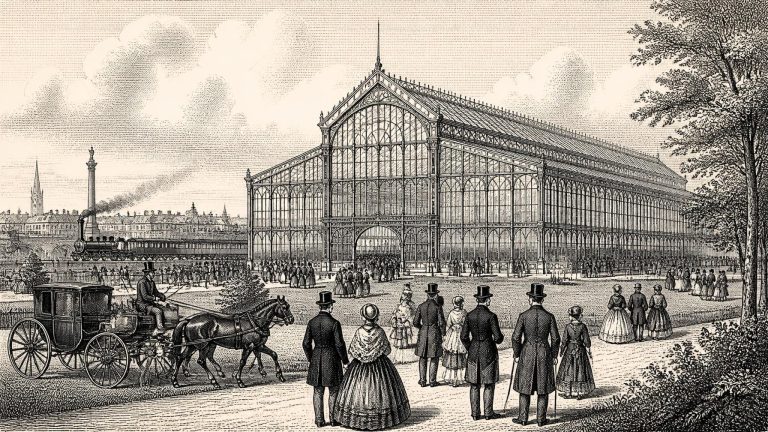
On 12 May 1853 Dublin acquired a striking, temporary landmark: the Great Industrial Exhibition opened on Leinster Lawn, beside Leinster House. Organised in connection with the Royal Dublin Society, it was the most conspicuous Irish public event of the year. Its glass-and-iron halls, designed by John Benson, consciously echoed London’s Great Exhibition of 1851. Yet this was not simply a smaller Irish copy of the Crystal Palace. It was a declaration that Ireland, only beginning to emerge from the catastrophe of the Great Famine, possessed skill, resources, artistic inheritance and a place in an international commercial world.
The potato crop again suffered badly in 1848. This was a devastating reversal for families whose food supply, labour patterns and small holdings had already been shattered by the failures of 1845 and 1846 and by the hunger and epidemic disease of 1847. The blight was caused by Phytophthora infestans, though contemporaries did not possess a secure modern explanation or a means of preventing it. For labourers, cottiers and small tenants with little land and few reserves, another damaged crop meant that survival could not simply be postponed until the following harvest.