Membership is completely free, giving members unlimited access to all available resources, services, features, and benefits without any restrictions or fees.
Welcome back. Sign in to continue enjoying unlimited access to all available resources, services, features, and member benefits at no cost.
MIS 3, conventionally dated from about 57,000 to 29,000 years ago, was not a single uniform “Ice Age weather” regime. Greenland ice-core records show repeated abrupt shifts between colder stadials and comparatively milder interstadials. Ireland’s temperature, snowfall, vegetation, coastlines and animal habitats would have altered in response, sometimes far faster than the broad millennial date ranges available for its fossils. Stalagmites, cave sediments, animal bone, pollen, insect remains and offshore landforms each register different aspects of this changing world. None can identify the weather, season or precise shoreline of 31,328 BCE.
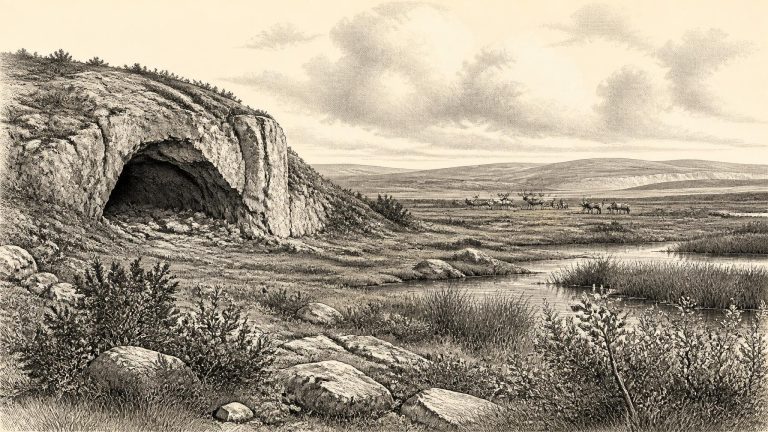
At this depth of time, even apparently precise figures can mislead. A radiocarbon age is not identical to a calendar age, and calibration becomes especially complex near the practical limits of the method. Nor can an old cave assemblage automatically be treated as a sealed archaeological floor. Castlepook was excavated principally between 1904 and 1908, long before modern recording standards. Its bones were recovered from passages and chambers that had been used, reworked and disturbed over many millennia by animals, water, sediment movement and excavators. Some specimens have subsequently been redated with improved pretreatment methods, producing ages substantially older than earlier results.
Modern calendar precision is unavailable. Even a very good radiocarbon result represents a probability range, not an anniversary; calibration converts radiocarbon years into ranges of calendar years using independently dated records of past atmospheric carbon. The margins become wider and more consequential beyond 30,000 years ago. Older Irish cave discoveries were also excavated before modern expectations of fine stratigraphic recording, systematic sieving and contamination control. A bone’s age may be measured, but that does not automatically establish the date at which it entered a cave, nor the age of every object recovered nearby.
The closest securely dated environmental evidence comes from Derryvree near Maguiresbridge, County Fermanagh. Roadworks there exposed organic silts and fine sands caught between two separate sheets of glacial till. The deposit produced a conventional radiocarbon age of 30,500 ± 1,200 radiocarbon years BP; later calibration places it broadly between about 36.9 and 31.7 thousand calendar years BP. That is a long interval by historical standards, but it encompasses the nominal date of 31,575 BCE. It establishes that, sometime within that range, freshwater and wetland conditions existed in north-central Ireland before a later ice advance sealed the evidence beneath a drumlin.
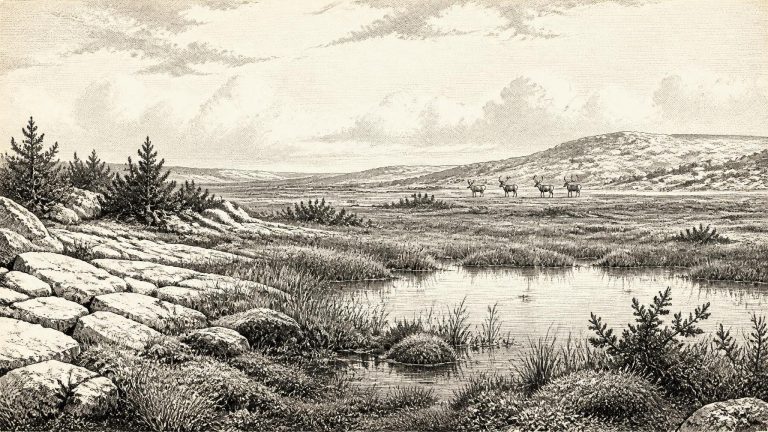
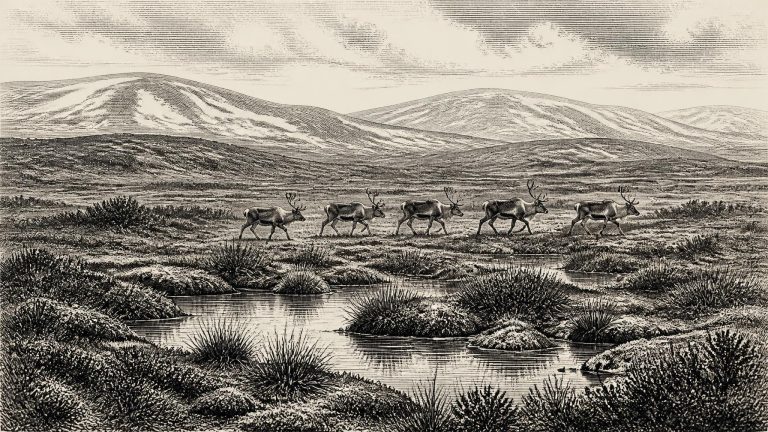
Ireland was not the green, wooded island familiar today. Across north-west Europe, long cold phases were interrupted by comparatively milder interstadials, sometimes with striking rapidity. In Ireland, the surviving evidence suggests a patchwork rather than a single uniform “ice-age landscape”: open grassland and herb-rich tundra, bare or stony ground, low shrubs, wet hollows, streams and sedge-rich marshes. Conditions varied greatly with altitude, exposure, season and the changing proximity of ice. Pollen, plant macrofossils, insects, cave deposits and glacial sediments can all illuminate parts of that world, but none supplies a weather report for a particular day in 31,718 BCE.