Domnall’s Colum Cille Law753 CE
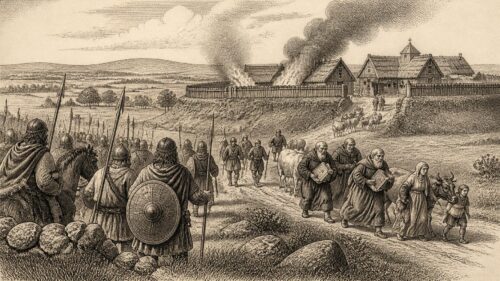
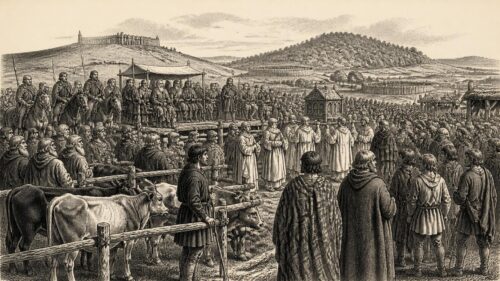
In 753 CE, Domnall Midi of Clann Cholmáin enforced the law of Colum Cille, publicly combining royal authority with the saint’s protection, privileges and ecclesiastical claims. The act reflected Ireland’s fragmented political order, where rulers, kin groups and churches negotiated power. Annals also record a solar eclipse, deaths of abbots and churchmen across Ireland, the death of Echaid, king of Uí Moccu Uais, slaughter among Connacht groups, and Ferblae’s death as a learned man. These terse notices reveal interconnected religious, political and economic communities. Chronological differences among annals require caution, although the eclipse is securely dated to 9 January 753.
Dateline
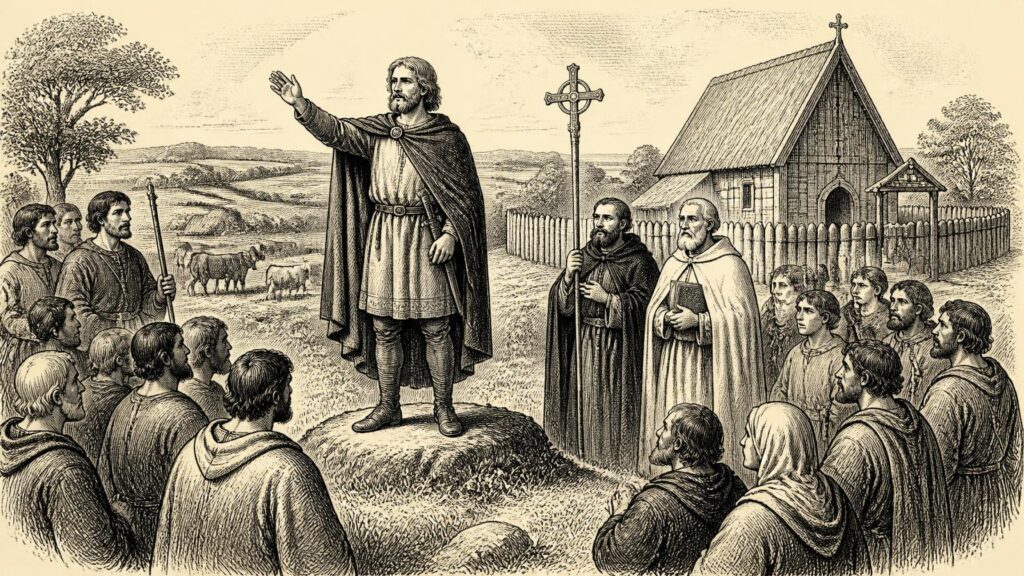
In 753 CE, the most consequential Irish event recorded in the principal annalistic tradition was the enforcement of the law of Colum Cille by Domnall of Mide. The notice is brief, but it joins royal authority to the cult of Ireland’s most influential northern saint and offers an unusually clear glimpse of how power worked in an island without a single permanent government. The year’s record also preserves a solar eclipse, the deaths of prominent churchmen, the killing of a regional king, and a local slaughter in the west. Yet the sources require care: medieval annals organise events under annual headings whose chronological systems do not always align perfectly with modern calendar dating. Their terse notices are evidence for what was remembered and recorded, not full narratives from which every motive or consequence can safely be recovered.
A Royal Enforcement
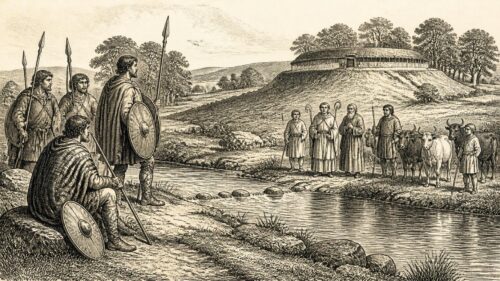
Domnall mac Murchada, generally known as Domnall Midi, belonged to Clann Cholmáin, a leading branch of the southern Uí Néill centred in Mide. He was a dominant overking among the Uí Néill and was counted in later tradition among the kings of Tara. That did not make him ruler of a unified Irish kingdom in the modern sense. Ireland was divided among numerous peoples and dynasties, with regional kings, subordinate lords and powerful ecclesiastical communities all commanding loyalties of their own. Domnall’s standing rested on kinship, military following, control of resources and the ability to make alliances with churches as well as secular rulers.
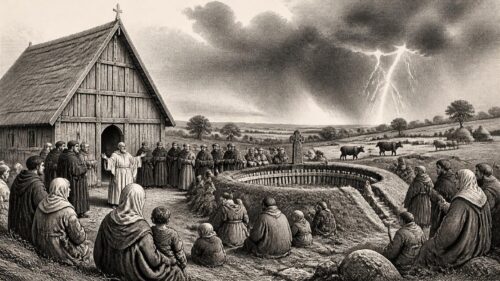
The annal’s phrase, “the law of Colum Cille”, does not preserve the text of a statute. It should therefore not be treated as evidence for a surviving code promulgated at a known assembly, nor can its provisions be reconstructed word for word. In early medieval Ireland, however, a saint’s “law” normally meant a public assertion of the saint’s peace, protection, privileges and claims, supported by clerical and secular authority. Such enactments could reinforce the security of churches and their people, validate claims to dues or hospitality, and turn the prestige of a revered founder into an instrument of order. The law of Colum Cille was thus religious language with practical political force.
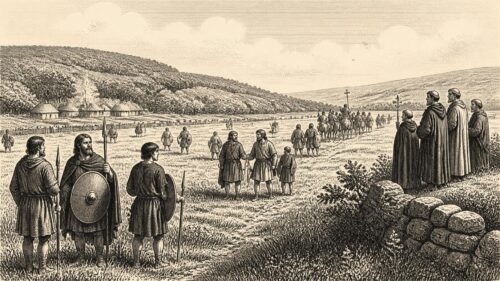
Colum Cille, or Columba, had died in 597, but his name remained central to a network of churches associated with Iona and with foundations in Ireland. His cult linked communities on both sides of the North Channel. Domnall’s intervention in 753 CE therefore mattered beyond Mide: it advertised an alliance with Columban interests and presented royal power as acting under saintly sanction. It is possible that relics, clergy and lay followers were involved in such a proclamation, as they were in other Irish enactments of saints’ laws, but the record for this particular year does not specify a procession, a shrine or a route. Those details must remain uncertain.
The event also illuminates Domnall’s distinctive position. Earlier annals say that he had entered clerical life, later assumed kingship, and again adopted a religious status while continuing to exercise political authority. Modern scholars differ over how literally to understand those notices and whether he held secular and ecclesiastical roles simultaneously. What is clear in 753 is that the supposed divide between king and churchman was not absolute. A ruler could cultivate a saint’s familia, while a major church could draw protection and reach from a ruler whose authority extended beyond its immediate neighbourhood.
Churches Marked by Loss
The annals place a striking cluster of ecclesiastical deaths beside Domnall’s enactment. Mac Oiged, abbot of Lismore, died; so did Luchraid, associated with Clonmacnoise; and Cellan, abbot of Clonfert. Scannlán of Dún Lethglaise, modern Downpatrick, is also named, while other obits commemorate Mo-Bái, Scannlaige of Cluain Bairenn and Fursa of Es Mac nEirc. The exact offices and local circumstances of several of these people are not supplied. Nonetheless, the geographical spread of the notices—from Munster through the Shannon region to Ulster—shows the annalist’s ecclesiastical horizon.
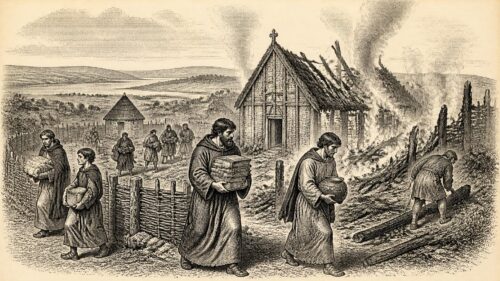
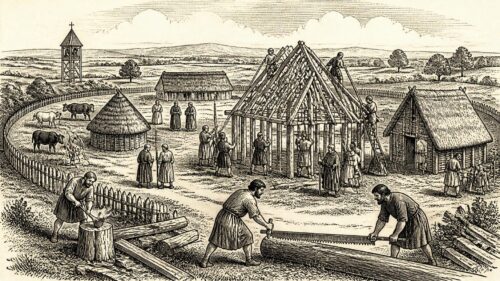
These were not isolated monasteries standing apart from ordinary society. Early Irish churches were settlements, estates, burial places and centres of hospitality as well as places of worship. Their communities included clergy, scholars, dependants, craftworkers and farming households. The death of an abbot could consequently affect landholding, food rents, client relationships and the succession of a locally powerful family. Many Irish abbots came from elite kindreds; ecclesiastical office and dynastic interest often overlapped. It would be unsafe to assign a particular succession dispute to any of the deaths recorded in 753, but their accumulation reminds us how frequently political and religious leadership changed together.
Clonmacnoise offers a useful example of the kind of place behind an annalistic name. Set beside the Shannon and important overland routes, it occupied a strategic as well as devotional location. Its later surviving stone churches and crosses should not be projected unchanged back into 753: much of its eighth-century settlement was built in timber and has disappeared. Even so, archaeology and landscape make clear why such a site could be a meeting point for travellers, patrons, traders, pilgrims and political contenders. Luchraid’s recorded repose belongs to this larger world of monastic households embedded in the routes and economies of the island.
Death, Learning and Local Violence
The secular notices are few but revealing. Echaid, grandson of Maenach and king of Uí Moccu Uais, died. The annal gives no account of his successor or of the circumstances of his death. Its economy of words is itself important: a king of a relatively small people was worth recording, but the political map was too fragmented for every transition to receive explanation. Irish kingship operated at several levels, and a regional ruler could be both independent within his own territory and subordinate to a more powerful overking.
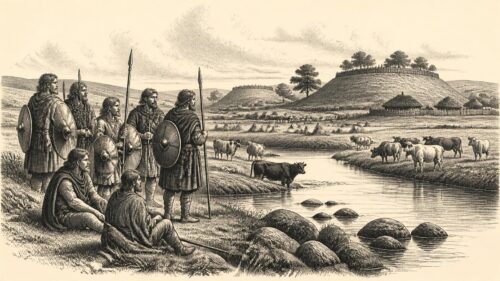
The annals also report the slaughter of the Uí Ailella by the Grecraige. No battle-site, leader, cause or casualty figure is given. It should not be inflated into an island-wide war. The Uí Ailella were associated with territory in north-west Connacht, and the entry points to conflict among regional groups there; beyond that, certainty ends. Such brief reports are a reminder that violence in early medieval Ireland often took the form of raids, retaliations, cattle seizures and struggles between neighbouring kindreds rather than campaigns directed by a national state.
Another death is recorded with a revealing title: Ferblae, son of Nárgus, was called a learned man. The designation offers no surviving list of books, pupils or writings, but it confirms the high value placed upon learning. Church settlements supported literacy in Latin and Irish, the copying of religious and scholarly texts, calculation of the church calendar, legal expertise and the preservation of genealogies. The annals themselves were products of this literate culture. Their compressed form reflects disciplined record-keeping rather than a lack of intellectual life.
A Darkened Sun
The first notice under the year is simply “a dark sun”. Astronomical calculation identifies a solar eclipse visible in this part of the world on 9 January 753 CE, making the entry one of the rare points at which an annalistic observation can be connected to a securely datable natural event. For observers, the darkening would have been startling; for annalists, it deserved preservation alongside the deaths of rulers and abbots. It should not, however, be made to explain the year’s politics. The record does not say that contemporaries interpreted it as a judgement, omen or cause of misfortune.
The eclipse also exposes a technical difficulty in using the annals. The surviving Annals of Ulster place these entries under the heading U753 but include an internal chronological notation equivalent to AD 752. Other annalistic compilations arrange related material differently, and later works sometimes preserve entirely different notices under their own 753 headings. Historians therefore compare manuscripts, synchronisms and astronomical evidence instead of assuming that every medieval year-number maps automatically onto a modern calendar year. For this article, 753 CE is the appropriate calendar setting for the eclipse and for the associated annual dossier, while the source’s chronological complexity remains part of the story.
Fields, Shore and Household
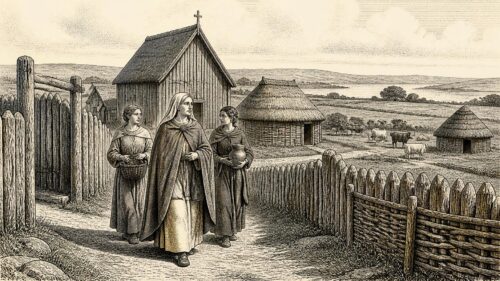
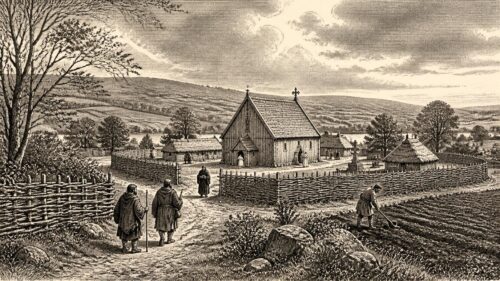
No annal for 753 provides a harvest total, market account or description of an ordinary household. Broader archaeological and legal evidence nevertheless gives the setting in which the year’s recorded events unfolded. Most people lived in a managed rural landscape of farmsteads, enclosures, pasture, fields and routeways. Cattle remained fundamental to wealth, status, food and payments, but agriculture was mixed: people also cultivated cereals, processed grain, made dairy produce, tended pigs and sheep, and stored food against seasonal scarcity. Mills, drying kilns and field systems show the labour invested in arable production.
Churches participated in that rural economy rather than merely receiving its surplus. Their lands and dependants sustained worship, hospitality and learning; their leaders could act as patrons and negotiators; and their sanctuaries offered places where claims might be articulated under the protection of a saint. Domnall’s enforcement of Colum Cille’s law makes most sense against this background. It was not an abstract devotional gesture. It was a public intervention in the relationships between authority, property, protection and belief.
A Year of Connections
What survives for 753 CE is not a continuous national chronicle. It is a set of carefully selected notices: an eclipse, a royal religious act, deaths at named churches, the end of a local kingship, a western slaughter and the passing of a scholar. Together they show an Ireland connected by roads, rivers, churches, kin groups and remembered saints, yet politically plural and locally contested. The strongest development of the year was Domnall Midi’s backing for Colum Cille’s law. In a society where authority had to be repeatedly made visible, the alliance of a powerful Mide ruler with a saint’s protection was a statement of order with reach far beyond the moment in which the annalist wrote it down.
Primary Sources
- The Annals of Ulster: Year U753
- The Annals of Ulster
- The Annals of Tigernach: Part 14
- Annals of the Four Masters: Part 58
- Annals of the Four Masters
- Chronicon Scotorum
- Chronicon Scotorum: Introduction
- Annals of Inisfallen
- List of Published Texts at CELT
- The Chronology and Sources of the Early Irish Annals
- The Dating of the Irish Annals
- Chronological Synchronisation of the Irish Annals
- The Chronicle of Ireland
- Early Irish Monasteries and their Dynastic Connections
- Iona and the Shrine of Columba, c. 800–1200
- Ecclesiastical Settlement in Ireland in the Early Medieval Period
- Clonmacnoise Visitor Guide
- Early Medieval Ireland: Archaeological Excavations, 1930–2009
- Early Medieval Dwellings and Settlements in Ireland, AD 400–1100, Vol. 1: Text
- The Economy of Early Medieval Ireland
- Changing Human-Cattle Relationships in Ireland: A 6000-Year Isotopic Perspective
- Religion and Society in Ireland