
Irish Neutrality
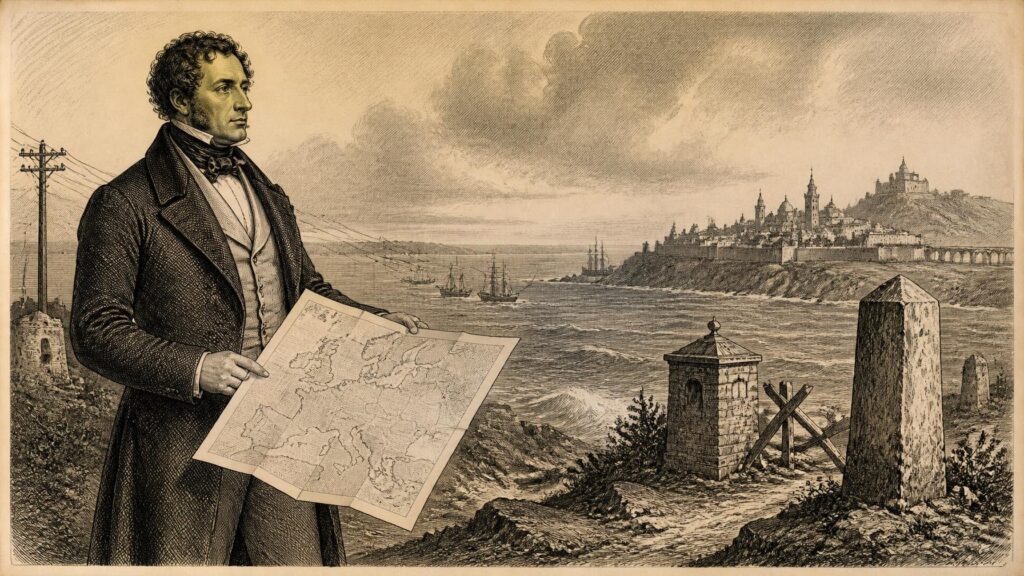
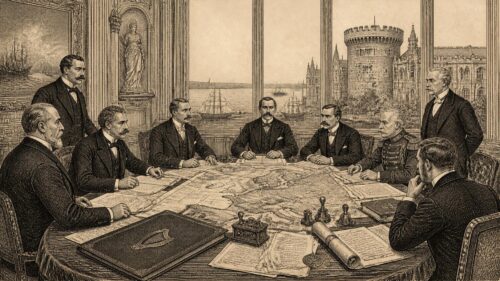
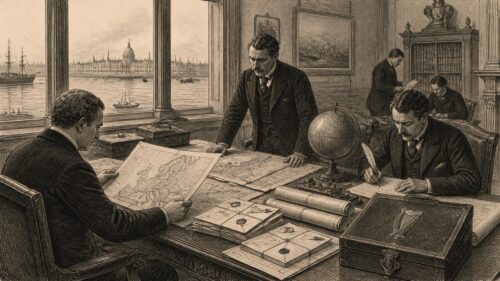
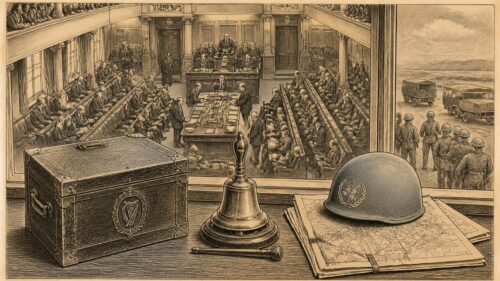
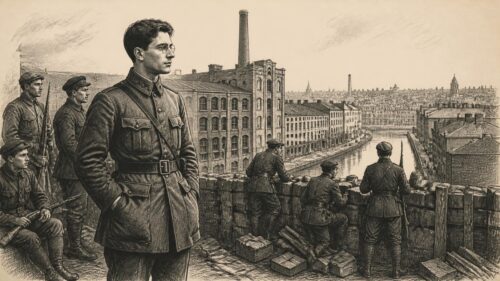
AI generated historical illustration, not a contemporary photograph.
At a Glance
Ireland’s response to the war in Ukraine has exposed a distinction that is simple in official language yet profound in historical meaning: the State claims military neutrality, but rejects political and moral neutrality towards aggression. That formulation is not merely a contemporary diplomatic convenience. It rests upon a long, uneven Irish history in which independence, sovereignty, international law, European co-operation, peacekeeping and public memory have repeatedly pulled the country’s foreign policy in different directions.
Historic Foundations
Neutrality is often described as one of the oldest and most settled features of Irish public life. That description contains a measure of truth, but it can mislead. The independent Irish State did not inherit a fully formed constitutional doctrine of neutrality, nor did every strand of Irish nationalism speak with one voice on war, alliance or international order. What it inherited was a powerful desire to prevent Irish territory and Irish people being committed to conflicts decided elsewhere. That desire had been intensified by the experience of incorporation within the United Kingdom, by the First World War, by the revolutionary decade after 1916, and by the precarious condition of a small new State sharing an island with Britain.
Ideas of a distinct Irish foreign policy existed before independence. Republican and advanced-nationalist writers frequently treated separation from Britain as inseparable from freedom of action in foreign affairs. Yet it would be folklore rather than sound history to present a continuous, unbroken national policy of neutrality stretching from Wolfe Tone to the present. Earlier invocations of neutrality belonged to political argument, not to a sovereign Irish government capable of enforcing it. The political movements that sought independence also sought outside aid at different moments, notably from France, Germany and the United States. Irish history contains traditions of non-alignment and anti-imperialism, but also traditions of alliance, diaspora military service and international revolutionary connection.
The more secure historical starting point is the State created after the Anglo-Irish Treaty. The Irish Free State entered an international system in which it was formally self-governing but remained entangled with Britain through constitutional links, trade, geography and defence. Its leaders understood that independence would not be convincing if Dublin simply followed London into every imperial conflict. At the same time, practical vulnerability placed sharp limits upon what a small state on Britain’s western approaches could undertake. Neutrality therefore developed as both a statement of sovereign equality and a calculation of survival.
This double character matters when considering Ukraine. Irish neutrality has never meant indifference to the conduct of larger powers, and it has never meant an ability to stand wholly apart from European affairs. It has instead been a way of asserting that Ireland, rather than an external alliance or former imperial connection, should decide when and how Irish force is used. The precise meaning of that assertion has changed with circumstances. What has endured is the argument over whether neutrality primarily protects independence, promotes peace, restrains military action, or permits Ireland to speak more credibly for international law.
Emergency Precedent
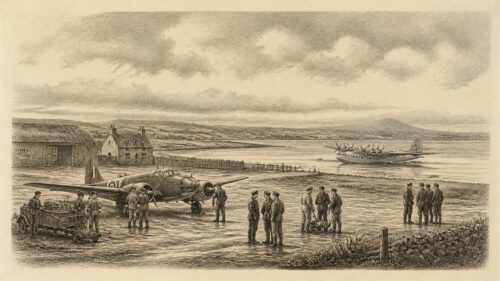
The formative episode was the Second World War, known in Ireland as the Emergency. When war began in September 1939, Éamon de Valera’s government declared a state of emergency and adopted neutrality. The policy was made practicable in part by the 1938 return from Britain of the Treaty Ports at Berehaven, Cobh and Lough Swilly. Without control of these strategically important harbours, a meaningful policy of non-belligerence would have been far harder to sustain.
The Emergency was not an idyll of detached peace. Ireland faced the prospect of invasion, endured shortages and censorship, suffered bombings, and had to balance its position between belligerent powers. Its neutrality was often uneven in practice. Dublin shared certain weather information with the Allies, while large numbers of people from the twenty-six counties volunteered for British forces or worked in Britain’s war economy. These facts do not establish that Irish neutrality was a sham; they demonstrate instead that neutrality, particularly for a weak state beside a major belligerent, involved compromise, secrecy and dependence. Historians have increasingly warned against treating the period as either spotless impartiality or disguised Allied participation.
The central purpose was defensive. As John Gibney and Michael Kennedy have observed in their account of the period, the essential aim was to avoid being drawn into the conflict unless there was no alternative. In that limited but vital sense, the Emergency gave neutrality enormous emotional authority. It seemed to prove that the State could make a decision different from Britain’s at a moment of existential peril. For a country only recently emerged from revolution, civil war and constitutional dependence, that was a powerful symbol of sovereignty.
The memory of the Emergency has consequently supplied much of the language of later debate. Supporters of neutrality recall a small state maintaining its own course against immense pressure. Critics reply that the circumstances cannot simply be transferred to a different Europe: Ireland now belongs to the European Union, works through the United Nations and faces threats such as cyberattack, sabotage and disinformation that do not respect a neutral frontier. Both arguments draw upon history, but neither can claim that history mechanically supplies a modern answer.
Legal Meanings
One source of present confusion is that the word neutrality has several meanings. In the classical law of war, neutrality describes the rights and duties of a state that is not a party to an international armed conflict. A neutral state must not make its territory available to belligerents in specified ways and must apply its obligations impartially. That legal position is not identical to a peacetime policy of military non-alignment. Ireland’s government has repeatedly stressed the distinction.
Ireland’s policy is not written into Bunreacht na hÉireann as a general constitutional command. The Constitution affirms devotion to peace, friendly co-operation, international justice and the peaceful settlement of disputes; it also requires Dáil assent before war is declared or the State participates in war. It does not, however, define neutrality or prohibit membership of a military alliance in every conceivable future circumstance. The Government’s published account describes Irish military neutrality as non-membership of military alliances and non-participation in common or mutual defence arrangements.
This is an important, narrower definition. It permits membership of the United Nations, participation in its peacekeeping system, membership of the European Union and participation in NATO’s Partnership for Peace, while excluding NATO membership and a mutual-defence commitment. It also explains why governments have argued that Ireland can support sanctions, provide humanitarian assistance, train personnel in defined contexts, and co-operate with European partners without abandoning military neutrality. Opponents often use neutrality in a broader sense: not merely absence from alliances, but a positive duty of impartiality, independence from great-power blocs and strict limitation of overseas military involvement. The disagreement is therefore not only over policy. It is over the definition of the word itself.
The so-called triple lock became central to this broader understanding. Under the legal arrangements developed for substantial overseas deployments, participation traditionally required a United Nations mandate, government approval and approval by Dáil Éireann. Its defenders consider it a practical safeguard ensuring that Irish troops serve only in internationally authorised peace operations. Governments and some constitutional specialists have answered that it is statutory rather than constitutional, and that it is not the definition of neutrality. This dispute gained urgency after Russia’s invasion, because a permanent Security Council member that wages aggression can use its veto to prevent the Council authorising responses to the consequences of that aggression.
European Entanglements
Irish neutrality did not freeze foreign policy after 1945. The State joined the United Nations in 1955 and developed an international reputation through peacekeeping, decolonisation, disarmament and support for multilateral institutions. Service in United Nations missions became an important part of the Defence Forces’ identity. This was not neutrality as withdrawal. It was neutrality, or military non-alignment, joined to collective security and international engagement.
European integration complicated the picture further. Ireland entered the European Economic Community in 1973, later participated in the Common Foreign and Security Policy, and became involved in European crisis-management structures. Referendums on the Nice and Lisbon treaties brought neutrality to the forefront of domestic politics. Government declarations and legislation sought to reassure voters that Ireland would retain control over Defence Forces deployments and would not be committed to a common European defence without the constitutional processes required in Ireland.
This evolution produced an arrangement that can appear contradictory only if neutrality is imagined as isolation. Ireland has accepted that security is affected by European conditions and that international institutions need active members. But it has resisted a formal alliance obligation to fight for another state, and it has retained political sensitivity about any implication that Irish soldiers might be committed to war by decisions beyond the State’s control. Ben Tonra’s account of Irish security and defence identifies the mixture of geography, limited military tradition, commitment to collective security and international law, and non-alignment that has shaped this dilemma.
Ukraine made the European dimension impossible to ignore. The conflict was not a distant colonial war, nor a crisis in which Irish interests could plausibly be separated from continental security. It involved the invasion of a European state, widespread displacement, pressure upon energy and food systems, and a direct challenge to the prohibition on acquiring territory by force. It also confronted the European Union with the question of whether its declared values carried practical responsibilities. Ireland’s response emerged from that setting: firmly aligned with European condemnation and assistance, yet formally outside NATO and outside common defence arrangements.
Ukrainian Invasion
Russia’s full-scale invasion began on 24 February 2022. Within days, the United Nations General Assembly adopted resolution ES-11/1, entitled Aggression against Ukraine. The resolution reaffirmed Ukraine’s sovereignty, independence, unity and territorial integrity within internationally recognised borders; deplored Russian aggression as contrary to the United Nations Charter; and demanded that Russia cease the use of force and withdraw its military forces. Ireland was among the sponsors of the draft resolution. That fact is significant: Dublin did not seek the posture of an uninvolved observer.
Irish ministers subsequently stated the position in unusually direct language. Ireland, they argued, remained militarily neutral but was not politically or morally neutral in the face of an unlawful invasion. Simon Coveney’s 2022 statement that Ireland had “chosen to take sides” was controversial because it seemed to clash with popular understandings of neutrality. Yet it accurately conveyed the government’s legal and political distinction. Neutrality, in this official view, did not require equal judgement of an invading state and the state it had invaded.
There is a historical irony here. Irish political culture has often invoked the experience of domination by a larger neighbour and the principle that smaller nations possess equal rights. In speeches on Ukraine, Irish leaders explicitly connected Ireland’s own history of invasion or subordination with the defence of Ukrainian sovereignty. Such analogies must be used carefully. Ireland’s struggle for independence and Ukraine’s war against Russia are not interchangeable events; their histories, international settings and political trajectories differ greatly. But the analogy explains why the language of sovereignty and national self-determination had such resonance in Dublin.
It also shows why governmental condemnation was not simply an exercise in alliance loyalty. The United Nations Charter and the wider prohibition on aggressive war are particularly important to smaller states, which have fewer material means of defending themselves against stronger powers. The Irish Government’s argument has been that the survival of a rules-based international order is itself a national interest. To remain morally neutral when those rules are openly breached, it contends, would weaken the principles upon which Ireland relies.
Material Assistance
Political support was accompanied by practical measures. Ireland joined European Union sanctions against Russia, offered humanitarian assistance, received people displaced from Ukraine under the European temporary-protection framework, and supported accountability efforts for violations of international law. The scale of Ukrainian arrival transformed the war from an abstract foreign-policy issue into a visible part of Irish social life, with families settling in towns and cities across the country. The humanitarian response was generous in many instances, though it also exposed acute difficulties in accommodation, public services and the management of emergency provision.
The most contentious area was support connected with defence. Ireland contributed through the European Peace Facility and participated in the European Union Military Assistance Mission in support of Ukraine. The Government described Irish assistance as non-lethal and cited activities including training in demining, combat casualty care and drill instruction, as well as support for mine clearance. For ministers, these measures were compatible with military neutrality because they did not make Ireland a member of a military alliance or a party to the war. They were presented as assistance to a state exercising the right of self-defence recognised by the UN Charter.
Critics regarded this interpretation as too permissive. Some argued that financing or facilitating military assistance, even when the Irish contribution is non-lethal, placed the State on one side of an armed conflict and diluted the practical meaning of neutrality. Others accepted support for Ukraine but feared that the language of a new security environment could be used to normalise deeper military integration long after the immediate crisis. Those concerns cannot be dismissed as ignorance of international law. They reflect a real contest between a narrow official definition of military neutrality and a wider popular ideal of active neutrality.
Nor should the practical effects of assistance be overstated. Ireland has not supplied the sort of large-scale lethal weapons associated with major military powers, nor has it sent combat forces to Ukraine. Its contribution has been shaped by limited defence capacity, by law and policy, and by the country’s particular political tradition. Yet its actions nevertheless marked a departure from the assumption that Irish neutrality means keeping an equal distance from every belligerent. The Ukraine war made visible a principle that had long existed beneath the surface: non-alignment does not necessarily entail neutrality of judgement.
Public Argument
The ensuing argument has been among the most searching Irish debates on foreign policy since the Cold War. It has involved parties, veterans, academics, peace organisations, military figures, constitutional lawyers and citizens with sharply different convictions. Its intensity arises partly because neutrality functions as more than a technical security policy. It is tied to national independence, distrust of great-power military projects, pride in United Nations peacekeeping and a conviction that Ireland should retain an independent voice.
Public debate has sometimes blurred distinct questions. Should Ireland join NATO? Should it increase defence spending and maritime surveillance? Should it participate in European training missions? Should the triple lock be changed? Should neutrality be inserted into the Constitution? Should Ireland provide only humanitarian assistance, or also forms of military support? A person may answer any one of these questions without logically answering all the others. Nonetheless, they are often fused into a single symbolic contest between neutrality and militarisation.
Government speakers have argued that military neutrality can survive adaptation. They point out that security threats include hostile cyber operations, interference with undersea infrastructure, disinformation and coercive economic pressure. Geography and non-membership of NATO, they say, do not confer immunity. They also argue that a Security Council veto should not give Russia, or any other permanent member, the ability to decide whether Ireland can contribute to an otherwise lawful peace-support operation. From this standpoint, revising the triple lock would strengthen Irish agency rather than surrender it.
Opponents answer that formal alliance membership is not the only measure of alignment. They fear a gradual movement through co-operation, funding, exercises and legal change towards a security policy increasingly shaped by NATO and European military priorities. They also stress that the triple lock has political value precisely because it sets a high bar for deployments. Their concern is not only that Ireland might join a war; it is that executive discretion could become normalised in the name of flexibility.
Documented evidence can establish the rival statements of policy and the legal mechanisms at issue. It cannot settle the larger moral choice. Claims that the triple lock alone created Irish neutrality, or that its reform necessarily ends neutrality, belong to political interpretation rather than uncontested fact. Equally, the assertion that military neutrality is fully preserved so long as Ireland remains outside a formal alliance is a defensible governmental definition, but not the only definition available in public life. Honest historical writing should retain that distinction.
Security Reassessment
Russia’s invasion has also changed the comparative landscape. Finland and Sweden, long associated with versions of neutrality or military non-alignment, reassessed their positions after 2022 and joined NATO. Their decisions did not compel Ireland to follow. Their histories, borders, military capacities and strategic locations are markedly different. But they removed an easy assumption that neutrality was a fixed category shared by a stable group of European states.
Ireland’s situation remains distinctive. It is an island state without a land border with Russia, but it is deeply connected to Europe by trade, communications, data infrastructure and financial networks. It has a long coastline and important submarine cable connections. Its defence forces have finite resources. It is not sheltered from cyberattack or information operations by any traditional conception of neutrality. The Government’s international-security documentation has used these conditions to argue for stronger resilience and greater engagement with partners while preserving non-membership of alliances.
This is not the first time that Irish neutrality has had to coexist with uncomfortable practical dependence. During the Emergency, Ireland’s capacity to enforce its position was limited, and its survival was intertwined with the wider Allied war effort even while it remained formally neutral. In the twenty-first century, the dependencies are different but no less real: airspace, cyber resilience, seabed infrastructure and economic security cannot be secured by a declaration alone. The historical lesson is not that neutrality is useless. Rather, it is that neutrality has always required resources, judgement and relationships.
Historical Reckoning
Ukraine has therefore forced a historical reckoning. The best-supported conclusion is that Irish neutrality was never a promise of silence. It was created through the Emergency as a means of safeguarding a vulnerable state’s autonomy; it later became entwined with United Nations peacekeeping and an outward-looking commitment to collective security. Over time it acquired an emotional and ethical significance greater than its original practical foundations. That wider public meaning is real, even when it exceeds the text of law.
It is equally clear that the tradition contains tensions. A state committed to international law must decide what action follows when one state invades another. A state committed to peaceful settlement must decide how to support a victim of aggression without prolonging war. A state proud of independence must decide how much security co-operation it can undertake without eroding independent judgement. There is no historical formula that removes those choices.
Folklore can make the debate harder. One recurring myth imagines an Ireland that was always neutral, wholly separate from European power struggles and consistently impartial in every conflict. Another imagines that neutrality has always been empty rhetoric, concealing complete subordination to larger powers. Both are too neat. The archival and historical record instead shows a policy formed under pressure, adapted through international institutions, and continually contested at home.
That complexity may be the most useful inheritance for the Ukrainian age. It cautions against treating neutrality as either a sacred relic or an obsolete embarrassment. Ireland can oppose aggression, assist Ukraine and defend the Charter while still asking rigorous questions about military commitments, democratic control and the limits of force. Whether future governments preserve that balance will depend not on historical slogans, but on choices made in the Dáil, in European institutions and in the wider public debate.
Future Questions
As of 2026, Ireland’s government continues to describe the State as militarily neutral, while proposing changes to the statutory arrangements commonly called the triple lock. That controversy will continue because it engages competing but sincerely held visions of the Republic: one emphasising freedom from military blocs and the restraining discipline of the United Nations; the other emphasising sovereign decision-making, European responsibility and the need to respond when the Security Council is paralysed.
Ukraine has not ended Irish neutrality. It has revealed that neutrality was never a single thing. It is law, policy, memory and identity; it is a defensive inheritance from the Emergency and an internationalist inheritance from the United Nations. Above all, it is an argument about how a small state should behave when peace is broken by force. In choosing not to be politically neutral about Ukraine, Ireland has not escaped that argument. It has entered its most consequential modern phase.

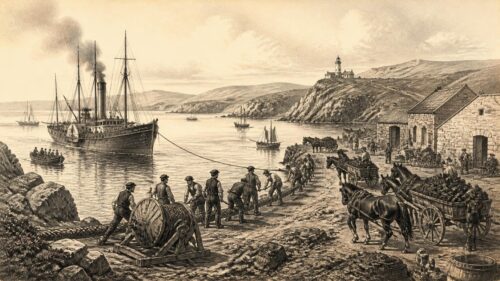
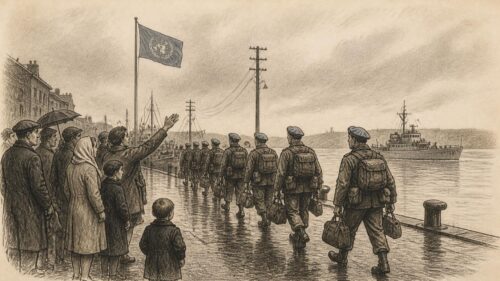
Ireland’s response to Ukraine highlights how military non-alignment can coexist with explicit moral judgement and practical support for a state resisting invasion. The article suggests that this is less a departure from neutrality than a contested interpretation rooted in sovereignty, international law and UN engagement. Yet non-lethal training, European Peace Facility participation and possible reform of the triple lock may gradually reshape what citizens understand neutrality to mean. The Emergency remains influential, although circumstances differ sharply in today’s Europe. How should Ireland balance independence symbolised by neutrality with responsibility to uphold collective security when international institutions are constrained by vetoes?