
Wartime Losses
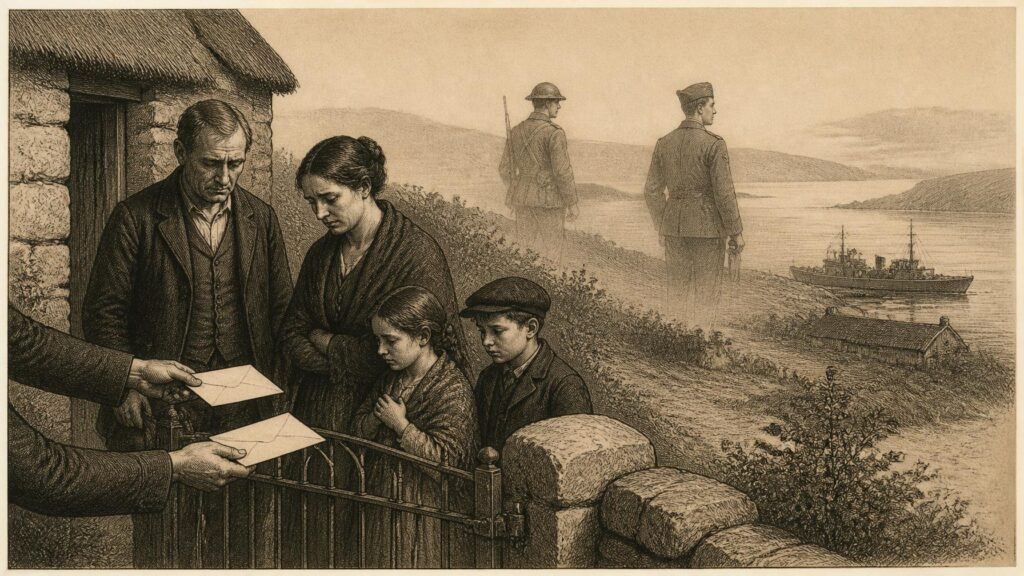
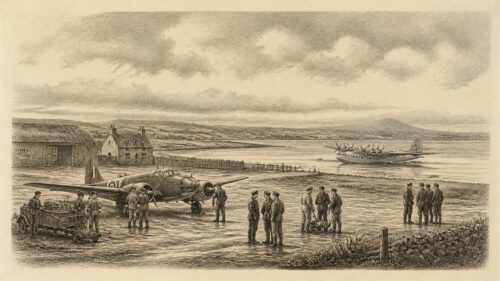
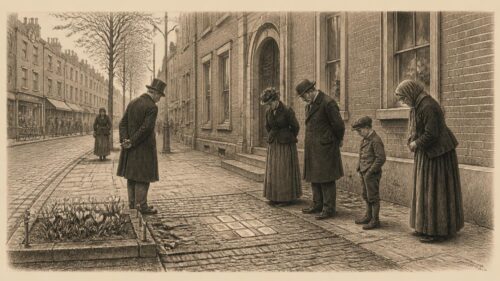
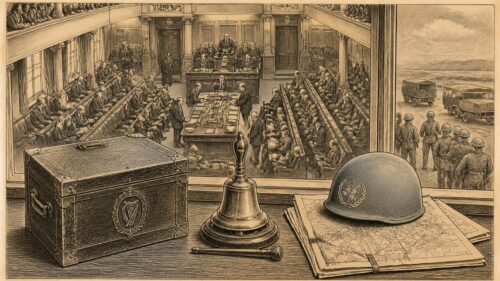
AI generated historical illustration, not a contemporary photograph.
At a Glance
The shortest responsible answer is that approximately 40,000 Irishmen died in the First World War, while 7,507 Irish men and women from the island of Ireland are recorded as having died on active service with British, Commonwealth and Dominion forces in the Second World War. Neither figure is a simple census result. Each depends upon what “Irish”, “died”, “service” and even “Ireland” are taken to mean.
The Question
“How many Irishmen died in the world wars?” sounds like a question that ought to have two neat numerical answers. In fact it is a historical question with several legitimate answers, because Ireland’s constitutional position changed between the wars, its population was divided by partition after 1921, and Irish-born people served in many forces besides the British Army’s Irish regiments. Some were born in Ireland but enlisted after emigrating to Britain, Canada, Australia, New Zealand, South Africa or the United States. Others lived in Ireland but gave British addresses when joining. Some died in uniform; others died at sea in merchant service, from wounds after discharge, in captivity, in air raids, or in civilian occupations connected with war.
The phrase “Irishmen” also requires care. The First World War evidence has traditionally been expressed in male terms, because the overwhelming majority of Irish participants under discussion were soldiers and sailors. In the Second World War, however, Irish women served and died as well. The most substantial modern roll of honour for the island therefore counts men and women together. A precise answer about men alone cannot be obtained merely by subtracting a guessed female total.
There is a further trap. Irish regiments were not ethnically or nationally exclusive. The Royal Dublin Fusiliers, Royal Munster Fusiliers, Royal Irish Rifles, Connaught Rangers, Royal Inniskilling Fusiliers, Royal Irish Regiment and other formations recruited heavily in Ireland, but also included men born elsewhere in the United Kingdom and across the wider Empire. Conversely, an Irish-born man could serve in a non-Irish regiment, or never serve in a British formation at all. Counting the dead of “Irish regiments” is therefore not identical with counting Irish dead.
First Answers
For the First World War, a sound general answer is about 40,000 Irish men dead in British service. That is the rounded figure increasingly used by historians who have tested older commemorative totals against casualty records and who recognise the importance of Irish emigrants recruited outside Ireland. It should be stated as an approximation, not as a final roll-call.
For the Second World War, the best clearly identified island-wide total presently available is 7,507 Irish men and women who died on active service in British, Commonwealth and Dominion forces. The Roll of Honour compiled by Dr Yvonne McEwan and presented to Trinity College Dublin divides them into 3,617 from the Republic of Ireland and 3,890 from Northern Ireland. Because that total includes women, it answers a broader and more accurate question—how many people from Ireland died in Allied service—rather than furnishing an exact male-only total.
These figures should not be simply added and treated as a complete count of every Irish person killed by either conflict. They principally concern people who died in military or related Allied service. They do not automatically embrace all civilians killed in Ireland, all Irish merchant seamen, every Irish-born person serving with foreign armies, or deaths caused indirectly by wartime deprivation, illness or post-war injury. Yet they are the most useful starting point for understanding the scale of Irish loss.
Changing Ireland
The two wars belong to markedly different Irish political worlds. In August 1914 the whole island was within the United Kingdom of Great Britain and Ireland. Home Rule had been passed but suspended; the constitutional dispute between Irish nationalists and Ulster unionists remained unresolved; and the British Army recruited across the island. In that setting, men born in Cork, Dublin, Belfast, Tyrone or Donegal could join the same imperial armed forces without crossing an international frontier.
By September 1939, the island had been partitioned for almost two decades. Northern Ireland remained within the United Kingdom and was fully involved in Britain’s war. The twenty-six counties, then officially Éire and later the Republic of Ireland, were neutral. The Irish state called the period “the Emergency”. It mobilised its own Defence Forces to safeguard neutrality and cope with the possibility of invasion, but it did not enter the conflict as a belligerent.
Neutrality did not mean that the inhabitants of the twenty-six counties were absent from the war. Tens of thousands volunteered for British forces; others travelled to Britain for war work; and many had long-standing family, employment, migration or military connections there. Northern Ireland made an openly British contribution, while its towns, factories, ports and airfields became part of the United Kingdom’s war effort. Consequently the Second World War figures must be read across a politically divided island.
The contrast helps explain why the First World War appears in Irish historical memory as a great but long-muted national loss, while the Second World War is often remembered through neutrality. Both impressions conceal as much as they reveal. Neutral Ireland was not a combatant state, but thousands of people from it died in Allied uniform. Ireland in 1914 was part of the United Kingdom, but Irish participation was shaped by conflicting national, religious, class and local loyalties rather than a single shared political purpose.
First Service
The scale of Irish military participation in the First World War was immense. A frequently used estimate is that more than 200,000 Irishmen served in British forces. Such totals usually combine those who volunteered after war began with men already in regular or reserve service. They also struggle to capture emigrants: a man born in Ireland who had moved to Liverpool, Glasgow, London, New York, Toronto or Sydney might have joined where he lived and disappeared from Irish recruiting statistics.
Recruitment was varied in motive and uneven in geography. Some unionists joined from loyalty to the Crown and the Empire. Many nationalist supporters of John Redmond accepted the argument that service would assist Home Rule and defend small nations against German aggression. Others enlisted for wages, stable meals, a uniform, family tradition, adventure, comradeship or escape from precarious work. The old image of a uniformly enthusiastic Ireland is unsustainable, but so is the opposite image of a population wholly hostile to enlistment.
About 150,000 Irishmen volunteered for the British Army during the conflict, according to one account of wartime recruitment, while roughly 50,000 Irishmen were already serving at its outbreak. These are useful indicators of magnitude, not a perfect denominator from which a casualty rate can be mechanically calculated. Men moved between units, enlisted outside Ireland, gave varying addresses, and served in naval, air and imperial establishments whose documentation was compiled on different bases.
The Irish divisions became potent symbols: the 36th Ulster Division, associated chiefly with unionist Ulster; the 16th Irish Division, associated broadly with Redmondite nationalism; and the 10th Irish Division, which served at Gallipoli, Salonika and in the Middle East. Symbolism should not obscure the mixed composition of units. Nor should it reduce Irish service to three divisions. Irish soldiers were found in cavalry, artillery, engineering, transport, medical services, the Royal Navy and units throughout the British Army.
First Losses
Older public accounts often repeated a total of 49,400 Irish dead in the Great War. It remains visible in memorial language, including the tradition associated with the Irish National War Memorial Gardens at Islandbridge. The number has emotional force because it represents a vast loss, but it is not a dependable count of Irish-born or Irish-connected men. It grew from commemorative records and from casualties in Irish formations, categories that included substantial numbers of men who were not Irish.
Historical investigation has exposed the problem. Kevin Myers, writing in History Ireland, argued that 49,400 was too high as a count of Irishmen and placed the likely number of Irish deaths in British service nearer 40,000. His discussion also highlights a vital corrective: many Irish-born dead had emigrated and enlisted in Britain, so are poorly reflected in recruitment returns from Ireland itself. An Irish casualty total derived only from Irish recruiting stations will miss a conspicuous part of the story.
Another carefully constructed approach comes from Tom Burnell’s extensive work on casualties associated with the twenty-six counties that later formed the Irish Free State. His published list reached 29,450 men who were born in, lived in, were buried in, or had next of kin in those counties. That research used Commonwealth War Graves Commission material, official casualty publications, memorial records and newspapers. It demonstrates both how much can be recovered through patient local research and why a national total depends on rules of inclusion.
Burnell’s 29,450 is not a total for the whole island. It excludes the six counties that became Northern Ireland as a separate geographic category, although men from there were deeply involved in the war. It also cannot straightforwardly include every Irish emigrant whose link to home had become obscure, or all civilian and merchant maritime losses. Its value lies precisely in its transparency: it tells the reader what has been counted.
Thus there are three figures that should not be confused. Around 49,400 is an older memorial-associated figure, inflated if interpreted as Irish nationality or birthplace. Around 29,450 is a documented twenty-six-county casualty compilation using stated connection criteria. Around 40,000 is the most defensible broad approximation for Irishmen who died in British service across the island and diaspora-linked experience. A careful writer should give the last figure as the headline answer and the others as explanations of why the subject has generated disagreement.
Battlefield Death
Irish losses were dispersed across the geography of the Great War. They occurred on the Western Front, at Gallipoli, in Macedonia, Mesopotamia, Palestine, Africa and at sea. The Somme has particular resonance. The 36th Ulster Division’s attack of 1 July 1916, and the later fighting of the 16th Irish Division around Guillemont and Ginchy, became central to unionist and nationalist remembrance respectively. That division of memory is real, but it can distort the larger fact that men from all parts of Ireland died in many campaigns.
Death was not confined to infantry attacks. Sailors died in minefields, torpedo attacks and the Battle of Jutland. Airmen died in training as well as operations. Artillerymen and engineers were killed far from the familiar trench image. Men died of wounds, disease, exposure and accident. Some died in hospitals in Britain or Ireland after having left the front. The administrative decision whether such a death counted as a war death could have direct consequences for pensions and commemoration, which is one reason that casualty totals require scrutiny rather than reverence.
The war’s human geography also complicates the word “Irish”. A man from a rural county might be recorded in a British city because he had migrated before enlistment. Another might have an Irish regiment on his attestation but be English, Scottish or Welsh by birth. A third might be Irish-born but serve in the Canadian Expeditionary Force or Australian Imperial Force. Memorial lists preserve names, but names alone do not solve questions of birthplace, residence, kinship, citizenship and identity.
Memory Divided
After 1918, the dead returned to an island undergoing revolution, partition and civil conflict. The Easter Rising of 1916, the War of Independence and the Civil War supplied the political foundation stories of the new southern state. Service in the British Army could be uncomfortable within that narrative, especially where veterans had later served British forces in Ireland or were suspected of doing so. This does not mean that all families forgot their dead. Rather, public commemoration was often quieter, local, denominational or private.
In Northern Ireland, Great War remembrance became strongly bound to unionist political culture, especially through the memory of the Somme. In the Free State, many war memorials existed and ex-servicemen’s organisations remained active, yet official and popular national memory seldom gave the conflict the same central place. The result was not an absolute silence but a fragmented landscape of memory. Names survived in parish churches, family papers, graveyards, workplace memorials and regimental associations even where they were less visible in state ceremony.
Later research and centenary commemorations altered this balance. They did not make the past politically simple, nor should they. The historical task is not to recruit the dead to a modern cause. It is to recognise that their experiences formed part of Irish history: Catholic and Protestant, nationalist and unionist, professional soldier and unemployed labourer, resident and emigrant, willing volunteer and man shaped by pressure or circumstance.
Second Service
The Second World War demands a different approach. Ireland was neutral, Northern Ireland was belligerent, and the British services kept records that were neither designed as an Irish national census nor consistently categorised by the later historical questions. A 1946 House of Lords answer acknowledged the difficulty. It reported that naval figures depended on address at entry, while army and Royal Air Force figures rested on birthplace; it also admitted that available figures were unsatisfactory and that enlistments in Great Britain could not be fully identified.
Those limitations matter. The same 1946 parliamentary answer recorded 28,645 men and 4,133 women serving in the Army at the end of 1944 under its southern-Ireland basis. It listed 483 men and 34 women in the Royal Navy and Royal Marines over a specified period, and 9,426 men and 528 women enlisted through Belfast for the Royal Air Force after January 1943. None of these categories constitutes a complete total from the twenty-six counties, and they overlap imperfectly with birthplace, address and enlistment location.
Modern estimates of participation are consequently broad. Historians have suggested that tens of thousands of people from neutral Ireland joined British forces, while Northern Ireland also supplied large numbers. Many southern volunteers had family connections in Britain or were already part of the extensive movement of Irish labour across the Irish Sea. They served in the Army, Royal Navy, Merchant Navy, RAF and women’s services, as well as in Commonwealth and other Allied formations.
The experience of former Irish Defence Forces personnel is especially remembered. Thousands left or deserted the Irish military during the Emergency, many to enter British service. Their motives varied, and it is misleading to reduce them to a single ideological type. Some wished to fight fascism; some sought pay or opportunity; some had inherited military traditions; some were already committed to Britain’s cause; others acted from personal circumstances. Their departure later became the subject of severe administrative penalties in Ireland, which were eventually recognised as unduly harsh.
Second Losses
The strongest answer for the Second World War is provided by the island-wide Roll of Honour compiled by Dr Yvonne McEwan. It lists 7,507 Irish men and women who died while serving in British, Commonwealth and Dominion forces. Its geographic division is exact within the project’s stated method: 3,617 from the Republic of Ireland and 3,890 from Northern Ireland. The total includes people serving across almost 200 branches of the British armed services.
The importance of this roll lies not merely in the number. It corrects the common assumption that neutrality made the twenty-six counties irrelevant to the conflict. More people on the roll came from Northern Ireland, as one would expect from a constituent part of the United Kingdom at war, but the 3,617 associated with the Republic represent a substantial death toll from a neutral state’s population. The reality is neither that Ireland fought as a united belligerent nor that Ireland stood entirely apart.
Because the roll includes women, 7,507 should not be casually restated as “7,507 Irishmen”. The great majority may have been men, but historical accuracy requires using the category supplied by the evidence. Nor is 7,507 necessarily every Irish-connected death in the war. The project concerns those dying in British, Commonwealth and Dominion forces. It does not purport to be a comprehensive register of Irish-born people in every Allied force, civilian victims, merchant seamen under all flags, or those who died in the armed forces of states outside that scope.
Contemporary British parliamentary evidence shows why earlier totals were incomplete. In April 1946 the Secretary of State for War said that exact casualty figures for volunteers from Éire were unavailable. He offered estimates only for men born in Éire serving in the Army or Navy: 220 killed or missing in the Royal Navy and 1,550 in the Army, with no satisfactory RAF estimate. These figures were explicitly provisional and excluded vast areas of service, identification and geography. They are valuable as evidence of official uncertainty, not as a final death total.
Neutral Reality
The word neutrality can wrongly imply safety. The state remained outside the war, but Ireland was affected by blockade, shortages, rationing, espionage fears, coastal danger, bombing and the threat of invasion. Belfast endured devastating German air raids in April and May 1941. The Republic also experienced fatal Luftwaffe bombings, including the North Strand bombing in Dublin on 31 May 1941. Civilian deaths are part of Ireland’s wartime history, even though they are not part of the 7,507 active-service total.
Neither should neutrality be treated as either simple cowardice or simple virtue. It was a policy shaped by sovereignty, limited military capacity, the unresolved partition question, fear of invasion, domestic political realities and memories of the previous generation’s conflict with Britain. At the same time, individual Irish people made their own decisions. They could volunteer for Allied service, labour in British industry, join the Irish Defence Forces, work in civil defence, remain at home, or attempt to avoid military involvement altogether.
The war was therefore experienced differently in Belfast and Dublin, in border counties and ports, in rural districts and industrial centres, and among families with relatives in British forces. One household might have had a son in an Irish uniform defending neutrality and another in a British uniform fighting in North Africa, Italy, the Atlantic, Burma or the air war over Europe. Such cases are not anomalies to be tidied away; they illustrate the layered identities created by Ireland’s history and proximity to Britain.
Reliable Numbers
The desire for a single definitive figure is understandable. Death totals make loss graspable, allow names to be sought, and guard against neglect. But precision without definition is false precision. The proper answer should name the population being counted, the forces included, the period involved and the source method. A total of regimental casualties, for example, may be exact in its own terms while being unsuitable as a measure of Irish national loss.
For the First World War, “approximately 40,000 Irishmen died” is the best concise formulation when referring broadly to Irish men in British service. It should be accompanied by the warning that older totals near 49,400 refer in significant part to deaths in Irish units rather than securely identified Irish individuals. If the question is limited to the twenty-six counties that became the Free State, Burnell’s 29,450 is a major documented compilation, though it relies on stated ties of birth, residence, burial and next of kin rather than a modern citizenship test.
For the Second World War, “7,507 people from the island of Ireland died on active service in British, Commonwealth and Dominion forces” is firmer because it comes from a named roll of honour with a clear north-south breakdown. It is also more inclusive in gender. If someone insists on asking how many men died, the honest answer is that this particular source does not furnish a separate male total and it would be improper to invent one.
Final Reckoning
The two headline totals tell a striking story. The First World War cost Ireland roughly 40,000 male dead in British service, a loss on a scale that touched virtually every county and many emigrant communities. The Second World War, despite southern neutrality, cost 7,507 recorded men and women from the island in British, Commonwealth and Dominion forces: 3,617 from the Republic and 3,890 from Northern Ireland.
Those numbers are not rivals in a contest of commemoration. They are evidence of two very different Irish encounters with global war. In 1914 Ireland was still constitutionally within the United Kingdom and was drawn into the conflict directly. In 1939 the island was divided: Northern Ireland went to war as part of the United Kingdom, while Éire maintained neutrality even as many of its people volunteered abroad. The dead belonged to families and communities with differing identities and motives, but their absence was real in every case.
History is best served not by pretending that the totals are flawless, nor by using their uncertainty as a reason to forget. The figures are approximate where the evidence demands approximation, precise where a carefully compiled record permits precision, and meaningful only when the lives behind them are remembered as part of Ireland’s complicated twentieth-century past.
The article shows that wartime loss is shaped not only by death itself but by the categories historians use: birthplace, residence, regiment, allegiance, gender and changing borders. The contrast between the First World War’s approximate 40,000 Irish men in British service and the Second World War Roll of Honour’s 7,507 men and women from a partitioned island suggests that commemoration can illuminate, but also frame, national experience. It is striking that neutrality did not prevent substantial Allied service from the Republic. How should museums, schools and memorial projects represent these overlapping Irish identities and service without flattening their historical contexts?