

Living Archive
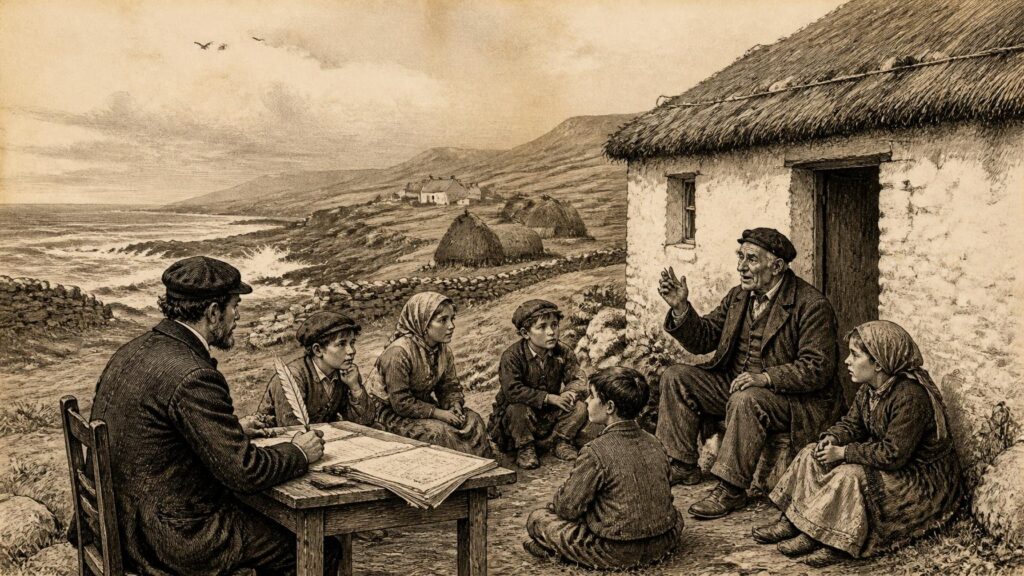
AI generated historical illustration, not a contemporary photograph.
At a Glance
Irish language planning is often described in the vocabulary of policy: targets, schemes, services, schools, networks and statutory duties. Yet it is also a public act of inheritance. It concerns not only whether Irish may be used in a State office or taught in a classroom, but how a society chooses to carry forward manuscripts, oral memory, local names, customary knowledge and the everyday speech of communities. The history is consequently more complicated than a simple tale of decline followed by revival. Irish has endured as a learned, literary, ceremonial, domestic and public language in changing combinations, while planning has alternately protected, promoted, standardised and sometimes constrained the diverse cultural worlds associated with it.
Heritage Meanings
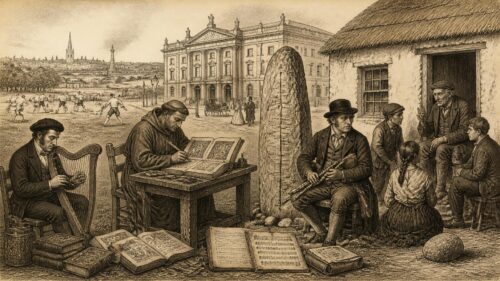
Public heritage is commonly imagined in material terms: monuments, historic buildings, museum objects, archaeological landscapes and manuscripts held in secure repositories. The Irish language belongs partly to that world. A medieval codex, an eighteenth-century manuscript book, an early sound recording or a schoolchild’s folklore copybook can be conserved, catalogued and digitised. But language itself is not an object that can be placed permanently behind glass. It survives only through use, transmission, memory and adaptation. That makes Irish an instance of intangible cultural heritage as well as a language with a deep documentary record. Its heritage value lies in the accumulated evidence of speech and writing, but also in the continued capacity of people to speak, read, sing, name places, tell stories and conduct ordinary affairs through Irish.
This distinction matters because preservation and vitality are related without being identical. A manuscript can be protected even when the language in which it was written is not widely used. A bilingual road sign can make Irish visible while doing little, by itself, to strengthen conversation in a household or village. Conversely, a community can sustain forms of speech and knowledge that have never been formally archived. Good language planning must therefore attend both to records of the past and to the social conditions in which speakers choose, or are able, to use the language in the present. It is not enough to regard Irish as a relic; neither is it historically sound to suppose that its present forms are merely survivals from an unchanging past.
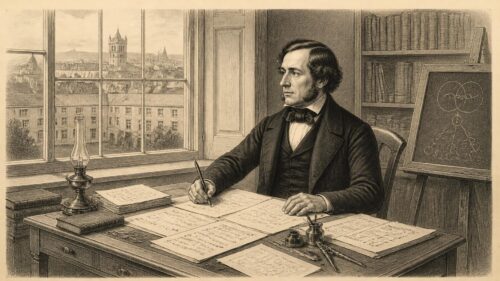
The language’s documentary heritage is extensive. The National Library of Ireland identifies Gaelic manuscripts from the fourteenth century to the present within its holdings, including material on literature, place lore and the revival movement. Such collections demonstrate continuity in textual culture, but they should not be mistaken for a complete map of speech. Manuscripts tend to preserve what scribes, scholars, collectors and institutions judged worth copying. They can reveal intellectual networks and local traditions, yet they also contain silences: the voices of people who left no written record, the changing speech of women and men in domestic settings, and forms of knowledge never committed to paper. Heritage institutions preserve evidence; historians still have to ask how that evidence was formed.
Language Worlds
Irish developed through many regional forms and social settings. Its earlier literary record reaches far back, but exact claims about the beginnings of spoken Irish or the dates of individual linguistic changes must be approached cautiously. Languages do not arrive in the historical record with a single timestamp. What can be said securely is that Irish became the medium of a major medieval literary, legal, religious and learned tradition, and that later manuscript culture continued to transmit poetry, history, genealogy, devotional writing and local learning. The language was neither confined to one class nor uniformly used across the island. Its history was shaped by political change, migration, landholding, schooling, religion, commerce and the prestige attached to English as well as Irish.
By the nineteenth century, English had become dominant across much of Ireland, while Irish remained strongest in western and southern districts and in scattered communities elsewhere. The reasons were multiple and cannot responsibly be reduced to a single calamity or decree. Poverty, emigration, demographic upheaval, the opportunities associated with English, the structure of national schooling and the uneven status of Irish all contributed to language shift. The Great Famine intensified disruption in many Irish-speaking districts, but it did not create the shift from nothing. Nor were Irish speakers passive recipients of change: families made difficult decisions within severe economic and social constraints, frequently valuing English because it widened access to work, mobility and public institutions.
The later designation Gaeltacht gave administrative and cultural shape to areas where Irish remained a community language, but it can obscure historical variation. The Gaeltacht was never a single uniform linguistic homeland. It comprised coastal, island and rural districts with distinct dialects, economic conditions and connections to English-speaking towns and emigrant networks. Treating it as a timeless reservoir of ancient culture has sometimes romanticised communities whose inhabitants faced poor infrastructure, limited employment and outward migration. A more humane heritage account recognises both the exceptional importance of these communities and the ordinary modern ambitions of the people who lived in them.
Revival Beginnings
The cultural revival of the late nineteenth and early twentieth centuries made Irish newly visible in public life. Conradh na Gaeilge, the Gaelic League, was founded in 1893 and became the leading voluntary organisation committed to restoring the language’s place in society. Its work extended beyond formal lessons. Branches organised classes, publications, lectures, competitions, music, drama and social occasions. The revival linked language with a wider effort to recover or define national culture, including folklore, sport, literature and historical study. It produced an energetic voluntary public sphere in which learners, fluent speakers, writers and activists met across regional and class lines.
Documentary evidence supports the League’s importance, but interpretation is needed when judging its effects. It did not reverse language shift across the country, and it would be misleading to present it as the sole source of political nationalism. Its membership contained varied political and cultural views, while many Irish nationalists were not Irish speakers and many speakers did not share the same political aims. Still, the League decisively altered the terms in which language could be discussed. It made Irish a matter of modern public organisation rather than private nostalgia alone. It also helped create networks of teachers, publishers and campaigners who would influence institutions after independence.
The revival carried a tension that would endure. Irish was promoted as the authentic expression of national distinctiveness, yet the movement depended substantially on urban learners and on printed, organised forms of culture. That was not a contradiction to be deplored; languages often survive through new speakers and new media. But it meant that revivalists could sometimes privilege an idealised rural speaker over the actual circumstances of rural life, or treat one standard of correct Irish as more valuable than local speech. The result was a heritage politics in which living dialects were celebrated, collected and sometimes reshaped by outsiders.
National Schools
Education became the most consequential instrument of twentieth-century language planning. In the nineteenth century, the national school system generally operated through English and did not treat Irish as the normal language of instruction. After the establishment of the Irish Free State, the new administration sought to give Irish a central place in schooling. In 1924, Irish was made compulsory in schools. The policy reflected a belief that education could create a Gaelic-speaking citizenry and could repair a break in cultural continuity. History, music and tradition were also placed within a broader nationalising programme.
The ambition was understandable in the context of a new State seeking institutions distinct from those of the United Kingdom. Yet the historical record also shows the limits of making a language compulsory. Teachers varied greatly in their own competence and confidence. Pupils encountered Irish under conditions that were not always conducive to fluent use, and the language could become associated with examination, obligation and correction. For many generations, school was the principal place where people met Irish regularly, but curricular exposure was not the same as habitual speech. The gap between learning a language as a subject and using it voluntarily in adult life became one of the central problems confronting policy.
It would nevertheless be too simple to call the school programme a failure. It created large numbers of people with some knowledge of Irish, formed teachers and writers, supported Irish-medium educational traditions and made the language a normal, if contested, part of national experience. It also supplied the basis from which later gaelscoileanna and Irish-medium initiatives could grow. Its mixed legacy is best understood as evidence that schools are necessary but insufficient. They can provide competence, cultural confidence and access to literature; they cannot alone provide the family, workplace, peer networks and local services through which a language becomes habitual.
Folklore Records
The connection between language and public heritage was made especially visible through folklore collecting. The Irish Folklore Commission, established in 1935, and the institutions that succeeded it assembled an extraordinary body of oral and written material. The Schools’ Collection of 1937–39 involved children in national schools recording stories, songs, customs, prayers, games, weather lore, local history and other knowledge from older people in their communities. The surviving corpus is immense. It contains Irish and English material, and it records traditions from many districts at a moment when social life, speech patterns and local memory were changing quickly.
Its value is considerable, but it must be used critically. The copybooks do not offer a transparent window onto an unaltered folk past. They were made within a State-supported collecting project, guided by teachers and suggested topics. Children transcribed or summarised what they heard; informants selected what to tell; standardised headings shaped what was sought. The project was part of a wider nation-building environment in which traditional life could be idealised. These circumstances do not diminish the collection. They explain why it is such a rich historical source: it records not merely older custom, but the encounter between local knowledge, schooling, preservation and national cultural policy.
Folklore within these records must also be distinguished from documentary fact. A tale of a lake, a saint, a hidden treasure or an ancient battle may reveal the moral imagination and place attachment of those who told it, even where the event described cannot be verified. Historians should not present a legend as proof of a prehistoric date, an individual’s action or a local origin. Nor should folklore be dismissed as mere error. It can preserve names, landscapes, social anxieties and patterns of memory that are historically meaningful in their own right. The proper question is often not whether a story happened exactly as told, but how, why and by whom it was remembered.
The National Folklore Collection at University College Dublin now cares for material inherited from the Commission, including manuscripts, photographs and sound recordings. Its holdings demonstrate why language heritage cannot be separated neatly into written and spoken categories. There are recordings of native Irish speakers, field notes on oral tradition, narratives in Irish and English, and visual documentation of practices embedded in local life. Digitisation broadens access, allowing families, researchers and communities to encounter material once available chiefly in a reading room. Yet digital access also raises responsibilities: transcription can introduce errors, contextual information can be lost, and archives must respect the provenance and ethical status of personal testimony.
Constitutional Status
The Constitution of Ireland gave Irish a distinct public position. Article 8 declares Irish to be the national language and the first official language, while recognising English as a second official language. This wording established an important symbolic and legal framework, but constitutional recognition did not by itself settle how State institutions would operate. It left open practical questions about administration, courts, legislation, public notices, correspondence, translation and staffing. The history of language planning after 1937 is therefore partly the history of turning constitutional principle into enforceable and workable public provision.
That process should be understood as more than symbolism. The right to use a language in dealings with public bodies affects citizenship. A person who speaks Irish should not have to abandon it at the door of a local office, a public service counter or an official form merely because the institution has not planned for that choice. At the same time, a right on paper can be hollow when there are too few competent staff, inconsistent translation, poorly designed digital systems or a lack of awareness among the public. The difference between formal recognition and reliable service is precisely where administrative planning becomes a form of heritage stewardship.
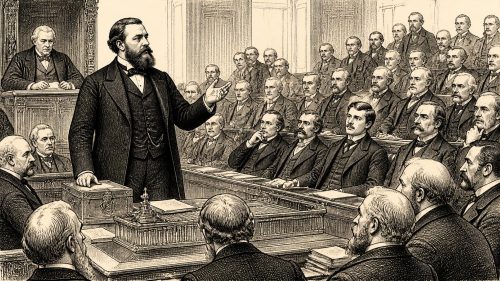
Irish in the Oireachtas illustrates the long relationship between language, law and public memory. Parliamentary debate and legislation make the State’s priorities visible, while translation and bilingual drafting affect the legal standing of texts. The language’s presence in parliamentary life cannot be treated simply as ceremonial. It is an assertion that public reasoning, not only song or commemoration, may be conducted in Irish. Nevertheless, formality has limits. A language used only on occasions of ritual recognition risks being separated from ordinary administration. The challenge has been to make institutional use dependable without reducing Irish to a set of translated displays.
Statutory Duties
The Official Languages Act 2003 created a statutory framework for the provision of public services through Irish. It placed duties on public bodies, addressed matters such as official stationery and publication, and provided for language schemes. Crucially, it established the office of An Coimisinéir Teanga, which monitors compliance and investigates complaints concerning failures to meet language obligations. This moved the matter beyond general aspiration. A citizen’s experience of Irish-language service could be examined in relation to legislation and commitments made by public authorities.
The amendment legislation of 2021 strengthened the framework and helped shift attention from individually negotiated schemes towards language standards and broader public-service planning. These changes recognise a hard lesson of the previous century: dispersed promises are not enough if a person cannot predict what service will be available, in which office, by which channel and from whom. Public heritage is sustained not only by ceremonial declarations but by administrative continuity. A bilingual form that is unavailable online, a telephone service without a competent speaker or a place name entered incorrectly into an official database can undermine that continuity in small but consequential ways.
Contemporary policy has also made recruitment and organisational capacity explicit concerns. The National Plan for Irish Language Public Services for 2024–2030 frames a route towards a more bilingual public service and links that objective to recruitment, training, technology, data and service delivery. Such measures are modern in form, but they continue an older question: can institutions treat Irish as a working language rather than a heritage add-on? The answer depends on resources, leadership and the routine design of systems. It also depends on listening to speakers, especially where public provision affects Gaeltacht communities whose linguistic needs cannot fairly be met by occasional translation.
Gaeltacht Futures
The Gaeltacht has been central to State policy because it contains the areas where Irish has remained, to varying degrees, a community language. Earlier policy often defined the Gaeltacht through boundaries and economic interventions, sometimes assuming that territorial recognition alone could protect everyday Irish. Later sociolinguistic research made the difficulty clearer: a designated area may contain Irish speakers without Irish necessarily being the principal language of family, friendship, commerce or youth culture. Boundary lines are administratively useful, but they cannot measure the full ecology of a language.
The Gaeltacht Act 2012 established a language-planning process under which communities may prepare plans as Gaeltacht Language Planning Areas, Gaeltacht Service Towns or Irish Language Networks. The structure is significant because it acknowledges that language vitality is not confined to traditional territorial districts. It also places local communities at the centre of identifying needs and actions. Planning may encompass childcare, youth activities, sport, business, housing, public services, education, media and cultural events. This is a more social conception of language than a policy concerned only with formal instruction.
There are reasons for caution as well as hope. Community planning can be meaningful only where local groups have time, expertise, stable funding and influence over implementation. A plan is not a guarantee of demographic renewal, affordable housing, employment or the continued use of Irish among young people. These wider conditions are not external to language; they are among the circumstances that make transmission possible. The survival of a community language is affected by who can remain in a place, who must leave for work, what childcare is available, what language peers use together and whether local public institutions make Irish the easy rather than exceptional choice.
Gaeltacht education policy reflects this wider understanding. Irish-medium schooling in Gaeltacht areas has been linked to local language-planning processes through the Gaeltacht School Recognition Scheme. The aim is not merely to teach Irish but to strengthen it as the language of school life and community connection. This is historically important because it tries to avoid a familiar paradox: children may be educated in Irish while the surrounding linguistic environment shifts steadily towards English. Education can support transmission most effectively when it is integrated with families, local organisations and opportunities for young people to use Irish beyond the classroom.
Public Memory
Place names offer one of the most visible points where language planning and heritage meet. Irish names carry information about terrain, settlement, family associations, saints, occupations and remembered events. Their spelling and pronunciation have changed across time, and English forms may have their own long local histories. Care is therefore needed. Restoring or using Irish names should not become an exercise in inventing an ancient certainty where documentary evidence is ambiguous. Equally, treating English-language forms as the only authentic names ignores the depth of Irish toponymic tradition. Public signage, maps, addresses and databases should respect evidence, local usage and the legitimate place of both official languages.
Archives and museums also shape public memory by deciding what is collected and described. A national manuscript collection may preserve the work of elite scribes, while a folklore archive records voices of storytellers, singers and schoolchildren. Neither is neutral in the sense of being comprehensive. Each emerged through particular institutions and collecting priorities. Recognising this is not an attack on archives; it is an argument for fuller interpretation. Catalogues, exhibitions and digital projects can explain who created a record, in what language, for what purpose and under what circumstances. Such context allows visitors to see Irish-language sources as evidence of lived worlds rather than decorative tokens of an imagined past.
Public commemoration has sometimes used Irish to signal authenticity or national continuity. This can be moving and appropriate, particularly where the language connects ceremonies to literary, political or familial traditions. But heritage becomes thin when Irish is restricted to mottos, speeches and inscriptions which few people are expected to understand. A stronger approach combines symbolic visibility with opportunities for participation: guided tours, community history, oral-history recording, local archives, bilingual interpretation and events where language is heard and used naturally. The goal is not to require every citizen to share the same level of competence. It is to ensure that Irish is encountered as a living means of knowledge and relationship.
Digital Continuities
Digital technology has transformed both the risks and possibilities of language heritage. Fragile manuscripts and obsolete recordings can be preserved through careful digitisation; searchable platforms can connect dispersed communities with local sources; online dictionaries, terminology resources and media can make Irish easier to use in contemporary domains. The digitisation of the National Folklore Collection through Dúchas.ie is particularly revealing. It makes large bodies of folklore material discoverable by place, person and subject, while volunteer transcription has helped open handwritten sources to broader research. Such work turns preservation into public participation.
Yet a digital surrogate is not identical to an original record. Images may omit physical features of a manuscript; sound files can lose technical detail; keyword searches privilege what has been transcribed and indexed. Machine-assisted transcription and language technologies offer useful tools, especially for handwritten Irish material, but their outputs require human checking. Dialect, older orthography, names and contextual nuances are precisely the areas in which automated systems may struggle. The heritage value of technology lies not in replacing skilled archivists, speakers or scholars, but in extending their work responsibly.
Digital public services create a parallel challenge. A State committed to Irish must consider whether online forms, automated messages, searchable records, identity fields and customer channels work properly in the language. This is not simply a technical matter. Systems encode assumptions about names, addresses, accents, diacritics, language preference and the expected path a user will take. If Irish is added only after a platform is designed around English, the result is often partial or awkward. Planning Irish into systems from the beginning is a practical expression of equal public respect.
Living Responsibilities
The historical evidence suggests that Irish language planning succeeds best when it avoids two opposite errors. The first is to treat Irish solely as an endangered inheritance, precious but detached from modern life. The second is to treat it solely as a service-delivery problem, reducible to targets and translated interfaces. Irish is both heritage and contemporary social practice. Its past is carried in manuscripts, recordings, literature, names and memories; its future depends on speakers making choices in families, schools, workplaces, towns, digital spaces and public institutions.
Interpretation must remain modest. It is not possible to identify one policy that would have reversed every historical pressure towards English, nor can the language’s future be predicted from a single census figure or statutory reform. Census returns measure declared ability and patterns of use, but they do not capture every setting in which Irish matters. The 2022 census recorded a substantial number of people able to speak Irish, while also showing the importance of asking how often and where it is spoken. Numbers are indispensable evidence, but they require context: competence, confidence, opportunity and community transmission are not the same thing.
The enduring lesson is that public heritage is not simply what a nation keeps. It is what a nation enables people to practise, question and pass on. Irish language planning has travelled from voluntary revivalism and school policy to statutory rights, local plans, archival digitisation and public-service design. Its record includes genuine achievement, repeated disappointment and ongoing debate. That complexity should not be concealed. It is precisely what makes Irish a living archive: not a sealed record of an older Ireland, but a continuing conversation between evidence, memory, public responsibility and the voices of speakers themselves.
The article’s distinction between preserving Irish as documented heritage and sustaining it as an everyday community language is compelling. Manuscripts, recordings, bilingual signs and recognition can protect visibility, yet they cannot automatically secure intergenerational conversation in homes, workplaces or Gaeltacht communities. Its account of schooling likewise suggests that competence gained through institutions may not translate into voluntary use. This raises a question about priorities: should contemporary language planning concentrate on extending Irish-language public services, or on creating social and economic conditions that make community use feasible, and how might these aims reinforce one another without overlooking dialects and community choices?