

Shelter Departures
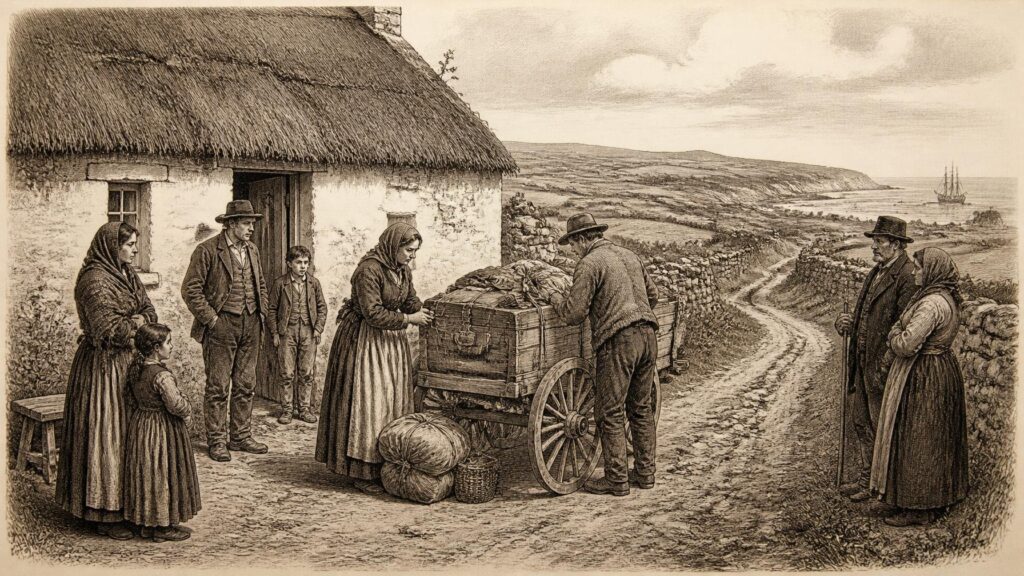
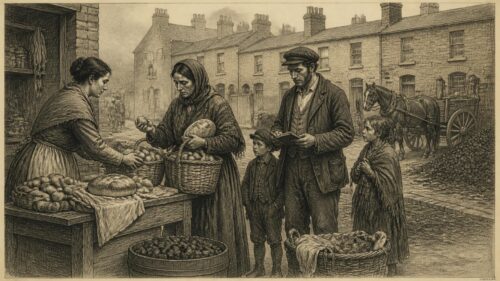
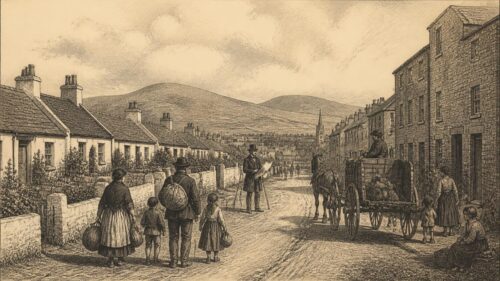
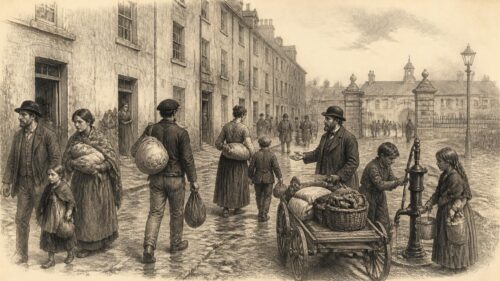
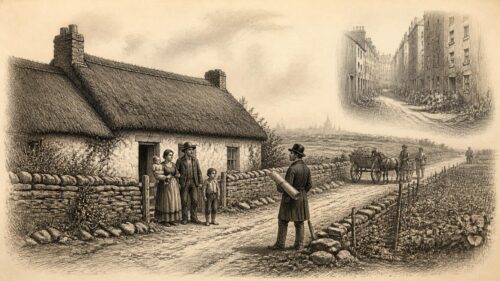
AI generated historical illustration, not a contemporary photograph.
At a Glance
In Irish history, housing and migration cannot be separated neatly into two subjects. A cabin, a tenement room, a workhouse ward, a labourer’s cottage or a newly built council house could determine whether a family endured in place, moved within Ireland, crossed the Irish Sea, embarked for North America, or eventually returned. Homes were material structures, but they were also expressions of tenure, class, health, kinship and political power. Their changing condition helps explain why movement became such a defining feature of Irish life.
Unequal Dwellings
Before the Great Famine, much of Ireland’s population lived in a rural world marked by profound inequalities in landholding and domestic comfort. The island contained great houses, demesne cottages, market-town terraces, fishing settlements and industrial districts, yet the most common home of the poorer rural population was modest, improvised and vulnerable. Small tenants and labourers frequently occupied dwellings built from locally available materials: stone where it could be had, mud walling in other districts, timber, thatch and whitewash. Surviving vernacular buildings should not be mistaken for a complete record. The modest houses of the poor were often altered, abandoned or demolished, leaving historians dependent on census materials, estate records, maps, official inquiries and later recollections.
Housing was inseparable from access to land. Many households did not regard a dwelling as a free-standing commodity in the modern sense. A cabin and its patch of ground were tied to a tenancy, a farm labourer’s employment, a landlord’s estate, or a complex chain of subletting. The right to occupy could be uncertain even where a family had lived on a holding for years. Population growth, the subdivision of farms and the dependence of many households upon potatoes produced a densely inhabited countryside in which the smallest dwelling might support a large family. In this setting, the loss of a holding threatened both shelter and subsistence at once.
Documentary evidence makes clear that conditions varied sharply between regions and social groups. Some tenant farmers occupied substantial farmhouses, while agricultural labourers could inhabit one- or two-roomed cottages. Estate villages and employer-built cottages could offer more regular accommodation, but they were not simply acts of benevolence. Such housing could bind workers closely to an estate or workplace and could be withdrawn when employment ended. The physical home was therefore also an instrument of dependency. This did not make every landlord uniformly oppressive, nor every tenant uniformly powerless, but it does reveal why housing cannot be detached from Ireland’s land question.
The Census of Ireland was already concerned with houses as well as people. The 1841 census instructions required enumerators to survey dwellings and record their class, while later censuses recorded household composition and aspects of domestic accommodation. These sources are valuable because they show that contemporaries understood housing as a public matter. Yet they also have limits. A census may count rooms or classify houses, but it cannot fully measure insecurity, the strain of shared sleeping spaces, informal lodging, seasonal absence, or the emotional force of leaving a home built by one’s own family.
Interpretation is necessary here. It is reasonable to see poor housing as one of the pressures that made migration imaginable, especially for people without secure land or steady work. It would be misleading, however, to claim that a particular kind of cottage automatically caused emigration. Migration depended upon age, family resources, employment, religious and social networks, the availability of passage money, and information from relatives abroad. A crowded cabin might make departure more urgent; a remittance from a son or daughter overseas might make repairs or a new roof possible. Housing and migration worked upon one another.
Precarious Tenure
The pre-Famine countryside was not static, even if later images of an unchanging Ireland often imply that it was. Seasonal labour, movement to towns, service in Britain, military enlistment and Atlantic migration all existed before the potato failure of the 1840s. University College Cork’s research on Irish emigration notes substantial departures to North America between the end of the Napoleonic Wars and the Famine. Protestant Dissenters, Presbyterians, Anglicans and Catholics participated in different streams of migration. The growth of Belfast and the linen economy also drew people from the Ulster countryside into an expanding industrial city, while limited industrial development elsewhere encouraged movement to British and transatlantic urban centres.
Housing lay beneath these movements in several ways. The rural poor had few buffers against failed harvests, fluctuating wages or rent arrears. A tenant without a secure lease could face removal; a labourer might be obliged to leave an employer’s cottage; a young adult could have no prospect of establishing an independent household in an already subdivided community. Marriage, inheritance and migration were thus linked. Where a holding could not sustain another household, departure might become part of a family strategy. One child or sibling left while others remained, perhaps maintaining the home place until money arrived from abroad.
It is important not to romanticise the cabin as a timeless emblem of national authenticity. Nineteenth-century observers often described rural homes through moralising language, sometimes treating poverty as evidence of personal failure and sometimes portraying the poor as picturesque inhabitants of a supposedly primitive landscape. Such descriptions reveal as much about observers as about occupants. The better evidence comes from comparing official reports, census data, estate documentation and the material remains of dwellings. These indicate genuine hardship, overcrowding and poor sanitation in many districts, but they also show resourcefulness: households extended buildings, shared labour, maintained thatch, kept animals, cultivated gardens and adapted rooms to multiple uses.
Nor was migration always a final act of despair. For some, it was a calculated effort to secure wages, save money or build a future household. A young man working in Britain might send funds to parents; a woman in domestic service might contribute to siblings’ passages; an emigrant in America might finance a relative’s journey. These connections demonstrate a central historical point. The Irish home was often maintained across distance. The person who left did not necessarily cease to belong to the household left behind. Letters, remittances and return visits could preserve authority, affection and obligation across the Atlantic or Irish Sea.
Famine Rupture
The Great Famine of 1845–1852 transformed this existing relationship between housing and movement with terrible speed. Potato blight did not strike an otherwise secure society. It entered a countryside in which large numbers depended on a fragile food system, tiny holdings and insecure tenures. Hunger, disease, debt and the failure of relief systems made ordinary domestic life increasingly impossible. People left homes in search of food, work or admission to relief. Others entered workhouses, where institutional shelter came at the price of separation from familiar domestic arrangements and, often, from family members.
Housing conditions mattered directly to health. Crowding and poor sanitation could intensify the spread of infectious disease among people already weakened by hunger. The University College Cork account of the Famine emphasises that typhus, relapsing fever, dysentery and cholera devastated communities, with disease spreading where destitute people congregated at public works, soup kitchens, prisons and workhouses. The home was no longer a refuge if food had disappeared and illness had entered the household; nor was relief accommodation safe merely because it had a roof.
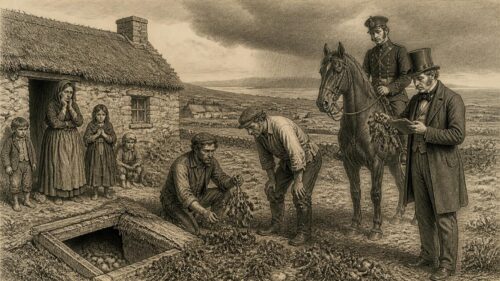
Eviction became one of the Famine’s most enduring and contested features. The facts are severe enough without embellishment. As the cost of poor relief was shifted increasingly towards local ratepayers and landlords, the smallest occupiers became financially burdensome to many estates. The Poor Law Extension Act of 1847 placed particular pressure on holdings valued at low levels. The so-called Gregory clause restricted access to outdoor relief for people retaining more than a small amount of land, creating an appalling choice for some families between surrendering a holding and seeking aid. Landlords’ responses varied: some offered assistance, abatements or emigration aid; others enforced clearances. The destruction of houses after eviction was especially consequential, since it reduced the possibility of return.
UCC’s Atlas of the Irish Revolution educational materials estimates that more than 100,000 families, or about half a million people, were evicted during the Famine years. Such figures should be read as scholarly estimates rather than as a complete roll of named individuals. They nevertheless convey the vast scale of disruption. The same materials record the disappearance of enormous numbers of small holdings by the early 1850s. Death, emigration, abandonment and consolidation all contributed. No single explanation is adequate for every vanished cabin, but the overall alteration of the rural landscape is beyond dispute.
For many people, emigration was a route out of danger; for others, it was an ordeal that began in destitution. Close to a million people left Ireland between 1846 and 1851, according to the UCC material on nineteenth-century migration, with further departures immediately afterwards. Some travelled with assistance from landlords, poor-law authorities, relatives or charitable bodies. Assisted emigration has often been remembered as straightforward expulsion. The historical record is more complicated. It could be coercive in its circumstances even where a person technically consented; it could also offer a family an escape from conditions in which remaining appeared impossible. That ambiguity must not obscure the unequal power between those who arranged passages and those whose homes, food and livelihoods had collapsed.
The image of a roofless cottage after eviction has become one of the defining symbols of the Famine. It is rooted in documented practice, but later memory has sometimes turned every ruin in the landscape into a Famine eviction site. That is folklore rather than proof. Rural ruins may have many histories: changing farming patterns, later emigration, rebuilding, inheritance disputes, road schemes or gradual abandonment. The historian’s task is not to dismiss local memory, which can preserve important clues, but to distinguish a remembered tradition from a verified event. Estate papers, valuation records, census returns and contemporary newspapers can sometimes make that distinction possible.
Atlantic Passages
Emigration did not end with the Famine. Indeed, the demographic consequences of the crisis unfolded for generations. Family networks established in the United States, Canada, Britain, Australia and elsewhere helped later migrants to find lodgings, employment and community. UCC’s Emigré history describes emigration as an intrinsic element of Irish life from the Famine onwards and estimates that approximately ten million people left the island after 1800. The figure is striking not because it means every departure was alike, but because it signals how thoroughly overseas movement entered family expectation.
Housing was one of the first practical problems facing Irish migrants abroad. Newcomers needed a bed, a room or a boarding house before they could establish themselves. Kinship networks could provide an address, but they might also produce crowding and dependency. The Irish abroad encountered very different urban environments: industrial Britain, North American port cities, mining districts, railway towns, domestic-service households and rural settlements. Their living conditions depended upon wages, discrimination, household size and local housing markets. The Irish migrant story is therefore not only a story of ships and jobs; it is also a story of lodging houses, shared rooms, domestic service quarters, company housing and eventual home ownership.
Remittances connected those new homes to old ones. Money sent back to Ireland could pay rent, purchase a ticket, redeem debt, improve a dwelling or sustain parents in old age. The effect was uneven. Not every emigrant earned enough to send money, and not every remittance transformed household circumstances. Yet remitting was sufficiently common to become central to family strategies. A household could endure separation because departure promised a material benefit for those who remained. In this sense migration sometimes preserved a home rather than simply emptied it.
Return migration complicates the idea of a one-way Irish exodus. Some emigrants came home temporarily, others permanently. Returned people brought savings, skills, household goods and new expectations about domestic comfort. They could build or purchase better homes, marry later, alter family arrangements or invest in land. Their return did not erase the losses caused by emigration, especially in communities depleted of younger people. It does, however, caution against treating every departure as final. Ireland’s population history was shaped by circulation as well as removal.
Popular songs and later family stories often present emigration as a clean break between a beloved home and a cruel foreign world. Such accounts possess emotional truth, but they are not neutral records. They frequently idealise the place left behind and simplify the conditions that prompted leaving. The historical evidence points to a more difficult reality: people missed homes that could be crowded, insecure or impoverished; they left communities that might be cherished and yet offer few opportunities; and they created new homes abroad while maintaining attachment to Ireland.
Urban Arrivals
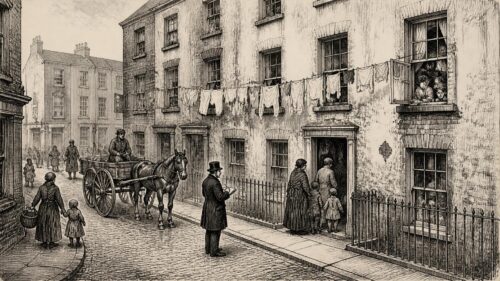
Migration within Ireland also changed housing profoundly. Belfast’s industrial growth attracted workers from surrounding districts, while Dublin remained a major centre of administration, commerce, labour and service. The city was not merely a place from which people departed overseas; it was also a destination for people seeking work. Yet urban arrival did not guarantee improvement. In Dublin, older Georgian houses and other large buildings were subdivided into tenements as wealthier residents moved outward to suburbs. The result was a concentrated crisis of crowding, sanitary neglect and high mortality.
The National Archives exhibition on the 1911 census describes Dublin as having the worst housing conditions of any city in the United Kingdom at that date. It draws attention to Henrietta Street, where 835 people were recorded in fifteen houses. The statistic is powerful because it comes from a specific documentary context rather than a generalised tale of misery. It reveals not a city uniformly made of slums, but a city of striking contrasts: professional and commercial wealth, suburban development, large institutional buildings and severe inner-city poverty existed alongside one another.
Tenement life should not be represented as social collapse without human agency. Residents formed neighbourhoods, rented rooms, took lodgers, worked in nearby trades, raised children, kept shops and sustained religious, political and mutual-support networks. At the same time, the structural conditions were dangerous. A household’s ability to move could be limited by rent, irregular wages, illness and discrimination. Crowding made disease more likely and privacy scarce. A family that had left a rural cottage in pursuit of urban work could find itself in a single room in a decaying former townhouse.
Here again, evidence needs careful use. Census returns offer names, occupations, ages, places of birth and room numbers, allowing historians to reconstruct individual households. They do not automatically explain why a family had moved or how its members judged their circumstances. Oral histories, newspapers and charitable reports add texture but bring their own biases. The strongest accounts combine these sources. They show that housing was neither a minor side issue nor a simple consequence of migration: it shaped the work available, the health of children, the likelihood of taking lodgers, and the possibility of moving again.
Rural Reform
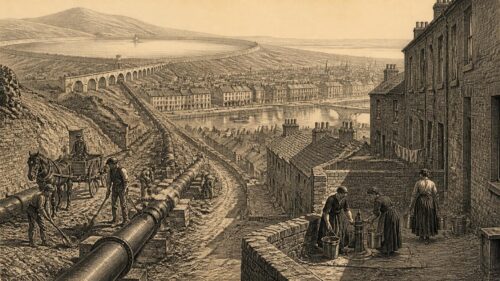
The later nineteenth century brought attempts to improve rural working-class housing through legislation. The Labourers’ Acts, beginning in 1883 and extended through subsequent measures, empowered local bodies to acquire sites and build cottages for agricultural labourers. AskAboutIreland’s account of Donegal’s housing history explains that the boards of guardians initially held this responsibility and that later local authorities built far larger numbers of cottages. The programme was uneven, sometimes slow and never sufficient to remove all hardship, but it marked a significant change: rural housing had become a matter for public intervention rather than solely for landlords, employers or private tenants.
Labourers’ cottages mattered because they offered something more than walls and roofs. A cottage with a plot could provide a degree of domestic independence from the employer’s farm or the landlord’s estate. It could improve light, ventilation and sanitation when compared with the worst older dwellings. It also reflected a political recognition that the agricultural labourer’s household had claims upon public policy. The cottages did not abolish rural poverty, and their construction could involve disputes about location, cost, eligibility and rents. Still, they altered the physical and social geography of many districts.
Housing reform also interacted with migration. Better cottages might help retain families who otherwise sought work elsewhere, but they could not create sufficient local employment on their own. Conversely, migration could make rehousing schemes difficult where communities had already lost younger workers. It is too simple to describe public housing as a cure for emigration. More accurately, it was one element in a wider effort to make remaining possible and dignified.
The Land War of the late nineteenth century gave renewed political force to questions of eviction, rent and occupancy. Its history should not be collapsed into the Famine, although Famine memories informed popular fears. Contemporary reports recorded evictions and social conflict, especially in districts already marked by smallholdings and insecure incomes. The political demand for tenant right and land purchase was also a demand for a more secure domestic foundation. Owning or securely occupying a farm could change a family’s relationship to its home, even though it could not eliminate the economic pressures that sent many Irish people abroad.
National Housing
Independence did not end the relationship between inadequate housing and migration. The Irish Free State inherited serious problems in both town and country, including poor dwellings, overcrowding and limited resources for large-scale construction. Housing legislation of the 1920s and 1930s created grants, loans and powers for local authorities and public utility societies. The Oireachtas record of the Housing (Financial and Miscellaneous Provisions) Bill of 1932 shows a state seeking to finance new construction, reconstruction and local-authority schemes, while retaining the older legislative strands concerned with labourers and working-class dwellings.
These measures mattered, but they should not be read as evidence of an immediate housing transformation. The state faced financial constraints, uneven local capacity and the enduring contrast between urban slum clearance, rural improvement and private building. Public housing could rehouse people displaced by dangerous or condemned dwellings; it could also create new estates whose distance from employment, transport or family networks posed fresh difficulties. The history of housing policy is therefore not a simple ascent from cabin to modern home. Each improvement brought questions about rent, maintenance, access, location and social belonging.
The 1950s made the connection to migration especially plain. UCC’s account of Irish emigration records that approximately half a million people left the Republic during that decade, when the population was under three million. Employment, agricultural change and economic stagnation were major reasons. Housing alone did not drive this departure, but the prospect of a stable home was part of what many migrants sought in Britain and elsewhere. The ideal of a regular wage was inseparable from the hope of establishing a household, marrying, raising children or escaping dependence on a parental home.
Housing also became a means through which migrants could later return. Savings earned abroad helped some families buy sites, build bungalows or improve older houses. This pattern has left a visible mark on the Irish landscape, though it varied by county and generation. The returned emigrant’s house can be read as a record of movement, aspiration and connection to another labour market. It should not be sentimentalised: building a home after years abroad could also testify to the inability to make a living in Ireland earlier in life.
Memory Evidence
Housing has unusual power in historical memory because it is tangible. A ruined gable, a surviving labourer’s cottage or a converted tenement can make broad demographic change appear immediate. Communities often attach stories of eviction, departure and return to particular houses. These stories deserve respect, especially when official records are thin. They may preserve names, relationships and local meanings excluded from formal archives. Yet they require corroboration before they can be presented as established fact.
A useful distinction can be made between evidence, interpretation and folklore. Evidence includes census forms, maps, valuation books, estate correspondence, poor-law records, legislation, contemporary newspapers and material remains. Interpretation is the historian’s reasoned explanation of how those sources relate: for example, that insecure accommodation increased the vulnerability of small tenants during crisis. Folklore includes inherited accounts that may be accurate, altered or symbolic, such as a claim that every abandoned cottage in a townland was burned after a Famine eviction. Folklore can guide research, but it is not automatically documentary proof.
This distinction does not diminish the moral significance of remembered loss. It strengthens historical understanding by allowing certainty and uncertainty to coexist. We can say with confidence that eviction, clearance, overcrowding, emigration and rehousing shaped Irish lives. We can also acknowledge when the precise story of a particular household cannot yet be verified. Such honesty is particularly important in subjects burdened by political argument and inherited grief.
Historical Balance
The history of housing and migration in Ireland is not solely a history of victims carried away by impersonal forces. It includes coercion, hunger, eviction and neglect, but also planning, family calculation, collective action, remittance, reform and return. Housing was at once a cause of movement, a consequence of movement and a goal pursued through movement. A family might leave because its home and holding could no longer sustain it; another might remain because money from abroad secured a roof; another might move from a rural cottage into an urban tenement; another might return years later to build a house with emigrant savings.
What makes the subject distinctly Irish is not that Ireland alone experienced bad housing or migration. Rather, Ireland’s unusually sustained population loss, the centrality of land tenure, the devastation of the Famine, the prominence of the diaspora and the persistent importance of the home place gave the relationship exceptional force. The house was not merely where history happened. It was often the point at which the pressures of the economy, the law, family duty and political power became impossible to ignore.
To study shelter and departure together is therefore to see migration not as an abstract statistic but as a domestic history. It concerns who could remain in a room, on a holding, in a street or within a community; who could claim security; and who had to seek it elsewhere. Ireland’s houses, from vanished cabins to surviving cottages and crowded tenements, remain evidence of both endurance and displacement.
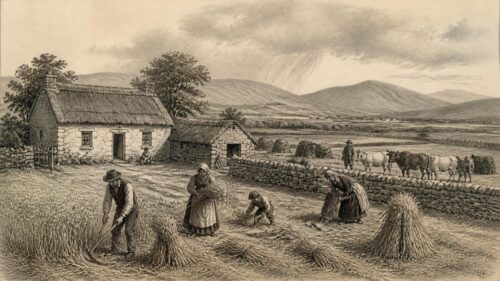
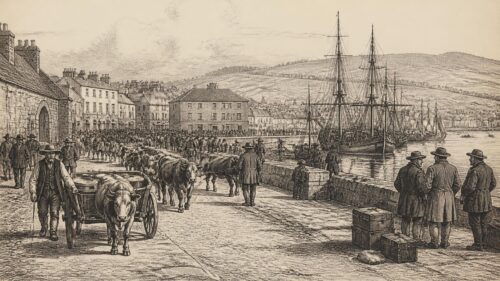
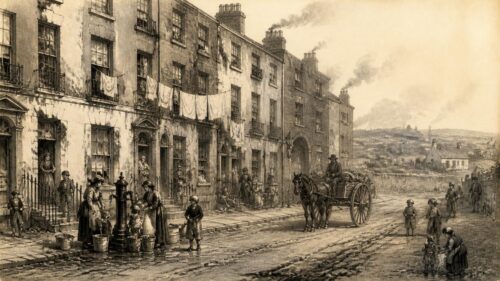
One theme is the article’s refusal to treat housing simply as a hardship that pushed people from Ireland. Cabins, workhouses, tenements and labourers’ cottages shaped health, family formation and mobility, yet migration could also sustain homes through remittances, return and investment. This reciprocal relationship complicates images of departure as a break from place. The contrast between rural insecurity and Dublin’s overcrowded tenements suggests that movement did not necessarily deliver shelter. How might combining census records, estate papers, family letters and memory reveal when migration weakened households, and when it enabled them to survive, improve housing or maintain ties across distance?