
Cromwell Remembered
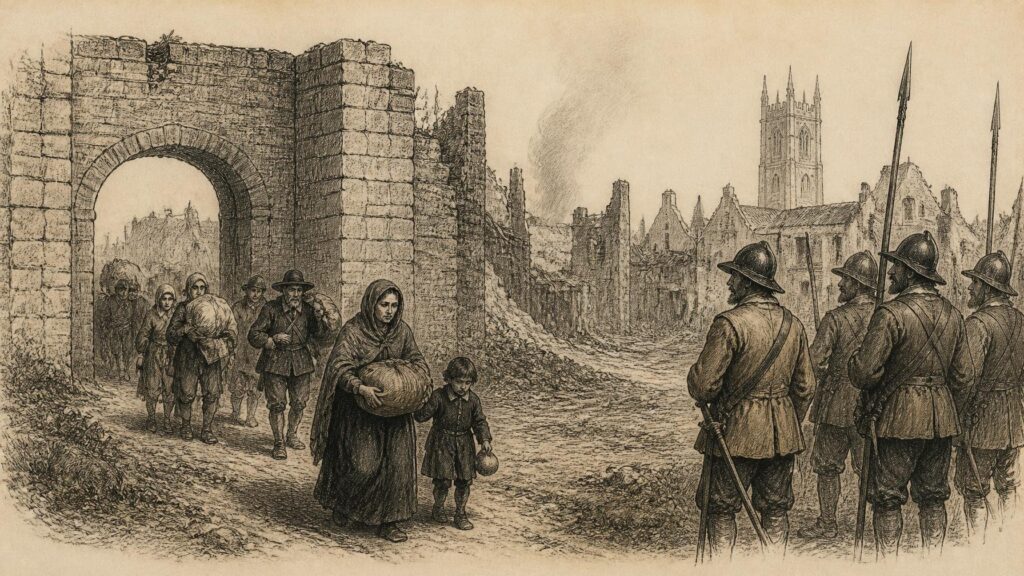
AI generated historical illustration, not a contemporary photograph.
At a Glance
Oliver Cromwell is hated in Ireland not simply because he was an English commander who came ashore in 1649, but because his name became the enduring human symbol for conquest, massacre, confiscation, religious persecution, displacement and colonial power. The historical record supports much of that association, while also requiring an important qualification: Cromwell personally spent only about nine months in Ireland, from August 1649 to May 1650. The war, the mass dispossession and much of the suffering conventionally called “Cromwellian” extended beyond his departure. His reputation therefore rests both on what he ordered and oversaw, and on the enormous settlement created in the name of the regime he led.
The Question
To ask why Cromwell is hated in Ireland is to ask two related but distinct questions. The first concerns the history of the 1640s and 1650s: what did Cromwell and the English parliamentary forces actually do in Ireland? The second concerns memory: why has one individual come to personify a catastrophe that involved many armies, governments, commanders and decades of previous colonial conflict?
The answer begins with a warning against easy simplification. Cromwell did not invade a peaceful, united Ireland. He arrived during a ferocious war which had begun with the rising of 1641 and had drawn in Irish Catholic Confederates, English and Anglo-Irish royalists, Scottish Covenanters, Protestant settlers and the competing forces of the English Parliament. Atrocities, sieges, hunger, disease and sectarian fear had marked the island long before Cromwell landed. Yet this context does not dissolve his responsibility. It explains the intensity of the conflict; it does not make the killings at Drogheda and Wexford, the anti-Catholic political order or the subsequent confiscatory settlement insignificant.
Cromwell’s Irish reputation is thus neither a mere nationalist invention nor a straightforward account of everything done in the 1650s. It is a moral and historical judgement formed from real events, later policies, inherited trauma and an exceptionally powerful folk memory. In Ireland his name became shorthand for a whole regime of conquest. That shorthand can obscure chronology, but it reveals something true about the scale of the rupture.
War Context
The Ireland entered by Cromwell in August 1649 had already been devastated by eight years of war. The rebellion of October 1641 began in Ulster amid profound tensions produced by plantation, land loss, confessional division and English state-building. Reports of killings of Protestant settlers, often exaggerated in English and Scottish print but rooted in genuine violence, inflamed Protestant opinion across the Irish Sea. In turn, Catholic civilians endured reprisals, expulsions and warfare. By 1642, Irish Catholic leaders had established the Confederate association, based at Kilkenny, while royalist and parliamentary interests also fought for control.
The conflict cannot be reduced to an ethnic contest between English and Irish. Many of the leading royalists in Ireland were Protestant; many Irish Catholics sought a settlement with Charles I or, later, Charles II; and soldiers moved between different allegiances. But religion, property and sovereignty were inseparable. Catholic Irish people had powerful reasons to fear the return of a Protestant English military state. English parliamentarians, especially those shaped by Puritan providential belief and the fearful tales of 1641, frequently regarded Irish Catholic resistance as rebellion compounded by popery.
In 1649 the political situation became still more dangerous for the new English Commonwealth. Charles I had been executed in January. In Ireland, the royalist lord lieutenant, James Butler, Marquis of Ormond, had assembled an alliance of royalists and many Confederate Catholics in the cause of Charles II. Dublin, held for Parliament, appeared vulnerable until the parliamentary victory at Rathmines in August. Cromwell was sent as Lord Lieutenant with a well-financed New Model Army to secure Ireland for the Commonwealth, break the royalist coalition and protect the sea routes that linked Ireland to England.
This was, then, a military expedition with strategic objectives. It was also a conquest carried out in language of divine judgement. Cromwell did not present his war as an ordinary contest between states. He framed Irish Catholic opponents through the memory of 1641 and through a militant Protestant understanding of history. That conviction helps explain both his unyielding refusal to recognise public Catholic worship and the exemplary violence that followed the storming of towns.
Drogheda Remembered
Drogheda, taken in September 1649, lies at the centre of Cromwell’s Irish reputation. The town was held for the royalist cause by a mixed garrison commanded by Sir Arthur Aston. It was strategically important: controlling it secured a route north from Dublin and warned other garrisons of the consequences of resistance. After artillery had breached the defences, Cromwell’s troops stormed the town on 11 September.
What followed was a massacre. The precise number of dead and the exact proportion of soldiers and civilians remain subjects of historical investigation, because surviving accounts are partial, partisan and sometimes contradictory. It is nevertheless beyond serious dispute that a very large number of defenders were killed after the assault, including men who had retreated into defensive positions and into St Peter’s Church. Catholic clergy were also targeted. Cromwell’s own letter to William Lenthall, Speaker of the English Parliament, provides powerful evidence. He wrote that those in the town had been denied quarter, claimed that almost all defenders had been put to the sword, and described the killing of friars.
His letter did not express regret. It cast the bloodshed as God’s righteous judgement upon people he associated with earlier killings of Protestants. Cromwell further argued that the severity would prevent future bloodshed by terrifying opponents into surrender. That reasoning is central to how the event has been remembered. Drogheda was not represented as an accidental loss of discipline, though individual acts in a stormed town can be difficult to reconstruct. It was defended by the commander as a deliberate, salutary example.
Contemporaries understood the message. Other towns calculated their chances in the shadow of Drogheda, and Cromwell himself believed fear could shorten the war. Modern historians debate how far the seventeenth-century laws and customs of war permitted the denial of quarter after a town had been stormed. The fact that a practice could be contemplated within contemporary warfare, however, does not make it morally neutral to later observers, nor did it remove its terror for those who experienced it. Irish memory did not preserve Drogheda as an argument about military jurisprudence. It preserved it as an emblem of slaughter and humiliation.
A further complication is that popular accounts have often attached every death in Drogheda directly to Cromwell’s personal hand or personal presence. That is not how command works, and historians should not turn a general into a lone murderer in a melodrama. But responsibility does not vanish into a chain of command either. Cromwell was the commanding authority; he reported and justified the killing; and he made its exemplary character explicit. Those documented facts are sufficient to explain why the town has remained a place of national memory.
Wexford Ruin
One month later, at Wexford, Cromwell’s name became connected with another disaster. Wexford was a port of considerable strategic significance. Parliamentary authorities regarded privateering from its harbour as a threat to English shipping, while Cromwell also saw the town through the sectarian and political assumptions that shaped his campaign. He opened negotiations with the governor, David Sinnott, and offered terms that included protection for inhabitants’ goods if the town surrendered.
The negotiations collapsed amid confusion. Captain Nicholas Stafford, who held the castle, surrendered it to parliamentary forces while the town’s authorities were still treating. Once the castle was in Cromwellian hands, troops entered Wexford. They killed soldiers and civilians and plundered the town. The toll cannot be established with the certainty sometimes claimed in popular retellings, but the event was catastrophic. Contemporary reports and later historical accounts agree that deaths were numerous, that the port and commercial life of the town were gravely damaged, and that many inhabitants fled.
Wexford matters because it complicates any argument that Cromwell’s harshness was limited to a garrison refusing a formal summons at Drogheda. At Wexford, he had proposed terms of protection; the circumstances of the surrender were confused; and yet a devastating sack followed. Cromwell’s subsequent letter described the outcome in providential terms, presenting the inhabitants’ privateering and alleged cruelty as reasons for divine punishment. This was not language likely to console survivors whose town had been overrun during a negotiation.
The two towns became inseparable in Irish remembrance: Drogheda for the systematic killing after a storm, Wexford for massacre and destruction in a trading town. They were also politically useful symbols. From the nineteenth century onward, nationalists, Catholic preachers, popular writers and campaigners could invoke their names as evidence of English violence in Ireland. That use did not create the events. It helped preserve and frame them.
Faith Politics
Cromwell’s hostility to the Catholic Church is another major reason for his enduring notoriety. He could, at times, show a degree of practical tolerance towards individual Catholics who submitted or whom he considered politically harmless. He insisted, in correspondence from the campaign, that he did not seek to meddle with private conscience. Yet he made an equally decisive distinction: public celebration of Mass would not be allowed. The Catholic Church was not merely a religious body in his political imagination; it was an institution he regarded as inseparable from rebellion, foreign influence and spiritual error.
This distinction between private belief and public worship mattered enormously. A faith cannot be reduced to thoughts held silently within the mind. It exists in communal rites, priests, churches, education, burial, charity and public belonging. Cromwellian policy placed severe restrictions on Catholic religious life, and Catholic clergy were particularly exposed to violence, banishment and prosecution. The result was not the total eradication of Catholicism; Irish Catholic practice survived, adapted and continued. But the state announced that Catholicism had no rightful public place in the political order it was constructing.
For Irish Catholics, therefore, Cromwell came to signify more than military defeat. He represented an assault upon their religious legitimacy. This memory was strengthened by martyrological writing and ecclesiastical tradition, which recorded priests and lay people as victims of persecution. Such accounts must be read critically, like all sources produced in conflict, but they reflect a genuine experience of coercion and exclusion. The religious dimension also explains why Cromwell could remain an object of hostility long after particular estates had changed hands or particular battlefields had faded from living memory.
It is important not to imply that all Irish people remembered him in the same manner. Protestant beneficiaries of the post-conquest order could view the Commonwealth more ambiguously, and some had their own complicated histories of loyalty and survival. Yet the broad Catholic majority had particular reason to connect Cromwell with the curtailment of their civil and religious standing. In a country where confessional identity remained politically consequential for centuries, that association had exceptional durability.
Conquest Continued
Cromwell left Ireland in May 1650, summoned back by the threat posed by Charles II’s alliance with the Scots. His departure is a necessary corrective to the common image of a single man personally directing every Cromwellian act until the war ended. Henry Ireton, Cromwell’s son-in-law, succeeded him in command; Edmund Ludlow, Charles Fleetwood and other Commonwealth officers later played leading parts. The final major resistance was not overcome until 1653.
The worst demographic effects of the conquest cannot therefore be allocated solely to the nine months of Cromwell’s residence. Prolonged sieges, scorched-earth practices, guerrilla warfare, harvest disruption, famine and epidemic disease killed vast numbers during the early 1650s. Limerick and Galway, among other places, suffered appalling conditions as Commonwealth armies tightened their grip. Exact totals for deaths across Ireland are uncertain and estimates vary considerably. The loss of records, the movement of refugees and soldiers, and the difficulty of distinguishing death by violence from death by hunger or disease make false precision especially dangerous.
Still, it would be evasive to use that uncertainty to minimise the calamity. The conquest was a national disaster. It brought a military victory for the Commonwealth and cleared the way for a dramatic remaking of landholding and political power. Cromwell had established the direction of the campaign, secured its early decisive victories and given the regime its most recognisable face. Later commanders completed a project that contemporaries and descendants reasonably called Cromwellian.
That is why an accurate historical account must make two statements together. Cromwell did not personally conduct the whole conquest, and he should not be blamed for every later act committed under the Commonwealth. But neither was he a passing visitor unfairly attached to someone else’s work. His campaign was the opening and defining military phase of a conquest whose political fruits were pursued by his government.
Land Revolution
The deepest source of Cromwell’s hated reputation may be land. Military violence was immediate and unforgettable, but confiscation transformed the lives of families for generations. The Commonwealth had promised land in Ireland to financiers who supported the parliamentary war effort under the Adventurers’ Act of 1642. It also needed to reward soldiers, pay arrears and secure a loyal Protestant interest in the conquered country. Victory made those objectives possible.
The settlement that followed was built on collective categories of guilt and loyalty. The Act for the Settlement of Ireland and the related measures of the early 1650s imposed penalties on those deemed to have participated in the rebellion or opposed Parliament. Catholic landowners faced confiscation on a vast scale. The Civil Survey of 1654–56 and William Petty’s Down Survey turned land into an administratively legible resource: mapped, measured, valued and allocated. These surveys are remarkable historical sources precisely because they show conquest becoming paperwork, acreage and title.
Land changed hands to soldiers, creditors, merchants and Protestant settlers. The transfer was not absolute; old proprietors sometimes retained or later recovered holdings, and the Restoration settlement after 1660 altered some arrangements. Yet the broad result was unmistakable: Catholic landownership fell sharply, while a new or enlarged Protestant landed interest acquired power. The distribution of property shaped social authority, voting rights, local office, tenancy and wealth far beyond the seventeenth century.
It is tempting to treat confiscation as a bloodless administrative sequel to war. For those dispossessed, it was part of the violence. A family’s estate was not simply an investment: it carried status, kinship, livelihood, local memory and a claim to place. The term “Cromwellian settlement” has endured because it names the structural outcome of the conquest. Even people who knew little about the manoeuvres of 1649 could know that their ancestors had lost land in Cromwell’s time, or that another family held an estate granted after the wars.
Such memory made Cromwell a durable political figure. His name could be invoked in nineteenth-century arguments about landlordism and tenant right, and later in nationalist accounts of colonisation. These uses sometimes compressed complex history, but they drew their force from a real historical transformation in ownership and power.
Human Dislocation
Confiscation was joined to displacement. The phrase “To hell or Connacht” is frequently presented as a direct Cromwell quotation or as a formal slogan of policy. No reliable contemporary evidence establishes it as his exact phrase, and it should not be quoted as though it were a documented order. The real policy is grim enough without the need for invented wording. Under the settlement, many Catholics were ordered to move to designated areas west of the Shannon, especially in Connacht and Clare, while their former lands were made available for redistribution.
Transplantation was unevenly applied, resisted, modified and never as total as later legend sometimes suggests. Some people evaded removal, obtained exemptions, leased land, moved elsewhere or found ways to remain. Yet its purpose was unmistakable: to separate a defeated Catholic population from strategically valuable and fertile regions and to create a more secure Protestant possession of the country. The forced movement of people by religious and political classification was a profound violation of community and belonging.
Transportation overseas is another part of the story. Prisoners taken after Drogheda were sent to Barbados, as Cromwell’s own letter records. Other Irish people, including prisoners and vulnerable civilians, were transported during the 1650s to Caribbean colonies and elsewhere. Their legal status varied. Some were prisoners, some indentured servants or forced labourers, and some were transported under coercive arrangements that exposed them to appalling conditions.
The modern claim that the Irish were simply “slaves” in exactly the same sense as enslaved Africans is historically misleading. It erases the racialised, hereditary chattel slavery imposed on Africans and their descendants, while also failing to describe the differing legal conditions endured by transported Irish people. That correction must not become denial. Coerced transportation, punitive labour and separation from home were real forms of suffering. The historical task is to name them accurately, rather than to turn one history of oppression into a rhetorical substitute for another.
Cromwell Responsibility
How, then, should Cromwell’s responsibility be assessed? A defensible judgement avoids both absolution and exaggeration. He was not the author of every English policy towards Ireland. Plantation predated him; anti-Catholic legislation had deeper roots; the Irish wars had already produced atrocities; and the settlement was developed and executed by a wider Commonwealth administration after he had left. The name Cromwell often serves as a container for events he neither planned nor personally witnessed.
Yet the central case against him does not depend on treating him as omnipotent. He led the parliamentary army during the assaults on Drogheda and Wexford. At Drogheda he publicly justified the denial of quarter and killing as providential judgement and effective terror. He regarded public Catholic worship as unacceptable. His government pursued a conquest that made mass confiscation, transplantation and transportation possible. His authority, rhetoric and victories gave the subsequent order its legitimacy and force.
There is also an ethical issue in the language of necessity. Cromwell believed that ruthless action could bring an end to war. Many conquerors have said the same. It may be historically important to understand his strategic reasoning, but explanation is not exoneration. A commander who imagines terror as a route to peace makes civilians and prisoners bear the cost of a political calculation. In Irish memory, that calculation is precisely what makes Cromwell so abhorrent.
The historical record allows no comfortable rehabilitation based on the claim that he was merely a conventional soldier of his age. He did operate within seventeenth-century practices of siege warfare, religious polemic and imperial conquest. But he also gave those practices unusual ideological force and became their most famous practitioner in Ireland. Nor is it adequate to call him uniquely monstrous and leave the wider structures unexamined. His actions were enabled by parliamentary finance, English colonial ambitions, anti-Catholic fears and a state capable of measuring and redistributing a conquered country.
Memory Making
Cromwell’s reputation did not remain fixed after the 1650s. It was remade by Restoration politics, Catholic devotional culture, Protestant self-fashioning, nineteenth-century nationalism, popular print and oral tradition. Sarah Covington’s work on Irish memory is particularly valuable because it shows that Cromwell was not merely remembered as a historical person. He became a flexible explanation for dispossession, ruined buildings, local misfortune, hostile landlords and national grievance.
This does not mean memory was fabricated. Rather, memory selected, joined and enlarged. A family might associate a lost estate with Cromwell even if the legal transfer occurred after his departure. A ruin might be called Cromwellian though it belonged to another era. A cruel local official might be likened to Cromwell. These associations turned a seventeenth-century commander into a recurring presence in Irish life.
The nineteenth century gave this memory new political energy. Campaigns over Catholic emancipation, land reform and national self-government were conducted in a society still marked by the unequal ownership patterns created after the seventeenth-century wars. Cromwell could be summoned as a symbol of what British power had done and might do again. In this sense he was not only an object of historical hatred; he was a political language through which people described present injustice.
It is also worth recognising that historical memory is not a courtroom transcript. It transmits emotional truths as well as factual claims. The loss of an ancestor’s land, the vulnerability of a minority faith, the memory of famine or eviction, and the persistence of colonial hierarchy all made the Cromwell story intelligible across generations. The historian’s duty is not to sneer at such memory because it contains errors. It is to distinguish evidence from embellishment while asking why particular stories endured.
Folklore Accretions
Irish folklore contains a vast body of Cromwell stories. He appears as an ogre, a devilish figure, a tyrant with grotesque physical features, a destroyer of churches and a relentless pursuer who “cleared the road before him”. Curses invoking his name survived in Irish speech. Local traditions attached him to landscape features, caves, ruins and stories of hidden treasure. In many of these tales, the historical Cromwell of 1649 has been transformed almost beyond recognition.
These traditions should not be mined as literal evidence for events. A folktale that Cromwell destroyed a particular church does not prove that he ever visited it. Nor should folklore be dismissed as worthless. It reveals how communities understood loss and power. The recurrence of Cromwell in collected oral traditions, second only to very few Irish historical figures, shows the extraordinary reach of his symbolic life.
Folklore also teaches caution. It is responsible for several popular assertions that cannot be securely documented: that Cromwell personally uttered “To hell or Connacht”; that he ordered every Irish Catholic expelled from the country; that all transported Irish people were chattel slaves; or that every old ruin called Cromwellian was destroyed by his army. These claims may preserve a broader sense of dispossession, but their literal forms must be tested against records.
The distinction between folklore and documentary history is not an attempt to soften Cromwell’s record. On the contrary, the documented record is severe enough. Drogheda, Wexford, anti-Catholic repression, conquest, land confiscation, transplantation and transportation require no mythical additions. Careful history honours the victims of those processes better than sensational claims do.
Lasting Verdict
Oliver Cromwell is hated in Ireland because his name stands at the crossing point of violence and dispossession. He commanded the army that committed notorious massacres at Drogheda and Wexford; he defended brutality as divine judgement and military necessity; he helped install a regime hostile to public Catholic worship; and his victories enabled one of the most sweeping transfers of land and power in Irish history.
He is also hated because later suffering became attached to his name. The conquest continued after he returned to England. Ireton and other Commonwealth commanders completed the military subjugation. Civil administrators, creditors, surveyors and settlers gave the new order permanent form. But the public memory of a system often chooses one face. In Ireland that face was Cromwell’s.
The fairest conclusion is therefore not that every story told about him is literally true, nor that the errors within popular memory make the hatred groundless. Cromwell was made into a larger-than-life villain by generations of remembrance, but he was made available for that role by his own conduct and by the vast political transformation carried out under his authority. His Irish legacy endures because it concerns more than a battlefield. It concerns who could worship openly, who could own land, who could remain at home, and whose suffering would be called justice by the victorious.
Cromwell Remembered usefully separates Cromwell’s nine-month command from the wider Commonwealth conquest, yet shows why his name became inseparable from later confiscation, transplantation and religious exclusion. This raises an important question about historical responsibility: can a political leader become the enduring symbol of policies largely implemented by successors when his campaign established their direction and justification? The article also suggests that folklore compresses chronology while preserving the emotional truth of dispossession. How should historians and public commemorations balance precise distinctions between Cromwell’s personal actions at Drogheda and Wexford and the longer-term structures of conquest that communities remember through his name?