
Storm Preparedness
At a Glance
Warning Issued
Official warnings for Storm Éowyn were issued on 23 January 2025, when the Met Office announced red weather warnings for Northern Ireland and parts of Scotland. The warning described the storm as bringing disruptive winds, with additional heavy rain and snow for some areas. The same day, the UK government announced Emergency Alerts for Northern Ireland and parts of Scotland in response to red weather warnings. The record shows an overlap between meteorological escalation and emergency communication. [1] [4]
The warnings did not describe a limited local event. They referred to a multi-hazard storm affecting wider areas, with red warnings for wind and further amber and yellow warnings elsewhere. The government statement said the alert would reach compatible mobile phones in the areas most at risk and would include weather information and safety guidance. The record therefore shows both hazard messaging and a specific delivery mechanism for public preparedness. [1] [4]
Wind Forecast
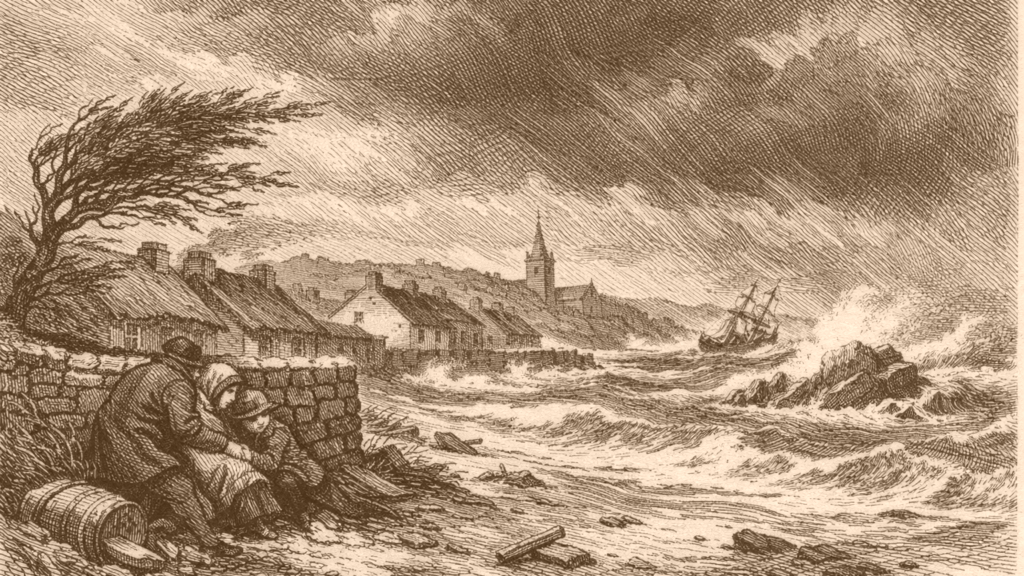
The Met Office warned that very strong winds were expected, with gusts of 80 to 90 mph fairly widely and up to 100 mph in exposed coastal places. Its bulletin listed danger to life, flying debris, large waves, fallen trees, power cuts, and damage to buildings, homes, roads, bridges, and railways. These details show that preparedness advice was grounded in a wide range of anticipated impacts rather than wind speed alone. [2] [4]
Irish and British meteorological summaries later described the storm as exceptionally severe. Met Éireann said that Storm Éowyn reached peak intensity near the northwest coast of Ireland and brought heavy rain, extreme winds, widespread disruption, and power outages. The Met Office later reported a 114 mph gust at Mace Head and described this as the peak recorded gust in the Republic of Ireland. These later summaries confirm the scale anticipated in the warnings. [3] [5] [8]
Public Advice
The practical advice attached to the warnings was explicit. People were told to avoid travelling by road, stay indoors if possible, secure loose items outside, and prepare for power cuts by gathering torches, batteries, and a mobile phone power pack. Coastal advice was also specific: people near the shore were warned about large waves and instructed to call 999 and ask for the Coastguard in an emergency. The guidance was therefore household and location specific. [2]
The Met Office also advised people to keep up to date with forecasts and follow advice from emergency services and local authorities. In its red-warning bulletin, it noted that weather warnings could change quickly and pointed readers toward practical preparedness advice. This shows a sustained emphasis on updating information as the storm evolved, rather than treating the warning as a single fixed announcement. [2] [4]
School Closure
Northern Ireland’s Department of Education advised all schools to close on Friday 24 January 2025 after the Met Office issued a red alert covering the entire region from 7 am until 2 pm. The department linked the closure to dangerous conditions and widespread disruption. This is a clear example of preparedness extending beyond weather offices into education administration, where the immediate response was to reduce exposure to risk by closing schools. [7]
The education notice also stated that schools should put plans in place for remote learning so pupils could study at home. That instruction shows a second layer of preparedness, moving from closure itself to continuity of learning during the storm period. The available record does not show how every school implemented those plans; it does show that the department expected them to exist and to be activated quickly. [7]
Transport Halt
Public disruption extended into transport. Irish coverage reported that public transport services were cancelled for the duration of the red warnings and that An Post would suspend deliveries and collections. The same report recorded the National Emergency Coordination Group meeting that morning to plan the national response. These details show preparedness operating through both service suspension and coordination among public bodies as the storm approached. [6]
The Met Office likewise warned that travel plans were likely to be severely affected, even outside the most severe warning areas. It said that warning areas covered Northern Ireland and central and southwestern Scotland, while other parts of the UK would still face disruptive weather and possible power cuts. The record therefore shows a preparedness message aimed not only at the hardest-hit districts but also at broader transport planning. [4] [5]
Aftermath Record
Later summaries help measure the storm’s impact. Met Éireann’s January climate statement said Storm Éowyn brought heavy rain and extreme winds across Ireland, with widespread disruption and power outages. Its storm-centre summary added that the storm produced record-breaking wind speeds, hurricane-force winds, and gusts up to 184 km/h, alongside one of the deepest lows ever recorded here. These summaries confirm that the preparedness warnings were matched by severe conditions. [3] [8]
The record also shows that Storm Éowyn stood within a wider winter sequence of named storms in the 2024/25 season. Met Éireann’s storm centre listed Éowyn among six named storms that season and placed it alongside earlier events such as Ashley and Darragh. That broader seasonal context is observable in the records, but the excerpted material does not explain how each storm shaped preparedness policy in detail. [8]
Source References
Hover over a number to see the source. Select it to open the source.

- [1] Government to issue Emergency Alert in response to Storm Éowyn - GOV.UK
- [2] Red warning of wind affecting Northern Ireland
- [3] Climate Statement for January 2025 - Met Éireann - The Irish Meteorological Service
- [4] Red weather warnings issued with damaging winds forecast for Storm Éowyn - Met Office
- [5] Storm Éowyn brings 90mph winds as it starts to impact the UK - Met Office
- [6] Public advised to shelter in place during 'damaging, destructive and dangerous' storm
- [7] Schools to close due to Storm Éowyn | Department of Education
- [8] 2024/25 Storm Centre Ireland - Met Éireann - The Irish Meteorological Service





How did official warnings and public guidance around Storm Éowyn frame emergency preparedness in Ireland and Northern Ireland?