

Final Gallows
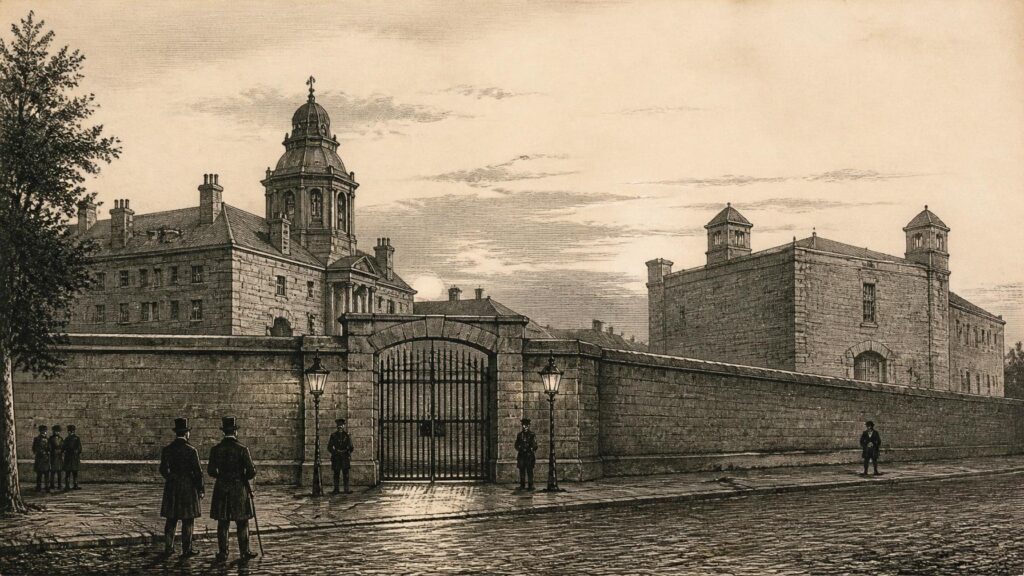
AI generated historical illustration, not a contemporary photograph.
At a Glance
The last man hanged on the island of Ireland was Robert McGladdery, executed at Crumlin Road Gaol, Belfast, on 20 December 1961. Yet the answer commonly given in the Republic is Michael Manning, hanged in Mountjoy Prison, Dublin, on 20 April 1954. Both answers are defensible only when the jurisdiction is stated. The distinction is not pedantry: it reveals how partition left two criminal justice systems, two political contexts and two separate routes away from capital punishment.
The Answer
Questions about “the last man hanged in Ireland” often receive a brisk answer: Michael Manning. He was indeed the last person executed by the State now known as Ireland, then constitutionally and commonly called the Republic of Ireland, and his hanging in Mountjoy Prison in 1954 ended a long sequence of civilian executions within the twenty-six counties. The Law Reform Commission’s historical account identifies Manning as the last man executed in that jurisdiction, for the murder of Catherine Cooper.
But Ireland is also the name of the island. Northern Ireland remained within the United Kingdom after the partition settlements of the early 1920s. Its courts, prisons and criminal law were not governed from Dublin. In that jurisdiction Robert McGladdery was convicted of the murder of Pearl Gamble near Newry and was hanged at Belfast’s Crumlin Road Gaol on 20 December 1961. The prison’s surviving execution chronology records him as its final execution. On the island-wide meaning of the question, therefore, McGladdery was the last man hanged in Ireland.
The wording matters further because “last hanged” is narrower than “last sentenced to death”, and “last executed” can include shooting as well as hanging. The twentieth-century history of capital punishment in Ireland contains all of these categories. Men were executed by British authorities during the revolutionary period; the Irish Free State and later Irish state used both hanging and firing squad in different circumstances; Northern Ireland continued judicial hanging after the final execution in Dublin; and death sentences continued to be imposed after actual executions had ceased. A careful answer must identify both person, place and legal authority.
This is consequently not only a story about two condemned men. It is also a history of the state’s claim to take life through law, of prisons built to conceal punishment that had once been public spectacle, of juries and judges working within mandatory rules, and of political leaders who gradually concluded that execution could not be reconciled with justice. It must also keep the victims in view. Catherine Cooper and Pearl Gamble were not merely names in the final chapters of capital punishment; they were people whose killings shaped the prosecutions, public feeling and later memory surrounding Manning and McGladdery.
Two Jurisdictions
After partition, the island did not possess a single criminal law. The Irish Free State, established in 1922, inherited much of the pre-independence legal framework but developed its own institutions, legislation and executive procedures. Northern Ireland, meanwhile, possessed devolved governmental structures within the United Kingdom and remained within a British legal and penal framework. The practical outcome was that an execution at Mountjoy and an execution at Crumlin Road Gaol belonged to different states and different chains of legal authority, even though both occurred on the same island.
That distinction is sometimes blurred by retrospective language. The phrase “in Ireland” can refer geographically to the island, culturally to an Irish setting, or politically to the independent state. Historical writing should not use one meaning while silently relying on another. Michael Manning was not the last person hanged anywhere on the island. Robert McGladdery was not executed by the Irish state in Dublin. The respective dates, 20 April 1954 and 20 December 1961, give the necessary precision.
There is also a difference between the history of capital punishment and the history of national identity. Hanging had powerful associations in Irish political memory because British governments had used it against people regarded by many nationalists as rebels, patriots or martyrs. Yet the independent Irish state retained the death penalty and used it in cases of ordinary murder. That apparent contradiction has been a central concern of historians of the period. It demonstrates that independence did not mean an immediate rejection of inherited criminal-law practices.
At the same time, political executions and executions for civilian murder should not simply be merged into one undifferentiated record. Their legal processes, public meanings and commemorative afterlives were different. The Office of Public Works exhibition on the Forgotten Ten, for example, documents ten men hanged at Mountjoy during the War of Independence after court martial proceedings under British administration. Their treatment in public memory differs profoundly from that of people executed for non-political murder after independence. The gallows were the same instrument, but the historical setting was not.
Colonial Inheritance
Capital punishment had been deeply embedded in the criminal law governing Ireland before independence. In earlier centuries, death could be imposed for a very broad range of offences. Nineteenth-century reform reduced the number of capital crimes, but murder remained the paradigmatic offence for which death was required. The Offences against the Person Act 1861, a United Kingdom statute extending to Ireland, made death the mandatory punishment for murder. That rule survived into the legal order of the new Irish state.
The character of execution had changed before the twentieth century reached its middle. Public hanging, once presented as a warning and a ritual of state authority, had been abandoned in the United Kingdom and Ireland in favour of executions within prison walls. The change did not make the punishment private in every sense. Newspapers reported trials, appeals and executions; crowds sometimes gathered outside prisons; and official notices confirmed that sentence had been carried out. But the actual mechanism was removed from public view, entrusted to prison staff, doctors, clergy, governors and executioners.
Mountjoy Prison became an especially potent site in this history. Opened in the nineteenth century, it functioned under British rule and then under the Free State and the Republic. It was a place of ordinary imprisonment, political confinement and execution. The ten War of Independence prisoners later commemorated as the Forgotten Ten were hanged there between 1920 and 1921. The building thus carried into the new state a physical inheritance as well as a legal one: condemned cells, an execution chamber and burial ground within prison walls.
Hanging also possessed a symbolism that shooting did not. In the popular imagination, the gallows could carry the shame of criminality, whereas death by firing squad could be framed as the death of a soldier. That contrast mattered greatly during and after the revolutionary era. It helps explain why state leaders who had known, supported or remembered men executed by British authorities could nevertheless preserve the legal machinery of hanging for convicted murderers. The distinction was morally unstable, but it was politically and culturally real.
State Practice
The post-independence record was neither one of constant execution nor one of immediate restraint. Research by Ian O’Donnell and David M. Doyle records thirty-five executions in the Irish state between 1923 and 1954, with hanging used in thirty cases and shooting in the remaining cases. Six involved politically motivated offenders. One woman, Annie Walsh, was executed in 1925. The figures underline that the death penalty was not merely a dormant colonial relic in the early decades of independence; it was an active power of the state.
Nevertheless, the use of that power was selective. The mandatory death sentence for murder did not mean that every person convicted of murder was executed. Commutation was possible through executive action, and many condemned prisoners were reprieved. The existence of mercy did not remove the severity or uncertainty of a capital sentence. Rather, it shifted enormous significance to decisions made after the jury had spoken and after the judge had imposed the sentence required by law.
This system created a striking tension. A court could pronounce death as the compulsory legal consequence of a murder conviction, while the Government could later decide whether the sentence would actually be carried out. The constitutional arrangements of 1937 expressly contemplated commutation, vesting the relevant presidential power in a form exercised on governmental advice. In practice, the distinction between judicial sentence and executive clemency meant that the final decision on life and death was not confined to the courtroom.
The records also show that the independent state did not develop a secure domestic cadre of professional hangmen. English executioners were contracted to carry out hangings at Mountjoy. O’Donnell and Doyle’s research into official files describes the uneasy efforts made during the 1940s to train a local assistant. The arrangement did not mature into a durable Irish service. The continued use of British executioners was an uncomfortable practical dependency for a state that had emerged from struggle against British rule.
It is tempting to treat this fact as merely bizarre or ironic. It was more than that. It reveals how a state may inherit a punishment without possessing, or wishing to create, the human apparatus needed to administer it. Officials could preserve death as a sentence in statute while keeping its most visible technical agent at a distance. That distance did not lessen responsibility, but it may help explain why executions were increasingly experienced by officials as exceptional, burdensome and morally troubling events rather than routine expressions of authority.
Manning Case
Michael Manning was a carter from Limerick. In 1954 he became the last person judicially executed in the Republic of Ireland. He had been convicted of the murder of Catherine Cooper, a nurse. The core facts are established by court and departmental material examined by later historians, by the Law Reform Commission’s historical survey and by public broadcasting archive material. What cannot responsibly be done is to turn a compressed legal record into a complete psychological biography. Later retellings often add colour, but the reliable historical account must distinguish firm documentary ground from reconstruction.
Cooper’s death was a grave crime, and Manning’s prosecution took place in a society in which murder was understood to demand the strongest response available to the courts. The question at Manning’s trial was not whether death could lawfully follow a murder conviction: it could, and the sentence was mandatory. The crucial legal contest concerned whether the evidence permitted a verdict other than murder. The case therefore illuminates the sharp consequences attached to distinctions that, in another context, might appear technical: murder or manslaughter; mental incapacity or criminal responsibility; intoxication as background circumstance or intoxication so profound that it affected legal intent.
O’Donnell and Doyle, drawing on National Archives files, report that the prison medical officer found no evidence of mental disorder and considered Manning fit to plead. Insanity was raised at trial, but the historical record examined by the scholars indicates that it was unsupported by medical evidence. The defence also relied on intoxication. Manning had been drinking, and the question was whether his condition could reduce legal responsibility. The trial judge explained that drink was not a defence merely because it made somebody more likely to yield to passion. The legal threshold was far higher.
The jury convicted Manning of murder. Under the law then applicable, the judge sentenced him to death. Such a sentence could sound inevitable once a guilty verdict had been reached, but it did not exhaust the process. The case passed into the stage of appeal, representations and consideration of clemency. This was the period in which a condemned prisoner’s behaviour, petitions, medical condition, personal circumstances and claims of remorse could be considered by authorities. It was also the period in which the gap between formal criminal law and executive power became most visible.
Trial Evidence
The surviving account of the Manning case should be read with care. Court proceedings establish that he was convicted; official reports establish that he was observed in custody; legal commentary explains the doctrine of intoxication; and later narratives preserve memories and interpretations. These are not interchangeable forms of evidence. A remembered conversation, a newspaper description or a dramatist’s reconstruction may be valuable for understanding public feeling, but it cannot replace the documentary record of what a court decided.
In legal terms, Manning’s case became significant because of the discussion of self-induced intoxication. The Court of Criminal Appeal later dealt with the question in The People (Attorney General) v Manning. The case is remembered in Irish criminal-law history as an authority on the limited circumstances in which intoxication could bear upon criminal responsibility. That subsequent legal significance is important, but it should not obscure the human reality: a doctrinal issue was being argued because the difference between murder and manslaughter could decide whether a prisoner lived or died.
Documentary evidence also complicates simple stories of an unfeeling penal system. The governor’s reports, petitions and departmental memoranda show officials observing Manning’s condition and processing the formal machinery around his sentence. Yet bureaucracy should not be confused with mercy. Careful paperwork may show that procedures were followed; it cannot prove that the outcome was morally acceptable. Historical interpretation must hold both points together. The execution was not casual or lawless, but its deliberation made it no less final.
Manning’s personal circumstances became part of later memory. Contemporary and later accounts record that his wife was expecting their first child as execution approached. Such facts understandably intensified public and retrospective sympathy. They do not alter the jury’s verdict or erase the killing of Catherine Cooper. Their historical importance lies elsewhere: they reveal why executions could become objects of discomfort even among people who believed murder deserved severe punishment. The gallows imposed punishment on a condemned person, but their effects radiated through families, prison staff and communities.
There is a further methodological caution. Statements attributed to condemned prisoners in their final days may be sincere, strategic, incomplete or shaped by the desperate hope of reprieve. Manning’s final petition expressed remorse and blamed drink. It is evidence of what he said at that moment; it is not a transparent window into motive. A responsible historian can report the petition’s existence and purpose while refusing to settle questions that the record cannot settle. This is particularly necessary when later accounts seek a neat explanation for a violent death.
Prison Routine
The execution of Michael Manning took place at Mountjoy Prison on 20 April 1954. Albert Pierrepoint, the English executioner whose name has become inseparable from British and Irish hanging history, carried it out with an assistant. The technical arrangements were designed to make the event controlled, rapid and hidden. Prison procedure regulated the condemned prisoner’s confinement, the attendance of officers, the preparation of the execution chamber, medical certification, inquest and burial.
Accounts of prison executions can become grimly fascinated with apparatus: ropes, trapdoors, timing and the supposed expertise of individual hangmen. Such details should not dominate the history. They risk converting a state killing into macabre theatre. The more illuminating point is that modern hanging depended upon administrative organisation. The state did not simply pronounce death; it assigned duties, prepared spaces, summoned personnel, documented events and disposed of the body. Official routine gave the penalty an institutional form.
The aftermath at Mountjoy was no less revealing. O’Donnell and Doyle identify departmental correspondence concerning whiskey issued to staff who attended the execution, post-mortem examination, inquest and burial. The correspondence is not evidence of levity. On the contrary, it records an official recognition that those required to participate in the process had undertaken what the prison described as an unpleasant and undesirable duty. The material humanises neither the punishment nor those who enforced it, but it does show that executions could burden the people ordered to carry them out.
Manning was buried within the prison grounds. This was part of a wider practice in which executed prisoners were denied ordinary burial outside the prison walls. The Department of Justice has since undertaken work connected with the recovery and reinterment of people believed to have been buried in Mountjoy grounds, including individuals executed between 1923 and 1954. That later process is historically significant. It indicates a change from concealment towards identification, commemoration and engagement with descendants.
The unmarked prison grave had a practical purpose in the penal system, but it also carried a powerful symbolic message. It separated the executed prisoner from normal communal rituals of death and mourning. The state’s sentence therefore continued beyond the gallows. Modern efforts to locate remains and provide appropriate reinterment do not revise the original convictions. They do, however, acknowledge that historical justice includes the treatment of the dead and the needs of families who inherited silence rather than a known grave.
McGladdery Case
Robert McGladdery was executed more than seven years after Manning, on 20 December 1961. He had been found guilty of the murder of Pearl Gamble near Newry, County Down. His hanging occurred in Crumlin Road Gaol, Belfast, then Northern Ireland’s principal prison for such cases. The execution chronology preserved by the gaol identifies McGladdery as the final person executed there. On the geographical question of the last man hanged on the island, that makes his case decisive.
McGladdery’s execution was not an Irish state execution in the constitutional or governmental sense used for Manning. Northern Ireland was within the United Kingdom, and the legal authority for the hanging came through its own courts and penal system. The distinction is sometimes emotionally inconvenient because it interrupts a simple national narrative, but it is indispensable. To call Manning the last man hanged in Ireland without qualification excludes an execution that occurred in Belfast in 1961. To call McGladdery the last person executed by the Republic is equally inaccurate.
The circumstances of Gamble’s murder and McGladdery’s trial have been retold in journalism, local history and drama. Those accounts have contributed to the case’s lasting presence in public memory. Yet the bare historical conclusion does not depend on every later detail being accepted. The prison’s record supplies the decisive point: McGladdery was executed on 20 December 1961 after conviction for Gamble’s murder. The academic history of Irish executions likewise notes that he was one of two men executed in Northern Ireland after the final execution in the Republic.
McGladdery’s death therefore marks a terminal point in the island’s history of judicial hanging, not because public or political debate instantly ended, but because no later hanging occurred. The label “last” can create an illusion of inevitability, as though a practice naturally stops after one final case. In reality, the end was contingent. It depended on later commutations, legislation, changing public and political attitudes, international human-rights commitments and the willingness of lawmakers to replace the death penalty with imprisonment.
Northern Context
Northern Ireland’s capital-punishment history followed a different timetable from that of the Republic. Crumlin Road Gaol’s execution list shows that Samuel McLaughlin was hanged there in July 1961 and McGladdery in December of the same year. The fact that two executions occurred within months of each other should caution against any suggestion that the death penalty had simply faded into irrelevance by the early 1960s. It remained an available and used punishment in Northern Ireland.
Its eventual abolition there came through United Kingdom legislation in a period of intense political instability. The Northern Ireland Emergency Provisions Act 1973 declared that no person should suffer death for murder and substituted life imprisonment. The statute also provided that pending capital-murder cases and sentences of death should be treated as murder cases and life sentences. The measure was enacted during the early years of the Troubles, when violence and emergency powers were central to political life.
That setting matters because capital punishment is often defended in moments of fear as an exceptional safeguard. In both jurisdictions on the island, debates about abolition were shaped by concern for police, prison officers and political violence. The history does not show a simple humanitarian progression in which everyone came to agree that execution was wrong. It shows legislators wrestling with deterrence, state security, public anger, wrongful conviction, punishment and the proper limits of government power.
By the time Northern Ireland abolished the death penalty for murder in 1973, the last execution had been twelve years earlier. The gap resembles the Republic’s experience after Manning. In each jurisdiction, execution stopped before every remaining legal provision for death had disappeared. This is a useful reminder that law and practice do not always move together. A punishment can remain on the statute book even when political authorities have ceased to use it; equally, its formal abolition may require a later moment of legislative resolve.
Mercy Politics
In the Republic, the years after Manning’s death were not a period in which the issue vanished. They were a period in which the death penalty became increasingly anomalous. The Law Reform Commission records concerns voiced in both Houses of the Oireachtas from the 1930s onwards. In 1951 Seán MacBride moved for a committee to consider abolition; the proposal was defeated. In 1956 a Seanad motion called for consideration of abolition or experimental suspension. Neither initiative immediately transformed the law, but each demonstrates that the issue remained alive.
The pressure for change arose from several directions. One was practical: repeated commutation weakened the argument that mandatory death sentences should remain. Another was legal and moral: the irrevocable character of execution became harder to defend in a system conscious of fallible evidence and unequal circumstances. A third was cultural. Works of literature and theatre, including Brendan Behan’s The Quare Fellow, brought the atmosphere of the condemned cell and prison execution into public discussion. Art did not legislate, but it could make official punishment emotionally visible.
The relationship between public opinion and abolition is difficult to measure. Politicians frequently claimed to know what the public wanted, while opponents of execution questioned whether popular support for retaining the death penalty should control a matter of fundamental rights. Historians should be wary of turning isolated letters, newspaper columns or parliamentary speeches into a complete portrait of national sentiment. The evidence shows debate, unease and endurance of retributive feeling. It does not permit a simple declaration that Ireland as a whole had reached a settled view in 1954.
Nor should the later abolition be treated as an implicit declaration that every earlier convicted person was innocent or that every victim’s death received insufficient seriousness. Abolition rests on a different proposition: that the state should not take a prisoner’s life as punishment, even for the gravest crimes. That principle can coexist with recognition of the terrible harm caused by murder. The historical challenge is to resist a false choice between compassion for the condemned and remembrance of the dead.
Abolition Process
The Criminal Justice Act 1964 was the major turning point in the Republic. It abolished the death penalty for ordinary murder but retained it for treason, certain military offences and a restricted category known as capital murder. The retained category included, among other matters, murders of Gardaí and prison officers acting in the course of duty, specified politically connected murders and the murder of certain foreign representatives. The law thus ended the general use of execution while preserving it as an exceptional sanction for offences regarded as attacks on the state or its security.
This partial abolition explains why later death sentences could still be passed. The end of actual execution in 1954 was not the end of capital sentencing. The continued legal possibility of death, especially amid the conflict and violence of later decades, kept the issue politically charged. Successive proposals to remove the remaining penalty did not always succeed. The law’s persistence reflected fears about political violence and the murder of members of the security services, rather than any revival of routine execution for ordinary homicide.
In 1990 the Oireachtas finally abolished the death penalty for all offences through the Criminal Justice Act 1990. Its first section is unambiguous: no person shall suffer death for any offence. The Act replaced death with life imprisonment for treason and murder, while retaining special sentencing consequences for specified forms of murder. The statute was not merely symbolic. It removed the legal power under which a future execution might have been ordered in the Republic.
The 1990 change is important because it separates two historical questions sometimes conflated. The first is when the Republic last carried out an execution: 20 April 1954. The second is when its law ceased to permit execution: 11 July 1990, the date of the Criminal Justice Act. A state can stop using a power long before it formally renounces it. In this case, thirty-six years passed between Manning’s hanging and the complete statutory abolition of the penalty.
That interval should prevent triumphal accounts of abolition. The death penalty did not disappear simply because political leaders had become more enlightened overnight. It ended through decades of argument, partial reform, legislative failure, security anxieties and eventual agreement that life imprisonment, not execution, was the proper maximum punishment. The long delay also shows why historical labels such as “last execution” are not endpoints in themselves. They are starting points for examining what changed, and what took much longer to change.
Constitutional End
Statutory abolition in 1990 did not put the matter beyond all possible future legislative reversal. That required constitutional change. In 2001 the people approved the Twenty-first Amendment of the Constitution in a referendum held on 7 June. The amendment removed remaining constitutional references to capital punishment and inserted a direct prohibition: the Oireachtas shall not enact a law providing for the imposition of the death penalty.
The amendment’s scope was deliberately strong. It did not merely prevent ordinary peacetime legislation from reviving hanging or another method of execution. It also removed constitutional wording that had allowed for capital cases and ensured that the death penalty could not be restored even under emergency provisions. The Electoral Commission’s account describes the combined effect as preventing reintroduction in any circumstances. The prohibition is now part of the constitutional order rather than simply a policy enacted by a temporary parliamentary majority.
The sequence is worth setting out plainly. Michael Manning was hanged in Dublin in 1954. The death penalty was largely abolished in the Republic in 1964. It was abolished in full by statute in 1990. The constitutional referendum occurred on 7 June 2001, and the Twenty-first Amendment later completed the constitutional change. Robert McGladdery’s hanging in Belfast in 1961 falls outside that sequence because Northern Ireland was under a separate legal system; there, the 1973 Emergency Provisions Act abolished death for murder.
These dates correct two widespread misunderstandings. First, the Republic’s final execution did not coincide with abolition: it preceded full statutory abolition by decades. Second, the island’s final execution did not occur in Mountjoy: it occurred in Belfast. Precision does not diminish the significance of Manning’s death. Rather, it places it accurately within a larger all-Ireland history in which the two jurisdictions ended capital punishment by different routes and on different dates.
Memory Ethics
Executions invite folklore. People remember alleged final meals, final words, prison rituals, the speed of the drop, the behaviour of hangmen, crowds at the gate and supposed confessions. Some such details may rest on contemporary testimony. Others derive from recollection long after the event, repeated through newspapers, local histories, novels or oral tradition. The proper response is not to dismiss every remembered detail, but to label it honestly. A claim drawn from a memoir or a later interview is not equivalent to a prison register, court judgment or government memorandum.
The cases of Manning and McGladdery have also entered cultural memory through writing and broadcast drama. Such works can convey atmosphere, grief and moral ambiguity in ways a departmental file cannot. They are not, however, substitutes for evidence. Dramatisation necessarily selects scenes, supplies dialogue and develops motives. It may be historically informed while remaining imaginative. Readers should value it as interpretation, not confuse it with a transcript of the past.
The changing treatment of burial sites is perhaps the clearest material sign of changed attitudes. Prison burial once reinforced the state’s separation of the executed from public mourning. Later recovery and reinterment projects recognise that those graves form part of national and family history. This does not require romanticising everyone buried there or disregarding the crimes for which they were convicted. It does require acknowledging that institutional burial practices were designed around punishment, secrecy and control.
There is an ethical reason to retain the names of the victims. Catherine Cooper and Pearl Gamble should not disappear behind the notoriety of the men convicted of killing them. Historical interest in final executions often gravitates to the condemned person, the executioner and the prison. That is understandable, since the legal question concerns punishment. But murder cases begin with a death that transformed families and communities. A history of capital punishment that treats victims only as a procedural necessity is incomplete.
Equally, the offenders should not be reduced to symbols. Manning and McGladdery were convicted men, but they were also human beings subjected to the state’s most irreversible punishment. To say so is not to excuse their crimes or to reopen settled questions without evidence. It is to recognise the basic historical fact that capital punishment asks a society to decide whether justice can include the deliberate killing of a captive person. The modern Irish constitutional answer is no.
Historical Verdict
The most accurate short answer is therefore twofold. Robert McGladdery was the last man hanged on the island of Ireland, executed at Crumlin Road Gaol in Belfast on 20 December 1961 for the murder of Pearl Gamble. Michael Manning was the last person executed by the Republic of Ireland, hanged at Mountjoy Prison in Dublin on 20 April 1954 for the murder of Catherine Cooper.
Those answers should be given together whenever the wording permits. They honour historical geography, legal reality and the experiences of two jurisdictions that shared an island but not a single penal system. They also prevent a familiar phrase from erasing either Belfast or Dublin. The question is small, but the correction is important: a final hanging was not a single national event but the end point of parallel histories shaped by partition.
The larger legacy is not confined to dates and names. Ireland’s history of capital punishment moved from inherited mandatory death sentences and concealed prison executions to statutory abolition and then constitutional prohibition. It did so slowly, unevenly and amid profound disagreement. The final gallows at Mountjoy and Crumlin Road Gaol remain historical sites because they reveal the practical reality behind legal language: a sentence, a cell, officials performing assigned roles, families waiting, victims mourned, and a state exercising power that it has since renounced.
That renunciation is the final historical fact. In the Republic, the Constitution now forbids the Oireachtas from bringing the death penalty back. In Northern Ireland, the abolition of death for murder belongs to the wider United Kingdom legal settlement. The island that saw its final judicial hanging in 1961 no longer permits that punishment in either jurisdiction. The answer to who was last is therefore inseparable from a second answer: no one can legally become the next.
