Janesboro School
At a Glance
School Origins
The school history places the Janesboro area within the early twentieth-century transformation of land once occupied by Janesboro House and later converted into housing. It says the new estate formed part of the parish of Donoughmore and that boys and girls from the area attended the Presentation School on Sexton Street before a local school became necessary. The same account states that in 1950 Canon Rice invited the Presentation Sisters to open a junior school in Janesboro.
The same history describes the school site as two fields bought from Mr Joe Barry of Southill House, with the foundation stone laid in early 1951. It adds that the land had previously been orchard ground and later grazing for horses, with a small gate, cow byres, a harness room, and a well mentioned in the Sr. Francis description. These details are concrete local observations preserved in the school’s own historical narrative.
Opening Years
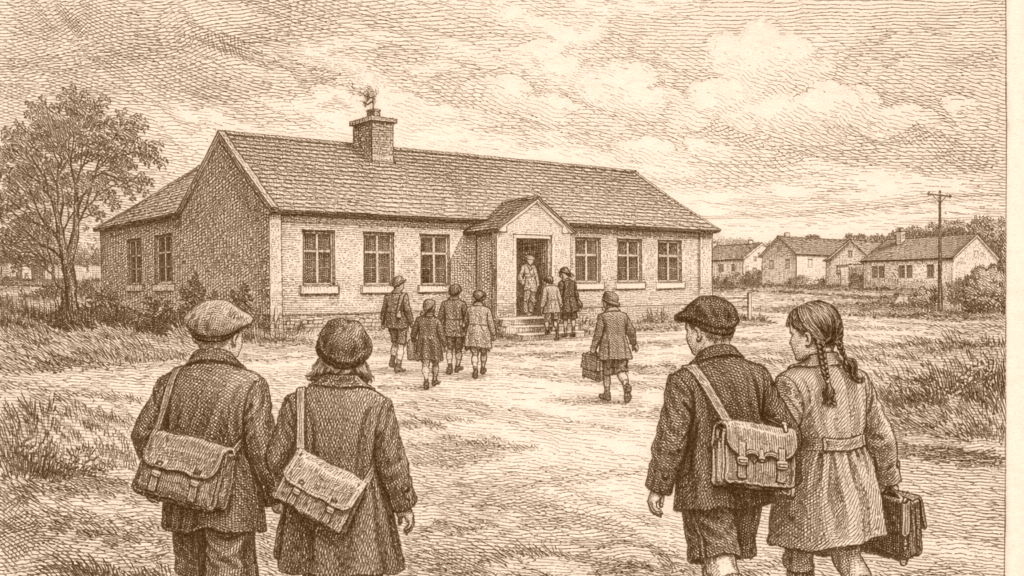
The history page records that the seven-roomed school, identified with the lower corridor of the present building, opened and was blessed on 2 July 1951 under the patronage of Our Lady Queen of Peace. It lists the original staff and identifies Sr. Celsus as the first principal. The same page notes that the Presentation Sisters of Sexton Street paid the site cost and local contribution, linking the opening to a specific institutional commitment.
A further change came in 1956, when the school added a second storey for senior pupils and reopened on 2 July of that year. The text connects this expansion to rapid population growth from new housing schemes in Janesboro and names additional teachers who joined the staff. What is directly visible in the record is an account of enlargement, increased staffing, and a continuing role for the Presentation community in meeting local costs.
Current Life
The school website identifies Our Lady Queen of Peace as a mixed national school in Janesboro, serving children from pre-school to sixth class. Its current pages list classes, transition support, parents’ resources, activities, sports, choirs, music, speech and drama, digital literacy, green schools, wellbeing, student council, and gardening. These items show a busy contemporary school profile, though the page itself does not explain how each programme developed.
The same site also presents a school that invites visitors to explore a virtual tour and recent news items. In that layout, the school appears as an active online presence with photographs and announcements attached to ordinary school life. The evidence here is limited to the visible website structure, but it is enough to show that the school now represents itself through both text and image on its own platform.
Photographic Record
A 2019 newspaper slideshow records the opening of a new astroturf pitch at Our Lady Queen of Peace in Janesboro. It says the pitch was formally opened by the principal, the Mayor of Limerick, and the chief executive of EI Electronics. The article also notes that students welcomed the pitch and that the school marked the occasion with activity on the new surface, including a basketball game between teachers and students.
The same report mentions a new extension at the back of the school and identifies Sister Claire Morrisey as the first person through the doors in 1954. Those details sit beside the photographs of the pitch opening and show how a current image story can be read against older institutional memory. The comparison is direct: the article joins present-day facilities, ceremonial participation, and remembered school beginnings.
Civic Study
In 2011, a Limerick Post report described pupils from Our Lady Queen of Peace visiting City Hall as part of an active citizenship programme. The article states that fifth-class pupils had been studying local government, that this topic had become part of the curriculum at the school, and that the pupils would sit an examination on it. The evidence shows a school engaging with civic learning through a structured class project.
The same report gives the school principal’s account of how the idea developed after a visit to Toronto, where he saw teachers and young people meeting representatives and later sitting an exam on local authority and government. It also describes a mock election, a future plan to study national government, and a twinning link with a school in Cape Town. These points are specific to the article and do not go beyond what it says.
Local Memory
Local archive material shows that Janesboro also appears in wider photographic collections beyond the school’s own website. A Limerick.ie archive page on From Limerick With Love explains that the project produced a web archive of Limerick in the 1970s from the Limerick Leader’s photographic archive. It states that the archive contains more than 25,000 images and includes Janesboro among the catalogue entries shown on the page.
Another Limerick.ie page describes Limerick Archives as holding collections related to local government and the commercial and cultural life of the city, with some popular collections digitised for online viewing. It specifically notes collections for Mayors of Limerick City and for Property Management, while also listing Janesboro among areas included in allotment-scheme records. These references show the kind of record environment in which Janesboro history and photographs can be placed.