Pride Nation
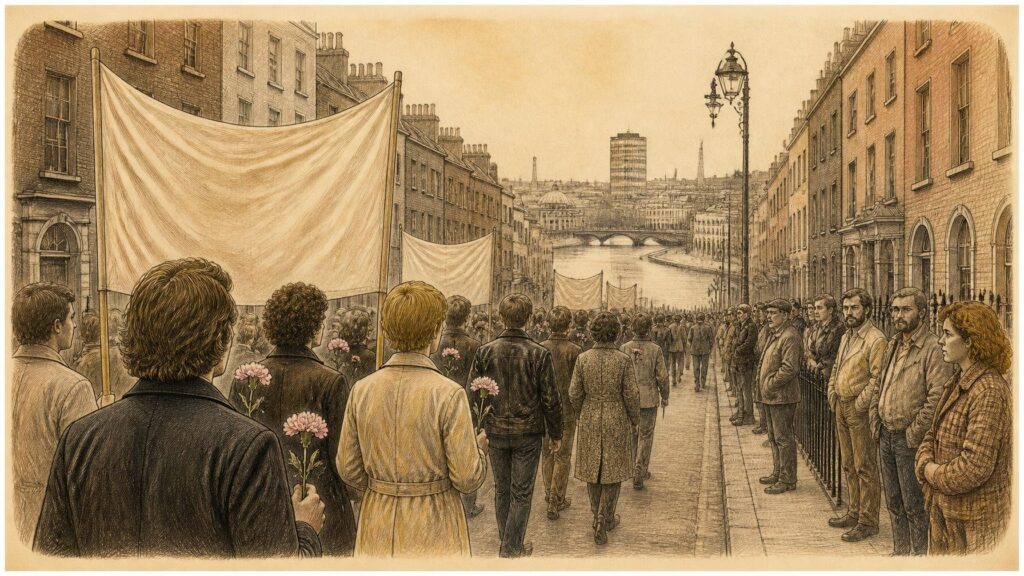
AI generated historical illustration, not a contemporary photograph.
At a Glance
Dublin Pride is not simply an annual festival placed upon the city’s summer calendar. Its history records a transformation in who could appear in public, claim safety, form a family, speak of love and belong visibly within Ireland. By 2026, the procession through Dublin carried both the confidence of a large civic occasion and the difficult memory of a movement formed when public identification could bring isolation, dismissal, violence or prosecution.
Public Beginnings
The phrase “Dublin Pride” can create a misleading impression of continuity. It is tempting to see the modern parade, with its crowds, voluntary organisations, public agencies, trade unions, performers, political contingents and commercial participants, as the natural expression of an already tolerant capital. The historical record suggests something much more contingent. Pride emerged from small, sometimes fragile networks of people who had to make themselves visible in a society where homosexual acts between men remained criminal offences and where lesbian, gay, bisexual and transgender lives were commonly pushed into privacy, euphemism or silence.
There had always been people in Ireland whose lives and desires did not conform to heterosexual expectations, but their histories do not form a simple unbroken modern identity. Historians must be cautious about projecting contemporary labels backwards. Earlier records may use legal, medical, religious or hostile language rather than the terms people would choose today. They also preserve some lives far better than others: men encountered by courts or newspapers are more readily visible than women whose relationships were not similarly criminalised; urban people are more visible than rural people; those with education, connections or surviving papers more visible than those without them. Absence from an archive is not proof of absence from society.
What can be documented is the emergence after the late 1960s and early 1970s of an organised liberation politics in Dublin. International developments mattered. The Stonewall uprising in New York in 1969 became a powerful international reference point, but it did not mechanically produce an Irish movement. Irish organisers adapted ideas about liberation, feminism, civil rights and public protest to local conditions: the influence of the churches, the authority of criminal law, censorship, emigration, university life, the Northern Irish conflict and the particular intimacy of a relatively small capital city.
The National Library of Ireland’s Irish Queer Archive preserves organisational papers, flyers, photographs, magazines, posters and other ephemera from this period. Its very existence alters the historical picture. Pride’s past is no longer dependent solely upon retrospective recollection or celebratory anniversary accounts. It can be approached through material made at the time: programmes for early Pride events, campaigning publications, correspondence, photographs of rallies, and records of groups whose labour made public community possible. That archive demonstrates that Irish queer history is not a marginal footnote to national history. It is part of the record of how modern Ireland was argued over, inhabited and changed.
Legal Inheritance
Early Dublin activism worked under a legal inheritance that was older than the Irish State. The Offences Against the Person Act 1861, enacted under the United Kingdom of Great Britain and Ireland, criminalised “buggery”; the Criminal Law Amendment Act 1885 later created the offence commonly known as gross indecency between males. After independence, these provisions remained in force in the new state. This continuity matters. It complicates any account that treats repression as merely a colonial residue or, conversely, as an unchanging essence of Irish society. Irish governments retained and enforced laws that placed a category of consensual adult intimacy under criminal sanction.
The law did not define every queer life, nor did it operate equally in every case. Yet its symbolic and practical force was extensive. It made disclosure dangerous, furnished blackmail with leverage, reinforced workplace and family secrecy, and confirmed the assumption that homosexuality belonged outside respectable public life. The law targeted male same-sex acts directly, but women and gender-nonconforming people were also affected by wider social sanctions, professional risk, medicalised ideas and institutional power. A history focused only on prosecution would therefore be too narrow. Criminal law was one part of a larger environment of constraint.
By the 1970s, activists increasingly refused the premise that private tolerance was sufficient. Their demand was not only that the police leave people alone. They sought the abolition of discriminatory law, the right to meet and publish, accurate representation, health information, social spaces, and a public culture in which queer people did not have to disappear in order to be safe. This distinction helps explain why Pride became important. A march does not merely celebrate a private identity. It reverses the older political instruction to remain unseen.
In October 1973, a small group met at Trinity College Dublin and established the Sexual Liberation Movement. Accounts associated with participants describe a broad agenda, concerned not only with homosexuality but with feminism, racism, colonialism, art and culture. The breadth was significant. It placed sexual liberation within a critique of social hierarchy rather than presenting it simply as a plea for tolerance. Some members subsequently concentrated more specifically upon gay rights through the Irish Gay Rights Movement. Such shifts should not be mistaken for division alone: movements often grow by developing different organisations, priorities and vocabularies.
The first small public demonstrations of the mid-1970s were acts of considerable courage. Sources differ on exact participant numbers and on how particular events should be named, a reminder that commemorative history can simplify messy beginnings. The broad sequence is clear, however. In 1974 activists protested against laws criminalising homosexuality outside the Department of Justice and at the British Embassy. The protest connected conditions in the Republic with those in Northern Ireland, where a related legal framework remained in place. Dublin Pride’s history was therefore linked from the outset to an all-island consciousness, even though legal jurisdictions, political institutions and local experiences differed.
Organising Voices
Public protest needed supporting institutions. The Hirschfeld Centre, opened in 1979, was a major development because it gave Dublin a recognisable community base. It offered space for meetings, events and services at a time when many people lacked any safe venue in which to find one another. Its name honoured Magnus Hirschfeld, the German sexologist and reformer whose Institute for Sexual Science had been destroyed by the Nazis in 1933. Choosing that name located Dublin organisers within a longer, international history of sexual reform and persecution.
Community infrastructure should not be romanticised. Centres require money, volunteer time, secure premises and resilience against hostility. Small organisations also experience disagreements about tactics, gender, class, political language and who gets to speak for a diverse population. But the creation of a centre made a practical difference. It allowed people to exchange information, organise social life and campaign with greater regularity. The National Library’s holdings, which include material from the Sexual Liberation Movement, the Irish Gay Rights Movement, Lesbians Organising Together, Gay Health Action, the National LGBT Federation and Dublin LGBT Pride, preserve evidence of this patient organisational work.
Lesbian organising deserves particular attention. Narratives centred on the decriminalisation of male homosexual acts can unintentionally make lesbian history appear secondary. It was not. Lesbian activists contributed to liberation politics, feminist organising, cultural life and Pride itself, while also confronting forms of exclusion that could exist within gay male spaces and within wider society. The history of bisexual, trans, intersex and queer organising likewise cannot be treated merely as an expansion of initials. Different experiences created different needs, whether around healthcare, legal recognition, language, youth support, safety or representation.
Print culture was another form of organising. Newsletters, magazines and leaflets enabled a dispersed community to recognise itself, debate strategy and advertise events. They recorded social worlds that conventional institutions often ignored. The later foundation of Gay Community News, now GCN, created a durable national LGBTQ+ press presence. Its archive is valuable not because it gives a single definitive account, but because it reveals contemporaneous arguments, anxieties and aspirations. A community publication can show how people narrated themselves while events were still uncertain, rather than only how later generations chose to remember them.
There was also an important relationship between public visibility and concealment. For some, attendance at a meeting, a march or a dance was a first step towards a less isolated life. For others, it was impossible or unsafe. Employment in schools, hospitals, state bodies or religiously influenced institutions could make disclosure feel perilous. Family relationships could be supportive, indifferent or hostile. Migration offered some people relief and opportunity, but it also removed experience and energy from Irish organising. Pride’s early history should therefore not be told only through its visible leaders. It also belongs to those who read a leaflet, made a phone call, attended once, offered a lift, donated money, or found a temporary refuge in company.
Fairview Turning
The event most closely associated with Dublin Pride’s emergence as a protest march was the killing of Declan Flynn. In September 1982, Flynn, a thirty-one-year-old gay man, was attacked in Fairview Park. His death, and the subsequent treatment of those convicted, shocked and angered many people in Dublin’s gay community and beyond it. The historical importance of the case lies not in treating one death as a symbolic abstraction, but in recognising how violence and the public response to it made existing vulnerability unmistakable.
Contemporary and retrospective accounts differ over some numerical details: the number who marched, the exact route and whether the March to Fairview or the later June parade should be identified as the first Pride event. Such variation is unsurprising in activist history, particularly where records are partial and memory is shaped by later commemoration. It does not alter the central fact that the March to Fairview in March 1983 was a major public demonstration against homophobic violence and official indifference. People marched from central Dublin to the park where Flynn had been killed. Their presence asserted that violence against gay people would no longer be met with invisibility.
That assertion was risky. To walk publicly in a gay-rights demonstration could expose someone to ridicule, employment consequences or family discovery. The march therefore represented a claim to citizenship in its most physical form: bodies together on city streets, refusing the expectation of shame. It also connected grief to political action. Pride traditions internationally have often combined commemoration and celebration; Dublin’s development made that combination especially clear. The later festival atmosphere must not obscure the bereavement and anger from which the early march drew force.
In June 1983, the Gay Rights Protest March provided the first formal Dublin Pride parade generally recognised in anniversary accounts. It was modest by twenty-first-century standards but historically consequential. Marchers moved through a city where the law still criminalised consensual sexual acts between men. The event did not signal that equality had been won. Rather, it made inequality publicly legible. Its language, route and participants framed gay rights as a question for the whole city, not a private concern to be confined behind closed doors.
The Fairview history also requires care because it has become a powerful origin story. Origin stories can inspire, but they can tidy the past by giving a diverse movement one decisive beginning. Dublin Pride grew from several strands: the Sexual Liberation Movement, Irish Gay Rights Movement campaigning, lesbian and feminist activism, social gathering, international solidarity, health work, publishing and the creation of community institutions. Fairview did not create those currents from nothing. It intensified them, gave them a shared public focus, and helped turn a dispersed struggle into a visible annual political tradition.
Marching Memory
The early 1980s were not a steady ascent towards the large parades of later decades. Pride events continued, but the capacity to mount a regular parade faltered. Activists confronted exhaustion, limited resources, emigration and the devastating arrival of HIV and AIDS. The tendency to describe this period merely as a hiatus understates its severity. It was a time when people were mourning friends and partners, navigating fear and misinformation, campaigning for services and attempting to sustain community life amid social stigma.
AIDS transformed the meaning of visibility. Public recognition could be lifesaving when it challenged silence, secured health information and demanded adequate care. It could also be dangerous where media language was hostile, where moral judgement displaced compassion, or where those living with HIV feared exposure. Irish queer communities responded through health activism, mutual aid and education. Gay Health Action and other networks carried burdens that state institutions and mainstream society did not always meet promptly or adequately. Pride, in this setting, was not an escape from crisis. It was one of the places where survival, remembrance and political demand could be articulated.
Archival photographs and programmes demonstrate that Pride did not disappear when parades became difficult to sustain. Week-long events, picnics, cultural gatherings, public information, kiss-ins and demonstrations continued in altered forms. In 1987, for example, activists staged a kiss-in outside Leinster House, the seat of the Oireachtas. The gesture was deliberately simple: affection made visible at the centre of political authority. Its power came from the fact that such visibility had been denied or rendered scandalous.
Memory of this period is now often carried by veteran activists, oral histories and archival collections. Each is indispensable, but each has limits. Oral testimony conveys emotion, atmosphere and the meaning of participation in ways that official papers rarely can. It may also compress dates or retrospectively connect events more neatly than they were understood at the time. Institutional documents can establish legislation, programmes and organisational structures, but may omit the private costs of living under stigma. Good historical writing needs both forms of evidence and should say when it is interpreting rather than reporting an uncontested fact.
The preservation of flyers, club notices, badges and photographs is especially important because queer history has often been vulnerable to loss. Families may discard papers after a death; organisations may lack storage; events intended as temporary may leave only traces. The Irish Queer Archive, donated to and maintained by the National Library of Ireland as a living collection, has helped turn fragile community memory into a resource for public history. Its holdings make it possible to see Pride not merely as a present spectacle but as accumulated labour.
Legal Turning
Legal reform changed the conditions in which Pride took place, though it did not by itself end prejudice. Senator David Norris’s challenge to Irish criminal law became central to that change. Norris brought a case before the European Court of Human Rights arguing that laws criminalising certain consensual homosexual acts between adult men breached his right to respect for private life under Article 8 of the European Convention on Human Rights. On 26 October 1988, the Court held that Ireland was in violation of Article 8.
The judgment did not instantly repeal Irish law. Its significance was legal, political and moral. It established that the State’s criminalisation of consensual adult male homosexual conduct could not be reconciled with the Convention. It also demonstrated the importance of transnational human-rights institutions to Irish reform, while the eventual legislative response remained a decision for the Oireachtas. In 1993, the Criminal Law (Sexual Offences) Act decriminalised consensual homosexual acts between adult men. The Oireachtas has rightly marked the legislation as a landmark in modern Irish history.
Decriminalisation was fundamental, but it was a floor rather than a completed equality settlement. It removed a particular criminal prohibition; it did not guarantee freedom from discrimination in housing, employment, education, family life, healthcare or public space. Nor did it settle questions of gender recognition, same-sex partnership, parenting or the experiences of people outside the categories most directly addressed by the 1993 reform. Pride remained necessary precisely because law reform and social equality move at different speeds.
The 1990s and 2000s consequently brought a mixture of progress and continued contest. Equality legislation offered important protections against discrimination, while campaigning organisations pressed for relationship recognition and broader social inclusion. Pride changed in scale and tone as a result. It became increasingly possible for individuals and organisations to appear openly, but its political purpose did not vanish. Parades could celebrate the legal changes already achieved while directing attention towards the gaps that remained.
This was also a period in which the language of identity changed. “Gay and lesbian” gave way in many contexts to “LGBT”, and later to longer formulations intended to recognise bisexual, transgender, queer, intersex and other people. No acronym can perfectly contain a diverse population, and terminology continues to evolve. Historians should avoid assuming that present language was universally used in the past. Yet the changing language itself is evidence: it reflects efforts to name people whom earlier public narratives had excluded and to challenge the idea that a single experience could represent an entire movement.
Constitutional Change
The marriage-equality referendum of 22 May 2015 became one of the most internationally recognised moments in recent Irish history. Voters approved the Thirty-fourth Amendment to the Constitution, enabling marriage without distinction as to the sex of the parties. The result was important not only because it led to the Marriage Act 2015, which removed the legal impediment to marriage for same-sex couples, but because the decision was made by popular vote. For many participants, the campaign involved an unusual degree of personal testimony: people spoke with relatives, neighbours, colleagues and communities about lives that had previously been concealed.
That history should not be reduced to a reassuring national story in which Ireland suddenly became uniformly liberal. A referendum campaign necessarily contained disagreement, religious and ethical debate, and uneven experiences across families and regions. Support for marriage equality did not erase bullying, discrimination or loneliness. Still, the vote was a powerful constitutional statement. It altered the symbolic boundaries of the Irish family by confirming that same-sex couples belonged within the institution of marriage. In historical terms, the contrast with criminalisation in 1993 is striking, though it should not make the earlier generation’s campaigning appear inevitable.
The Gender Recognition Act 2015 was another major milestone, allowing eligible people to obtain legal recognition of their preferred gender. Its passage followed years of trans activism and litigation, including the long campaign associated with Dr Lydia Foy. The law represented an important shift from requiring trans people to fit administrative categories imposed upon them towards acknowledging gender identity in state documentation. Yet, as with marriage equality, legislation did not resolve every question around healthcare, family law, age, non-binary recognition or everyday acceptance. Progress in law can be decisive while still incomplete.
Dublin Pride’s place in Irish identity changed in this context. What had begun as a challenge to exclusion increasingly became a prominent civic occasion. The transformation is visible in the participation of public bodies, cultural institutions, schools, universities, unions and businesses. This can be read as evidence that the meaning of Irishness widened. It can also raise difficult questions. When institutions celebrate Pride, are they acknowledging the movement that pressed them to change, or are they using its colours without sharing its responsibilities? The answer varies by institution and cannot be settled by branding alone.
The most useful interpretation is not that Pride became either wholly radical or wholly absorbed into the mainstream. It became a site where those tendencies coexist. Its route through central Dublin joins official and unofficial Ireland: Parliament, public offices, commerce, historic streets, transport networks, workplaces and private households. The parade’s visibility is therefore itself a record of changing citizenship, but also an arena in which the terms of citizenship continue to be disputed.
Visible Nation
By 2026, Dublin Pride was a large annual event with a route through the city centre and a scale unimaginable to the early marchers. The 2026 parade took place on Saturday, 27 June. Contemporary festival information described a route beginning around O’Connell Street and moving through the quays towards Merrion Square, while the announced theme, “One Story, Many Voices”, explicitly acknowledged diversity of experience. The phrase is apt historically. There is no single queer Irish story, and no single version of Irish identity into which LGBTQ+ people have merely been inserted.
At the same time, numerical scale should not become the only measure of historical success. Large crowds can offer joy, reassurance and visibility. For a young person from an isolated place, seeing thousands of people gather openly can be deeply significant. For older participants, the occasion may recall a time when a much smaller group risked far more simply by assembling. But a parade cannot, by itself, establish whether people are safe at school, supported by family, able to access healthcare, secure in employment or free from harassment. The historical meaning of 2026 lies partly in holding those two truths together: public transformation was real, and private vulnerability did not vanish.
Pride’s relation to Irish identity is especially revealing because national identity has often been imagined through family, religion, respectability and community. In the twentieth century these ideas could be invoked to exclude people whose lives did not conform to dominant sexual or gender norms. The late twentieth and early twenty-first centuries saw vigorous challenges to that inheritance. LGBTQ+ activists did not simply request admission to an unchanged national story. They argued that the story had always been incomplete: queer people had been present in Irish families, workplaces, cultural life and political movements, even where public recognition was denied.
There is a temptation to contrast an allegedly repressive past with a wholly emancipated present. Such a contrast flatters the present and simplifies the past. Ireland’s earlier decades contained courage, friendship, artistic creativity and forms of unofficial community despite hostile structures. Present-day Ireland, meanwhile, includes people with sharply different experiences shaped by age, disability, class, race, migration status, religion, geography and gender identity. A national parade can display solidarity, but it cannot automatically speak equally for everyone.
The most historically responsible understanding of Irish identity is therefore plural. It includes those who marched at risk in 1983, those who campaigned in court and parliament, those who cared for friends during the AIDS crisis, those who voted in 2015, those who did not feel represented by prevailing campaigns, and those newly arriving in Ireland with their own histories of safety or persecution. Pride is meaningful because it makes room for this complexity in public, rather than because it produces a final consensus.
Contested Belonging
The growth of Pride has generated debates about sponsorship, policing, corporate participation and political representation. These are not signs that the festival has somehow failed to become uncomplicatedly celebratory. They are part of its history. Early organisers also debated resources, respectability, radicalism and the purposes of public events. The contemporary scale of Dublin Pride makes such questions more visible because large festivals require funding, planning, crowd management and relationships with institutions that earlier activists often challenged.
Commercial involvement can provide practical support and signal changes in workplace culture. It can also provoke legitimate criticism if organisations display rainbow imagery while failing to protect LGBTQ+ staff, customers or communities in their policies and conduct. The historical lesson is that Pride was never created as a marketing opportunity. It grew from protest against violence, criminalisation and exclusion. Any institution that participates in a parade inherits, at least symbolically, that history. The value of participation should be measured less by a logo than by sustained action.
Similar questions arise around official participation. The presence of Garda representatives, civil servants, elected politicians and state agencies can indicate institutional change, particularly given earlier experiences of mistrust and neglect. Yet it does not erase the need for accountability where individuals encounter discrimination or feel unsafe. Pride offers neither a verdict of acquittal nor a permanent condemnation. It is a public setting in which institutions can be welcomed, questioned and asked to demonstrate what their stated commitments mean in practice.
The relationship between Dublin and the rest of the island also deserves attention. Dublin Pride is the largest event of its kind in Ireland, but it does not represent every local experience. Pride festivals and LGBTQ+ groups operate across towns, cities and counties, while Belfast has its own distinct history within the political and legal context of Northern Ireland. The 1974 Dublin protest’s attention to laws north and south showed that activists understood these connections early. A Dublin-centred story is useful, but it should not imply that queer Irish history is confined to the capital or identical in both jurisdictions.
Questions of trans and intersex equality have made the limits of a simple triumphal narrative particularly clear. Legal gender recognition was a major achievement, yet many practical and political issues remain debated. Likewise, racism, ableism, poverty and insecure migration status affect access to safety and community. The Criminal Justice (Hate Offences) Act 2024, which came into force on 31 December 2024, created aggravated offences where crimes are motivated by hatred relating to specified protected characteristics including sexual orientation, gender and sex characteristics. Its enactment recognises that prejudice can inflict particular harm; it cannot by itself create the social conditions in which hate ceases.
Archival Futures
One of the most important developments in the history of Dublin Pride is the determination to preserve it. The Irish Queer Archive holds the papers of organisations ranging from the Sexual Liberation Movement and the National LGBT Federation to Lesbians Organising Together, GAZE, Gay Health Action and Dublin LGBT Pride. It also includes posters, publications, photographs, audio-visual material and web archives, including material from the 2015 marriage-equality campaign. These collections give historians evidence with which to test memories, recover overlooked voices and understand the everyday machinery of activism.
Archives are not neutral containers. They reflect what was saved, donated, catalogued and made accessible. Some groups had the resources to produce publications; some people could safely keep correspondence; some lives remain difficult to trace precisely because secrecy was a condition of survival. Digital preservation creates opportunities but introduces its own risks of loss, unstable formats and dependence on platforms. The absence of a record should consequently prompt questions: who could safely create one, whose material was judged valuable, and which stories remain outside the collection?
This is why folklore, memory and documentation should be distinguished rather than set against one another. Folklore in the broad sense includes repeated stories about first marches, hidden meeting places, acts of defiance and the personalities who held communities together. Such accounts may preserve truths about atmosphere and belonging even where details are uncertain. Documentation can verify dates, laws, organisational decisions and printed claims, but it cannot exhaust the meaning of a life. Interpretation links these forms of evidence, acknowledging both their strengths and their limits.
The 2026 Pride theme offered an accidental methodological lesson. “One Story, Many Voices” should not mean forcing many lives into one comforting narrative. Rather, it should mean accepting that historical truth is richer when it allows for disagreement, different memories and incomplete evidence. The story of Dublin Pride includes protest and party, grief and comedy, legal strategy and artistic experiment, intimacy and public spectacle. Its archive needs room for all of them.
Continuing Questions
Dublin Pride’s historical importance lies in its refusal of a choice between celebration and politics. Celebration has political meaning where a community has been told that its love, body or identity should be hidden. Politics has emotional meaning where rights concern friendship, fear, family and survival. The most successful accounts of Pride do not strip away either dimension. They understand that joy can be evidence of a hard-won freedom, while remembering that freedom must be defended and extended.
Irish identity in 2026 cannot credibly be described without LGBTQ+ people and their histories. They are not recent additions to the nation, although public acknowledgement of them is recent in many settings. They were present in the lives of the cities, towns, institutions and families that constitute Ireland. What changed was the capacity to organise publicly, to contest law, to establish archives, to secure recognition and to claim the streets without accepting shame as the price of belonging.
That change was neither automatic nor complete. It depended on people whose names are recorded and on many whose names are not: organisers, writers, volunteers, carers, lawyers, teachers, performers, health workers, friends and families. It depended on individuals prepared to appear when appearance carried a cost. The large Dublin parade of 2026 is best understood as their inheritance, not as proof that the work is finished.
The continuing question is therefore not whether Pride belongs to Irish identity. Its history has answered that. The question is what kind of Irish identity Pride asks the country to practise: one that treats difference as a decorative sign of modernity, or one that accepts equal dignity, safety, memory and participation as ordinary conditions of national belonging. The answer lies less in any single parade than in the everyday institutions and relationships that follow after the crowds have gone home.