

Triple Lock
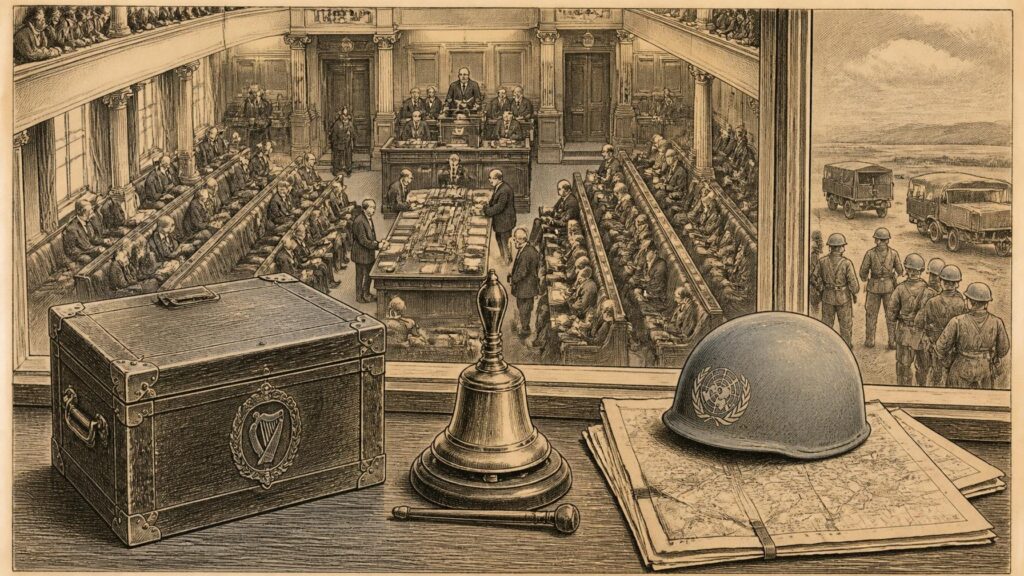
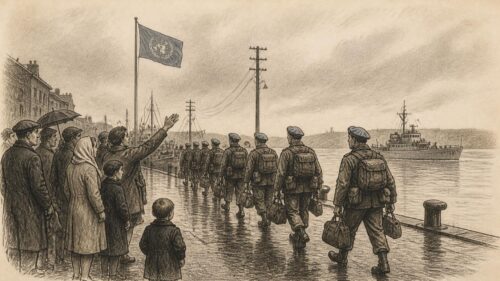
AI generated historical illustration, not a contemporary photograph.
At a Glance
Ireland’s “triple lock” is the name commonly given to the legal and political safeguards governing substantial overseas deployments of the Defence Forces on international peace support operations. In its familiar form, it required three things: a decision of the Irish Government, approval by Dáil Éireann, and a United Nations mandate. It was not a constitutional provision and it was never a complete definition of Irish neutrality. Yet, through the long association of Irish soldiers with United Nations service, and through arguments about sovereignty, European integration and war, it acquired a symbolic force far greater than its compact statutory wording might suggest.
Legal Meaning
The expression “triple lock” describes a combination of controls rather than the formal title of one single law. In broad terms, the mechanism arose from provisions governing the despatch of members of the Permanent Defence Force outside the State as part of an International United Nations Force. The three elements conventionally identified were Government approval, a Dáil resolution for a significant armed contingent, and a United Nations authorisation for the relevant operation. These requirements developed through legislation enacted at different moments, rather than appearing all at once under the modern phrase.
Its central purpose was to make overseas military service an exceptional and publicly accountable act. Ireland’s Defence Forces could not simply be sent abroad at executive discretion for a large peacekeeping deployment. The Government had to decide that a contribution was desirable; the elected lower House had to approve it; and the mission had to possess international authority through the United Nations system. The arrangement connected domestic democratic consent to an international legal framework.
That description needs qualification. The triple lock did not apply to every form of overseas activity undertaken by Defence Forces personnel. Statutory provisions permit members to travel abroad, with Government authority, for matters such as training, exchanges, military representation, monitoring, reconnaissance, fact-finding, humanitarian work in response to disaster, and inspections. Nor did the historical legislation require a Dáil vote for every member attached to a UN force. The threshold of twelve personnel was important. A small armed contingent of no more than twelve could be despatched without a prior Dáil resolution, provided that the total Irish contingent with that force did not thereby rise above twelve.
Equally, the term does not mean that the United Nations commands the Irish Defence Forces. Irish personnel remain subject to Irish national authority while serving within international arrangements, even where operational command is exercised under agreed multinational structures. The United Nations element was a legal condition for Ireland’s participation in the class of operations to which the relevant statutory provisions applied. It was an authorising gate, not a transfer of constitutional sovereignty.
In public discussion, the three locks are often reduced to a memorable formula: UN, Government, Dáil. That formula is useful, but it can obscure the legal detail. A UN mandate, for example, may be understood differently according to whether a mission is directly established by the Security Council, authorised by it, or organised by another international body under Security Council authority. Historical legislation used the language of an “International United Nations Force”, while later policy and political debate spoke more broadly of peace support and crisis-management operations.
The most careful answer to the question “what is the triple lock?” is therefore both simple and precise. It was Ireland’s statutory framework for substantial deployments of Defence Forces personnel overseas on UN-authorised international peace operations, combining executive decision, parliamentary approval and UN authority. It was closely associated with Ireland’s policy of military neutrality, but was neither identical with neutrality nor embedded as an unalterable rule in Bunreacht na hÉireann.
State Origins
The background to the triple lock lies in the formation of the Irish State and in the changing meaning of neutrality. The Free State entered the League of Nations in 1923 and participated actively in multilateral diplomacy. Its leaders did not understand independence as isolation. They sought recognition for a small state, protection through international law, and a voice in institutions where larger powers might be constrained, at least in principle, by common rules.
That aspiration existed alongside a persistent concern that Ireland should not become entangled in British wars or permanently tied to a great-power alliance. The State’s neutrality during the Second World War, known domestically as the Emergency, became a formative episode in public memory. It was shaped by principle, strategic weakness, the legacy of partition, domestic security, and the need to preserve a newly achieved independence. Later accounts have sometimes portrayed it as a timeless national doctrine. The documentary record suggests something more complex: a policy with deep political resonance, but also one altered repeatedly by circumstance.
After the war, the new United Nations offered a different model of international order. Whereas a military alliance commits a group of states to defend one another, collective security is based on a wider international institution identifying threats to peace and organising a response. The distinction mattered in Ireland. Successive governments rejected membership of NATO, but they could support the UN Charter, international law and peacekeeping under UN authority. Military non-alignment and support for collective security were not treated as mutually exclusive.
Ireland joined the United Nations in 1955. Membership was itself a significant moment. It followed a long delay caused by Cold War disagreement within the Security Council, not by Irish indifference to the organisation. Admission made it possible for the State to participate more fully in the diplomatic and practical work of the UN. Within a few years, Irish officers and soldiers were serving overseas under the blue flag.
The beginning of continuous overseas involvement is generally dated to 1958, when Irish military observers served with the United Nations Observer Group in Lebanon. The deployment was modest, but its consequences were extensive. Overseas service became a defining task of the Defence Forces, bringing experience, international visibility, danger and bereavement. Missions in the Congo, Cyprus, Lebanon, Somalia, the Balkans, East Timor, Liberia and elsewhere later made peacekeeping central to the public image of the Irish military.
This history helps explain why the triple lock became important. It did not grow out of an abstract constitutional theory alone. It developed in a state that had decided to provide military personnel for international operations while remaining outside formal collective-defence alliances. The question was how to enable participation without opening an unrestricted executive power to commit troops abroad.
Early Legislation
The decisive early measure was the Defence (Amendment) (No. 2) Act 1960. Its purpose was practical: it provided a legal basis for sending contingents of the Permanent Defence Force outside the State with International United Nations Forces. The Act was enacted during the early years of Irish peacekeeping, when the emerging practice of UN operations was still developing and the Congo crisis was about to demonstrate how dangerous and politically consequential such service could become.
Section 2 of the 1960 Act established the parliamentary element clearly. A contingent could be despatched for service outside the State as part of a particular International United Nations Force only if Dáil Éireann had passed a resolution approving that despatch, subject to stated exceptions. The main exceptions concerned an unarmed force, a contingent of not more than twelve personnel, and replacements or reinforcements for an already approved contingent of more than twelve. The legislation did not employ the later popular phrase “triple lock”, but it created one of its essential locks: Dáil approval.
The Act must be read in the legal and institutional language of its own time. It referred to “International United Nations Forces” rather than to the wider vocabulary of peace support operations now common in policy documents. It reflected a period in which the UN was expected to organise peacekeeping forces on its own behalf and in which the boundary between observation, traditional peacekeeping and enforcement had not yet acquired all the later distinctions.
Government approval was also fundamental. Even where a Dáil resolution was necessary, deployment did not occur automatically. The executive had to propose and organise it. The Government was responsible for assessing Ireland’s interests, the mission’s character, the available personnel and equipment, the risks involved, and the diplomatic consequences. In practice, therefore, the Government and the Dáil performed different functions: one initiated and managed policy; the other supplied a public democratic authorisation for significant deployments.
The UN dimension derived from the definition and structure of the 1960 statute, and from the broader premise that Ireland was contributing to an international force authorised within the UN system. Later public shorthand rightly identified this as a third condition. The result was a legal formula that gave Ireland a distinctly cautious route into overseas military service: national executive consent, parliamentary assent and multilateral authority.
Congo Experience
The Congo crisis gave the early legislation its sharpest historical context. In 1960, the Belgian Congo gained independence and rapidly descended into political and military crisis. The United Nations established the ONUC mission, one of the largest and most difficult operations of the Cold War. Ireland contributed troops. The deployment showed that peacekeeping could involve far more than monitoring a ceasefire. It exposed Irish personnel to danger, uncertainty and lethal violence.
Irish soldiers served in conditions that challenged simple ideas of neutrality and peacekeeping. They were armed, operating in a fragmented conflict with competing authorities, armed groups and international pressures. In September 1960, nine Irish soldiers were killed in an ambush at Niemba in Katanga. Their deaths became a lasting part of the Defence Forces’ institutional memory. They also demonstrated to the Irish public that UN service was not ceremonial humanitarianism: it could exact a grievous human cost.
The Congo experience did not create the triple lock in the strict legal sense; the 1960 Act was already the statutory vehicle for participation. But it gave force to the political instinct behind safeguards. Sending troops abroad could involve consequential choices over war, force, international legitimacy and national responsibility. The Dáil’s role ensured that large deployments could not be treated as routine administrative decisions.
It also revealed a tension that would persist. UN peacekeeping was presented as a contribution to peace, yet missions could become entangled in coercive action, internal conflict and competing interpretations of international authority. A state could wish to support the UN and still be cautious about exactly what an operation required its soldiers to do. The Irish mechanism sought to preserve that caution while allowing participation.
There is no reliable historical basis for treating the triple lock as a magical guarantee that Irish soldiers would never face combat. The Congo alone disproves that notion. Nor did a UN mandate remove all moral or strategic difficulty. What the framework did was require formal Irish decision-making within a UN-centred system before a major contingent was committed. It was a process of authorisation, not a promise of safety or political unanimity.
United Nations
The UN component of the triple lock rests on a particular understanding of international legitimacy. Under the UN Charter, the Security Council has primary responsibility for the maintenance of international peace and security. The Council can establish peace operations, set mandates, revise them and end them. Its five permanent members possess veto rights over substantive decisions. This constitutional arrangement of the UN has always been both a source of authority and a source of frustration for smaller states.
For supporters of the traditional framework, Security Council authorisation supplied a vital collective judgement. It placed an overseas deployment within the institution intended to represent international peace and security, rather than leaving it to the preferences of a coalition of states or a regional organisation. In this view, the UN requirement did not diminish Irish sovereignty. Ireland had freely chosen, through legislation, to make UN authorisation a condition of a particular kind of military participation.
For critics, the same requirement gave disproportionate influence to the permanent five members of the Security Council: China, France, Russia, the United Kingdom and the United States. A veto, or the credible prospect of one, can prevent a mandate from being adopted. Critics argued that this could obstruct Ireland from contributing to otherwise lawful and necessary peace operations, and that it was anomalous for a permanent member to have effective power over whether Ireland could make a sovereign decision to send personnel abroad.
That disagreement reflects a genuine contradiction within the post-war international system. The Security Council was designed to combine universal principles with the power realities of 1945. Its authority can give a mission broad legitimacy, but its decision-making is vulnerable to rivalry among major powers. Ireland’s triple lock placed Irish deployments within that system and therefore inherited both its strengths and its defects.
Peacekeeping itself must also be understood accurately. It is not identical to neutrality, and it is not simply the absence of force. The UN identifies three core principles: consent of the principal parties, impartiality, and non-use of force except in self-defence and defence of the mandate. These principles distinguish peacekeeping from peace enforcement, although real missions can be complex and mandates have sometimes become more robust. The presence of Irish troops on a UN mission has never meant that they were detached from the hazards or moral dilemmas of conflict.
Irish participation has nevertheless given practical meaning to the State’s commitment to multilateralism. The Defence Forces’ long record of overseas service has made United Nations peacekeeping a prominent element of Irish international identity. It has also created an important distinction in public language. Ireland is often described as militarily neutral, but it has not been indifferent to international security. Its policy has generally combined non-membership of military alliances with active support for collective security, peacekeeping, humanitarian assistance and international law.
Neutrality Debate
The triple lock became strongly associated with Irish neutrality, especially from the late twentieth century onward. This association was politically powerful, but it should not be stated too absolutely. Irish neutrality is not defined in one constitutional article or comprehensive statute. Nor has Irish practice matched every classical legal model of neutrality in all periods. Rather, military neutrality has generally been described by the Irish State as non-membership of military alliances and non-participation in common or mutual defence arrangements.
That definition places the emphasis on alliances and mutual-defence commitments. The triple lock concerns something different, though related: the circumstances in which Irish Defence Forces may be deployed overseas as part of international operations. A country could be militarily non-aligned yet send peacekeepers abroad; conversely, a procedural deployment rule could exist without creating neutrality by itself. The two ideas overlap in public sentiment because both are concerned with preventing Ireland from being drawn into wars chosen by others.
For many supporters, the lock expressed a moral and political preference for international law over military blocs. It required that a substantial deployment be connected to a UN mandate and approved by representatives in Dublin. It seemed to embody the proposition that Irish troops should serve peace under international authority, rather than fight in wars of alliance or expeditionary intervention.
For others, describing the mechanism as the heart of neutrality overstates both its legal status and its reach. The rule was enacted by ordinary legislation and could therefore be amended or repealed by the Oireachtas. It did not regulate all forms of cooperation with other states, every overseas military activity, the transit of foreign forces, intelligence relationships, or diplomatic policy. On this interpretation, the triple lock was an important statutory safeguard but not a constitutional prohibition on war.
Both positions contain an element of truth. The law was not constitutionally entrenched, and the term “triple lock” should not be treated as ancient doctrine. Yet legal arrangements may have constitutional importance in a broader political sense without appearing in the constitutional text. Over decades, the mechanism became part of the reassurance offered to citizens that overseas deployments would be restrained, parliamentary and internationally authorised. Its political meaning exceeded its technical origins.
Folklore has played little direct role in this subject, because the triple lock is a matter of twentieth- and twenty-first-century statute, parliamentary debate and official policy. There are, however, public myths. One holds that it has always existed in its present form; it has not. Another holds that it was created by referendum; it was not. The more defensible historical account is that a 1960 statutory foundation later acquired renewed political importance during debates about European treaties and neutrality.
European Questions
The modern prominence of the term emerged particularly in the context of Ireland’s relationship with the European Union. European integration brought recurring questions about security and defence cooperation. Ireland supported European cooperation while seeking to preserve military non-alignment. Every treaty debate therefore revived anxieties that participation in common European structures might gradually draw the State into a military alliance or oblige it to take part in conflict.
The Nice Treaty was especially important. Irish voters rejected it in a referendum in June 2001. Concerns about neutrality and defence policy were among the issues raised during the campaign, even though the treaty itself did not abolish Irish military neutrality. In response, the Government pursued political reassurances, including the National Declaration and the Declaration on the Common Foreign and Security Policy of the European Union, commonly associated with Seville in 2002. The second Nice referendum was approved in October 2002.
The Seville declarations did not create the 1960 statutory rules. What they did was reinforce the political message that Ireland retained control over decisions to deploy troops and would not be committed to a common defence without a further decision of the Irish people. In this setting, the triple lock became a familiar phrase for a safeguard that reassured voters about Irish participation in EU crisis-management activity.
The Lisbon Treaty generated similar concerns. Voters rejected it in June 2008 and approved it at a second referendum in October 2009 after additional legal guarantees and political assurances. Again, the triple lock became part of a wider public vocabulary of protection. It was invoked as evidence that Ireland’s participation in international operations would remain subject to national decision-making and UN authority.
It is historically inaccurate, however, to say that the Irish people directly inserted the triple lock into the Constitution through the Nice or Lisbon referendums. The referendums concerned treaty amendments. The triple lock rested in ordinary defence legislation. The referendums gave the mechanism political prominence and made it part of broader assurances surrounding neutrality, but they did not transform it into a constitutional clause.
The European issue also illuminated a practical difficulty. EU-led missions might be mandated by the Security Council, but not every conceivable European operation would fit easily into the statutory conception of an International United Nations Force. Ireland’s participation depended on the legal character of the mission and the authorisation available. This could limit involvement in certain operations while allowing participation in others. For advocates of the lock, that restraint was its purpose. For critics, it was evidence that the legal framework had failed to keep pace with changing international structures.
Parliamentary Control
The Dáil requirement is the most visibly democratic element of the traditional arrangement. It ensures that a substantial proposed deployment becomes a matter for parliamentary resolution. Ministers must explain the mission, its mandate, personnel numbers and purpose. Deputies may question the Government, debate the risks and record their approval or opposition. The process places an overseas commitment in the public arena.
This is significant in a parliamentary system where many executive decisions are made without a separate vote of the Dáil. Defence policy, diplomacy and operational planning often require confidential information and swift action. A statutory obligation to seek a Dáil resolution therefore marks overseas military deployment as an exceptional category. It acknowledges that sending armed personnel beyond the State’s territory engages questions too grave to be left wholly to ministerial discretion.
Parliamentary approval is not the same as continuous operational control. The Dáil does not direct a unit in the field or rewrite a mission mandate. Once a deployment has been authorised, command arrangements and day-to-day decisions remain matters for the Defence Forces, the Government and the relevant international mission. Nor does a parliamentary vote make a difficult mission uncontroversial. It does, however, create a formal occasion for accountability before the commitment is made.
The twelve-person exception illustrates the attempt to balance scrutiny with flexibility. Small numbers of observers, staff officers or specialists may be required at short notice or for limited functions. Requiring a Dáil resolution for every such movement could frustrate practical participation in UN work. The exception therefore gave the executive room to act while preserving parliamentary approval for contingents of meaningful size.
Critics of the traditional system sometimes argue that Dáil approval is sufficient democratic protection and that a UN mandate is an unnecessary external constraint. Supporters reply that parliamentary approval and UN authorisation perform different jobs. One asks whether Ireland should participate; the other asks whether the mission has a recognised basis in the international peace and security system. The continuing dispute is not merely about procedure. It is about whether international legitimacy should be a legal precondition or a political consideration.
Changing Missions
The legal framework evolved as peacekeeping evolved. The Defence (Amendment) Act 1993 altered the rules concerning liability for overseas service and removed wording associated with duties of a “police character”. This change reflected the transformation of UN operations after the Cold War, when missions increasingly involved complex mandates, larger military components, civilian protection, humanitarian access, state-building and peace enforcement questions.
Such changes complicate nostalgic pictures of traditional peacekeeping. The familiar image of lightly armed soldiers standing between former combatants after a ceasefire was never the whole story, and it became still less adequate after the 1990s. Missions could be deployed where there was no settled peace agreement, where armed factions remained active, or where civilians faced immediate danger. The Security Council sometimes authorised more robust use of force to protect civilians or defend the mandate.
Ireland’s own experience reflected these developments. Service in Lebanon, for example, became one of the most enduring and visible strands of Irish peacekeeping. Personnel worked in a region shaped by recurrent conflict, invasion, occupation, armed groups and fragile local security arrangements. The public association of Irish soldiers with the blue beret was strengthened by such deployments, but the practical reality was demanding military service in unstable environments.
The triple lock had to operate amid these changing conditions. A mechanism originally framed in the language of International United Nations Forces was applied in a world of UN missions, UN-authorised multinational forces, EU operations, regional organisations and hybrid arrangements. Legal interpretation, parliamentary practice and policy guidance became increasingly important in deciding what kinds of operation fell within the framework.
This explains why some scholars and officials have described the mechanism as both a safeguard and a constraint. It gave Irish governments a clear test and a defensible political basis for declining unsuitable requests. At the same time, it could make participation impossible where an operation was internationally supported but lacked a Security Council mandate because of great-power deadlock. Whether that result is prudent restraint or damaging inflexibility is a matter of political judgement, not a historical fact capable of simple proof.
Recent Reform
The most consequential recent development has been the proposal to remove the UN-mandate requirement from the statutory scheme. The Government argued that the Security Council veto should not enable any permanent member to obstruct an Irish decision about participation in peacekeeping or crisis-management operations. It maintained that Ireland could preserve military neutrality while grounding deployments in the UN Charter, international law, Government approval and Dáil approval.
In 2025, the Government announced proposals to reform the mechanism, including an increase in the number of personnel who could be deployed without a Dáil resolution. The issue then moved into a more concrete legislative phase. The Defence (Amendment) Bill 2026 proposed to consolidate and amend provisions relating to the despatch and deployment of Defence Forces personnel outside the State. Its explanatory material stated that the UN-mandate requirement would be removed.
As of 29 October 2026, the Bill had completed Dáil Second Stage and had been referred onwards for detailed legislative consideration. It had not been enacted. The historical triple lock therefore remained the relevant established framework unless and until the Oireachtas completed the legislative process and the President signed a new Act into law. This distinction matters. Political announcements, draft proposals and parliamentary debate do not by themselves change statutory law.
Government supporters presented the change as a reform rather than an abandonment of restraint. Their argument was that Government and Dáil approval would remain, that deployments would still be limited by the Constitution and international law, and that Ireland would continue to serve only with international forces for purposes such as peacekeeping, conflict prevention and international security. In this account, the reform would restore Irish agency without joining a military alliance.
Opponents described the proposal as abolition rather than reform. They argued that a UN mandate is the most concrete legal expression of multilateral legitimacy and that removing it would leave future governments exposed to pressure to join operations outside the UN framework. Some opponents also argued that the change conflicted with the political assurances made during the Nice and Lisbon treaty debates, even if those assurances did not constitutionally entrench the existing statute.
Neither position can be resolved simply by invoking the word neutrality. The disagreement turns on competing assessments of risk. One side sees Security Council paralysis as the principal danger: Ireland may be prevented from assisting legitimate peace operations because a permanent member deploys its veto for reasons unrelated to the mission. The other sees executive and geopolitical pressure as the principal danger: without a UN mandate, Ireland may gradually move from peacekeeping towards participation in military ventures with less universal legitimacy.
Historical Balance
The history of the triple lock is therefore a history of balance. It balanced Irish willingness to contribute troops to international peace operations against a desire to avoid unrestricted foreign military commitments. It balanced executive responsibility against parliamentary scrutiny. It balanced national sovereignty against the authority of a global organisation. And it balanced support for collective security against mistrust of great-power politics.
Its origins in the 1960 legislation should prevent two opposite errors. The first is to imagine that it is an ancient and immutable essence of Irish nationhood. It is a modern statutory arrangement, made by the Oireachtas in response to the State’s participation in UN peacekeeping. The second is to dismiss it as a technicality without wider significance. Over more than six decades, it became a recognisable public assurance about the circumstances in which Irish troops could be sent abroad.
Documented evidence supports the view that Ireland’s overseas military role has been closely tied to the United Nations since 1958, and that the Defence Acts placed meaningful limits on major deployments. Interpretation begins when one asks what those limits signify. They may be read as a practical expression of military neutrality, as a commitment to collective security, as an instrument of parliamentary democracy, or as all three. They may also be criticised as an inflexible inheritance from an earlier era.
The debate is sharpened by the failures as well as the achievements of the UN system. The Security Council’s permanent-member veto can paralyse action. Yet the UN remains the central global institution created to address threats to peace, and its authorisation carries a form of legitimacy no smaller coalition can wholly replicate. Ireland’s triple lock placed the State deliberately within that tension.
The question is not whether Irish peacekeepers have served honourably. Their record, including the losses suffered by personnel and their families, is separate from the argument over the legal mechanism. Rather, the question is what legal and democratic conditions Ireland should impose on governments before they deploy those personnel abroad. The answer has changed before and may change again, but it should be understood historically before it is judged politically.
Lasting Significance
For most of its history, the triple lock was less famous than the missions it regulated. Irish people were more likely to encounter it indirectly, in reports of deployments to Lebanon or in referendum campaigns, than in the text of a statute. Its prominence grew when it came to represent a larger anxiety: whether a small state could cooperate internationally without surrendering control over war and peace.
The arrangement offered no perfect solution. A Dáil vote cannot guarantee wise policy; a UN mandate cannot guarantee a successful mission; a Government decision cannot eliminate the danger facing personnel on the ground. The lock was a procedure for making grave decisions, not a substitute for judgement. Its value, to those who supported it, lay precisely in requiring several forms of judgement to coincide.
Its critics made an equally historical point. The world of 1960 was not the world of contemporary peace operations. The Security Council has often been divided, regional organisations have become more active, and emergencies may require states to make rapid choices. They argued that a framework devised for an earlier model of UN force could leave Ireland unable to contribute where its participation might be valuable and lawful.
Whether retained, revised or replaced, the triple lock will remain a useful lens on Irish history. It reveals the State’s attempt to reconcile independence with international responsibility; neutrality with peacekeeping; and parliamentary democracy with the practical demands of security policy. More than a procedural formula, it records a continuing Irish argument over who should decide when the country’s soldiers go abroad, under what international authority, and in the service of what conception of peace.

The article exposes a tension: requiring UN authorisation can strengthen multilateral legitimacy, yet Security Council vetoes may restrict Ireland’s capacity to support peace operations endorsed by Government and Dáil. This complicates the view that the triple lock simply safeguards neutrality, because neutrality, parliamentary oversight and practical flexibility do not always point towards the same outcome. Ireland’s experience in the Congo and subsequent peacekeeping missions also suggests that UN approval cannot eliminate danger or political difficulty. As debates about reform continue, how should Ireland weigh the value of UN-centred legitimacy against the need for democratic discretion in responding to international crises?