Aiken’s Order and Yeats1923 CE
In 1923, the Irish Free State moved from civil war towards constitutional government, though division and repression persisted. After Liam Lynch’s death, Frank Aiken suspended IRA operations and ordered Volunteers to conceal arms, ending organised anti-Treaty resistance without reconciliation. Internment continued, and an eight-thousand-strong hunger strike caused two deaths. Cumann na nGaedheal won the August election, while abstentionist Sinn Féin left parliament incomplete. The state expanded administration through Garda, land, electoral and censorship legislation, and customs barriers made partition economically tangible. League of Nations admission and Yeats’s Nobel Prize brought international recognition, while bereavement, imprisonment and political bitterness endured deeply.
Dateline
For the Irish Free State, 1923 was the year in which war stopped being the central fact of public life without ceasing to shape almost everything that followed. The state was only months old, its constitutional institutions were untested, and its territory excluded Northern Ireland. In the first months, fighting between the National Army and the anti-Treaty IRA remained bitter and lethal. By the year’s end, voters had elected a new Dáil, the Free State had entered the League of Nations, legislation was creating the machinery of ordinary government, and W. B. Yeats had received the Nobel Prize in Literature. None of this erased the division caused by the Treaty. Rather, 1923 showed how a new state tried to exchange emergency rule for administration while thousands of its defeated opponents remained behind wire or prison walls.
The War’s Final Phase
The Civil War did not end through a negotiated settlement, formal surrender or single peace treaty. Its closing phase was instead a sequence of military reverses, political decisions and orders issued by the anti-Treaty leadership. Liam Lynch, chief of staff of the anti-Treaty IRA and a determined opponent of ending the campaign, was fatally wounded by Free State troops on 10 April while fleeing on the Knockmealdown Mountains in County Tipperary. He died that evening in Clonmel. His death removed the leading military advocate of continued resistance at precisely the moment when the republican movement was exhausted, increasingly fragmented and under severe pressure.
Frank Aiken succeeded Lynch as IRA chief of staff on 20 April. A week later, on 27 April, Éamon de Valera issued a statement calling on republican forces to cease hostilities against the Free State. Aiken simultaneously ordered the suspension of offensive operations. In late May he issued the order commonly remembered as the instruction to ‘dump arms’: Volunteers were to conceal rather than surrender their weapons and return home. The wording mattered. It allowed republicans to claim that they had not recognised the Free State or abandoned the Republic they believed had been established in 1919. Yet, in practical terms, it ended organised anti-Treaty military operations.
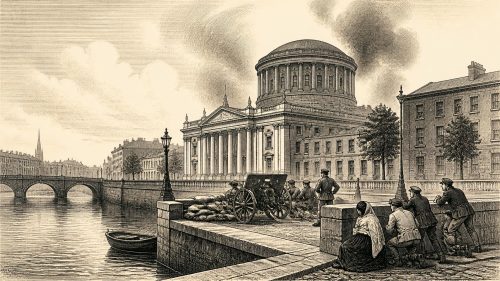
That outcome should not soften the brutality of the preceding months. The conflict had involved executions under the Free State’s emergency legislation, reprisals, destruction of property and the killing of prisoners, including notorious incidents in County Kerry during March. Families who had supported independence found themselves divided between men in the National Army, IRA columns, prison camps and political organisations. Houses associated with public figures were attacked or burned; W. T. Cosgrave’s family home at Beechpark in Templeogue was among those targeted in January. The formal quiet that followed May was therefore not reconciliation. It was an uneasy and often fearful cessation after a conflict fought within communities.
Prisoners, Security and the Price of Peace
The Free State government regarded the war’s end as incomplete while anti-Treaty arms remained hidden and large numbers of republicans retained the capacity to reorganise. Internment continued. Men and women were held in prisons and camps, including Mountjoy, Kilmainham and the Curragh, often without trial. The scale of detention gave the new state an immediate administrative as well as political problem: it had to feed, guard and provide medical care for thousands of people whose legitimacy as prisoners was fiercely contested.
On 14 October a mass republican hunger strike began in Mountjoy and rapidly spread to other places of detention. At its height, around 8,000 prisoners participated. They demanded unconditional release, while the government feared that a wholesale release would restore armed organisation before security was secure. The action placed Catholic clergy, prison doctors, families and ministers in difficult positions. Cardinal Michael Logue, Archbishop of Armagh, appealed for an end to the strike and urged releases. The government remained unwilling to grant the prisoners’ central demand.
The protest ended on 23 November after forty-one days, but only after Denis Barry died on 20 November and Andy O’Sullivan on 23 November. Their deaths demonstrated that the human cost of the Civil War continued after rifle fire had largely ceased. Gradual prisoner releases followed, but detention remained a defining republican grievance. The state’s insistence on order was also reflected in legislation. The Gárda Síochána (Temporary Provisions) Act, passed on 8 August, gave statutory form to a police force intended to replace the coercive associations of the disbanded Royal Irish Constabulary with a nationally recruited civic service. Its temporary title revealed how much still had to be settled.
An Election After Conflict
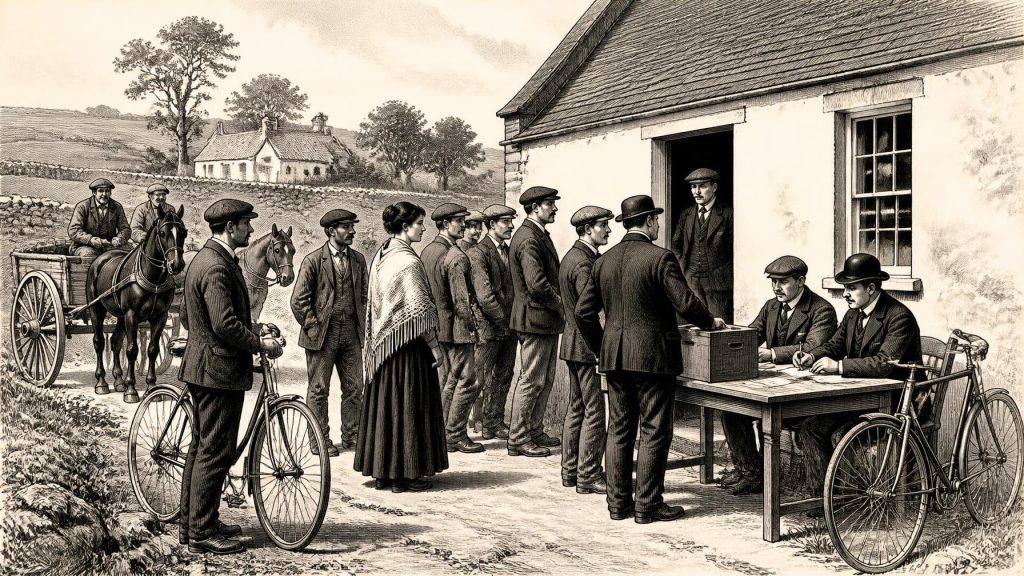
Politics resumed in a more recognisably parliamentary form during the summer. The Third Dáil was dissolved on 9 August, the same day that the Land Act received assent. Cumann na nGaedheal, the new party formed from the pro-Treaty wing of Sinn Féin and led by Cosgrave, sought a popular mandate for reconstruction, public order and constitutional government. Its anti-Treaty opponents contested as Sinn Féin but maintained abstention from the Free State’s institutions. Campaigning was still inseparable from the war: de Valera was arrested at an election meeting in Ennis on 15 August, a reminder that electoral politics and internment existed side by side.
The general election of 27 August was the first election held by the Free State after the fighting had ended. Cumann na nGaedheal won 63 of 153 seats. Anti-Treaty Sinn Féin won 44, the Farmers’ Party 15 and Labour 14, with the remainder divided among smaller groups and independents. The result was not a simple endorsement of one outlook. Farmers and Labour candidates showed that questions of land, prices, employment and representation could again compete with the Treaty divide. But republican abstention changed the working arithmetic of the chamber. The 44 Sinn Féin TDs did not take their seats or swear the constitutional oath, enabling the government to command an effective majority among those present.
The Fourth Dáil met on 19 September. Michael Hayes was elected Ceann Comhairle and Cosgrave was elected President of the Executive Council, heading what became the second Executive Council of the Irish Free State. The occasion was an important constitutional step: authority now rested on a fresh electoral mandate rather than the emergency arrangements inherited from revolution and civil war. Yet it also exposed the central weakness of the new order. A parliament intended to represent the country assembled with a large bloc of elected republicans absent from its benches.
Land, Law and Everyday Administration
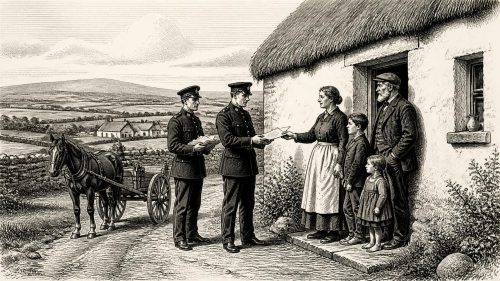
For many people outside the towns, the most consequential measure of 1923 was the Land Act of 9 August. It amended and extended the long process of land purchase that had transformed the countryside since the late nineteenth century. The Act empowered the state to issue 4½ per cent Land Bonds, strengthened the role of the Land Commission in purchase and redistribution, and provided mechanisms relevant to congested districts, uneconomic holdings and the consolidation of farms. It did not instantly solve rural poverty or scarcity of viable land, particularly in the west. Nevertheless, it made land settlement a central responsibility of the Free State rather than a residual function of the former British administration.
State-building also appeared in less dramatic legislation. The Electoral Act established a register for the new polity. The Censorship of Films Act, enacted on 16 July, created an official film censor and an appeals board; public exhibition of films would require certification when the relevant provisions came into operation in January 1924. This early regulation of cinema indicated both the reach of popular modern entertainment and the desire of legislators to supervise it. Other acts addressed insurance, civil-service regulation, property damage, pensions and the winding-up of the revolutionary Dáil courts. In offices, courtrooms, police stations and county administration, independence was being translated into procedures, salaries, records and rules.
Economic separation also became more tangible. Customs barriers between the Free State and the United Kingdom came into force on 31 March. For border districts, traders, farmers and transport workers, partition was no longer solely a constitutional dispute: it could affect routes, paperwork and the movement of goods. Northern Ireland remained outside the Free State’s jurisdiction, while the unresolved boundary question continued in the background. The border thus entered daily commercial life even as Dublin focused on restoring authority across the twenty-six counties.
Geneva and Stockholm
On 10 September, the Irish Free State was admitted to the League of Nations at Geneva. Membership did not remove the Treaty relationship with Britain, nor did it resolve partition. Its importance was symbolic and practical: the state could now appear in an international assembly in its own right, register agreements and cultivate a diplomatic identity. For a government emerging from civil war, acceptance into the League offered a public statement that the Free State belonged among the recognised states of the post-war world.
Two months later, William Butler Yeats was awarded the 1923 Nobel Prize in Literature. The Swedish Academy praised poetry that expressed the spirit of a whole nation. Yeats’s award did not represent a unanimous national culture; he was an Anglo-Irish Protestant poet, senator of the Free State and a figure whose politics could provoke sharp disagreement. Even so, the honour gave international distinction to an Irish writer at a moment when the country’s public image had been dominated by violence and political rupture. It offered a different, though not uncomplicated, emblem of Ireland abroad.
By December, the Free State had survived its first full year amid a difficult inheritance. The guns had largely fallen silent, but bereavement, detention and ideological division endured. The election and the Fourth Dáil supplied a constitutional framework; the Garda legislation, land programme and expanding statute book supplied instruments of government; League membership and Yeats’s Nobel Prize supplied international markers of recognition. The achievement of 1923 was not national unity. It was the establishment of a functioning state in the shadow of a civil war whose consequences would remain deeply present for decades.
Primary Sources
- Aiken, Francis Thomas (‘Frank’) | Dictionary of Irish Biography
- Lynch, William Fanaghan (Liam) | Dictionary of Irish Biography
- Cosgrave, William Thomas | Dictionary of Irish Biography
- O'Higgins, Kevin Christopher | Dictionary of Irish Biography
- Barry, Denis | Dictionary of Irish Biography
- Timeline of events, 1919-69 | Documents on Irish Foreign Policy
- History of Government | Department of the Taoiseach
- Dáil and Seanad terms | Houses of the Oireachtas
- Land Act, 1923
- Electoral Act, 1923
- Censorship of Films Act, 1923
- Gárda Síochána (Temporary Provisions) Act, 1923
- Irish Statute Book: Acts of the Oireachtas, 1923
- 1912–1923 Timeline | UCD Decade of Centenaries
- UCD Decade of Centenaries: 1912–1923 Events Timeline
- Election ’23 – Pro-Treaty Cumann na n Gaedhael to be largest part in new Dáil | Century Ireland
- Irish Elections 1922–44: Results and Analysis
- Why did 8,000 IRA prisoners go on hunger strike in 1923? | RTÉ Brainstorm
- Ireland's largest hunger strike began 100 years ago | RTÉ News
- The Nobel Prize in Literature 1923
- Civil War Radio Reports | Military Archives
- Guide to the Military Service (1916-1923) Pensions Collection | Military Archives
- The GAA and the Civil War
- 100 Years of Seanad Éireann, 1922–2022