

Accountable Memory
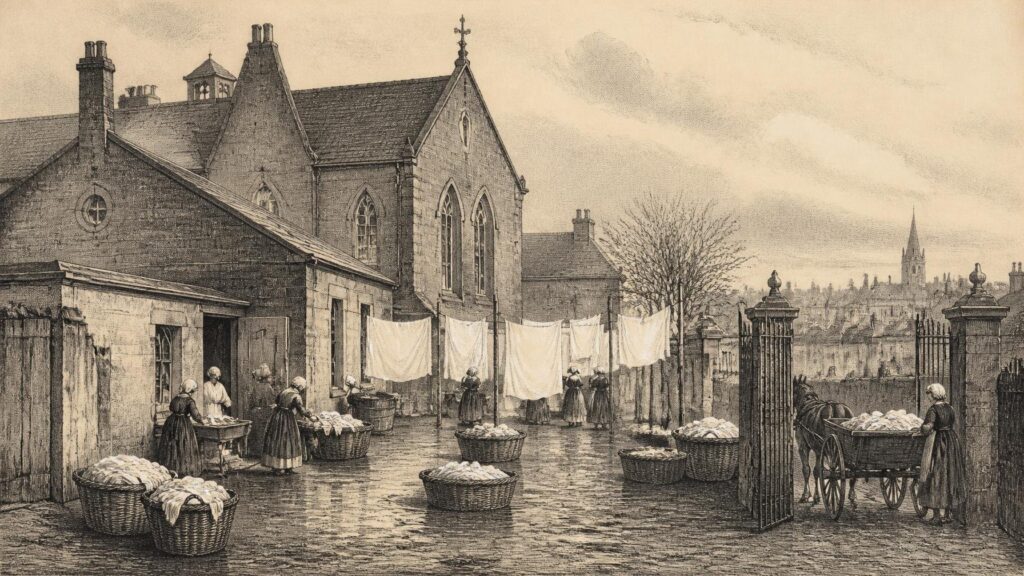
AI generated historical illustration, not a contemporary photograph.
At a Glance
The Irish response to the Magdalen laundries is not simply a story of compensation after historical wrong. It is a continuing argument about what a State owes to people harmed in institutions sustained by a mixture of religious authority, family pressure, social stigma, administrative practice and public power. The 2013 State apology and subsequent redress scheme were major acknowledgements. Yet they also exposed unresolved questions: what precisely the State’s responsibility had been, whose experiences were recognised, what evidence was available, whether an investigation had gone far enough, and whether financial and medical supports could address losses accumulated across an entire life.
Historical Setting
Magdalen institutions did not emerge from a single Irish political decision, nor did they possess one fixed form throughout their long history. Their origins lay in a broader European and Christian tradition of refuges intended, at least in stated charitable language, for women described as having fallen into sexual or moral danger. Irish institutions developed within this inheritance, but took distinctive shape in a society structured by colonial rule, poverty, denominational division, limited welfare provision and, after independence, a highly gendered public morality. The word “Magdalen” invoked Mary Magdalene, conventionally but inaccurately identified in popular religious culture with a repentant prostitute. That association gave an apparently sacred vocabulary to institutional projects concerned with reform, containment and labour.
The institutions commonly called Magdalen laundries should not be reduced to a single simple description. They varied by place, managing congregation, period and relationship with adjacent convents, schools, homes, hospitals or training centres. They also changed over time. Nonetheless, the laundry was central to the system’s material operation and public identity. Women and girls undertook washing, ironing, sorting and associated work, while the laundries competed for commercial custom. Work was represented as discipline, rehabilitation, training, penance or contribution towards maintenance. For many former residents, however, labour was remembered as unpaid, compulsory and exhausting.
Care is needed with language. “Incarceration” appears in official and advocacy discussion because many women could not freely leave and experienced the institutions as closed regimes. It does not mean that each woman arrived through a formal criminal sentence. Equally, “forced labour” describes the absence of ordinary wage relations and the coercive circumstances many survivors reported; it should not obscure the task of establishing the circumstances of an individual placement where records survive. A historical account must retain both truths: institutions were not prisons in a uniform legal sense, but the boundaries between welfare, religious discipline, family authority and confinement were frequently oppressive.
The women who entered the laundries cannot be made into a single type. Public memory often focuses on unmarried mothers, but the evidence points to wider routes: women and girls referred by families, courts, health authorities, industrial and reformatory schools, religious organisations and other institutions. Some had disabilities, some were poor, some had been in State care, some were regarded as sexually transgressive, and some were simply difficult for relatives or authorities to accommodate. The categories imposed upon them often told more about prevailing social anxieties than about their own actions or character.
The Irish State was established in 1922, but independence did not sweep away inherited assumptions concerning women’s roles, sexuality, poverty or institutional care. Instead, the new State developed a welfare order in which voluntary and religious bodies supplied many services, often with public funds, regulation or referrals. This was not unusual in Europe, but its consequences in Ireland were especially significant because religious congregations exercised major influence across education, health, residential care and social work. Magdalen laundries must therefore be placed within an institutional landscape rather than isolated as an inexplicable aberration.
Social Discipline
The laundries served, in part, as mechanisms of social discipline. Respectability was closely tied to female sexual virtue, domestic service, marriage and motherhood within marriage. A woman who did not conform to these expectations could be treated as a problem requiring removal from ordinary life. The danger lay not merely in individual prejudice but in the conversion of prejudice into practical power: a family could seek institutional placement; an official could arrange a referral; a court could act; a school or hospital could transfer someone; a congregation could receive her. A system of containment was created through connected decisions, not only through a single commanding authority.
Historical interpretation has increasingly rejected the comforting suggestion that religious orders alone created this system while the State and wider society stood outside it. Religious congregations ran the institutions and were responsible for their internal governance. Their members exercised direct authority over residents and work. But State agencies had dealings with the laundries through routes of entry, inspections, contracts, grants, social services and other administrative arrangements. Families and local communities also participated in, tolerated or benefited from a culture in which women could disappear into institutions. Responsibility was consequently layered rather than exclusive.
That does not absolve any participant by distributing blame too widely. On the contrary, it helps explain why redress proved difficult. If wrongdoing is imagined as the work of a few individuals, an apology may seem a sufficient moral response. If it is understood as institutional and systemic, the question becomes more demanding: how should public authorities acknowledge their own contribution, recover records dispersed across departments and congregations, provide remedies where evidence is incomplete, and preserve survivor dignity while examining painful events?
Documented history and cultural memory do not always move together. Films, memoirs, journalism and dramatic works have played an important role in making the laundries visible to audiences who had heard little about them. They have also sometimes encouraged viewers to assume that every institution worked in the same way, that every resident had the same route of entry, or that every remembered episode can be treated as general proof. Such works can illuminate moral realities and encourage inquiry, but they are not substitutes for archives, testimony gathered with proper safeguards or careful historical comparison.
Folklore likewise has a limited but meaningful place. Communities may recall a particular building as a place where women were sent, remember laundry vans, or repeat stories of harsh discipline. These recollections can identify questions for research and demonstrate the local reach of institutional stigma. They cannot, by themselves, establish dates, legal responsibility or the experience of every resident. The distinction matters because the scarcity, fragility and uneven survival of records have often made survivors’ accounts vulnerable to unfair demands for documentary proof. Good history neither dismisses testimony because it is personal nor transforms every tradition into verified fact.
Documentary Record
The most important official account of State involvement was published on 5 February 2013: the Report of the Inter Departmental Committee to establish the facts of State involvement with the Magdalen Laundries, chaired independently by Senator Martin McAleese and generally known as the McAleese Report. Its remit was not a general public inquiry into every allegation of abuse. It was an investigation into the nature and extent of State interaction with the institutions. This limitation has been central to later debate, because a report can establish important facts while leaving other questions unanswered.
The report examined ten laundries operated by four religious congregations within its defined scope. It assembled material from departmental records, institutional files, legal sources and other archives. Its chapters addressed the history of the laundries, relevant legislation, methods of statistical analysis, routes of entry, employment regulation, State funding, public contracts, taxation, social insurance, death registration and burial. The report’s scale itself was significant. It demonstrated that the historical relationship between State and laundry could not credibly be described as negligible or accidental.
Among its major documented findings were multiple channels by which women and girls came into the laundries through public systems. The report identified links involving the criminal justice system, industrial and reformatory schools, health authorities and social services. It also detailed public-sector laundry contracts and forms of financial interaction. These were not merely symbolic connections. They showed the State relying upon, referring to or doing business with institutions that confined women and extracted their labour under conditions far removed from ordinary employment.
The report also challenged a long-standing public assumption that the laundries were entirely self-contained religious enterprises. State involvement could take bureaucratic forms which appeared routine at the time: a placement, a contract, a grant, the operation of regulatory law, an official record. In retrospect, routine administration is precisely what makes the history troubling. It reveals how systems of coercion can be normalised when each office sees only its own narrow task and no authority confronts the experience of the person at the centre.
Yet the McAleese Report did not claim to decide every moral or legal question. Its findings on routes of entry and State interaction were based on available records and the committee’s defined mandate. Critics, including survivor advocates and human-rights bodies, argued that it did not provide the independent, survivor-centred investigation needed to establish the full extent of abuse, coercion and responsibility. Supporters of the report emphasised its extensive archival research and the significance of its factual findings. Both positions can be understood without treating the report either as worthless or as final.
The evidence problem was structural. Records were divided between State departments, religious congregations, local authorities, hospitals and other bodies. Some were incomplete; others had been created for administrative purposes rather than to preserve the voices of residents. The absence of a record might mean that an event was never recorded, that a file was lost, that it remained inaccessible, or that the relevant institution had used another label. It could not automatically prove that a woman had not been resident or had not worked. This issue became especially consequential when the State designed a scheme that required verification of eligibility and length of stay.
Survivor Advocacy
State action did not arise in a vacuum. Former residents, relatives, journalists, researchers, lawyers and campaigners made the laundries a matter of public accountability. Their work involved difficult and sometimes unglamorous labour: gathering testimony, locating records, challenging official language, writing submissions, meeting politicians and maintaining attention after moments of media interest had passed. Justice for Magdalenes, later Justice for Magdalenes Research, was especially influential in framing the issue as one of human rights as well as national memory.
Advocacy mattered because it altered the terms of discussion. Earlier public discourse could present the laundries as regrettable remnants of a vanished moral order. Campaigners insisted instead on questions of State responsibility, unpaid labour, access to remedies and the right to truth. They pressed the Irish Human Rights Commission to consider the matter in 2010 and brought international human-rights mechanisms into the conversation. The effect was not simply to add external pressure. It supplied a vocabulary through which survivors’ experiences could be discussed without being confined to charity, shame or private tragedy.
International bodies repeatedly expressed concern. United Nations treaty-monitoring mechanisms called for prompt, independent and thorough investigation of allegations, effective remedies and attention to barriers faced by survivors. These interventions did not themselves determine Irish law or dictate the design of a domestic scheme. They did, however, articulate standards against which the State’s response could be assessed: investigation, compensation, restitution, rehabilitation, satisfaction and guarantees against repetition. The disagreement thereafter was not whether something had happened, but whether the measures adopted were adequate to these broader obligations.
Survivor testimony occupies a special place in this history. It is evidence of lived experience, but it is also a record shaped by trauma, elapsed time, privacy concerns and the fact that women were often denied access to their own files. Testimony has described fear, separation, unpaid work, loss of education, humiliation, religious control and difficulty returning to ordinary life. Not every account is identical, and responsible historians avoid using one woman’s experience as a universal template. But the cumulative force of testimony makes clear that the laundries were not benign refuges merely because they were presented in charitable or religious terms.
The campaign for recognition also confronted the problem of language. To speak of women as “fallen” reproduces the judgement that underpinned their confinement. To speak only of “residents” can obscure coercion and labour. To call every survivor a “victim” may fail to recognise agency, resilience and preferred self-description. Contemporary official language therefore tends towards “women who were admitted to and worked in” the relevant institutions. This wording is cautious and administratively useful, though it cannot fully capture the range of experience.
Public Apology
On 19 February 2013, Taoiseach Enda Kenny delivered the State apology in Dáil Éireann. The apology followed publication of the McAleese Report and marked a major change in official recognition. It acknowledged a dark chapter in Irish history and recognised the failures of Irish society and the State towards women who had spent time in Magdalen laundries. In political terms, the moment was important because it abandoned denial of meaningful State involvement. In human terms, its significance depended on whether recognition would be followed by practical action.
Public apologies are often scrutinised for what they say and what they avoid. The 2013 apology was welcomed by many as overdue recognition, particularly after years in which former residents had been ignored or treated as peripheral to the history of institutional abuse. At the same time, some survivors and advocates argued that language of collective shame could blur the distinct duties of government bodies, religious orders and other actors. An apology from a Taoiseach can accept public responsibility, but it does not automatically produce a full account of how decisions were made, who benefited or what remedies will follow.
The word “accountability” therefore needs careful handling. It may mean a government publicly admitting that it failed in its duties. It may mean administrative accountability, in which a department corrects an unjust procedure. It may mean legal accountability, including civil or criminal processes where evidence and law permit. It may mean historical accountability: opening records, supporting research and enabling society to understand how institutional systems worked. These forms overlap, but none should be confused with the others.
The State’s decision after the apology was to develop a non-adversarial redress process rather than require women to litigate individually. There were humane reasons for that choice. Many potential applicants were elderly, unwell, living abroad or unwilling to relive their experiences in court. Litigation would have required proof, exposed applicants to procedural risk and could have taken years. A redress scheme could provide payment and supports more quickly, without making each survivor prove a specific act of abuse.
But non-adversarial procedures also have limits. They may avoid the searching examination of documents and witnesses that court proceedings can produce. They can turn historical recognition into eligibility criteria, forms and administrative decisions. They may ask survivors to choose between accepting a payment and pursuing legal rights. The Magdalen scheme would embody this tension: designed as an act of restorative recognition, it was also a State administrative system with boundaries, exclusions and evidential thresholds.
Quirke Proposals
Following the apology, the Government appointed Mr Justice John Quirke, former High Court judge and President of the Law Reform Commission, to advise on the establishment of an ex gratia scheme and related supports. His report, generally called the Quirke Report or Magdalen Commission Report, was submitted in 2013. The Government accepted its recommendations in principle. The resulting scheme was intended to acknowledge women who had been admitted to and worked in designated Magdalen institutions, while also providing practical assistance for the remainder of their lives.
The scheme had several elements. Eligible women could receive a lump-sum payment calculated principally by reference to the duration of their stay. Payments also incorporated a component for lost earnings. In addition, the scheme provided an enhanced medical card and a weekly payment, rising at pension age to the level of the State Pension Contributory. The Finance legislation of 2013 made provision concerning the tax treatment of Magdalen laundry payments. The arrangement thus moved beyond a one-off symbolic award and recognised that institutionalisation could have enduring effects on health, income and security.
The decision to base awards on duration of stay had administrative logic. Length could be evidenced more readily than the intensity of particular harms, and a duration-based approach avoided requiring applicants to narrate abuse. Yet duration was an imperfect measure. Two women who spent similar periods in a laundry might have experienced profoundly different conditions, entered at different ages, lost different opportunities or sustained different injuries. Conversely, a woman who spent a shorter period in a coercive setting could suffer serious and lifelong consequences. A standardised scheme necessarily simplified lives which had not been standard.
The scheme was ex gratia: payment did not amount to a judicial finding of liability in an individual case. That status mattered. It enabled the State to make awards without litigation, but it also reflected official caution about legal responsibility. Applicants were required to waive certain rights of action against the State and public bodies in relation to their admission and work in the specified institutions. International human-rights critics questioned whether such waivers were compatible with fully effective remedy, especially where no comprehensive independent investigation had occurred.
Eligibility was another contested matter. The scheme initially covered specified institutions, not every setting in which women may have worked in a laundry or lived under connected religious authority. In 2018, an addendum extended eligibility to certain women who worked in the laundries while resident in adjoining institutions. The 2019 amendment to the Redress for Women Resident in Certain Institutions Act gave statutory recognition to that addendum. This was an important correction, but it also showed that institutional boundaries drawn on paper could fail to reflect the physical and organisational realities of a convent complex.
By July 2023, the Irish Government reported to a United Nations process that €33 million had been paid in awards to 824 qualifying applicants. These figures demonstrate that the scheme was not merely announced but operated over years. They do not, on their own, settle whether every eligible woman applied, whether all applications were fairly determined, or whether payments amounted to adequate reparation. Statistics record administrative output; they cannot measure lost family relationships, interrupted education, stigma, health consequences or the moral weight of being removed from public life.
Administrative Failure
The strongest official criticism of the scheme’s administration came from the Office of the Ombudsman. Its 2017 report, Opportunity Lost, investigated complaints about eligibility, assessment of duration and the treatment of applicants who lacked capacity. The Ombudsman did not deny the value of the original scheme. Rather, the report argued that a process intended to bring healing and reconciliation had, in some cases, caused further distress through an unduly narrow interpretation of its own terms.
The Ombudsman found that some women who lived in convent settings and worked in a named laundry were excluded because departmental decision-making treated adjoining units as distinct institutions. This approach was especially problematic where evidence showed that the laundry and other residential parts of a complex were intertwined. The report urged a wide and generous interpretation consistent with the public purpose of the scheme. It also criticised failures in pursuing available evidence of work and in making timely arrangements for women deemed unable to manage their own affairs.
This episode reveals a central difficulty in historical redress. A government may make a sincere public apology and establish a generous-looking package, but implementation occurs through files, definitions, delegated decisions and evidential practices. A survivor does not encounter “the State” as an abstract moral actor. She encounters a letter, an application form, a decision maker, a request for records and perhaps a refusal. Administrative narrowness can therefore contradict the spirit of an apology even without any official intention to do so.
The Government accepted the Ombudsman’s recommendations. The later addendum and legislative amendment addressed part of the issue involving women resident in adjacent institutions. Still, acceptance of recommendations is not the same as historical closure. The administrative controversy reinforced concerns that redress schemes should be designed with flexibility where records are incomplete, applicants are elderly and institutional categories obscure lived reality. It also demonstrated the importance of independent oversight after a scheme begins, rather than assuming that a Cabinet decision resolves all foreseeable problems.
There is a further ethical question about proof. Survivors whose files were missing could be asked to produce evidence controlled by bodies that had once exercised authority over them. The current official scheme information recognises this difficulty by directing applicants to religious congregations for records and providing for further contact where records are absent or incomplete. That procedure may be necessary for verification, but it places a burden on women to re-enter a documentary relationship with institutions associated with harm. The fair administration of redress requires sensitivity to that imbalance.
Investigative Limits
Perhaps the most enduring controversy concerns investigation. The McAleese Committee collected extensive evidence and established important facts about State involvement. But it was not a statutory commission with powers to compel testimony in the manner sought by many advocates. It did not conduct a comprehensive examination of all alleged ill-treatment in the laundries, nor did it determine individual responsibility. The distinction between a factual review of State involvement and a full inquiry into human-rights violations is central, not semantic.
United Nations bodies repeatedly drew attention to this gap. The Human Rights Committee, the Committee against Torture and other mechanisms expressed concern that Ireland had not established a prompt, independent and thorough investigation into allegations concerning the laundries. Their recommendations included effective remedies and, where appropriate, accountability for perpetrators. The Irish State has maintained that the McAleese Report was comprehensive regarding its remit and that victims can make complaints to An Garda Síochána where they believe criminal offences occurred. These positions answer different questions: one concerns existing research and legal avenues; the other concerns whether a dedicated independent inquiry is required.
It would be wrong to suggest that all historical wrongs can be resolved through criminal prosecution. Time, evidential loss, death of witnesses and changing legal frameworks can make prosecution impossible or inappropriate in many cases. Nor can a historian decide criminal guilt. Yet the limits of prosecution do not remove the need for truth recovery. Public acknowledgment, record access, archival preservation and independent historical investigation may remain necessary even where courts cannot act.
The absence of a single inquiry has practical consequences. It leaves survivors and relatives navigating a fragmented landscape of reports, departmental archives, congregational records, redress procedures and public memory projects. It also makes it difficult to form a fully integrated account of links between Magdalen laundries, mother and baby homes, industrial schools, psychiatric institutions, hospitals and other settings. These institutions were not identical and should not be collapsed into one category. Nevertheless, the movement of people, records and authority between them makes rigid separation historically misleading.
Interpretation must remain proportionate. It is supportable to say that the State was implicated through documented routes of entry, public contracts, funding and administrative interaction. It is not supportable to claim, without individual evidence, that every official knew the conditions experienced by every woman. Equally, lack of proof of universal knowledge is not a defence against systemic responsibility. Governments are responsible for the systems they operate, fund, inspect and rely upon; they must ask whether those systems protect the rights and dignity of people subject to them.
Records Access
Records are not neutral objects. An admission ledger, a medical note, a court document or a departmental file may have been created to administer an institution, not to tell the truth from a resident’s perspective. It may use stigmatising language, omit coercion or treat a woman solely as a case number. Yet these documents can be essential to a survivor seeking recognition, family information or redress. The question is therefore not simply whether records exist, but who can see them, how they are interpreted and whether they can be connected across institutions.
The McAleese process itself created a substantial archive of material gathered from many sources. Questions about access to this archive have become part of the broader accountability debate. Survivors may seek personal information; relatives may seek knowledge of a family member; researchers may seek a fuller historical record; the public may seek assurance that evidence is not being concealed. These interests must be balanced with privacy, data protection and the particular vulnerability of people whose institutional histories were recorded without meaningful consent.
Archival access is not merely a technical matter. It can shape the distribution of credibility. Where a State relies on documents to assess applications but restricts access to those documents, applicants may struggle to challenge errors or omissions. Where researchers cannot examine sources, official conclusions may be difficult to test. Where records remain dispersed, families may never reconstruct what happened. A fair records policy should make information as accessible as possible while protecting living persons from unnecessary exposure.
Oral history is vital alongside written archives. University College Dublin’s Magdalene oral-history and archival work recognises that survivors, relatives, religious personnel and others hold knowledge absent from institutional files. Oral history is not an inferior substitute for official paperwork. It has its own methods: informed consent, ethical safeguards, contextual interviewing, careful transcription and respect for decisions not to make material public. It can preserve experience that bureaucracy ignored, while also making room for uncertainty, contradiction and changing memory.
Memorialisation depends on this work. A plaque or ceremony may acknowledge suffering, but meaningful remembrance requires an informed public record. The Dublin Honours Magdalenes event and subsequent discussion of survivor wishes reflected a movement towards listening rather than imposing commemoration from above. Survivors have identified needs that extend beyond monuments: health and social support, education, access to records, respectful representation and the assurance that future generations will understand why the institutions existed.
Gendered Citizenship
The history of the laundries raises larger questions about citizenship. Women were formally citizens of the Irish State, but many did not enjoy equal power to define their lives, sexual identities, work or family relationships. They could be subject to decisions made by fathers, mothers, clergy, doctors, teachers, police officers, judges and welfare officials. Their marginal position was intensified by class, disability, age, pregnancy, institutional history or lack of family support. The laundries reveal how citizenship can be hollow when social respectability is made a condition of belonging.
The term “gendered citizenship” helps explain why redress cannot be treated purely as a labour dispute or welfare payment. Women lost wages, but some also lost education, relationships, health, confidence and the opportunity to make decisions about where and with whom they would live. The injury was material and civic. A society communicated that certain women could be hidden because their public presence was embarrassing or inconvenient. Later recognition therefore has to address not only economic loss but the denial of status and voice.
This perspective also guards against an overly national story of moral progress. It is tempting to set a cruel past against an enlightened present. Ireland has changed substantially in law, public attitudes and institutional practice. But historical accountability is weakened if the laundries are explained only by saying that “people thought differently then”. Many people did challenge harshness and injustice in their own times; women resisted, left, sought help or maintained relationships where they could. The existence of prevailing attitudes did not make confinement inevitable or morally acceptable.
Nor should religious belief be treated as the sole explanation. Catholicism, Protestantism and religious organisations formed important parts of the institutional setting, but the laundries also involved State structures, commercial customers, family decisions and social silence. A historical account that blames religion alone risks allowing secular institutions and wider society to evade their roles. Conversely, an account that focuses solely on State responsibility risks obscuring the authority and agency of the congregations that operated the laundries. Accountability must be specific enough to include both.
Restorative Meaning
“Restorative justice” was the phrase adopted for the Irish scheme, but it is an ambitious description. In ordinary criminal justice, restorative processes commonly involve dialogue, acknowledgement and repair between people affected by an offence. The Magdalen scheme did not create a conventional encounter between survivors and those responsible. Rather, it was a State-administered package of payment, pension-related support and healthcare. Its restorative character lay in its intention to acknowledge harm without adversarial litigation.
The advantages were real. An elderly applicant could receive assistance without proving every detail of her treatment. A lifelong medical card and weekly payment recognised continuing need. The public apology made clear that shame belonged not to the women but to the institutions and society that failed them. These measures should not be dismissed because they were incomplete. For some recipients, they offered tangible security and a long-denied affirmation that what happened mattered.
But restoration in the literal sense was impossible. No sum could restore lost adolescence, relationships, fertility, schooling, earnings or a life lived under stigma. The language of healing can also be dangerous if it implies that survivors must forgive, reconcile or accept official closure. A State may apologise and provide support; it cannot demand that the recipients experience those acts as sufficient. Redress must leave room for anger, ambivalence and the refusal of closure.
The scheme’s history offers a broader lesson for public policy. Reparative measures should be created with survivors rather than simply for them. They should allow generous interpretation of eligibility, provide independent appeals or review, minimise burdens of proof, ensure access for people abroad, make provision for incapacity and explain the consequences of waivers plainly. Above all, they should not make administrative convenience the overriding measure of justice. The Ombudsman’s intervention showed what can happen when the machinery of eligibility overtakes the stated purpose of recognition.
Continuing Duties
State accountability is a process rather than a ceremony. The Irish Government’s scheme remains open to applications according to current published guidance, and the relevant department continues to set out routes for people who may lack complete records. That administrative continuity is important because historical evidence can surface late and some survivors may only become able or willing to apply after many years. Nonetheless, ongoing duties extend beyond application processing.
First, there is a duty of care in the administration of existing supports. Survivors should not have to navigate complex systems alone, particularly where disability, age, trauma, geographical distance or lack of documentation creates obstacles. Second, there is a duty to preserve and facilitate access to records. Third, there is a duty of education: schools, museums, archives and public institutions should present this history accurately, neither sensationalising it nor allowing it to fade into euphemism.
Fourth, there is a duty to sustain research. The historical record is incomplete, and new work may refine understanding of individual institutions, routes of entry, commercial practices, deaths, burials, records and survivor experiences. Research should not become an excuse to delay remedies already justified by available evidence. Rather, it should deepen the public account while respecting the rights of people whose lives are being studied.
Finally, there remains the question of a fuller independent investigation. Reasonable people may differ over its exact structure, legal powers and feasibility. The documented concerns of the Ombudsman and United Nations bodies show, however, that this is not a marginal demand. It arises from a recognised gap between a report on State involvement and an inquiry into the whole range of alleged violations. The State’s past decisions do not make that question disappear; they make clarity about it more necessary.
Historical Judgement
The Magdalen laundries were sustained by a system in which women’s perceived nonconformity could be converted into confinement and labour. Religious congregations managed the institutions, but the Irish State’s documented interactions through referrals, contracts, funding and administration meant that the State could not honestly place the matter outside its responsibility. The 2013 apology and redress scheme were therefore historically significant acts of recognition.
They were not, however, the final verdict. The later Ombudsman investigation demonstrated that redress can fail people when interpreted narrowly. International human-rights criticism demonstrated that compensation does not necessarily answer the demand for independent truth. Survivors’ testimony and archival research demonstrate that official records, though indispensable, cannot alone tell the history. The most responsible conclusion is neither that nothing was done nor that everything has been resolved.
Ireland’s encounter with the laundries asks whether democratic institutions can face harms in which they were entangled. It asks whether apology can lead to open records, careful evidence, generous remedy and enduring education. It asks whether a nation can reject the old judgement placed upon institutionalised women by recognising them as citizens whose rights, labour and lives mattered. Those are not questions belonging only to the past. They remain the measure of accountable memory.


The article’s distinction between acknowledgement and accountability is striking. Ireland’s apology and non-adversarial redress scheme offered recognition without requiring survivors to endure litigation, yet the same administrative approach risked making access to justice depend on incomplete records and eligibility rules. This creates a dilemma: remedies intended to be humane can still leave unanswered questions about responsibility, exclusion and the record. The article also suggests that State involvement was routine and dispersed, rather than concentrated in one decision-maker. How should Ireland balance survivor testimony, fragmented archives and the need for redress when assessing whether accountability requires investigation, record access or commemoration?