

Sacred Boundaries
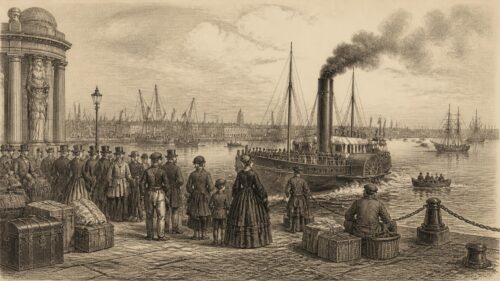
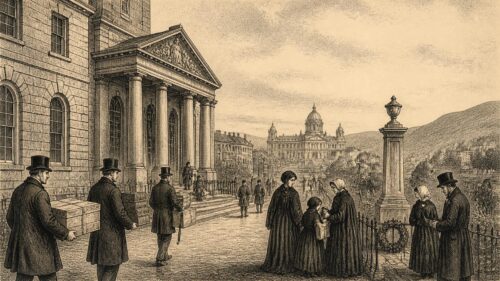
AI generated historical illustration, not a contemporary photograph.
At a Glance
The Troubles were not, in any sufficient sense, a war over theology. They were a modern conflict about sovereignty, national identity, political power, security and competing understandings of citizenship in Northern Ireland. Yet religion was not incidental. Catholic and Protestant identities supplied the principal language through which many people recognised community, remembered history, inherited loyalties, encountered discrimination, organised neighbourhood life and, at times, selected enemies. To say that the conflict was “religious” is therefore both true and seriously incomplete.
Central Question
Asking about the religious element of the Troubles requires care with language. “Catholic” and “Protestant” were often used as if they described two internally uniform religious populations. They did not. Northern Ireland contained practising and non-practising Christians, people from several Protestant denominations, people of other faiths and people with no religious commitment. Nor did every Catholic favour Irish unity, every Protestant favour the Union, or every person who voted for a nationalist or unionist party understand politics chiefly through religion. The categories were nevertheless exceptionally powerful. They commonly joined faith, family descent, locality, schooling, class, nationality and political tradition into shorthand identities that could be read by others.
The immediate constitutional issue was whether Northern Ireland should remain within the United Kingdom or become part of a united Ireland. Unionism defended continued membership of the United Kingdom; nationalism and republicanism sought, in different ways and with different methods, Irish reunification. In broad historical terms, most unionists were Protestant and identified as British, while most nationalists were Catholic and identified as Irish. That correspondence was the product of centuries of settlement, state formation, political mobilisation and social separation. It was not an inevitable consequence of Christian belief. The constitutional divide could not be solved by a theological argument, but religious affiliation made it socially visible and emotionally charged.
It is also important not to use “religious conflict” as a polite way to conceal politics. Such phrasing can suggest that ancient hatreds simply erupted, absolving governments, parties, armed organisations and individuals of specific choices. The Troubles followed a period in which the Northern Ireland state had been governed continuously by unionists, while many Catholics and nationalists experienced unequal access to housing, employment, local political influence and policing. The civil-rights agitation of the late 1960s arose from these practical grievances as well as from the larger constitutional dispute. Violence then enlarged and transformed the crisis. The religious element lay in the communal map of the conflict, not in a contest over the Trinity, the Mass, the Bible or the authority of Rome.
Historians consequently tend to use terms such as sectarian, ethno-national, communal and constitutional alongside, rather than instead of, “religious”. Each term illuminates something and obscures something else. “Sectarian” identifies hostile behaviour directed at people because they are believed to belong to a religious community. “Ethno-national” highlights British and Irish identities. “Constitutional” directs attention to the question of sovereignty. None should erase the others. The religious element was real because communal membership was routinely understood in religious language; it was limited because religious doctrine was rarely the central object of political contention.
Historic Foundations
Plantation Legacy
The deep background lay in the Reformation, the Tudor and Stuart extension of English power in Ireland, and the seventeenth-century plantations. In Ulster, land confiscation and settlement brought English and Scottish settlers, many of them Protestant, into regions with substantial Irish Catholic populations. These processes were uneven, contested and locally varied. They did not create two perfectly separate peoples, nor did they dictate every later development. But they established patterns of landholding, language, political allegiance and religious difference that later generations remembered as foundations of their respective communities.
The Williamite war at the end of the seventeenth century acquired similar importance in Protestant political memory. The defence of Derry, the siege, and William III’s victory at the Boyne became symbols of survival, liberty and attachment to the Protestant succession. Catholic political memory, meanwhile, included dispossession, penal restrictions, exclusion from political authority and resistance to British rule. These memories were repeatedly reshaped rather than simply preserved. Nineteenth-century organisations, parades, sermons, schools and newspapers selected episodes that gave contemporary politics a usable past. Commemoration did not mechanically cause twentieth-century violence, but it supplied narratives through which fear and loyalty could be expressed.
The nineteenth century also demonstrated that religious identity was inseparable from changing political circumstance. Catholic emancipation in 1829, the rise of constitutional nationalism, the growth of Belfast industry, the mobilisation against Home Rule and the formation of the Orange Order all altered the public importance of religion. Unionist opponents of Home Rule often feared not merely constitutional separation from Britain but government under a Catholic-majority Irish parliament. Nationalists frequently regarded this fear as evidence that unionism wished to preserve Protestant political dominance. Religion thus became an index of anticipated power: who would rule, whose traditions would be secure, and whether minorities could trust the state.
One must not treat the word “Protestant” as a single political denomination. Presbyterians, Anglicans, Methodists and other groups had distinct histories and sometimes sharply different class interests. Belfast’s industrial working class contained Protestant labourers and Catholic labourers whose material lives could overlap even while politics divided them. Equally, Catholic social life included constitutional nationalists, republicans, labour activists, conservatives and people principally concerned with family, parish or employment. The later binary language had force precisely because it compressed complexity. It offered a quick judgement about identity in a society where political institutions and everyday geography often reinforced the division.
Partition Settlement
Partition made the religious balance of population central to the political design of Northern Ireland. The Government of Ireland Act 1920 created Northern Ireland from six Ulster counties, and the new Northern Ireland Parliament began functioning in 1921. The territory was chosen in part because it contained a unionist and Protestant majority considered large enough to sustain the Union. The result was not a homogeneous state. A very substantial Catholic and nationalist minority lived within its borders, particularly in parts of Belfast, Derry, south Armagh, Tyrone and Fermanagh. The border was therefore both a constitutional boundary and a line drawn through mixed and interdependent communities.
For unionists, Northern Ireland was a democratic safeguard against absorption into an all-Ireland state in which they feared becoming a vulnerable Protestant minority. For nationalists, it was an imposed partition that created a permanent Catholic minority under a unionist government. These were opposing interpretations of legitimacy, not merely rival church positions. Yet each was saturated with religious demography. Protestant numerical strength was understood as essential to the state’s security; Catholic numbers were viewed by many unionists through suspicion of disloyalty. Catholics, in turn, could see public authority as confessional in culture and partial in operation, even where its formal laws did not prescribe a Protestant religion.
Partition also concentrated political authority. The Unionist Party held power at Stormont from 1921 until direct rule from Westminster in 1972. Nationalist abstentionism, electoral weakness, the limited powers of local government and the use of emergency measures helped entrench the sense that the state belonged principally to one community. There were unionists who defended equal citizenship and nationalists who pursued reform through constitutional means, but the institutional pattern made mutual confidence difficult. Religious difference mattered because it tracked the distribution of authority and exclusion.
Popular accounts sometimes portray the new state as wholly religious in character. That needs qualification. Northern Ireland was part of the United Kingdom, its constitutional order was not a Protestant church state, and its government included people with different degrees of personal faith. Still, public symbols, unionist rhetoric, Orange institutions and the overwhelmingly Protestant composition of important state bodies could make the state appear Protestant to many Catholics. Conversely, unionists who treasured those symbols commonly understood them as British civic inheritance rather than sectarian supremacy. The disagreement over what institutions meant was itself politically consequential.
Religious Markers
Faith Practice
Religion provided more than a label on a census return. Churches shaped the weekly rhythm of many communities through worship, youth organisations, schools, welfare, sport, music and social networks. Catholic parishes were important centres of local belonging, particularly where nationalists felt excluded from the state. Protestant churches and associated voluntary organisations likewise offered dense networks of fellowship and public service. Ministers and priests could command respect, influence social norms and act as intermediaries during moments of tension. The institutional strength of churches meant that religious language carried social authority even among those who were not especially observant.
At the same time, religious practice should not be confused with political radicalism. Many churchgoers recoiled from violence, and clergy in the principal denominations regularly condemned murder. The Provisional IRA did not wage a campaign to impose Catholic teaching, while loyalist paramilitaries did not fight to establish Protestant doctrine. Republican prisoners and activists could be devout, indifferent or hostile to clerical authority; the same range existed among loyalists. A person’s baptismal background could be politically decisive in the eyes of neighbours or attackers regardless of private belief. The category often functioned as inherited communal origin rather than a statement of theology.
That distinction becomes clearer in the experiences of secular people. A non-believer brought up in a Catholic family could still be treated as Catholic in employment, housing or local politics. A Protestant who seldom attended church could still participate in cultural practices associated with unionism. The conflict’s social classification was therefore closer to what scholars call ethnoreligious identity: descent and culture expressed in religious terms. It was possible to leave a church, but far harder to escape the communal meanings attached to surname, address, school, accent, friendship circles or family history.
Religion also contributed to moral boundaries. Marriage across the divide could provoke family anxiety; separate schools limited ordinary childhood contact; cemetery practices and funeral rituals marked communal membership. None of these practices applied uniformly, and many people formed friendships and workplaces across the divide. Yet the aggregate effect was a society in which each major community possessed distinctive institutions and memories. During crisis, those patterns could become mechanisms for rumour, fear and rapid mobilisation. The religious element was not simply what people believed on Sundays. It was part of how social worlds were organised every day.
Public Ritual
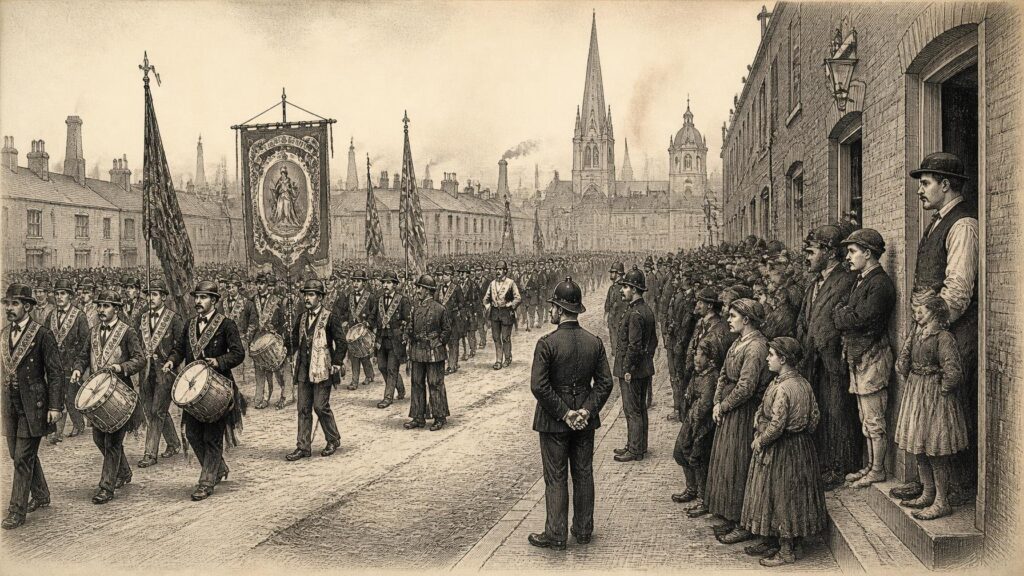
Public ritual was among the most visible religious-cultural dimensions of division. Orange parades, especially around 12 July, commemorated Protestant and unionist history through marching, banners, bands and lodge membership. Supporters often described them as legitimate expressions of heritage, civil and religious liberty, and communal continuity. Critics, particularly in nationalist districts, could experience routes, drums and symbols as assertions of Protestant dominance in places where Catholics had long felt vulnerable. The same procession could therefore be interpreted as celebration by one group and intimidation by another.
Republican commemorations, Easter Rising events, Irish-language activity, tricolours and memorials to republican dead performed comparable work of collective memory, though not in identical forms or with identical institutional roots. They affirmed Irish national belonging and recalled histories of resistance. Unionists frequently interpreted some of these symbols as endorsement of armed republicanism or rejection of Northern Ireland’s legitimacy. Symbolic disputes were not superficial additions to a more rational conflict. They involved claims about who belonged, which past was honoured and whether a neighbourhood was safe.
Church services, commemorative Masses, remembrance ceremonies and funerals could likewise carry political weight. Funerals of victims, soldiers, police officers and paramilitaries were occasions of private grief, public solidarity and sometimes political demonstration. A priest’s homily or minister’s sermon might attempt restraint, bless a community’s suffering, condemn violence, or be heard as endorsing one side’s interpretation of events. The importance of ritual did not mean that clergy controlled political crowds. It meant that religious settings were among the places where loss and collective identity were publicly made meaningful.
Folklore and communal storytelling should be distinguished from documentary evidence. Stories about an allegedly hostile priest, a bigoted employer, an ancient betrayal or an enemy community’s inherent character circulated easily, especially after killings. Such accounts can reveal what people feared or believed, but they cannot automatically establish what happened. The historical record shows repeated discrimination, intimidation and sectarian violence. It does not support the claim that either religious community possessed a fixed or timeless disposition towards violence. Treating inherited anecdote as proof is one way sectarian myth reproduces itself.
Unequal Citizenship
Political Control
The religious element of the Troubles cannot be separated from disputes about equality before the late 1960s. Catholic and nationalist critics alleged that unionist control of local government, electoral arrangements and public administration denied them fair representation. In Derry, gerrymandered ward boundaries helped sustain unionist control of the corporation despite a nationalist majority in the wider city. The franchise in local elections, linked in important respects to property, further restricted participation. These arrangements were political mechanisms, but their effects were widely understood through Catholic and Protestant communal lines.
The Northern Ireland Civil Rights Association, formed in 1967, demanded reforms including fair electoral boundaries, an end to the business vote, non-discriminatory allocation of public housing, safeguards in employment and repeal of special powers. Its programme was not a demand for Catholic religious privilege. It sought civil rights within Northern Ireland. Its supporters included Protestants, socialists, liberals and people with varied constitutional aspirations. That cross-community element is vital: the early movement challenged the assumption that every political question had to be reduced to communal allegiance.
Nevertheless, many unionists interpreted civil-rights demonstrations through the security fears created by republican history and contemporary activism. Some believed, sincerely or strategically, that reform was a staging post towards dismantling Northern Ireland. Police responses, counter-demonstrations and television images of marches transformed the dispute. The events in Derry on 5 October 1968, when police batons were used against demonstrators, became a defining moment. The question was no longer simply whether particular local practices were fair; it was whether the state could command legitimacy across its Catholic minority.
The Cameron Commission, appointed by the Northern Ireland government, found grievances concerning discrimination and the conduct of public bodies sufficiently serious to recommend reforms. Its findings did not imply that every Protestant individual discriminated or that every Catholic suffered identical disadvantage. Rather, they showed that a system could produce patterned inequality without requiring an identical motive in every decision. To a Catholic family waiting for a house or seeking work, the distinction between formal intention and practical outcome could seem academic. Political resentment accumulated within a religiously marked community.
Social Access
Housing was particularly explosive because it joined material need to local political power. Allocation of public housing could determine where people voted in local elections and whether particular wards remained unionist-controlled. In overcrowded nationalist districts, allegations of unfair allocation carried intense force. Employment generated similar concerns. Catholics were under-represented in some public bodies and in sectors tied to the state, while Protestant workers feared that reforms might remove hard-won security in a region already affected by industrial decline. Social inequality did not map perfectly onto religion, but communal affiliation influenced how economic opportunity was perceived.
The Royal Ulster Constabulary and the Ulster Special Constabulary also became central to the religious question. Many Protestants saw them as necessary defences against republican violence; many Catholics viewed them as overwhelmingly Protestant bodies attached to a unionist state. Confidence in policing is not merely a technical matter. Where a community doubts that officers will protect it impartially, ordinary criminality and political disorder can acquire communal meaning. The deployment of the British Army in August 1969 initially brought reassurance to some Catholic residents, but that relationship deteriorated sharply as security policy changed.
Internment without trial, introduced in August 1971, was a decisive turning point. Its early operation fell overwhelmingly on republican suspects, and many Catholics saw it as collective punishment. Allegations of ill-treatment and the use of coercive interrogation methods intensified anger. The policy did not create republican militancy from nothing, but it enlarged support for armed resistance and deepened the conviction that the state treated Catholic citizens differently. Here again the religious element was political and institutional: the impact of security measures was experienced through an already established communal divide.
The killing of thirteen civil-rights demonstrators by soldiers in Derry on 30 January 1972, followed by the death of another who later died of injuries, became known as Bloody Sunday. The Saville Inquiry found that none of those killed or wounded was posing a threat of causing death or serious injury, and that the Army’s justification for shooting was unjustified. The event had consequences far beyond Derry. It damaged faith in British impartiality among many nationalists, strengthened recruitment to republican organisations and demonstrated how state violence could harden a conflict that was already read through Catholic and Protestant identities.
Conflict Escalation
Civil Rights
The descent from civil-rights agitation into sustained conflict was neither automatic nor inevitable. It developed through escalating street confrontation, loyalist and republican violence, failures of political leadership, contested policing, British intervention and the rapid growth of fear. In 1969, serious disorder in Derry and Belfast led to the displacement of families from mixed areas. Houses were attacked and burned; people fled because they were Catholic or Protestant. Once residential security became uncertain, religious identity turned from a social marker into a question of physical survival.
The violence of these years also altered the language of politics. Moderate constitutional reform seemed insufficient to people who had witnessed attacks or lost confidence in the authorities. Republican armed groups, notably the Provisional IRA, claimed to defend Catholic districts and to pursue British withdrawal. Loyalist groups, including the Ulster Volunteer Force and Ulster Defence Association, presented themselves as defenders of Protestant communities and the Union. Their claims to defence frequently entailed intimidation and murder. The vocabulary of protection was shared across the divide; so was the readiness of paramilitaries to define entire neighbourhoods as suspect.
It would be misleading to describe these organisations as religious armies. Their programmes were political. The Provisional IRA sought an end to British jurisdiction and a united Ireland; loyalist groups defended Northern Ireland’s place in the United Kingdom. But members, supporters and victims were often identified by religion. A Catholic civilian could be killed because attackers assumed he was a nationalist or republican; a Protestant civilian could be killed because attackers assumed he was a unionist or loyalist. The religion attributed to the victim could matter more than any actual political activity.
The fragmentation of political language had terrible human consequences. A murder could be represented by perpetrators as retaliation, defence or response to another atrocity. Yet the victim was frequently an individual with no role in the event invoked as justification. Sectarian killing depended on collective attribution: someone became a target because he or she stood for a category. The act thereby reinforced the belief that communal membership itself was dangerous. Violence and identity fed one another in a vicious circle.
Armed Campaigns
Republican violence was directed at British security forces, police, prison staff, political targets, economic infrastructure and, at times, civilians. Loyalist violence was responsible for a very large number of killings of Catholic civilians, as well as attacks on republican activists and others. State forces killed civilians and combatants and were accused, in particular cases, of collusion or unlawful conduct. The distribution of responsibility, targets and intention varied across the years and is still examined through police records, inquests, public inquiries and historical research. No single phrase captures every death.
The religious element is clearest in deliberately sectarian attacks: shootings at pubs, workplaces, homes, rural roads or other places where victims were selected because they were believed to be Catholic or Protestant. Names, addresses, accents, schools and places of work could become lethal information. The fact that some victims were misidentified is revealing. It demonstrates that killers often sought a representative of an imagined community rather than a person known for a particular action. Sectarianism converted ordinary signs of belonging into a basis for violence.
However, the presence of sectarian murder does not mean all killing was sectarian. A soldier killed on patrol was not necessarily attacked because he was Protestant; a police officer could be targeted as an agent of the state; a politician could be attacked for public office; a civilian could die in an indiscriminate bomb. Conversely, a bombing whose immediate political purpose was to pressure the British government might devastate a predominantly Protestant or Catholic town. Motive, target selection, location and perpetrator statements must be examined rather than presumed from the victim’s religion.
Paramilitary organisations also imposed social discipline within their own communities. Punishment shootings, beatings, expulsions and threats were inflicted on people accused of crime, antisocial conduct, informing or disloyalty. These practices show why it is inadequate to imagine two united religious blocs confronting one another. Communities were divided by age, gender, class, party allegiance and attitudes towards violence. Families of victims could find themselves isolated in the very neighbourhood whose cause an armed group claimed to serve. Religious identity gave the conflict broad lines; it did not extinguish internal dissent.
Church Responses
Clerical Influence
The churches were neither detached observers nor simple engines of conflict. Clergy had influence because they ministered within communities that were frightened, bereaved and politically polarised. Some religious leaders used language that reinforced separate identities or gave an aura of moral certainty to political positions. Others worked persistently to restrain violence and build contact. Their influence varied by denomination, locality and period. A priest or minister could not simply command paramilitaries, and neither Catholic bishops nor Protestant church leaders controlled all believers. Still, ecclesiastical words mattered because they could legitimate, challenge or soften communal narratives.
Catholic leaders faced a particular difficulty. They had to offer pastoral support to a community in which many people believed the state was unjust, while opposing the IRA’s use of violence. Republican activists sometimes criticised clergy as cautious or compromised; priests who condemned violence could face hostility, while those who ministered to prisoners or bereaved families could be accused of sympathy. The ordinary pastoral duty to comfort families was liable to political interpretation. A funeral Mass could become an event in which grief, nationalism and public scrutiny converged.
Protestant clergy faced corresponding pressures. They served communities with real fears of republican violence and constitutional change, and they had to confront loyalist militancy in places where armed groups claimed to defend Protestant people. Some ministers openly criticised paramilitaries and challenged anti-Catholic prejudice. Others were closer to unionist political culture or reluctant to alienate congregations. The diversity of Protestant opinion matters greatly. Theological conservatism did not always produce political extremism, and ecumenical sympathy did not necessarily imply nationalism.
Ian Paisley is often placed at the centre of discussions of religion and the Troubles. As a Free Presbyterian minister and a formidable unionist politician, he used explicitly Protestant rhetoric and fiercely opposed ecumenism, Irish republicanism and arrangements he considered threatening to the Union. His prominence proves that religion could be deployed directly in political mobilisation. Yet Paisley was not representative of every Protestant, much less every unionist. Nor was his political career reducible to theology. He combined religious conviction with populist campaigning, constitutional unionism and acute awareness of working-class loyalist insecurity.
Ecumenical Work
There were also important efforts at inter-church contact. The Irish Council of Churches and the Catholic Church developed channels of discussion before and during the Troubles. Local clergy met across denominational lines, organised prayers after atrocities, assisted families and created opportunities for dialogue. Such work rarely made dramatic headlines. It could seem inadequate beside bombs, funerals and riots. Yet it created relationships that made practical cooperation possible when tensions were high and offered a public refusal of the idea that religious difference required enmity.
Ecumenical activity had limits. Dialogue between senior church figures did not necessarily reach segregated estates, and shared statements could be dismissed by people who felt threatened or bereaved. Some Catholics feared that ecumenism diluted their community’s grievances; some Protestants suspected it concealed nationalist advance. Moreover, reconciliation required more than goodwill. It demanded institutional reform, political negotiation, credible policing and an end to armed campaigns. Church dialogue could contribute to a climate of restraint, but it could not settle the constitutional question on its own.
Religious organisations nevertheless supplied practical care often absent from public accounts. Congregations collected money, visited prisoners, supported widows, counselled traumatised children and helped families after displacement. These acts could strengthen inward-looking communal solidarity, but they also represented humane responses to suffering. Some initiatives deliberately crossed the divide through integrated education, youth work, victims’ support and shared social projects. Their historical importance is not that they abolished sectarianism; it is that they preserved alternative forms of relationship in conditions designed to make mistrust appear normal.
It is therefore wrong to ask whether churches were “for peace” as if they formed a single actor. The more useful question is how religious authority operated in particular circumstances. It could provide moral vocabulary, social welfare, inherited prejudice, community discipline, critical dissent or bridge-building. The same institution might do more than one of these things at once. Historical judgement should acknowledge this ambiguity rather than praising churches wholesale or blaming them collectively for a conflict whose causes and participants were much wider.
Violence Patterns
Targeted Identity
In daily life, the danger of being read as belonging to the other community became a defining experience. People altered routes to work, avoided particular shops, concealed surnames, changed schools, moved house or warned children not to enter unfamiliar streets. In some workplaces, especially during periods of intense tension, an individual could be isolated because colleagues presumed a political identity from religion. The practical question was not simply, “What do you believe?” It was, “What will others assume you are?”
Segregation increased markedly during the early years of the conflict. Mixed working-class areas in Belfast and Derry became less mixed after intimidation, arson and fear drove families away. “Peace walls” and other barriers later made physical the boundaries that violence had already created. They reduced immediate contact and sometimes reduced immediate danger, but they also institutionalised separation. Children could grow up knowing the other community principally through stories, flags, murals, occasional confrontation or media accounts of violence.
Women’s experiences complicate simple communal narratives. Women sustained families amid bereavement, prison, unemployment and displacement; they also participated in political organisations, community groups, protests and peace activism. Gender expectations sometimes placed women in roles of mourning and moral guardianship, but many refused confinement to those roles. Their work in cross-community organisations demonstrated that religious division did not eliminate shared concerns about safety, housing, childcare and education. At the same time, women could be targets of sectarian intimidation and could reproduce communal prejudices like men.
Victimhood likewise crossed the constitutional divide. Catholic and Protestant families lost relatives; members of the security forces, civilians, paramilitaries and people with no discernible political role were killed. The equality of human grief does not require historians to blur responsibility for particular acts. It does require resistance to competitive suffering, in which the pain of one community is treated as evidence against the humanity of the other. Religious affiliation shaped patterns of loss, but it cannot provide a moral ranking of bereavement.
Everyday Separation
The most enduring religious legacy may be the normality of separate social worlds. Separate schools, residential areas, sports cultures and commemorative traditions existed before the Troubles and were intensified by them. Separation is not identical to hostility. Many parents chose schools for reasons of ethos, convenience, family tradition or perceived educational quality, and many neighbourhoods were shaped by housing markets as well as fear. But limited routine contact made it easier for political leaders and rumour to portray the other community in simplified terms.
Language can perpetuate that simplification. Calling everyone Protestant a “loyalist” and everyone Catholic a “republican” collapses religion into paramilitarism. Calling the Troubles a “Catholic-Protestant war” suggests that churches or doctrine explain bombings and shootings. Both labels erase the many people who rejected violence, supported moderate parties, held mixed identities or sought no constitutional change. Accurate historical language is not evasive; it is part of explaining why conflict became possible without assigning collective guilt.
The evidence also warns against treating sectarianism as an exclusively working-class phenomenon. It was most visible in working-class streets because housing, parades, policing and violence were concentrated there, but political decisions were made by governments and party leaders, while professional, commercial and media institutions could reproduce communal preferences in subtler ways. Class shaped experience: unemployment, poor housing and local deprivation heightened vulnerability. Yet class did not dissolve religious division, and religious affiliation did not determine class position. The two interacted unevenly.
Modern survey evidence shows that identity has become more varied than the old binary suggests. Some people describe themselves as neither unionist nor nationalist; others hold British, Irish and Northern Irish identities in combination. This does not mean that religious background has ceased to matter, nor that the historical wounds of the Troubles have disappeared. It means that present-day society should not be read backwards into the conflict, and the conflict should not be used to imprison later generations within inherited categories.
Peace Settlement
Constitutional Consent
The Belfast Agreement of 10 April 1998 did not declare religious differences unimportant. Instead, it shifted the framework of legitimacy. It accepted that Northern Ireland would remain part of the United Kingdom unless a majority voted otherwise, while recognising the legitimacy of the aspiration to a united Ireland and the birthright of people to identify as British, Irish or both. This approach addressed the constitutional conflict without requiring either principal tradition to surrender its identity or to accept the moral superiority of the other.
The Agreement’s language of parity of esteem, equality and mutual respect was especially significant in relation to the religious element of the Troubles. It did not divide power between churches. Rather, it recognised that national and cultural identities, often associated with Protestant and Catholic communities, had to receive equal treatment. Power-sharing institutions sought to ensure that government could not simply revert to majority rule exercised by one communal bloc. Human-rights commitments and equality duties were designed to make public authority more credible to all citizens.
Consent was crucial because it replaced coercive constitutional ambition with democratic procedure. Unionists could retain the Union while accepting that Irish unity was a legitimate constitutional preference. Nationalists could pursue unity through peaceful and democratic means while accepting that Northern Ireland’s status could not change without majority support there. The agreement did not compel people to forget their past, abandon symbols or agree on historical interpretation. It sought a political order in which disagreement would not require violence.
The referendum of 22 May 1998 gave the agreement public authority, though it did not command universal support. Dissident republican groups rejected its settlement; some unionists opposed power-sharing with Sinn Féin; loyalist and republican violence did not vanish overnight. The Omagh bombing later that year demonstrated the fragility of peace. Yet the agreement created institutions and principles through which disputes could be managed. Its achievement was not the disappearance of difference, but the establishment of rules under which difference could be negotiated.
Continuing Legacies
Religion remains relevant in Northern Ireland after the main period of the Troubles, but its role should be described with precision. Census categories, school systems, housing patterns, flags, parades and political alignments continue to reflect a society shaped by Protestant and Catholic traditions. The language of “community background” remains common because it records real patterns of history and inequality. At the same time, a growing number of people do not fit comfortably into either inherited bloc, and religious observance cannot be assumed from communal identity.
Contemporary disputes about commemorations, legacy investigations, language, equality, policing and constitutional change can reactivate older fears. They should not automatically be regarded as evidence that the Troubles are returning. The existence of disagreement in a democratic society is normal. The decisive question is whether political institutions, civic organisations and public language can contain disagreement without allowing religiously marked identities to become grounds for exclusion or violence. The post-agreement framework remains a protection precisely because it accepts plural identities rather than demanding a single settled story.
The past also places obligations on historical writing. Researchers must distinguish verified records from rumour, individual responsibility from communal attribution, and religious affiliation from personal conviction. Official inquiries, archival documents, oral testimony and statistical studies are indispensable, but each has limits. A state record may reflect what officials chose to notice; an oral account may preserve emotional truth while misremembering sequence or detail. The most responsible history brings such evidence into conversation, states uncertainty where it remains, and refuses comforting myths.
One such myth is that the Troubles were inevitable because Catholics and Protestants had always hated one another. Another is that religion had nothing whatever to do with them. The first mistakes historical division for destiny; the second ignores the ways faith communities, religious labels and sectarian structures shaped lived experience. The conflict was made by decisions under particular conditions: partition, unequal political power, civil-rights protest, security policies, paramilitary campaigns, communal fear and failures of trust. Religion was woven through each of these conditions, but it did not alone determine them.
Historical Judgement
The religious element of the Troubles was therefore neither a superficial disguise nor a complete explanation. Religion supplied identities that were socially inherited and publicly legible. It organised schools, rituals, welfare networks and memories. It shaped perceptions of state power and vulnerability. It made certain people visible as potential allies or enemies, sometimes with fatal consequences. Sectarian violence used the Catholic-Protestant divide as a means of identifying targets and asserting territorial control. In that sense, religious affiliation was central to the conflict’s human geography.
But the struggle was not principally about the truth of one Christian tradition against another. Its central political question was the status of Northern Ireland, and its central moral crisis was whether people of differing identities could share a state on equal terms. The most useful formulation is that the Troubles were a constitutional and national conflict conducted within, and made more combustible by, a deeply divided religious-social order. Catholic and Protestant were at once faith descriptions, community labels and political signals. The meanings overlapped, but they were never identical.
That conclusion also restores agency. People were not driven inevitably by the churches into violence. Governments chose policies; parties chose strategies; paramilitary organisations chose murder; individuals chose whether to join, assist, resist or protect. Clergy and laypeople could reinforce boundaries, but they could also contest them. Civil-rights activists, victims’ groups, community workers, mediators and negotiators showed that inherited identity did not dictate conduct. Their history is essential because it explains how a society marked by religious division could nonetheless construct a peace settlement based on consent, equality and shared citizenship.
An important insight is that religion operated less as a theological cause than as an inherited social marker, linking neighbourhoods, schools, memories and perceptions of political power. This helps explain why equality reforms alone could not dissolve mistrust: symbols, rituals and everyday separation carried meanings beyond policy. The article further shows that a single parade or institution might signify heritage and security to one community while conveying dominance or vulnerability to another. How should historians and policymakers weigh constitutional reform, integrated social spaces, and sensitive public commemoration when considering how sectarian boundaries changed after the Belfast Agreement in subsequent decades?