

Shared Allegiance
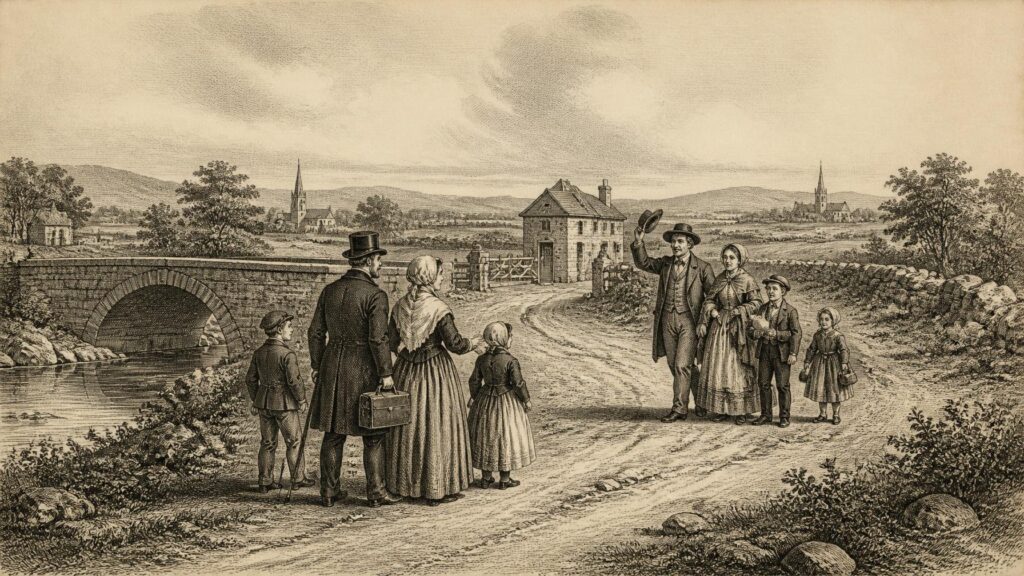
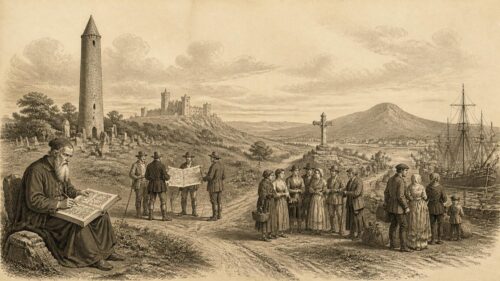
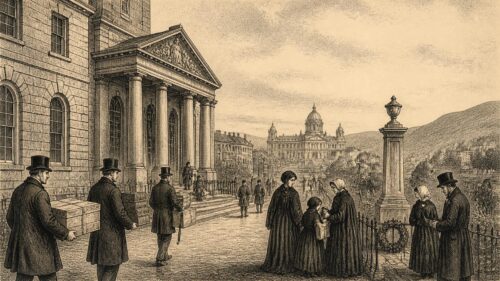
AI generated historical illustration, not a contemporary photograph.
At a Glance
Citizenship was not a peripheral detail of the Northern Ireland peace process: it was one of the means by which a conflict over sovereignty, identity and belonging could be recast without requiring either principal tradition to surrender its understanding of home. The Belfast or Good Friday Agreement of 10 April 1998 is often remembered through its institutions, its arrangements for decommissioning, and the end of large-scale political violence. Yet its promise concerning citizenship was equally consequential. It recognised the birthright of the people of Northern Ireland to identify and be accepted as Irish or British, or both, as they chose, and accepted their right to hold both citizenships. That language was an answer to a long historical problem. Since partition, state boundaries, nationality law and political allegiance had overlapped imperfectly on the island of Ireland. The peace settlement did not abolish that complexity. It made room for it.
Contested Belonging
Modern citizenship in Ireland developed amid revolution, partition and competing claims to legitimate authority. Before 1921, people born in Ireland were British subjects under the constitutional arrangements of the United Kingdom of Great Britain and Ireland. That legal status did not settle political identity. Irish nationalism increasingly treated Ireland as a distinct national community, while unionism, strongest in the north-east, understood British connection as both a constitutional allegiance and an important protection for a Protestant and unionist population. These were not simply abstract theories. They shaped access to power, the character of public institutions and the everyday language through which people described themselves.
The partition settlement of 1920–22 created Northern Ireland within the United Kingdom and the Irish Free State in the remainder of the island. It did not neatly divide national feeling. A substantial nationalist minority remained in Northern Ireland, while unionist communities lived outside it. The border consequently became more than an administrative line. It marked different constitutional systems, but it crossed family networks, commercial routes, religious affiliations and older local connections. For many nationalists in Northern Ireland, Irish identity continued to be a matter of nationality and political aspiration, despite residence in a territory governed from Westminster. For many unionists, British citizenship and the Union were inseparable from their security and public equality.
It is important not to project later legal language too easily backwards. The citizenship framework of the late twentieth and early twenty-first centuries did not exist at partition. Nevertheless, the basic tension was already clear: could people be full members of the state in which they lived without being compelled to renounce a national identity directed beyond it? The question became more difficult because Northern Ireland’s devolved institutions were not widely trusted by the nationalist population. Allegations of discrimination in housing, employment, electoral administration and local government deepened the belief that constitutional membership did not deliver equal civic standing.
National Claims
The Constitution of Ireland, adopted in 1937, expressed an all-island national aspiration in its original Articles 2 and 3. The provisions were interpreted differently over time, but they mattered symbolically and politically. Unionists regarded them as an assertion of claim over Northern Ireland; many nationalists regarded them as an expression of Irish nationhood that partition had not extinguished. Meanwhile, British governments maintained that Northern Ireland’s constitutional position rested on its place within the United Kingdom, subject in practice to changing statutory arrangements and political pressure.
Citizenship law carried a related, though not identical, message. The Irish Nationality and Citizenship Act 1956 stated that every person born in Ireland was an Irish citizen from birth, subject to a narrow diplomatic exception. In legal terms, this gave people born in Northern Ireland a route to Irish citizenship. It did not make the constitutional conflict disappear, nor did it ensure that Irish identity would receive equal public recognition in Northern Ireland. But it preserved a legal connection between people in the North and the Irish state, a connection of particular significance to those who rejected the idea that their political identity could be exhausted by British nationality.
British nationality law evolved separately. The British Nationality Act 1981, in force from 1983, created the modern status of British citizen and set out the principal rules for acquisition by birth, descent and registration. Northern Ireland was treated as part of the United Kingdom for these purposes. In broad terms, a person born there who met the applicable parental conditions was a British citizen at birth. The coexistence of British and Irish citizenship was therefore legally possible for many people, but possibility was not the same as an agreed constitutional principle. Nor did the law itself answer what it meant for someone who regarded British citizenship as unwanted or irrelevant.
Political Conflict
The civil-rights movement of the late 1960s brought questions of citizenship into sharper focus. Campaigners demanded equal treatment in voting, housing, employment and policing. Their language was often civic rather than narrowly constitutional: they sought rights as residents and citizens, not merely concessions to one community. But the movement operated in a society where citizenship, state authority and communal identity were already contested. Unionists feared that reforms might weaken Northern Ireland’s place in the United Kingdom; nationalists argued that equality could not be secured under institutions built around unionist dominance.
Violence transformed these disputes. From the late 1960s, the conflict later commonly called the Troubles involved republican and loyalist paramilitary organisations, the British Army, the Royal Ulster Constabulary, British state agencies and political parties. The human cost was grave. Citizenship became entangled with security policy, emergency powers, imprisonment, policing and the experience of travelling across a heavily militarised border. A passport, accent, address or claimed nationality could acquire a significance far beyond routine administration.
During these decades, arguments about constitutional status were frequently presented as mutually exclusive. Republican organisations insisted that British jurisdiction in Northern Ireland lacked legitimacy. Unionists defended the Union as the democratic choice of the majority within Northern Ireland. The British government gradually moved towards a more explicit consent principle: Northern Ireland would remain in the United Kingdom unless a majority there decided otherwise. That principle did not satisfy everyone, but it created a basis on which the constitutional future might be decided democratically rather than by force.
Uneasy Experiments
The Sunningdale Agreement of 1973 was an important precursor. It proposed power sharing within Northern Ireland and a Council of Ireland linking North and South. Its collapse in 1974 demonstrated the fragility of institutional plans unsupported by sufficient trust, especially among unionists who feared an imposed all-Ireland trajectory. The failure did not mean that its ideas vanished. Power sharing, North-South co-operation and British-Irish involvement would all return in later negotiations.
The Anglo-Irish Agreement of 1985 represented another significant stage. It gave the Irish government a formal consultative role in Northern Ireland affairs through the Anglo-Irish Intergovernmental Conference, while reaffirming that a change in Northern Ireland’s status required majority consent. Unionist opposition was intense, in part because the agreement had been negotiated without unionist participation. Yet the agreement established sustained governmental co-operation between Dublin and London. That relationship, developed through officials as well as ministers, became essential to later peace-making.
These arrangements did not resolve citizenship questions, but they altered their context. The Irish state could advance views on Northern Ireland through agreed intergovernmental channels rather than solely through constitutional claim. The British government, in turn, increasingly accepted that Irish identity in Northern Ireland was not foreign or merely private. The slow movement was from rival claims of exclusive authority towards a recognition that the people affected had overlapping political and cultural affiliations.
Negotiated Identity
The ceasefires of the 1990s and the multi-party negotiations that followed created an opportunity to express that recognition in a new constitutional form. The Belfast Agreement was reached on 10 April 1998 by the British and Irish governments and most of Northern Ireland’s principal political parties. It contained both a multi-party agreement and a British-Irish Agreement between the two states. This dual character matters. The settlement was at once a domestic political compact, an international agreement and a programme for constitutional change.
Its architecture was often described through three strands. Strand One created devolved, power-sharing institutions in Northern Ireland. Strand Two established North-South bodies for practical co-operation across the island. Strand Three created and developed East-West institutions, including the British-Irish Council and the British-Irish Intergovernmental Conference. The purpose was not to determine a final winner in the old argument between union and unity. Rather, it was to make constitutional disagreement manageable by giving political expression to several relationships at once.
At the heart of the constitutional section stood the principle of consent. Northern Ireland would remain part of the United Kingdom unless a majority of its people voted otherwise. If a majority were to support a united Ireland in a referendum, the British and Irish governments undertook to give effect to that choice. Nationalists obtained recognition that constitutional change could occur through peaceful democratic means; unionists obtained an explicit guarantee that it could not be imposed without majority consent in Northern Ireland.
Birthright Promise
The citizenship provisions gave this balance an individual dimension. The agreement recognised “the birthright of all the people of Northern Ireland to identify themselves and be accepted as Irish or British, or both, as they may so choose”. It further confirmed that the right to hold both British and Irish citizenship was accepted by both governments and would not be affected by any future change in Northern Ireland’s constitutional status. The agreement defined “the people of Northern Ireland” for this purpose by reference to birth in Northern Ireland and a parental connection through British citizenship, Irish citizenship or an unrestricted right of residence.
The wording was carefully constructed. It did not say that everyone must be both Irish and British. It did not say that British identity should be treated as a temporary anomaly pending Irish unity, nor that Irish identity should be treated as a private cultural preference within an unalterably British territory. Instead, it treated both as legitimate identities and permitted their combination. The significance lay not only in the availability of passports. It lay in the commitment that people would be “accepted” according to the identity they chose.
This was a notable departure from the assumption that territorial sovereignty must produce one compulsory national allegiance. The agreement accepted that a person born in Northern Ireland might understand themselves as British alone, Irish alone, both, or in terms that changed over a lifetime. It also acknowledged that the constitutional future should not strip people of citizenship rights. The protection was directed towards continuity as much as choice: whichever state exercised sovereignty in the future, individuals should not be required to abandon a recognised nationality.
Interpretation requires care. The agreement did not create a single unified British-Irish citizenship. Nor did it replace British or Irish nationality legislation with a new supranational status. Citizenship remained administered through the laws of two states. The agreement’s achievement was to establish a political and treaty commitment that those separate legal systems should accommodate a distinctive population whose national affiliations could not be confined to one side of the constitutional divide.
Constitutional Change
The settlement required changes in both states. In Ireland, the Nineteenth Amendment to the Constitution was approved in the referendum of 22 May 1998. It enabled the state to consent to the British-Irish Agreement and provided for revised Articles 2 and 3 to take effect when the agreement entered into force. The change was momentous. The earlier territorial formulation was replaced by language that recognised the entitlement and birthright of every person born on the island of Ireland to be part of the Irish nation, while acknowledging that a united Ireland could be brought about only by peaceful means with the consent of a majority in both jurisdictions.
These revised articles balanced continuity and change. They maintained an all-island idea of Irish nationhood, including the entitlement of those born in Northern Ireland to Irish citizenship, but they abandoned any suggestion that the Irish state possessed an immediate constitutional authority over Northern Ireland. For nationalists, this was a difficult but deliberate accommodation, endorsed in a popular vote. For unionists, it removed a longstanding constitutional grievance and reinforced the consent principle.
In the United Kingdom, the Northern Ireland Act 1998 gave domestic statutory effect to central elements of the agreement. It affirmed that Northern Ireland remained part of the United Kingdom unless a majority voted otherwise and established the Assembly, Executive and associated institutional arrangements. It also provided mechanisms for future referendums on constitutional status. British constitutional law is shaped differently from written constitutional texts in Ireland, but the 1998 Act made the principle of consent part of the domestic legal framework.
Popular Consent
The referendums of 22 May 1998 were themselves important acts of citizenship. Voters in Northern Ireland approved the agreement by a substantial majority, while voters in Ireland approved the constitutional amendment by an overwhelming majority. The two ballots were legally distinct and took place in different jurisdictions, but politically they were interdependent. Their combined result granted the settlement a democratic legitimacy that negotiations alone could not provide.
Referendums should not be romanticised as moments of total consensus. People voted for varied reasons. Some primarily welcomed the prospect of peace; some supported power sharing; some accepted the consent principle; some considered the agreement the least damaging available compromise. Others opposed it, whether because they feared constitutional erosion, objected to prisoner-release provisions, distrusted paramilitary commitments or believed the settlement abandoned fundamental principles. The votes did not dissolve disagreement. They established a framework within which disagreement could be conducted through politics rather than sustained armed conflict.
The constitutional revisions also demonstrated that citizenship and sovereignty were related but distinct. A person could be an Irish citizen while Northern Ireland remained within the United Kingdom. A person could be a British citizen while living in a state that recognised Irish national belonging. The peace settlement thus placed personal nationality alongside, rather than wholly beneath, territorial sovereignty. That was one of its most original features.
Everyday Rights
Citizenship is experienced through ordinary acts. It concerns passports, entry and residence, the right to vote, access to public services, family life, employment and the ability to describe oneself without official contradiction. In Northern Ireland, the difference between holding a right in principle and enjoying it in practice has repeatedly become visible in these mundane settings.
Irish citizenship offered people born in Northern Ireland an Irish passport and, after Ireland and the United Kingdom joined the European Economic Community in 1973, a connection to wider European rights. British citizens had their own rights through United Kingdom membership. For much of the period after 1998, the fact that both states were members of the European Union softened the practical consequences of choosing one passport, both passports or neither. Free movement, common regulatory rules and the absence of routine frontier infrastructure made the border less intrusive than it had been during the conflict.
The Common Travel Area also mattered. Long before the Belfast Agreement, arrangements between Ireland and the United Kingdom enabled extensive reciprocal travel and residence rights. Irish citizens in the United Kingdom and British citizens in Ireland generally enjoyed a status more favourable than that of other foreign nationals. These arrangements were never a substitute for the agreement’s identity commitments, but they made the practical overlap between the two states unusually dense. People could live, work, study and form families across the islands with a degree of ease that reinforced the peace settlement’s plural logic.
Passports Matter
A passport is a travel document, but in Northern Ireland it can also be a declaration of belonging. For some people, obtaining an Irish passport has been a straightforward exercise of a citizenship already understood as theirs. For others, a British passport performs the same function. Many hold both, sometimes for practical convenience and sometimes because dual documentation reflects a genuinely dual identity. The agreement’s language made each of these choices politically intelligible.
Yet passports can obscure a key distinction. Possession of an Irish passport is evidence of Irish citizenship, but a person may identify as Irish without currently holding one. Equally, a person may possess British citizenship automatically under nationality law while rejecting a British identity. Administrative categories do not always match self-description. The Belfast Agreement’s reference to being accepted was significant because it addressed recognition, not simply paperwork.
The issue became especially clear in disputes over immigration and family reunification. Some people born in Northern Ireland who identified solely as Irish argued that UK immigration rules nevertheless treated them as British citizens. In cases involving non-European spouses, this could mean that they were required to use rules applied to British citizens rather than routes available to Irish citizens exercising European free-movement rights. The case associated with Emma and Jake De Souza brought the problem into public view. It illustrated that a government may accept the availability of Irish citizenship while still applying domestic law on the premise that a Northern Ireland-born person is British.
The resulting controversy was not merely technical. It concerned whether identity could be treated as an optional cultural label while nationality law imposed consequences from which an individual could escape only through a formal renunciation of British citizenship. Human-rights bodies, including the Northern Ireland Human Rights Commission and the Irish Human Rights and Equality Commission acting through their Joint Committee, argued that the birthright commitment required a more secure domestic legal response. The UK government altered aspects of its immigration rules in 2020 to address particular family-migration circumstances, but debate continued over whether piecemeal administrative remedies fully reflected the agreement’s letter and spirit.
Legal Tensions
The De Souza controversy exposed a wider interpretative question: does the Belfast Agreement give every eligible person a free choice of citizenship from birth, or does it principally protect the right to identify as Irish, British or both while the underlying acquisition of nationality remains governed by ordinary law? The agreement’s wording supports the view that it envisages strong individual choice. It refers to identity, acceptance and the right to hold both citizenships. At the same time, neither the British Nationality Act 1981 nor Irish citizenship legislation was wholly rewritten in 1998 to create a bespoke opt-in system for Northern Ireland.
That gap between treaty language and domestic law is documented, not speculative. The Joint Committee’s commissioned legal analysis argued that UK law did not fully incorporate the birthright commitment. It distinguished the ability to identify as Irish from the legal consequences of being automatically treated as British. The analysis did not deny the United Kingdom’s connection to people born in Northern Ireland. Rather, it asked whether automatic attribution could meet a promise designed to ensure that national identity would not be imposed to a person’s detriment.
Other interpretations are possible. Supporters of the existing legal structure note that dual citizenship is widely available and that the agreement expressly confirms the right to hold both British and Irish citizenship. They may argue that automatic British citizenship does not prevent Irish citizenship or Irish identity, particularly where a person can obtain an Irish passport without renouncing British status. They also point to the practical difficulty of constructing nationality rules around changing personal identification. Citizenship law usually depends on birth, parentage, residence and formal application rather than subjective allegiance alone.
Recognition Gap
The central historical point is that the dispute exists because the agreement deliberately connected legal status with recognition. Had the text said only that those born in Northern Ireland might obtain both citizenships, the issue would have been narrower. Instead, it placed the right to be accepted as Irish, British or both beside the right to hold citizenship. This invites the argument that public authorities should not make British nationality the unavoidable gateway to rights for people who identify only as Irish.
The phrase “without any loss of rights or entitlements” is often used in policy discussion, though those precise words are not the operative text of the constitutional-issues section. It expresses an influential interpretation of what equal recognition should entail. The challenge is to identify which rights are affected by nationality classification and which can be protected through exemptions or administrative adjustments. Immigration law is particularly sensitive because it determines family residence, deportation powers and access to routes that may differ according to citizenship.
Historical perspective helps here. The problem is not that the agreement failed to erase every legal complication in 1998. Peace settlements commonly leave difficult issues to be worked out over time. The more important question is whether later governments treat such issues as peripheral anomalies or as tests of the settlement’s underlying purpose. Where an individual is asked, in effect, to renounce a citizenship they never sought in order to exercise rights as Irish, the historical memory of imposed allegiance on the island of Ireland makes the matter politically charged.
European Change
Brexit gave citizenship a new prominence. In the United Kingdom’s 2016 referendum on membership of the European Union, Northern Ireland voted to remain, although the United Kingdom as a whole voted to leave. The result placed the border, cross-border movement and the differing implications of British and Irish citizenship at the centre of public debate. The peace process had developed during a period when both states were EU members. Their shared membership did not cause the Belfast Agreement, but it supplied a supportive environment in which borders became less visible and overlapping identities less administratively burdensome.
Irish citizens remain citizens of the European Union wherever they live. A person born in Northern Ireland who is an Irish citizen therefore retains EU citizenship after the United Kingdom’s withdrawal, while a British citizen who is not also Irish no longer has that status by virtue of British nationality. This created a new practical distinction within a population whose citizenship arrangements had been designed to permit equality of esteem. It did not invalidate the agreement, but it changed the context in which its promises were understood.
The Withdrawal Agreement’s Protocol on Ireland and Northern Ireland, subsequently adjusted through the Windsor Framework, sought to avoid a hard border on the island while recognising Northern Ireland’s place in the United Kingdom. Article 2 of the Protocol contains a commitment that the United Kingdom will ensure no diminution of rights, safeguards and equality of opportunity, as set out in the relevant chapter of the Belfast Agreement, resulting from its withdrawal from the European Union. This provision has made rights protection a continuing legal and political issue rather than a matter of historical commemoration.
Border Questions
Brexit demonstrated that citizenship can produce different lived outcomes even where formal identity rights are acknowledged. An Irish citizen in Northern Ireland may rely on EU citizenship for movement and residence in EU states, while a British-only citizen relies on different arrangements. British and Irish citizens continue to benefit from Common Travel Area provisions between the two states, but the Common Travel Area is not equivalent to EU citizenship. It does not reproduce every European right, especially in relation to wider EU residence, political participation or the position of family members from outside Ireland and the United Kingdom.
This distinction should not be exaggerated into a simple story of one citizenship being superior. British citizenship confers important rights, and many people in Northern Ireland value it deeply. Nor are all Irish citizens equally positioned to use EU rights in practice. The historical significance lies elsewhere: Brexit made visible the fact that the two identities protected by the 1998 settlement now connect to different external political and legal orders. That difference has intensified arguments about equal treatment and the meaning of dual citizenship.
It also renewed attention to the border as a civic space. During the Troubles, security installations made the border physically conspicuous. In the years after 1998, their removal became one of the everyday signs of normalisation. Brexit negotiations raised fears that customs or regulatory controls might restore visible divisions. The eventual arrangements sought to avoid a land frontier, but debates about trade between Great Britain and Northern Ireland showed that the constitutional sensitivities associated with borders had not disappeared. They had changed form.
Democratic Futures
The Belfast Agreement does not predetermine Northern Ireland’s constitutional future. It provides a democratic procedure through which that future may change. This is often reduced to discussion of a future referendum, but the agreement’s larger achievement was to make constitutional aspiration compatible with civic peace. Nationalists may advocate Irish unity; unionists may advocate continued membership of the United Kingdom. Neither position, in the agreement’s design, authorises coercion or the denial of the other community’s legitimate identity.
Citizenship is essential to that design because constitutional change affects people before it affects maps. A future vote, if one were called, would concern institutions and sovereignty, but it would also concern passports, welfare rights, representation, symbols, public service and the security felt by communities with different national attachments. The 1998 commitment that citizenship rights would not be affected by a future change was intended to reduce the fear that a constitutional outcome would make one tradition alien in its own home.
Lasting Framework
There is no historical basis for assuming that law alone can settle questions of belonging. The peace process succeeded to the extent that it combined legal guarantees with political restraint, cross-community participation and continuing British-Irish co-operation. Its institutions have experienced repeated suspensions and crises. Disputes over language, flags, legacy, policing, equality, welfare, Brexit arrangements and constitutional rhetoric have shown that the conflict’s underlying memories remain powerful. Citizenship questions belong within that unfinished history.
Nor should the agreement be treated as folklore, a sacred text beyond interpretation. Its provisions are legal and political commitments made in particular circumstances; they require institutions, courts, governments and citizens to interpret them. Different parties will continue to disagree over the exact reach of the birthright promise. Such disagreement is not evidence that the promise was meaningless. On the contrary, it reflects the seriousness of a settlement that attempted to translate rival national narratives into enforceable principles of coexistence.
The documented evidence supports a measured conclusion. The Belfast Agreement transformed citizenship from a marker of exclusive sovereignty into a safeguard for plural belonging. It did not abolish British or Irish nationality, erase the border, or make all legal outcomes identical. It did, however, establish that neither Britishness nor Irishness should be made the price of political peace. That principle remains historically significant because it offers a civic answer to a conflict long shaped by competing national loyalties: people may inhabit the same place, participate in the same democratic institutions and retain different, even overlapping, allegiances.
For Ireland and Northern Ireland alike, that remains the demanding work of the peace process. Citizenship is most durable when it is not used to classify neighbours into permanent winners and losers, but to guarantee that no person need abandon a truthful account of who they are in order to belong. The achievement of 1998 was not to make identity simple. It was to make complexity constitutional.
Shared Allegiance
Brexit demonstrated that citizenship can produce different lived experiences even where the peace settlement protects equal belonging. The United Kingdom’s withdrawal from the European Union did not alter the birthright recognised in 1998, but it made the consequences of holding Irish citizenship more visible. Irish citizens in Northern Ireland continued to possess European Union citizenship, while British citizenship by itself no longer carried that connection. For people who held both nationalities, the distinction could be managed through dual status; for those who understood themselves as Irish alone, it renewed attention to the difference between personal identity and the nationality attributed by British law.
The post-Brexit arrangements also tested the Agreement’s wider accommodation of overlapping relationships. Avoiding new checkpoints at the Irish land border was treated as important not only for trade but for the preservation of cross-border life and the political conditions created by the peace process. The Northern Ireland Protocol placed checks and documentation requirements on certain goods arriving from Great Britain. Its supporters emphasised the protection of all-island co-operation and the avoidance of a hard border; its unionist critics regarded the arrangements as weakening Northern Ireland’s connection with the rest of the United Kingdom. The Windsor Framework sought to reduce checks on goods intended to remain in Northern Ireland while retaining controls for goods considered at risk of entering the European Union.
These arguments concerned commerce and constitutional symbolism, but they also revealed the continuing importance of shared allegiance. The Belfast Agreement had made it possible to participate in Northern Ireland’s public life without accepting an exclusive answer to the question of nationhood. Brexit introduced a new setting in which the Irish, British and European dimensions of identity could carry unequal practical advantages or burdens. The settlement’s task was therefore not finished by recognising dual citizenship. Its institutions had to remain capable of handling disagreement when borders, markets and legal rights again became politically charged.
The controversy around the De Souza case illustrates a related problem at the level of the individual. British nationality law generally confers British citizenship at birth on a person born in the United Kingdom when the relevant parental conditions are met. A person born in Northern Ireland may consequently be treated by British authorities as British even if that person identifies only as Irish and possesses Irish citizenship. In immigration matters, that classification could affect which family-reunion rules applied. The issue was not whether Irish citizenship existed, but whether the state could require someone to be treated as British for legal purposes unless they undertook a formal renunciation.
Legal debate has exposed competing readings of the 1998 commitment. One position distinguishes the right to identify as Irish from a right to elect Irish rather than British nationality from birth. It stresses that nationality systems require administrable rules, and that automatic citizenship helps prevent statelessness. Another gives greater weight to the undertaking that people be accepted as Irish, British or both as they choose. On this view, official treatment as British may be inconsistent with the promise when it brings legal disadvantages to a person who identifies solely as Irish.
Neither interpretation permits a simple solution. A system based entirely on unexpressed personal preference could create uncertainty about citizenship, residence and rights. Yet a system that makes renunciation the sole means of escaping an unwanted nationality risks reducing a central peace-process assurance to a procedural formality. The legal analysis commissioned by the two human-rights bodies considered possible legislative mechanisms, including an election of nationality while preserving safeguards against statelessness and protecting a continuing right of abode.
Shared allegiance is thus not a compromise in the weak sense of postponing a decision. It is the constitutional practice of allowing people to sustain different national connections without making equal treatment depend upon a single, compulsory identity. Its durability rests on law, administration and institutions as much as on political language. The continuing challenge is to ensure that choices promised in 1998 remain meaningful in the ordinary circumstances—travel, family life, employment and public recognition—through which citizenship is actually experienced.

One striking implication is that the Agreement’s recognition of British, Irish and dual identities depends on more than symbolic permission: passports, residence, family migration, voting and EU-related rights determine whether belonging feels equally secure in daily life. Brexit has exposed the gap between a treaty commitment to accepted identity and the domestic systems through which citizenship is administered. The article suggests that peace was supported by preserving overlapping allegiances rather than forcing a single constitutional narrative. How should policymakers assess whether citizenship rules uphold the Agreement’s promise of equal acceptance for people who identify as British, Irish, both, or neither?