

Earned Legitimacy
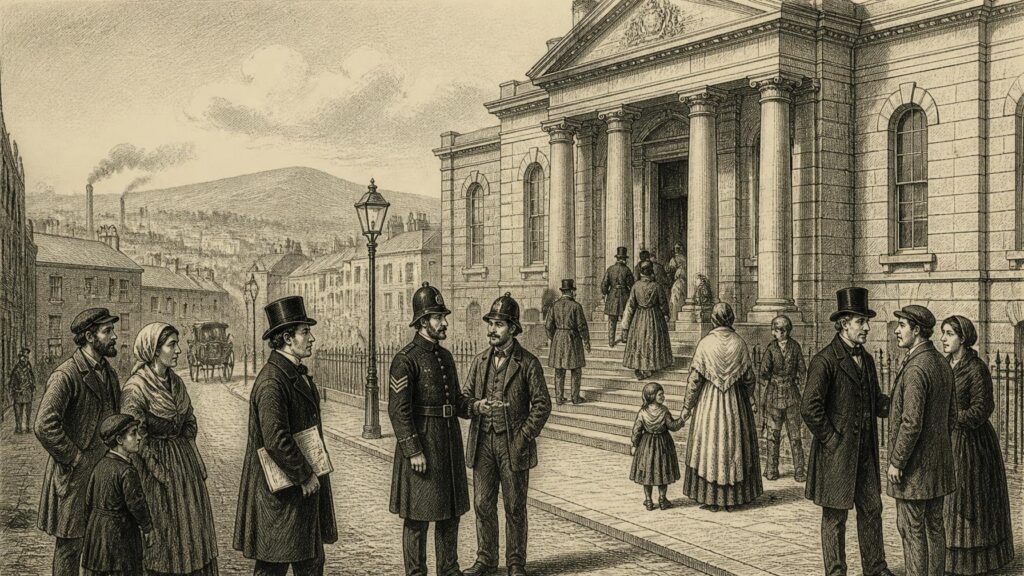
AI generated historical illustration, not a contemporary photograph.
At a Glance
Public trust in justice in Northern Ireland in 2026 is neither a simple measure of approval nor a finished chapter in the peace process. It is the accumulated result of constitutional compromise, institutional redesign, daily encounters with police and courts, and the enduring claims of people harmed during the conflict. The evidence records considerable progress since the late twentieth century, but it also demonstrates that confidence is conditional. It can be strengthened by fairness, visibility and independent scrutiny; it can be weakened by delay, poor service, misconduct, exclusion and unanswered questions about the past.
Trust Measured
The phrase “public trust” can obscure more than it explains. It is often used as though every citizen holds a single view of “the justice system”. In practice, people distinguish between the police officer who attends a call, the emergency telephone response, the treatment of a victim, the impartiality of an investigation, the work of prosecutors, the speed of a court and the possibility of complaining when authority is misused. They may feel safe in their own street while distrusting the handling of a particular crime. They may approve of policing generally while believing that the institutions dealing with the legacy of the Troubles have not delivered truth or remedy.
The available official evidence gives a cautiously encouraging broad picture. The Department of Justice’s 2023/24 Northern Ireland Safe Community Telephone Survey, published in July 2025, found that public confidence in the police and in police accountability arrangements remained around 80 per cent. The same survey estimated that 4.5 per cent of respondents had experienced at least one of the crimes measured in the preceding twelve months, down from 5.8 per cent in 2022/23. These figures do not prove that every community experiences justice equally. They do, however, indicate that confidence has become sufficiently widespread to be measured as a normal feature of civic life rather than treated solely as a constitutional aspiration.
The Northern Ireland Policing Board’s separate 2025 survey adds texture. Based on interviews with 2,500 adults between January and April 2025, it found that 91.5 per cent felt safe in their community and 72.9 per cent considered the Police Service of Northern Ireland effective or very effective at keeping that community safe. Yet 67.5 per cent were satisfied or very satisfied with the PSNI’s work overall, lower than the equivalent figures reported in 2022 and 2023. Only 61.4 per cent responded positively when asked about confidence in the PSNI’s ability to protect and serve all people in Northern Ireland. The Board warns that wording changes prevent a straightforward comparison with earlier surveys, an important methodological caution.
Most revealingly, the experience of crime makes a difference. In the Board’s survey, victims were more than twice as likely as non-victims to be dissatisfied with the fairness of police treatment. Confidence in contacting the PSNI was high overall, at 92.1 per cent, but lower among crime victims, at 82.7 per cent. That gap is historically significant. A justice system earns legitimacy not principally from the opinion of citizens who have no occasion to use it, but from those who require protection, explanation, evidence, advocacy and a decision at a difficult moment.
Burdened History
Justice in Northern Ireland cannot be understood apart from the political conflict that became known as the Troubles. Policing, courts, imprisonment, emergency powers and security operations were not perceived as neutral terrain. For many unionists, the Royal Ulster Constabulary represented a force exposed to sustained republican violence and charged with defending public order amid grave danger. For many nationalists and republicans, it was an institution connected to a state they did not accept and associated with discrimination, force and inadequate accountability. These views were not merely competing stories about symbols. They shaped willingness to report crime, cooperate with investigations or recognise the authority of official institutions.
That history also requires precision. It would be misleading to treat either community as possessing one fixed attitude, or to assume that all mistrust arose from inherited identity. Trust was affected by personal bereavement, intimidation, local relationships, class, gender, place, political affiliation and direct experience of institutions. The conflict itself generated multiple forms of victimhood and fear. Police officers, prison staff, soldiers, civilians and members of political organisations were all among those killed and injured. A historical account should therefore resist the tempting folklore of a population divided into two permanent and homogeneous camps.
The 1998 Belfast or Good Friday Agreement recognised that a durable political settlement required new policing arrangements capable of broad support. Its language placed policing within a coherent criminal justice system, committed to human-rights norms, accountability, impartiality and representation. This was not an incidental administrative reform. It was an acknowledgement that authority in a divided society could not rest securely on legal powers alone. It had to be made publicly credible.
The Independent Commission on Policing for Northern Ireland, chaired by Chris Patten, was established in that setting. Its 1999 report, A New Beginning, described a programme of 175 recommendations. The report was emphatic that reform should be understood as a package. It proposed a human-rights-based approach, stronger democratic and independent oversight, local participation, changes in symbols and culture, and measures to produce a more representative service. The point was not simply to rename an organisation. It was to help separate ordinary policing from the constitutional conflict that had so often engulfed it.
Patten Settlement
The creation of the Police Service of Northern Ireland in November 2001 marked the most visible expression of the Patten settlement. It did not erase the past, nor could it have done so. The PSNI inherited personnel, buildings, files, risks and the expectations of a society emerging unevenly from violence. Its significance lay instead in the institutional proposition that policing must be answerable to the whole community. The change in name, badge and oath carried political importance precisely because everyday symbols can signal whose authority a service is thought to embody.
The Northern Ireland Policing Board was established on 4 November 2001. Its origins matter because it was designed not as a public-relations appendage but as part of the constitutional architecture of legitimacy. The Board was given responsibilities to secure an effective and efficient police service, set strategic priorities, monitor performance and hold the Chief Constable to account. Its membership combines political and independent members. In historical terms, this arrangement sought to create public accountability without placing operational decisions under partisan direction.
The Patten reforms also gave weight to human rights. The Commission recommended that fundamental rights should be integrated into the purpose, training, ethos and supervision of policing, rather than treated as an external restraint applied after the event. The distinction is consequential. A force may be efficient at enforcement yet still lack legitimacy if citizens believe power is exercised selectively, disrespectfully or beyond scrutiny. The post-Agreement model asked the police to regard equal respect and impartiality as practical standards of service.
Interpretation should not be confused with documentary fact. The documentary record shows that Patten’s recommendations encouraged a radical recasting of structures, language and oversight. It is an interpretation, albeit a persuasive one, that their deepest achievement was to make disagreement about policing more governable. Arguments about operational decisions, parades, public order, surveillance or resources did not disappear. But they could increasingly be addressed through public meetings, performance scrutiny, complaints procedures, judicial processes and political debate rather than being treated automatically as proof that one community’s police were acting against the other.
Accountable Policing
Independent complaint investigation is central to that achievement. The Office of the Police Ombudsman for Northern Ireland was established to investigate complaints about police conduct independently of the police themselves. Such independence does not guarantee that every complainant will agree with an outcome. It does provide an institutional route by which allegations can be examined, evidence tested and findings made outside the command structure of the PSNI. In a jurisdiction where allegations about policing historically carried profound political weight, that distinction is essential.
The Ombudsman’s 2024/25 statistical bulletin records the continuing practical demand for this form of accountability. Its accompanying material reported that evidence substantiating all or part of a complaint was found in 12 per cent of complaints concluded within the relevant reporting. The figure should not be misread. It does not mean that all other complainants acted in bad faith; complaints can be unsubstantiated for many reasons, including limited evidence. Nor does it measure every concern a person may hold about policing. It does show that independent examination is not ceremonial. It can identify wrongdoing and provide a route towards learning, discipline or correction.
Complaint categories also matter. The Ombudsman’s later quarterly statistics for 2025/26 identified alleged failure in duty as the largest category, followed by oppressive behaviour and incivility. These are not exclusively questions of dramatic misconduct. They concern the ordinary texture of authority: whether officers act when needed, explain their actions, treat people with dignity and use powers proportionately. Public trust is often lost in such encounters before it is measured in a survey.
The Policing Board’s work occupies a related but different role. It scrutinises performance and strategy rather than adjudicating individual complaints. The Board and PSNI published the Policing Plan 2025–2030 with three broad outcomes: victim-focused policing; safe and engaged communities with confidence in policing; and a representative, valued and enabled workforce. The prominence of confidence in this plan is noteworthy. It treats legitimacy as an outcome that should be planned for and assessed, not as goodwill that institutions can presume.
There remains a danger in reducing accountability to publication. Reports, meetings and statistics are necessary, but trust depends on whether they lead to visible remedial action. The PSNI’s April 2026 accountability report acknowledged that misconduct and cultural concerns go to organisational integrity and legitimacy, and stated that independent scrutiny and internal reform were required. The wording reflects a wider historical lesson: an institution’s claim to be trusted is strongest when it admits that trust can be damaged and demonstrates how it will respond.
Justice Devolved
The policing story is closely tied to a broader constitutional change. Policing and justice powers were transferred to the Northern Ireland institutions on 12 April 2010. The Department of Justice Act (Northern Ireland) 2010 established a Department of Justice to exercise functions consisting wholly or mainly of devolved policing and justice matters. The transfer was a landmark because sensitive responsibilities previously retained at Westminster became part of the restored devolved settlement.
Devolution did not make justice politically simple. It placed responsibility closer to locally elected institutions while leaving national security and some other matters within a different constitutional sphere. Nevertheless, it gave Northern Ireland a Justice Minister and Department capable of shaping policy across courts, prisons, probation, youth justice, community safety and policing-related functions. In historical terms, this was another movement away from exceptional administration and towards locally accountable government.
Public confidence in justice must therefore be broader than confidence in the PSNI. Courts need to be accessible and timely. Prosecutorial decisions need to be intelligible to victims and defendants. Prisons and probation services must protect the public while respecting lawful rights. Community organisations need routes into prevention and safety policy. The Department of Justice’s official statistics on prosecutions, convictions and out-of-court disposals offer one partial view of this system, but administrative totals cannot answer the deeper question of whether users believe procedures are fair.
The distinction matters especially where delay occurs. A case may be properly investigated yet feel like a failure to a victim if communication is poor or if the process takes too long to reach a decision. Equally, a defendant’s confidence in justice rests on the presumption of innocence, legal representation, disclosure, an impartial tribunal and a sentence that follows law rather than popular pressure. Public trust should never mean public deference. A system worthy of trust includes safeguards that sometimes require it to resist the immediate preferences of majorities.
Evidence Uneven
The best recent statistics should not be forced to say more than they can. Survey evidence is valuable because it captures unreported victimisation and perceptions among a representative sample. It also has limits. The Northern Ireland Safe Community Survey was conducted by telephone from 2020/21, creating a break in the historical series from earlier face-to-face work. The Policing Board’s 2025 questionnaire included wording changes that limit direct comparison with prior confidence measures. The differences between a finding of around 80 per cent confidence in police accountability and a 61.4 per cent positive response on the PSNI’s ability to protect and serve all people are not necessarily contradictions. They are measurements of different questions, asked in different research instruments.
This is a reason for care, not pessimism. A mature account of public confidence should acknowledge that people can hold several views at once. Someone may approve of oversight while fearing that officers will not arrive promptly. A person may report feeling safe locally but believe the police are not representative enough. A crime victim may respect the professionalism of individual officers but be disappointed with the eventual result. These distinctions are evidence of citizens making judgments, rather than proof that survey results are useless.
Representation remains an especially sensitive issue. Patten treated it as important because a police service cannot plausibly claim the confidence of every part of society if substantial sections do not see a credible route into its ranks or senior leadership. Representation, however, is more than a count of religious background. It encompasses gender, ethnicity, disability, age, language, geography and the ability of staff to understand changing communities. The PSNI’s 2025 Race and Ethnicity Action Plan recognised the need to improve trust and engagement with ethnic-minority communities, a reminder that Northern Ireland’s public is not exhausted by the categories that dominated late twentieth-century politics.
There is no reliable basis for declaring public confidence either fully restored or broadly absent. The evidence supports a more exact conclusion: confidence is substantial in aggregate, but it is differentiated by experience and vulnerable to institutional failure. This is not a weakness in the concept of trust. It is what trust looks like in a democratic society where citizens are entitled to judge public power.
Victims Waiting
Victims occupy a difficult position in discussions of legitimacy. Official surveys show that people who have experienced crime tend to report lower satisfaction than those who have not. That is understandable, but it should not be dismissed as inevitable. A victim does not necessarily expect police or prosecutors to produce a conviction in every case. Many expect to be kept informed, treated respectfully, protected from further harm and given a clear explanation of what can and cannot be done. These are practical standards through which the larger promise of justice becomes real.
The 2025 Policing Board survey showed the pressure point plainly. Although two thirds of respondents thought the PSNI treated the public fairly, victims were much more likely than non-victims to say otherwise. The historical importance of that finding lies in its challenge to complacency. An institution may retain a reasonably positive reputation while still failing those with the greatest reason to need it. Improving contact, case updates, investigative quality and complaint handling is therefore not merely managerial work; it is work of democratic repair.
There is also a distinction between safety and justice. High proportions of people can feel safe in their neighbourhoods while victims of domestic abuse, sexual offences, hate crime, fraud or coercive control encounter barriers to reporting or support. Some harms remain hidden precisely because fear, dependency or previous disappointment reduces willingness to approach authorities. Statistics on reported crime and prosecutions must be read alongside this possibility. The absence of a report is not always the absence of harm.
A historically informed approach rejects the folklore that strong justice means only severe punishment. Deterrence and lawful sentencing have their place, but confidence is also made by prevention, restorative work where appropriate, support for survivors, rehabilitation, clear communication and procedural fairness. The justice system earns authority when it demonstrates that it takes harm seriously without sacrificing the rights that distinguish law from retaliation.
Legacy Demands
No account of trust in Northern Irish justice can avoid the unresolved legacy of the Troubles. Families affected by killings and serious violence have sought different things: criminal accountability, factual answers, acknowledgement, records, apology or official recognition of wrongdoing. These objectives do not always sit easily together, and the passage of time makes evidence, witnesses and legal proceedings more difficult. Yet the absence of easy remedies does not remove the obligation to act fairly and candidly.
Legacy is frequently discussed in sweeping political language. It is more accurate to describe it as a collection of individual cases, each with its own evidence and legal history, alongside wider disputes about state responsibility, paramilitary violence, collusion, disclosure and the meaning of reconciliation. For relatives, an impersonal reference to “the past” may conceal an immediate and continuing loss. For former members of security forces and their families, the past may include service under threat, bereavement and anxiety about how investigations are conducted. Public confidence will not be advanced by denying any of these realities.
The European human-rights framework has helped shape expectations concerning effective investigations into conflict-related deaths. Domestic institutions have also repeatedly faced scrutiny over how historic cases are examined. The significance for present trust is not that every case can now yield a prosecution. Rather, justice bodies must be clear about legal limits, preserve independence, explain decisions and avoid treating bereaved families as obstacles to administrative closure. A process that cannot guarantee a particular outcome can still demonstrate respect and procedural integrity.
Interpretively, legacy makes Northern Ireland unusual but not exceptional. Every society must decide how law addresses historic wrongs. Northern Ireland’s particular difficulty is that memory remains connected to constitutional identity and to living political argument. This means that even a procedurally correct decision may be viewed through inherited suspicion. The proper response is not to abandon procedure in favour of competing narratives. It is to make procedure as independent, transparent and humane as the law permits.
Present Pressures
Trust has material conditions. The PSNI’s 2025 annual report and subsequent accountability reporting placed confidence within a period of financial constraint, workforce pressure and sustained demand. The Chief Constable’s December 2025 report noted that police expenditure had fallen as a share of total Northern Ireland public expenditure between 2010 and 2023. A historical article should not convert that observation into a simple claim that more money automatically produces more legitimacy. Funding does not substitute for impartiality or accountability. But persistent shortages can affect response times, neighbourhood visibility, investigative capacity, staff wellbeing and the ability to maintain the patient local relationships on which confidence depends.
The House of Commons Northern Ireland Affairs Committee’s 2026 report similarly identified real-terms budget erosion since 2011 and periods of political instability as challenges for policing. Its timing, the twenty-fifth anniversary of the PSNI’s creation, offers a useful perspective. The reform settlement has endured long enough to be judged not merely by its founding ideals but by whether institutions can maintain them under ordinary pressures: cybercrime, safeguarding, violence against women and girls, public disorder, organised crime and the expectations of a more diverse population.
Political instability creates another difficulty. Justice systems benefit from predictable budgets, legislation and ministerial direction. Periods without a functioning Executive can postpone decisions and make long-term planning harder. Yet the resilience of Northern Ireland’s independent institutions should not be understated. The Policing Board, the Police Ombudsman, courts and justice agencies exist in part to ensure that basic accountability does not depend wholly upon day-to-day party agreement. Their continued operation is itself an inheritance of the post-Agreement preference for checks, balances and publicly defined duties.
Public Confidence
What, then, can reasonably be said about public trust in 2026? The documented evidence supports three conclusions. First, the transformation since the 1990s is substantial. A policing model explicitly founded on human rights, external oversight, public accountability and the ambition of cross-community support has become embedded in Northern Ireland’s civic institutions. The regular measurement of confidence, publication of accountability reports and independent investigation of complaints would have been difficult to imagine as routine features of the earlier conflict.
Second, progress is real but incomplete. The 2025 surveys show high feelings of local safety and broadly positive assessments of policing, but lower ratings on some measures of overall satisfaction and universal service. Victims report less confidence than the population at large. Complaints continue to identify allegations of failure in duty, oppressive conduct and incivility. The unresolved demands of legacy cases remain capable of influencing views of the justice system far beyond those directly involved.
Third, trust should be treated as a relationship rather than a possession. It is renewed when officers answer calls, investigators explain decisions, courts act fairly, oversight bodies challenge failures, and Ministers provide institutions with the capacity to do their work. It is diminished when public bodies appear distant, defensive, partisan or incapable of remedy. This is true everywhere, but it has heightened force in Northern Ireland because earlier generations learned to associate justice with contested political authority.
Historical Verdict
The historical verdict should therefore be guarded. Northern Ireland has not solved the problem of trust; no democratic jurisdiction has. It has, however, built an institutional framework expressly intended to make public power more accountable, rights-conscious and representative than the structures it replaced. The framework has survived political contention and practical strain. Its survival should not be romanticised, but neither should its importance be minimised.
The most responsible reading of 2026 is that legitimacy has been earned in important measure and must continue to be earned. High aggregate confidence is meaningful, yet it is not a licence for complacency. The decisive test remains the experience of people who are least secure, most marginalised, newly victimised or still seeking answers about loss during the conflict. Their encounters with justice will determine whether the promise of a new beginning remains a living public settlement rather than a historical slogan.







Emerald Archives’ account suggests that legitimacy in Northern Ireland is earned through victims’ experiences, rather than headline confidence figures alone. The contrast between widespread feelings of safety, willingness to contact the PSNI, and lower satisfaction among people affected by crime highlights how procedural fairness, communication and visible remedies shape trust in everyday institutional encounters. It also raises the issue of whether oversight bodies and published plans can translate accountability into improvements people actually encounter. How should the PSNI, courts, prosecutors and accountability institutions prioritise victims’ experiences while preserving fair safeguards for defendants and maintaining confidence across Northern Ireland’s diverse communities?