Power and Hardship1077 CE
In 1077, Tairdelbach Ua Briain of Munster extended his influence through Leinster, Dublin and the midlands, capturing a rival ruler’s son and enforcing authority around his court. Nevertheless, Ireland remained politically fragmented, with killings, succession disputes and warfare occurring from Meath and Ulster to Fermanagh. Fire devastated much of Clonmacnoise, disrupting an important religious, economic and settlement centre. Cattle and people suffered from an unidentified disease, while autumn storms damaged grain crops and likely intensified scarcity. Ecclesiastical deaths and charitable offices reveal the Church’s social importance. The annals portray connected yet unequal communities facing power struggles, environmental damage and hardship.
Dateline
Ireland in 1077 was dominated by the expanding power of Tairdelbach Ua Briain, king of Munster and the most formidable ruler on the island. Yet the year cannot be reduced to the career of one overking. The annals record warfare from Leinster to Fermanagh, killings within regional dynasties, the destruction of much of Clonmacnoise, the deaths of prominent church figures, disease among cattle and people, and an autumn storm that damaged the harvest. Together, these notices reveal a society in which royal ambition, local rivalry, religious authority and environmental misfortune were tightly intertwined.
The Reach of Ua Briain
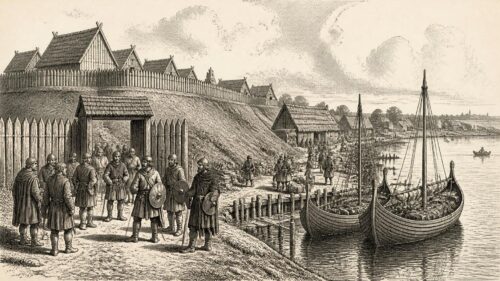
Tairdelbach’s position rested on the political transformation that followed the death of Diarmait mac Maíl na mBó in 1072. Tairdelbach had inherited Munster and secured influence over Dublin, Leinster, Osraige and parts of the midlands, although this was not a united kingdom governed through permanent institutions. His supremacy depended on hostages, tribute, personal alliances, military expeditions and the placement of trusted relatives in strategic kingships. His son Muirchertach had been installed as king of Dublin in 1075, giving the dynasty access to the ships, craftsmen, trade and revenues of Ireland’s leading port.
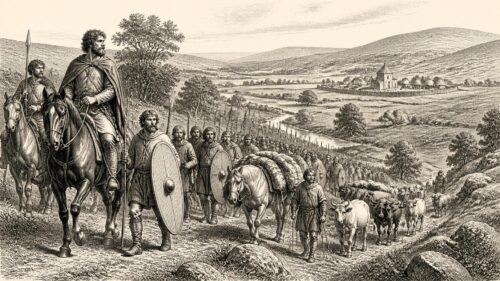
The principal campaign firmly assigned to 1077 was Tairdelbach’s expedition into Uí Cheinnselaig in south-east Leinster. The Annals of Ulster state that he captured a son of Domnall Remar, identified as the reigning king of Uí Cheinnselaig. The later Four Masters describe the captive as being fettered. This was more than an isolated raid: Uí Cheinnselaig had supplied the powerful dynasty of Diarmait mac Maíl na mBó, and controlling its king helped prevent the emergence of an independent Leinster challenge. Captivity could compel submission, hostages or tribute while leaving the defeated ruler available for restoration under conditions dictated by the victor.
Tairdelbach’s court at Cenn Corad, or Kincora, also appears in a Munster-centred account of the year. Donnchad Ua Flainn, king of Eóganacht Locha Léin in the Killarney region, was killed by Ua Cerbaill while returning from Ua Briain’s residence. The killer was reportedly banished for the deed. The episode illustrates both the attraction and danger of the overking’s household. Regional rulers travelled there to negotiate, seek favour and acknowledge authority, but their journeys exposed them to rivals. Ua Cerbaill’s punishment suggests that violence committed against someone travelling from the royal court could be treated as an offence against Tairdelbach’s peace as well as against the victim’s kindred.
Violence Across the Provinces
Beyond Ua Briain’s campaign, the political landscape remained fragmented. Mael Sechlainn, styled king of Temair, killed the king of Gailenga, a territory in the eastern midlands. The victim was described as a grandson of Maelán. This probably belonged to the continuing contest involving the Ua Maíl Shechnaill dynasty, Gailenga and the ecclesiastical centre of Kells, where a related killing had occurred in the preceding annalistic year. The sources do not provide enough detail to reconstruct a single continuous feud with certainty, but they show royal authority being pursued through personal retaliation and control of strategically important districts.
Murchad Ua Maíl Shechnaill, regarded by the Four Masters as a royal heir of Meath, was killed by the men of Tethba. His death weakened a dynasty already contending with both local rivals and Tairdelbach’s intervention in the midlands. In Dál Araide, in the north-east, Ua Loingsig was killed by his own people, a terse notice that may indicate deposition, factional rebellion or vengeance within the kingdom. The annalists rarely explain such internal killings, but their frequency warns against imagining Irish kingship as secure or automatically hereditary.
Further west, the Cenél Eógain of Telach Óc defeated the Fir Manach at a place called Mael Dergi, with many casualties. This reflects the pressure exerted by the northern Uí Néill upon the communities around the Erne basin. Elsewhere in the north, Ua Célecán, heir-designate of Airthir, and Ruarc Ua Cadusaig were killed. These scattered conflicts were not necessarily parts of one war. They arose from overlapping claims to land, cattle, tribute, succession and allegiance, and demonstrate how local struggles continued beneath the wider supremacy claimed by Ua Briain.
Fire at Clonmacnoise
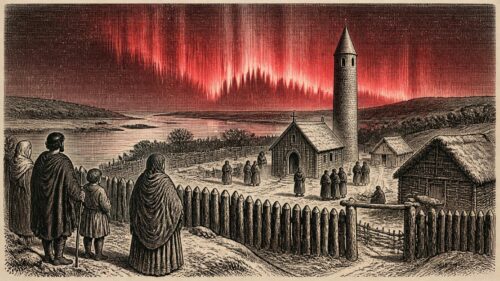
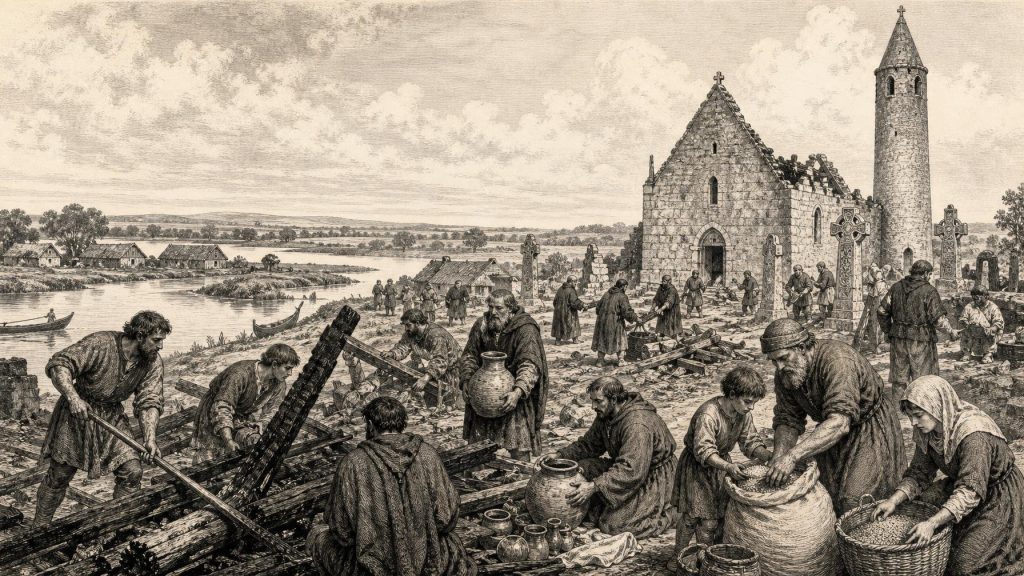
One of the year’s most consequential disasters was the burning of Clonmacnoise. The Chronicon Scotorum says that the entire settlement burned except the church, while the Annals of Tigernach specify the church associated with St Ciarán; the Four Masters say that the churches survived. The exact number of spared buildings is therefore uncertain, but the common core is clear: a major fire swept through the settlement while at least an important stone church escaped destruction.
Clonmacnoise was far more than an enclosed community of monks. Its position where the Shannon met east–west routes across the eskers made it a centre of pilgrimage, burial, learning, craftsmanship, exchange and political assembly. Archaeology indicates an extensive lay population living in timber buildings around the churches. Those houses, workshops, stores and fences were acutely vulnerable to fire. The annals do not identify an attacker in 1077, so the blaze should not automatically be described as a raid. Whatever its cause, rebuilding would have required timber, thatch, food, labour and assistance from patrons at a time when the surrounding midlands were politically unsettled.
Disease and a Damaged Harvest
The Annals of Inisfallen preserve unusually direct evidence for hardship in everyday life. They report an affliction called sinech, characterised by numerous lumps, which struck cattle severely and could also affect human beings. A confident modern diagnosis is impossible. The notice is nevertheless significant because it records a condition crossing the boundary between livestock and people, whether through a shared infection or through symptoms that appeared comparable to medieval observers.
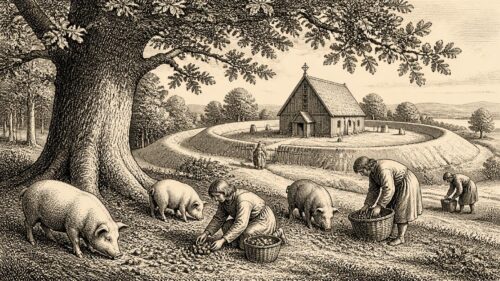
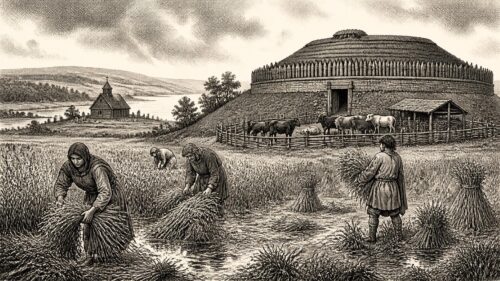
The same source records a violent autumn wind that greatly damaged the corn crop. Grain was an essential part of the mixed farming economy, alongside cattle, sheep and pigs, and severe losses near harvest time threatened winter supplies and seed for the following year. The later Four Masters add that there was great scarcity and persecution of churches in 1077. Because this wording comes from a compilation made centuries afterwards and is not matched exactly by the earlier annals, it should be treated cautiously. Even so, cattle disease, crop damage and the burning of a major settlement provide credible grounds for local shortages and heightened pressure upon ecclesiastical stores.
Churches and Communities
The year’s obituaries show the varied organisation of the Irish Church. At Killaloe, an important centre closely associated with the Ua Briain kings, the anchorite Mael Maith Ua Lachtnáin and the elderly celibate priest Loingsech Ua Conaire died. Cathal son of Donnacán of the Déisi, described as a distinguished bishop, died at Maethal Brócáin. At Armagh, Colcu Ua Erudán, “head of the poor”, also died. His title suggests an organised responsibility for dependants or charitable distributions within one of Ireland’s richest ecclesiastical communities.
Ailbe, wife of the king of Airthir and successor of St Moninne, died in penitence. Her office connected her with Moninne’s church at Killeavy, demonstrating that a woman could hold the hereditary and spiritual authority of a saint’s successor while also belonging to a ruling household. Gormlaith, wife of Tairdelbach Ua Briain, lies on the border of the year’s chronology: Inisfallen places her death in 1076, whereas Tigernach and the Four Masters assign it to 1077. The latter tradition remembers her distribution of wealth to churches and the poor. She can therefore be connected to the year, but not dated to it without qualification.
A Connected but Unequal Ireland
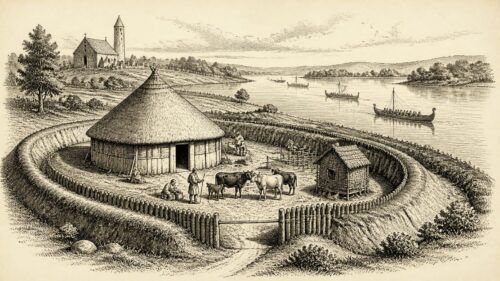
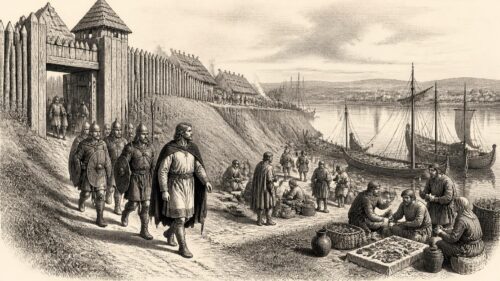
Most people in 1077 lived in rural settlements, working with animals, crops, woodland and textiles, while rendering food, labour or cattle dues to secular and ecclesiastical superiors. Towns such as Dublin, Waterford, Wexford, Cork and Limerick formed a smaller but increasingly influential urban network. Dublin’s merchants and craftspeople handled silver, hides, wool, slaves and imported materials, and its coinage and ships made control of the city politically valuable. Tairdelbach’s dominance over Dublin therefore strengthened his ability to reward followers and project power beyond Munster.
The record of 1077 remains uneven because annalists selected events important to their own churches and regions. Nevertheless, the year emerges clearly as one of forceful Ua Briain expansion accompanied by persistent local warfare and serious material strain. Kings captured rivals and punished offenders; communities fought over succession and territory; church leaders mediated wealth, memory and charity; and ordinary households faced disease, fire and a damaged harvest. Ireland was interconnected through roads, rivers, courts, monasteries and ports, but authority remained negotiated, regional and vulnerable to sudden violence.
Primary Sources
- The Annals of Ulster: Year U1077
- The Annals of Ulster
- Annals of Inisfallen
- CELT Project: Annals of Inisfallen
- Annals of Inisfallen: Irish Text
- The Annals of Tigernach
- CELT Project: Annals of Tigernach
- Chronicon Scotorum: Annals 1075–1079
- Chronicon Scotorum
- CELT Project: Chronicon Scotorum
- Annals of the Four Masters, Volume II
- Ua Briain, Tairdelbach (1009–86)
- Darerca (Mo-Ninne)
- Clonmacnoise Visitor Guide
- Early Medieval Ireland: Archaeological Excavations, 1930–2009
- Early Medieval Archaeology Project Report 2.1
- The Archaeology of Livestock and Cereal Production in Early Medieval Ireland, AD 400–1100
- The Archaeology of Livestock and Cereal Production in Early Medieval Ireland: Full Report
- Agriculture, Settlement and Society in Early Medieval Ireland
- The Economy of Early Medieval Ireland
- The Viking Age in Ireland
- 950–1450: Vikings, Normans and Medieval Mints
- Early Medieval Ireland
- The Irish Sea and the Atlantic Trade in the Viking Age
- The History and Provenance of Two Early Medieval Crosiers