

Wireless Ireland
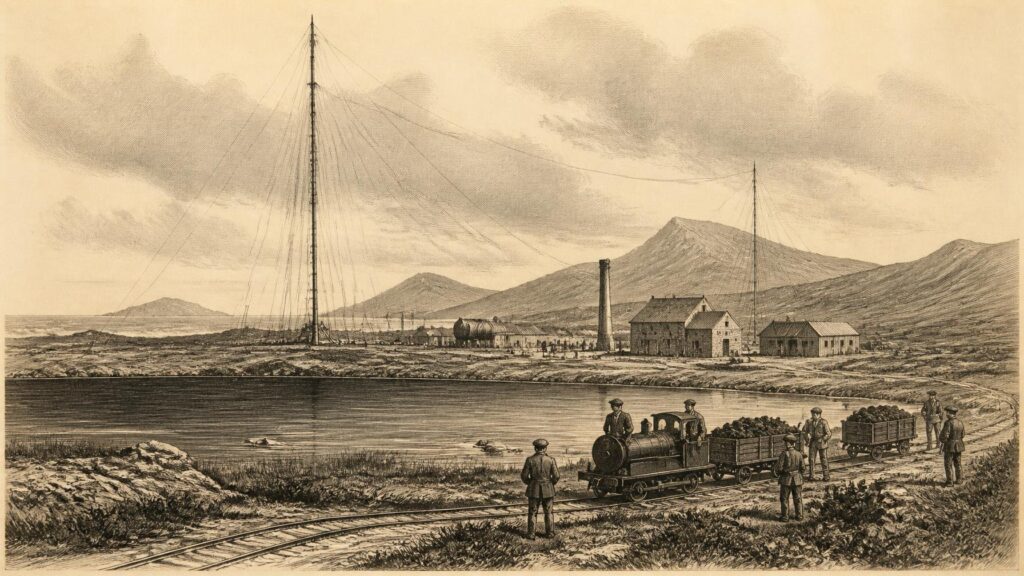
AI generated historical illustration, not a contemporary photograph.
At a Glance
Guglielmo Marconi was not an Irishman in the simple national sense, but Ireland was woven deeply into both his family history and his work. His mother was Annie Jameson of County Wexford; his wireless experiments and commercial ventures repeatedly used Irish coasts; and the station at Derrigimlagh near Clifden became one of the most consequential communications sites in the early twentieth century. There, on 17 October 1907, a regular commercial wireless service began with Glace Bay in Nova Scotia, making western Ireland a working terminus of a new Atlantic system.
Irish Roots
Marconi’s Irish connection begins with family rather than machinery. He was born at Bologna on 25 April 1874, the younger son of Giuseppe Marconi, an Italian landowner, and Annie Jameson. Annie was the daughter of Andrew Jameson of Daphne Castle, County Wexford, a branch of the family associated with the famous Irish whiskey business. Her background linked the future inventor to the Anglo-Irish commercial and landed world, though he was born and raised principally in Italy and later made his career in Britain and across an international corporate network.
This ancestry matters because Marconi’s life is sometimes compressed into a national story: an Italian inventor who developed radio in Britain, or a heroic individual who sent messages across oceans. Both descriptions contain elements of truth, but neither adequately explains the Irish component. The Jameson connection did not make him culturally or politically Irish in a straightforward sense. Nor should it be used to annex him retrospectively to a national pantheon. It did, however, provide family relationships, social connections and a continuing familiarity with Ireland that were significant in the early development of his business.
Annie Jameson had grown up in a family with wealth, international outlook and connections extending beyond Ireland. Her marriage to Giuseppe Marconi joined Italian property and Irish commercial capital. Their son’s education was irregular but privileged. He received private tuition in Italy, developed an interest in electrical science, and experimented at the family estate at Pontecchio. When official Italian interest in his early wireless apparatus proved limited, he went to Britain in 1896. There he encountered the Post Office engineer William Preece, patent agents, investors and a state communications culture more willing to test the commercial implications of wireless telegraphy.
Ireland in this period was still governed from Westminster. That constitutional fact is essential to understanding the story. Marconi’s Irish stations were not established in an independent Irish state, nor were they conceived as an Irish national communications project. They were parts of a company operating within the British imperial and transatlantic worlds. Yet their siting in Ireland had practical consequences for Irish labour, landscapes, local memory and later heritage. The distinction between Irish place and British jurisdiction helps explain why the Clifden station could become both an imperial enterprise and an important element of Irish technological history.
Family association also continued in public recollection. Local and later historical accounts frequently noted his Wexford mother, while a University College Cork account of a 2002 Marconi commemoration also identified his later wife, Beatrice O’Brien of Dromoland, County Clare, as another Irish family link. Such connections should not overshadow his Italian identity or the multinational character of his company. They do, however, demonstrate that Ireland was neither an accidental dot on a map nor merely the location of one famous mast field.
Coastal Experiments
Wireless telegraphy promised a way to communicate without the fixed wires that tied ordinary telegraph systems to poles, seabeds and physical routes. Its particular attraction was maritime. Ships could not trail telegraph cables behind them, and the sea presented enormous hazards to cable laying and maintenance. A system using electromagnetic waves therefore had obvious commercial, naval and journalistic potential. Marconi was not alone in investigating the subject: his work depended on foundations laid by scientists including James Clerk Maxwell, Heinrich Hertz, Oliver Lodge and Augusto Righi. His distinctive achievement lay in combining experiment, engineering, publicity, patents, capital and practical deployment.
Ireland offered an unusually favourable testing ground. Its coastline faced Britain, continental routes and the Atlantic; its ports connected shipping lanes; and its western extremities brought the eastern terminus of an Atlantic circuit nearer to North America than Cornwall or south-east England. These geographical advantages were apparent before Clifden was chosen. Marconi’s work around Ireland included temporary and experimental installations as well as the later large stations. In the history of wireless, islands and headlands mattered because range, elevation, access to water and open sea all affected what could be attempted.
One early public success came at Kingstown, now Dún Laoghaire, during the Royal St George Yacht Club regatta of July 1898. Marconi equipment was used to report the progress of races from a tugboat to a shore station. The information was then passed by telephone to Dublin newspapers. Contemporary enthusiasm and later accounts have treated this as an early example of live sports reporting by wireless. Caution is appropriate with claims of absolute priority: technological history is full of overlapping experiments and varying definitions of what counts as “live”, “broadcast” or “first”. What is securely important is that the regatta demonstrated a plausible commercial use for wireless information before a public audience.
The Kingstown experiment was not radio broadcasting in the later sense of programmes sent to listeners with domestic receivers. It was point-to-point wireless telegraphy. Operators transmitted coded signals, professional recipients decoded them, and conventional telephone and newspaper systems carried the results onwards. Nevertheless, the arrangement foreshadowed a central feature of twentieth-century media: events at a distance could be reported with a speed that altered the experience of spectatorship. Ireland thus appeared early in the development of wireless as a working field for news, sport and maritime communication.
Marconi also tested longer links involving southern Ireland. Accounts of the company’s work record transmissions between Poldhu in Cornwall and Crookhaven in County Cork in 1901. These were experiments in range rather than a settled public service, but they showed why the Irish coast was attractive. The westward path across water, the separation from urban electrical interference and the prospect of linking into Atlantic routes all made Irish locations commercially interesting. The company’s ambitions were expanding from demonstrations across a harbour, channel or stretch of sea towards a dependable network over thousands of miles.
That word, dependable, is crucial. The famous reception at Newfoundland in December 1901 has often been presented as the moment the Atlantic was conquered. It was an extraordinary experimental milestone, but it did not instantly create a reliable transatlantic communications business. Signals varied with atmospheric conditions, equipment and time of day. Antenna systems were demanding, and the science of long-wave propagation was not yet fully understood. A dramatic signal was one thing; repeated two-way traffic, scheduled operation and paying customers were another. Ireland became important because it helped Marconi’s company pursue the second objective.
Atlantic Ambition
By the middle of the first decade of the twentieth century, Marconi and his company needed a powerful western European station capable of sustained work with Canada. The choice was shaped by geography, technology and money. A station farther west shortened the physical Atlantic path. It also needed extensive ground for aerial systems, space for buildings and plant, access to fuel and water, and a route by which heavy machinery could be brought to a remote site. The company considered locations in the west of Ireland and selected Derrigimlagh, a bogland area near Clifden in Connemara, County Galway.
The decision was not simply an act of scientific inspiration. It was an industrial project. The station required land acquisition, construction, labour, transport and energy. Derrigimlagh was remote, exposed and wet, but those apparent disadvantages were offset by its open western aspect and by local turf, which could fuel boilers for the generating plant. University College Cork’s industrial-archaeological account notes that the station occupied several hundred acres and possessed its own narrow-gauge railway to move locally won turf. That detail is particularly revealing. The celebrated “wireless” system depended on a dense material infrastructure of buildings, rails, fuel stores, boilers, generators, wires and skilled workers.
Construction began after the site was selected in 1905. The landscape was transformed by a large station complex, including a power house, condenser house and aerial system. At its height, the visible structure was formidable: tall masts, wires and industrial buildings stood amid Connemara bog and lakes. The contrast between the apparently empty landscape and the scale of the machinery has shaped local memory ever since. It is tempting to regard the site as a romantic outpost where invisible waves met an ancient landscape. Yet the historical reality was equally a story of modern energy, corporate investment and disciplined labour.
Clifden’s role should be described precisely. It was not the location of the first ever transatlantic wireless signal; that distinction is associated with the 1901 experiment between Cornwall and Newfoundland, an episode whose technical interpretation has itself attracted debate. Nor was it a radio broadcasting station in the later entertainment sense. Clifden was, however, the European end of the first regular commercial transatlantic wireless telegraphy service between it and Glace Bay, Nova Scotia. The Nobel Prize biography of Marconi identifies 1907 as the opening of that commercial service, and archival evidence in Nova Scotia records the first commercial press message on 17 October 1907.
The event was a step from experiment towards communications infrastructure. Messages could be accepted for transmission, particularly press material, and the system was intended to compete with or supplement submarine cable traffic. According to the Nova Scotia record, regular service between Clifden and Glace Bay began in 1907. A contemporary account reproduced by University College Cork described the commercial significance in practical terms: traffic was accepted at stated rates and approximately 10,000 words were exchanged on the opening day. The glamour of a message leaping across the Atlantic was inseparable from invoices, rates, traffic volume and the confidence of newspaper clients.
For Ireland, the new service placed a remote corner of Connemara in direct functional relationship with North America. This was not merely symbolic transatlanticism. Operators in Clifden, engineers in Canada, company offices in London, newspaper editors and customers elsewhere participated in one system. It linked an Irish locality to global information flows at a time when the movement of people between Ireland and North America was already one of the defining facts of Irish social history. Wireless did not erase distance, nor did it democratise communication immediately. It was expensive, specialised and corporate. But it changed the speed and imagined scale of connection.
Clifden Station
The station at Derrigimlagh must be understood as a workplace as much as a monument. The public image of Marconi often centres on the inventor or the spectacular antenna. The actual service depended on station staff who monitored signals, maintained generators, handled coded traffic and made technical adjustments in difficult conditions. Their names have not always survived in public memory as clearly as Marconi’s, but their work was indispensable. The Nova Scotia Archives photograph of the Glace Bay receiving room on 17 October 1907 is useful precisely because it captures a room of apparatus and operators, not an isolated genius.
The link was also technically demanding. Early long-distance wireless did not resemble a modern telephone call or digital message. Spark transmitters generated bursts of electromagnetic energy that could travel long distances but occupied broad portions of the radio spectrum and created interference. Reception was affected by atmospheric noise, seasonal conditions and the behaviour of the upper atmosphere. The operators’ task involved trained listening, timing and interpretation. A successful commercial system therefore meant not only that a signal might arrive but that sufficient intelligible traffic could be handled repeatedly.
At Clifden, immense power was required to force signals into the Atlantic path. The station’s dependence on turf-fired steam generation anchors it in the environmental history of the west of Ireland. Turf was not an incidental local colour; it was the energy source that made the generating machinery run. The narrow-gauge railway carried it from the bog to the plant. The wireless age was, in this instance, a steam-and-turf age. The apparently immaterial transmission of information rested on labour-intensive extraction and combustion in a landscape often represented as remote from modern industry.
That dependence complicates simplistic narratives of technological progress. The station represented advanced communications, but not a clean break from older forms of work. It employed local resources and adapted them to a global system. Its physical remains—foundations, mast bases, railway traces and building sites—are therefore historical evidence in their own right. Industrial archaeology can recover aspects of the enterprise that popular stories overlook: the movement of materials, the organisation of space, the demands of maintenance and the sheer scale of the installation.
Clifden also became associated with a second celebrated episode in aviation history. In June 1919, John Alcock and Arthur Brown completed the first non-stop transatlantic flight, travelling from Newfoundland and landing near the wireless station at Derrigimlagh. Their Vickers Vimy came down in boggy ground, which they mistook for suitable land. The proximity of their landing to the station has encouraged a powerful retrospective pairing of radio and flight: two technologies of modern connection meeting on the edge of Europe. The association is real and the site is historically remarkable, but it should not obscure the fact that the flight and the wireless service were separate undertakings with distinct technical histories.
The pairing nevertheless has interpretative value. Both achievements depended on international organisation, engineering expertise and the attempt to overcome the Atlantic as a barrier. In the Irish imagination, they made Connemara part of a modern global drama. The bogland landscape was not simply a peripheral survival from an older Ireland; it was briefly one of the places through which the future announced itself. That does not mean local society was transformed uniformly or immediately. Rather, it demonstrates how global technological systems can be rooted in places that outsiders imagine to be distant from modernity.
Letterfrack Experiments
Marconi’s Irish work did not end with the Clifden station. A second important Connemara location was Letterfrack, north of Clifden and now closely associated with Connemara National Park. In April 1911 Marconi rented a room in the infirmary of St Joseph’s Industrial School, then run by the Christian Brothers. The National Parks and Wildlife Service records that receiving equipment was kept there and that an operator listened for messages from Glace Bay and from the company’s London address at Fenchurch Street.
Two aerial arrangements were installed in the surrounding landscape. One used masts and wires extending between Diamond Hill and Mweelin; another ran between the vicinity of the present park office and Bunaboghee Bog. The setting is striking, but the historical point is practical: a remote institutional building and mountain landscape were recruited into a technical experiment on simultaneous communication. Marconi and his engineers were working towards full-duplex wireless, the ability to send and receive at the same time rather than taking turns.
Descriptions of Letterfrack commonly call this the world’s first full-duplex two-way radio installation, with Marconi receiving a patent in 1912. The National Parks account makes that claim directly. It is best read as a statement about the particular system developed and tested there, not as a sweeping assertion that all forms of simultaneous radio communication everywhere began in one room in Connemara. The broader history of radio contains parallel inventions, patent disputes and overlapping definitions. Nonetheless, the evidence supports Letterfrack’s substantial place in Marconi’s work on duplex wireless telegraphy.
The location has another historical dimension that should not be softened. St Joseph’s Industrial School was part of an institutional system that affected many children in Ireland. The later use of part of its infirmary by Marconi’s enterprise does not define the institution’s whole history, nor should a communications achievement erase that context. Responsible heritage interpretation can hold both histories in view: the building’s role in a technological experiment and its place within a system of care, control and institutionalisation. A commemorative plaque may be valuable, but it should not narrow the historical frame.
Letterfrack also shows that Marconi’s Irish connection was not confined to a single famous date in 1907. His company continued to use the Irish west as a practical laboratory. The region’s mountains, bogs and Atlantic exposure were not passive scenery; they were components in the technical choices of aerial placement, reception and transmission. The work joined local geography to global communications at a moment when radio technology remained experimental, competitive and rapidly changing.
Imperial Context
Marconi’s Irish stations were embedded in the communications politics of empire. In the early twentieth century, control over fast long-distance information had strategic importance. Telegraph cables had already transformed diplomacy, military command, finance, shipping and journalism. Wireless promised an alternative route that could cross water without a cable and reach moving vessels. Governments, naval authorities and commercial interests watched its development closely. The Marconi company’s achievements therefore belonged not only to the history of invention but also to the history of imperial infrastructure.
Ireland’s position within the United Kingdom gave the company a western base under the same political jurisdiction as its British operations. A Clifden–Glace Bay route joined two territories within the wider British imperial world, even though the practical users of messages could be much more diverse. The system was international in operation but imperial in its legal, commercial and strategic setting. To describe Clifden simply as “Ireland connecting to America” is evocative but incomplete. The connection was constructed through British and Canadian corporate arrangements, patents, capital and communications priorities.
This context does not diminish the site’s importance in Irish history. On the contrary, it explains why the site is important. Irish history includes the history of infrastructures imposed, operated or financed through imperial systems, as well as the history of resistance to them. Railways, ports, postal networks, telegraph lines and wireless stations shaped daily life and economic possibility regardless of who owned them. Derrigimlagh reveals an Ireland that was both peripheral to imperial decision-making and central to one of its most ambitious technological projects.
The station also complicates assumptions about cultural isolation. Connemara in the popular imagination has often been represented as remote, Gaelic and economically marginal. Those characteristics had real historical meanings, but they coexisted with migration, seafaring, commerce and technological change. A high-power wireless station in the bog did not cancel poverty or emigration. It did, however, make the district an operational node in a system extending to Canada and London. The contrast between perceived remoteness and actual connectivity is one of the most instructive features of the story.
Marconi himself should likewise be placed in context rather than elevated into solitary mythology. He was a gifted experimenter and organiser, and his public reputation was enormous. He shared the 1909 Nobel Prize in Physics with Karl Ferdinand Braun for contributions to wireless telegraphy. Yet modern radio emerged from collective scientific work, skilled engineering, corporate rivalry and governmental support. The Irish stations were company enterprises staffed by many people and dependent upon local labour. Their history is richer when it is treated as a collective achievement rather than a one-man miracle.
Revolutionary Damage
The political world that had enabled the Clifden station changed profoundly after 1916. The Easter Rising, the War of Independence, the Anglo-Irish Treaty and the Civil War altered authority across Ireland. Infrastructure became vulnerable where it was identified with strategic value, state power or external ownership. The Marconi site at Derrigimlagh did not stand outside these conflicts. Its international purpose and corporate identity could not protect it from local military realities.
In 1922, during the Civil War, the station was attacked and damaged by anti-Treaty republican forces. The Marconi Archives catalogue records material concerning the destruction of the station and messages related to National Army and irregular forces in the area. University College Cork’s industrial-archaeological summary states plainly that the site was destroyed by IRA irregulars in 1922 and that operations were thereafter transferred to Letterfrack. Local histories differ in wording and sometimes give compressed accounts of timing and responsibility, but the central fact of destructive Civil War damage is securely documented.
It is important not to turn this into a simple morality tale. The destruction of a major technological site is regrettable as a loss of infrastructure and heritage, but the Civil War was not an abstract outbreak of vandalism. It was a struggle over sovereignty, the Treaty settlement and the authority of the emerging state. Sites associated with communications could acquire military or symbolic significance beyond their ordinary commercial use. The station’s fate demonstrates that technology is never detached from politics: systems built to carry information can become objects of conflict when control of territory and communication is contested.
The damage accelerated the end of Clifden’s active life. Other stations, changing technical requirements and the company’s wider network also affected its prospects. It would be misleading to attribute every subsequent change solely to the attack. But the Civil War episode has understandably dominated local memory because it marks the violent interruption of an enterprise that had made the district internationally famous. The remaining structures later became ruins, their original functions difficult to read without maps, photographs, archaeology and archival documentation.
There is a recurrent tendency to describe the 1922 destruction as the end of Irish wireless ambition. That is too broad. Radio continued to develop in Ireland, and the Marconi company remained involved in Irish communications in various ways. The more accurate conclusion is narrower and more poignant: the Clifden complex, a vast purpose-built transatlantic station, did not regain its former centrality. Its material fabric was dismantled, damaged or left to decay, while radio technology itself moved on.
Memory Landscape
Derrigimlagh survives now principally as a cultural landscape of traces. The original masts are gone, and the industrial buildings no longer function. Yet foundations, alignments and surviving features permit visitors and researchers to reconstruct the scale of the undertaking. The site’s later recognition reflects a wider shift in attitudes towards industrial heritage. Earlier generations often saw derelict works as obsolete remnants. More recent scholarship and community work have treated them as evidence of labour, technology, power and landscape change.
The Clifden and Connemara Heritage Society has played a prominent role in interpreting the station, while the National Archives of Ireland has presented an evocative National Library image of the complex in its census exhibition. University College Cork’s conservation appraisal underscores the site’s international significance and draws attention to its railway and turf-fuelled operation. Such work matters because the public memory of Marconi is otherwise likely to settle on a handful of simplified images: an inventor, a mast, a first message and a ruined wall. The documentary record permits a more complete history.
Heritage interpretation should be alert to several forms of exaggeration. First, it should not claim that Clifden was the site of every “first” associated with radio. It was not. Second, it should not confuse telegraphy with broadcasting. The operators at Clifden did not offer a schedule of spoken programmes to household listeners. Third, it should not present the station as an isolated Irish triumph detached from Britain, Canada and corporate networks. Finally, it should not erase the Civil War, the industrial-school context at Letterfrack or the physical labour behind the invisible signal.
None of those cautions weakens the story. In fact, they make it stronger. The genuine achievement is extraordinary enough: a major high-power station in Connemara became the European terminus of a commercial wireless route across the Atlantic. It relied on local fuel and transport, put Irish terrain into an international technological system, and sat near the landing place of Alcock and Brown. It then became entangled in the violence of revolutionary Ireland and later re-emerged as an important heritage landscape.
Folklore has a place in this landscape, but it should be labelled as folklore. Visitors and local accounts have long repeated vivid descriptions of sparks, strange sounds, burning-bright aerials and messages travelling invisibly above the bog. Such stories convey how startling the station must have appeared, especially in a rural district. They cannot all be verified in every detail, and they should not substitute for evidence. Their value lies in showing how new technology entered local imagination. A wireless station was not merely a workplace; it was a spectacle, a source of rumours and an emblem of a world becoming larger and faster.
Lasting Meaning
What, then, was Guglielmo Marconi’s connection to Ireland? The shortest accurate answer has three parts. He had Irish maternal ancestry through the Jameson family of County Wexford. He undertook important early wireless activity at Irish coastal sites, including Kingstown and Crookhaven. Most consequentially, his company built and operated the Clifden station in Connemara, which began commercial transatlantic wireless service with Glace Bay in 1907, and later conducted important duplex work at Letterfrack.
The longer answer is that Ireland was part of the making of global communications. Marconi’s career illustrates how invention is shaped by place. Italy provided his early experimental world; Britain offered patent, institutional and commercial opportunities; Canada supplied the western Atlantic partner; and Ireland provided family affinity, strategic geography and ground for a powerful operational system. No single national story can contain that network. The historical importance of Ireland lies precisely in its role as a connective place within it.
For Irish history, the story expands the usual map of modernisation. It directs attention away from capitals and parliamentary institutions towards bogland, ports, mountains, schools and industrial sites. It shows that the west of Ireland was not merely a recipient of decisions made elsewhere. Clifden and Letterfrack were places where difficult technical work occurred, where local landscapes were reshaped, and where global messages were sent and received. The connections were unequal and commercially driven, but they were real.
Marconi’s legacy in Ireland is therefore not best expressed as ownership of a famous inventor. It is better understood as participation in a technological transformation. Ireland supplied a mother’s family, a series of experimental coasts, a transatlantic terminus and a landscape of innovation. The ruins at Derrigimlagh are reminders that communications history has a physical geography. Before messages became apparently weightless and instantaneous, they depended on boilers, turf, railways, operators, wire, weather and a hard-won command of distance.
Documentary Record
The history of wireless Ireland is unusually vulnerable to simplification because it is preserved through several different kinds of evidence, each answering a different question. Photographs, company papers, local landscapes, patent records, heritage interpretation and institutional histories do not provide interchangeable proof. A photograph of operators at Glace Bay can establish the human and technical setting of a particular moment, but not by itself explain the company’s commercial strategy. The remains at Derrigimlagh reveal the physical scale of construction and energy use, but cannot independently disclose every decision made in London, Clifden or Canada. Reading these sources together makes it possible to recover a more convincing history: not a sequence of isolated “firsts”, but a system built through experiment, labour, capital and place.
The surviving image from the Canadian receiving station is especially valuable in this respect. It preserves an aspect of wireless work that grand narratives often overlook: waiting. The operators were listening for signals during a weak spell in radio, surrounded by specialised apparatus. That scene corrects any impression that transatlantic communication was immediate, automatic or effortless. Long-distance wireless telegraphy required attention, technical judgement and tolerance for uncertainty. Its success depended upon people who could distinguish meaningful signals from noise and keep complex equipment functioning. The Atlantic connection was therefore not simply a triumph of transmission power; it was also an achievement of trained reception.
Company archives add another necessary perspective. Their records include material relating to the development of wireless telegraphy, the businesses that administered it, and the succession of corporate bodies through which Marconi’s work was organised. Such documentation places Ireland within an enterprise much larger than any one inventor or station. It shows why the language of solitary genius is inadequate. Marconi’s name mattered enormously, but the work was sustained by companies, assistants, engineers, administrators, operators and local employees. Even the history of preservation reflects this collective character: records once held as business papers became historical archives because later custodians recognised their importance for understanding communications technology.
Letterfrack requires an equally careful documentary reading. The present National Park account identifies the former infirmary as the place from which receiving equipment was operated and records the aerial routes laid across the surrounding terrain. It also makes clear that the building belonged to St Joseph’s Industrial School. This is not a minor contextual detail. The technological episode took place within a site whose wider history includes institutionalisation and the abuse suffered by children. Neither history should cancel the other. A responsible account acknowledges that the same landscape can contain innovation, labour, grief and remembrance, and that heritage does not become more truthful by selecting only its most celebratory elements.
Modern commemoration has also given the Irish and Canadian sides of the story a shared frame. The twinning of Derrigimlagh with Signal Hill in Newfoundland formally recognises that the development of transatlantic wireless cannot be confined within one national narrative. It connected places across the ocean long before later heritage institutions connected them through conservation and interpretation. Yet this relationship should not be reduced to a sentimental tale of technological unity. The original communications network was commercial, imperial and unequal in access; its benefits were shaped by price, expertise and corporate control. Remembering that complexity makes the later heritage connection more meaningful rather than less so.
The enduring importance of wireless Ireland lies partly in this tension between visibility and invisibility. The masts have disappeared, the machinery is silent and the messages themselves were fleeting coded transmissions. What remains is dispersed: a bogland site, an institutional building, archival catalogues, photographs, technical descriptions and memories on both sides of the Atlantic. Taken together, they show that Ireland was not merely a backdrop to radio history. It was a place where modern communications were tested, operated, contested and later remembered. The strongest legacy of the story is therefore not a claim to possess every radio “first”, but the more substantial recognition that Irish landscapes and workers formed part of the infrastructure through which the modern world learned to communicate across distance.
One striking theme is that Clifden’s seemingly weightless wireless connection relied on very physical systems: turf cutting, steam power, narrow-gauge railways, imported machinery and local expertise. This complicates the familiar image of radio as an instant, disembodied technological breakthrough. It also suggests that a remote Connemara bog was not simply peripheral, but an active industrial node within imperial and transatlantic communications networks. The article’s distinction between Marconi’s Irish family ties, British jurisdiction and multinational business resists national ownership of achievement. How should historians and heritage interpreters balance these local, environmental, labour, imperial and international dimensions when explaining Derrigimlagh’s significance today?