
Year by Year
Explore Year by Year articles from the most modern historical year back to the oldest.
3,305 Articles Archived
Irish Mission
Archived: 6 November 2026
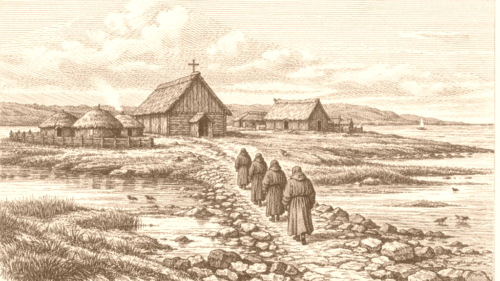
This article examines the documented 635 mission associated with Aidan, an Irish monk sent from Iona to Lindisfarne at the request of the Northumbrian king Oswald. It separates the Irish monastic background of Aidan and Iona from Ireland itself, and it avoids extending the evidence beyond what is directly attested. The discussion also places Lindisfarne within Northumbria, not Ireland, while noting the later prestige of the site. Because the supplied evidence is uneven, the argument emphasizes what can be proved, where sources overlap, and where later interpretation must remain cautious. The result is a strictly sourced account of early seventh-century connections.
Annal Year
Archived: 6 November 2026
The surviving Irish annals for 634 CE are uneven and must be read with caution. The Annals of Inisfallen preserve a short cluster of notices for that year, including deaths and a slaying, while the Annals of the Four Masters attach a fuller set of notices to 634, notably the battle of Magh Rath and related deaths. The Annals of Tigernach survive for this period but show a different chronological alignment and, for 634, no substantive entry in the preserved fragment. The result is not a single coherent narrative, but a layered annalistic record that mixes secure year notices with chronology that shifts between texts.
Silent Munster
Archived: 6 November 2026
Ireland in 633 CE is visible in the annals chiefly through one securely dated notice: the death of Failbhe Flann, king of Munster. This brief entry does not supply a cause, place, or political aftermath, so any fuller narrative must remain cautious. The surviving evidence also invites attention to method, because Irish annals are later textual constructions shaped by chronology and transmission. By separating the attested year from surrounding seventh-century context, this account shows how much can be said, and how much cannot, about a single annalistic year.
Ireland Remembered
Archived: 7 November 2026
The surviving annalistic evidence for 632 CE in Ireland is narrow but clear. Two battles, Fid Eoin and Dún Cethirn, anchor the year in the Annals of Tigernach, together with named deaths associated with those conflicts. Comparative notices in the Four Masters and Inisfallen help confirm the historical memory of the events, while also showing that medieval chronicle dating could vary. The year therefore offers a disciplined case study in how to separate secure dating from broader context, and how to resist filling annalistic silence with conjecture.
Yearly Record
Archived: 7 November 2026
The surviving annalistic notices for 631 CE are brief and uneven. One annal gives only the year heading, while another records the death of Ernaine son of Fiachna and the banishment of Carthach, identified as Mochuda, from Rathain. The Annals of Inisfallen, in its own year entry, names the death of Echaid Buide, the battle of Dún Cethrair, and the slaying of Cáilchíne from Liathmuine. Its bracketed references link the notices to earlier annalistic numbering. No extra event should be added to fill the gap.
Ireland Yearly
Archived: 7 November 2026
The annals do not preserve a single, uniform picture of Ireland in 630 CE. One witness, the Annals of Ulster, assigns the year to a brief notice about a battle of Aille’s son and the death of Cinaed son of Lugthriene. The Annals of Tigernach, under 630, preserve several notices for battles, deaths, a church foundation, and the devastation of Leinster. The Annals of the Four Masters also give 630 entries, but with different wording and a different selection of events. Comparison of these witnesses shows both overlap and divergence in dated notice, while the year remains sparse and carefully delimited.
Ard Corann
Archived: 7 November 2026
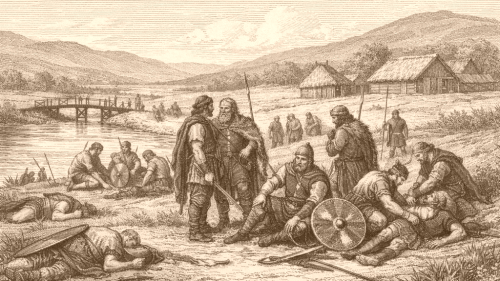
The surviving notices for 629 CE in Irish annalistic material are sparse and uneven. One entry in the Annals of Tigernach places the battle of Ard Corann in that year and records a Dál Riata victory with the death of Fiachna son of Deman. A comparative note, however, says the same battle is dated to 629 in one tradition and 630 in another. This narrative therefore separates the securely attested battle notice from broader context, and avoids turning an annal gap into invented sequence or consequence. The year is visible, but only through a very short and disputed record.
Ireland Remembered
Archived: 7 November 2026
The annalistic record for 628 CE is unusually compressed and must be read with care. One set of excerpts fixes the year as AD 627, alias 628, while others place the same cluster of notices under different regnal or calendar headings. Securely dated material includes the death of Cathal son of Aed, king of Mumu, and several battle notices associated with Laigin, Dál Riata, and the kingship of Ireland. The surviving passages also preserve strong evidence of chronological overlap, duplication, and retrospective alignment. This narrative separates what the excerpts place in 628 from what they only imply by comparison.
Anno Witnesses
Archived: 8 November 2026
The annalistic evidence for 627 CE in Ireland is sparse and uneven. In the Four Masters, the year is marked as the Age of Christ 627 and the fourth year of Domhnall, with notices for the battle of Ath Abla and the foundation of Inis Medcoit by Bishop Aedhan. Chronicon Scotorum presents a different 627 entry, with battles at Ard Corann and Carn Feradaig. This account separates securely dated notices from surrounding context, notes where the witnesses diverge, and avoids filling any annal gap with conjecture. Editorial framing is also kept distinct from the year entries themselves.
Irish Chronicle
Archived: 8 November 2026
The surviving annals preserve a small but usable dossier for Ireland in 626 CE. Their securely dated notices record battles, deaths, and a religious vision, while related entries in other annal traditions help confirm the placement of several items. The evidence is uneven: some notices are explicitly tied to AD 626, others are cross-referenced from neighboring years or later compilations. This account keeps the year distinct from wider context, avoids filling gaps with conjecture, and compares only what the texts themselves state about that year.
Some records do not yet have a verified historical year and are awaiting chronological placement.