Broadcast Pioneer
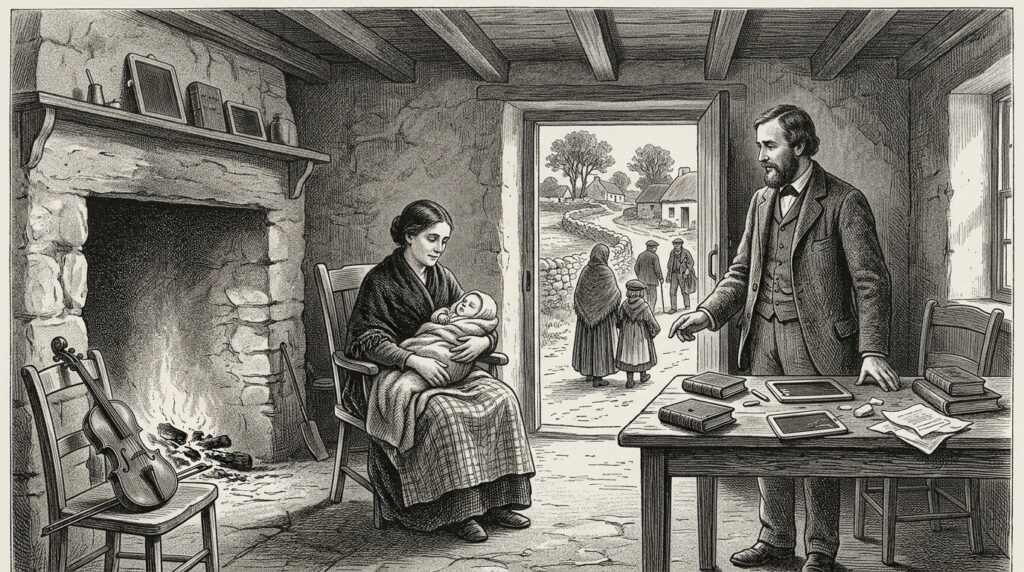
Séamus “Clan” Clandillon was born near Gort, County Galway, on 6 June 1878 into a household closely connected with education. His father, William A. Clandillon, was a national school teacher, while his mother, Joanna Little, also came from a family shaped by work, migration and service. The countryside surrounding Gort preserved a strong inheritance of Irish-language speech, traditional singing and local storytelling. These influences entered Clandillon’s life early and later guided his work as a teacher, musician, civil servant and broadcaster. The child born in rural Galway would eventually help determine how the newly independent state presented Irish culture through radio.
Clandillon attended St Flannan’s College in Ennis before entering university in Dublin during the closing years of the nineteenth century. His education brought him into contact with students and teachers involved in the Gaelic revival, which sought to preserve and restore the Irish language after generations of decline. He became fluent in Irish, joined the Gaelic League and developed a reputation as a singer and pianist. Clandillon did not regard traditional music as a decorative remnant of the past. He believed that Irish songs contained language, memory and emotional experience capable of strengthening national identity within a rapidly changing society.
His musical interests were shared by Máighréad Ní Annagáin, whom he later married. Together they collected, arranged and published traditional Irish songs, drawing attention to melodies and lyrics that might otherwise have disappeared. Their work required travel, careful listening and cooperation with singers who had learned music through oral transmission rather than printed notation. Clandillon’s knowledge of regional performance styles later distinguished him from administrators who approached Irish culture chiefly through official policy. He understood that traditional music depended upon individual voices, local communities and subtle variations that could not easily be reproduced by formal choirs or standardised arrangements.
Clandillon combined his cultural interests with careers in teaching and the civil service. He worked in educational institutions before entering government employment and continued performing at cultural gatherings throughout Ireland and Britain. His experience as a singer, organiser and Irish-language advocate eventually brought him to the attention of those planning the new national radio service. In 1925 he was appointed the first director of broadcasting at 2RN. When the station began transmitting on 1 January 1926, Clandillon was responsible for shaping programmes within severe financial and technical limits while trying to serve listeners whose expectations of radio were only beginning to form.
As broadcasting director, Clandillon promoted Irish-language speech, traditional music, public ceremonies, sport and national cultural life. He persuaded Douglas Hyde to deliver the address that opened the station and sought to make radio a meeting place for Gaelic culture across Ireland and neighbouring Celtic regions. His decisions were sometimes criticised, yet his influence upon the early character of Irish broadcasting was considerable. The child born near Gort entered a world without electronic broadcasting, recorded sound in most homes or a politically independent Irish state. By adulthood, he had helped place traditional voices and music at the centre of a new national medium.
- Shaun Boylan and Lesa Ní Mhunghaile, “Clandillon, Seamus (‘Clan’),” Dictionary of Irish Biography, Royal Irish Academy, recording his birth near Gort, County Galway, on 6 June 1878 and outlining his career in music, public service and broadcasting.
- General Register Office, Ireland, civil birth registration for Séamus Clandillon, County Galway, 1878.
- RTÉ Archives, “Séamus Clandillon, 2RN First Director of Broadcasting 1925,” biographical and broadcasting records concerning his appointment and the establishment of Irish radio.
- Séamus Clandillon and Máighréad Ní Annagáin, An Londubh: Dhá Amhrán Déag, Dublin, 1904, collection of traditional Irish songs.
- Nicholas Carolan, “From 2RN to International Meta-Community: Irish National Radio and Traditional Music,” Journal of Music in Ireland, examining Clandillon’s cultural policy and commitment to traditional music.