
Mounted Volunteers(c.1900s)
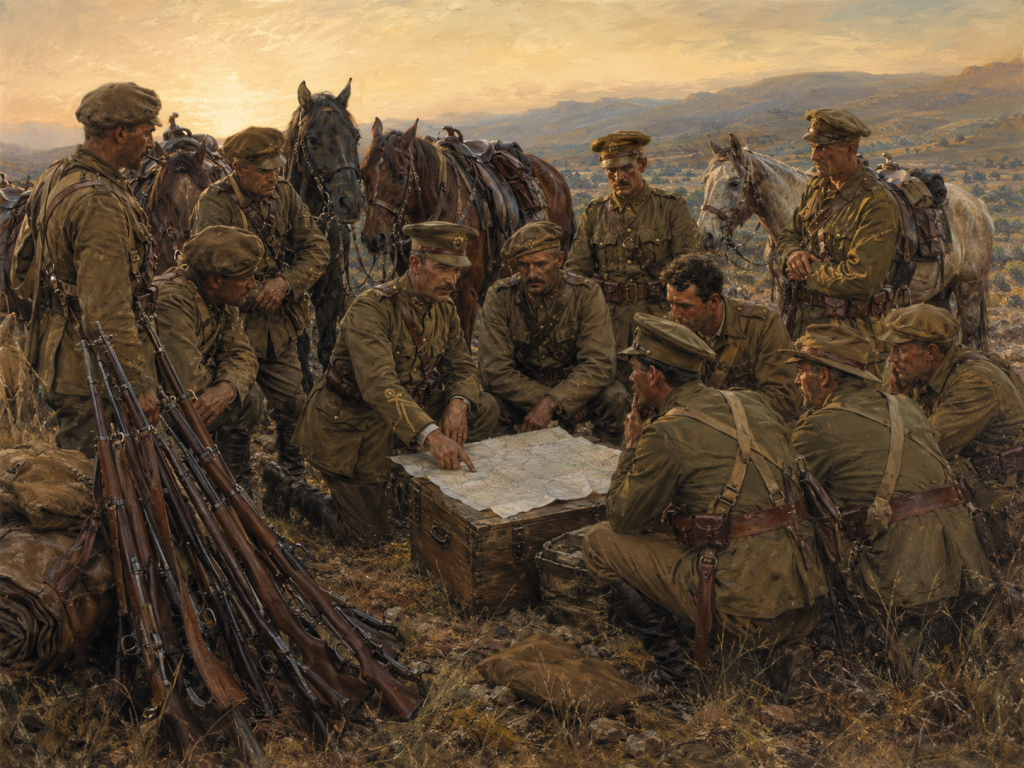
A Special Army Order issued at the beginning of January 1900 established the machinery for recruiting the Imperial Yeomanry, a volunteer mounted force intended for service in South Africa. The decision followed the British defeats of December 1899, when Boer commandos demonstrated the effectiveness of mobile riflemen operating across difficult country. Existing yeomanry units were invited to provide trained volunteers, while suitable civilians could also enlist for a limited period of overseas service. The new formation was organised as mounted infantry rather than conventional cavalry, emphasising movement, marksmanship and the ability to fight after dismounting.
Recruiting officers sought medically fit men who could ride confidently and handle a rifle. Applicants were generally expected to be between twenty and thirty-five years of age and to demonstrate practical proficiency before acceptance. The force was arranged in companies and battalions, reflecting its intended role as infantry transported rapidly by horse rather than cavalry trained primarily for mounted charges. Volunteers received higher pay than ordinary soldiers and enlisted for the duration of the emergency. The system allowed the War Office to draw upon horsemen, former servicemen, volunteers and civilians without relying entirely upon the overstretched regular army.
The creation of the Imperial Yeomanry revealed how seriously the military situation had deteriorated. British commanders had entered the war with insufficient mounted troops to match Boer forces that travelled swiftly, selected favourable ground and fired accurately at long range. Reinforcements were therefore required who could patrol, scout, protect communications and accompany mobile columns. By February, ministers reported that thousands of men had been raised. The new force did not replace regular cavalry or infantry, but it acknowledged that the campaign demanded a broader mobilisation of civilian skills, private horses, local military experience and voluntary enthusiasm.
The order held clear relevance for rural Limerick even where individual enlistments cannot be confirmed from the surviving notice. County Limerick possessed strong traditions of horse breeding, hunting, racing, farming and mounted travel, while former soldiers and reservists lived throughout the city and countryside. Men accustomed to handling horses or firearms would have recognised the qualifications being sought. Families and employers also understood the consequences of enlistment: an accepted volunteer could leave work and home for South Africa, while local communities absorbed the economic and emotional strain created by another expansion of wartime recruitment.
Imperial Yeomanry recruitment added a new layer to Limerick’s involvement in the South African War. Regular soldiers, reservists and militia units were already being mobilised or redistributed, and the mounted volunteer force widened the range of people who might be drawn into service. Its creation also challenged confidence in the existing army system. A government compelled to seek civilian horsemen and marksmen had effectively admitted that regular formations alone were insufficient for the campaign. For Limerick observers, the order connected distant battles with local horses, military experience, employment decisions and the possibility that familiar men might soon depart for war.
- War Office, Special Army Order, 2 January 1900, establishing the organisation and recruitment machinery of the Imperial Yeomanry; reprinted in the Army Orders for January 1900.
- Royal Warrant, 24 December 1899, authorising the creation of the Imperial Yeomanry for service during the South African War.
- House of Lords Debates, “South African War—Contemplated Military Measures,” 12 February 1900, discussion of the raising of approximately 8,000 Imperial Yeomanry volunteers.
- War Office, Annual Report of the Inspector-General of Recruiting for the Year Ending 30 September 1900, Parliamentary Papers, 1901, Cd. 519.
- The National Archives, Imperial Yeomanry soldiers’ documents, South African War, 1899–1902, WO 128.
- Irish Times, January 1900, reports concerning the selection and training of Irish Imperial Yeomanry recruits at Newbridge Cavalry Barracks.
- Luke Diver, Ireland and the South African War, 1899–1902, PhD thesis, Maynooth University, 2014.