Churches, Castles and Conflict1,164 CE
The Ireland recorded in 1164 was politically divided but closely interconnected. Kings competed through hostages, tribute, raiding and alliances; major churches commanded lands and loyalties extending far beyond their immediate neighbourhoods; and the Irish Sea linked Dublin and Ulster with western Scotland and the Isles. The surviving annals preserve no continuous narrative of the year. Instead, they offer sharply lit fragments: a royal fortress at Tuam, a remarkable new church at Derry, cattle raids, dynastic killings, destructive fires and the deaths of churchmen and rulers. Some entries are firmly assigned to 1164, while others survive in chronicles whose dating differs. Those distinctions matter, particularly in a period poised between apparent political stability and severe upheaval.
Mac Lochlainn’s High-Kingship
Muirchertach Mac Lochlainn of Cenél nÉogain remained the dominant ruler in Ireland. Northern annalists called him king or arch-king of Ireland, although such titles did not mean government through a central administration. His authority depended upon military reputation, personal alliances, tribute and the submission of provincial and lesser kings. Leinster and Dublin were broadly aligned with him, while Ruaidrí Ua Conchobair, king of Connacht, remained his most formidable rival. Mac Lochlainn’s close partnership with senior churchmen also strengthened his public standing, most visibly at Derry.
His position was powerful but not untroubled. Later biographical reconstruction identifies a rebellion within Cenél nÉogain in 1164, apparently suppressed without overturning his rule. The annals record a major cattle raid into Tír Eógain by the Fir Manach and Uí Fhiachrach of Ardstraw. Ua Crícháin, lord of the latter people, was then killed by Mac Lochlainn. These terse notices suggest local resistance, shifting loyalties and retaliation within the northern territories. Cattle-taking was not incidental vandalism: it stripped a district of mobile wealth, food, breeding stock and the means of paying obligations.
Elsewhere, David son of Donn Sléibe Ua hEochada was treacherously killed by the Uí Echach of Ulaid. The precise circumstances are not preserved, but the death belonged to the continuing instability of the Ulaid dynasties. Mac Lochlainn’s attempts to dominate Ulaid would become far more dangerous in the following two years. It would be misleading, however, to present his eventual fall as inevitable in 1164. For now, he remained the most prestigious king on the island and a patron capable of mobilising substantial resources.
A Royal Fortress at Tuam
In Connacht, Ruaidrí Ua Conchobair made a conspicuous statement of power. The Annals of Tigernach say that he built a “wonderful castle” at Tuam. Its precise appearance and building material cannot now be recovered, and it should not be imagined automatically as a later Anglo-Norman keep. It was probably a fortified royal residence and administrative centre, standing near an important ecclesiastical settlement that had recently become an archiepiscopal see. The fortress gave Ruaidrí a secure and impressive base while continuing the monumental patronage associated with his father, Tairdelbach Ua Conchobair.
Tuam’s development illustrates how royal and ecclesiastical power could reinforce one another. A king’s residence attracted retainers, craftspeople, supplies and assemblies; a metropolitan church drew clerics, students, pilgrims and revenues. The result was not a town in the later chartered sense, but a concentration of authority unusual in a predominantly rural landscape. Ruaidrí was not yet high-king, but the castle advertised ambitions extending well beyond Connacht.
Strife in Munster and Leinster
Munster remained fractured between the Ua Briain rulers of Thomond and the Mac Carthaig dynasty of Desmond. The Annals of Inisfallen record that Tairdelbach Ua Briain raided through Druim Fíngein and carried away many cows. They also describe conflict among the Mac Carthaig kindred: Máel Sechnaill son of Domnall Ua Carthaig raided an opponent and carried him into Eóganacht Locha Léin; when Cormac Mac Carthaig and the Desmond host pursued, fighting broke out within their own camp and Domnall son of Domnall was among those killed. Peace followed, but only after bloodshed within the ruling family.
Amlaíb Ua Cennétig, lord of Ormond, was blinded by Tairdelbach Ua Briain. Blinding was a calculated political punishment, commonly intended to make a rival ineligible for kingship without killing him. Mac Carthaigh’s Book also places the rebellion of Tairdelbach’s son Muirchertach and a Connacht intervention under 1164, whereas the Annals of Inisfallen assign the main crisis to 1165. It is therefore safest to regard the rebellion as developing around this period rather than insist that every stage occurred within the calendar year 1164.
In Leinster, Muirchertach Ua Tuathail, lord of Uí Muiredaig, died after penance. An annalist praised him for hospitality and prowess, virtues expected of a successful ruler. Máel Sechlainn Ua Conchobair Failge was killed by Clann Máel Ugra, apparently in revenge for earlier treachery. These deaths reveal a political world in which lineage, personal honour and remembered injury could be as important as territorial ambition.
Derry and the Columban World
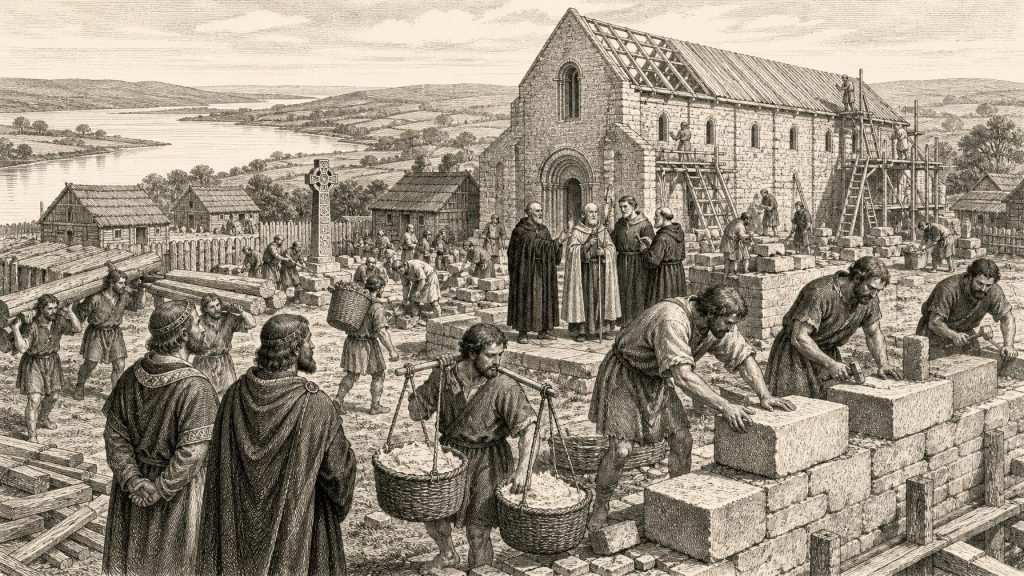
The year’s most celebrated construction was the great church at Derry. Flaithbertach Ua Brolcháin, successor of Colum Cille and head of the Columban community, built it with the support of Mac Lochlainn and the clergy of Derry. The Annals of Ulster give its length as ninety feet, while the Four Masters give eighty; both say that its uppermost stone was completed within forty days. The discrepancy cautions against treating every measurement as exact, but all accounts agree that the church was exceptionally large and rapidly constructed.
This was the culmination of an organised rebuilding programme. Houses crowding the sacred precinct had already been removed and a stone enclosure and limekiln prepared. The work required quarrying, transport, lime burning, skilled masonry, carpentry, food and accommodation for labourers. Royal patronage supplied more than piety: it demonstrated Mac Lochlainn’s capacity to protect and enrich a church whose network extended through Ireland and into Scotland.
That international reach was dramatically confirmed when senior representatives from Iona came to request that Flaithbertach accept its abbacy. They acted with the support of Somerled and leading communities of Argyll and the Isles. The archbishop of Armagh, Mac Lochlainn and the nobles of Cenél nÉogain prevented the appointment. Their motives are not fully explained, but they may have feared losing a powerful ecclesiastical leader or transferring effective direction of the Columban federation away from Derry. The episode shows that Irish monastic affiliations still crossed the sea even as territorial dioceses and reforming religious orders gained importance.
Fire in the Sacred Settlements
Several annals associate 1164 with destructive fires. A portion of Armagh burned, while the Four Masters also list Clonmacnoise, Clonfert and Tuam among the places affected. Louth was largely burned by a fire said to have begun at the residence of Donnchad Ua Cerbaill, king of Airgialla, where northern nobles were staying. Tuamgraney and Terryglass were likewise burned. The chronicles do not establish that all these outbreaks shared a cause or formed one coordinated disaster.
Fire was a recurring danger in settlements where timber houses, workshops, roofs, fences and stored fuel stood close together. An ecclesiastical centre was not merely a church surrounded by monks. It could contain clergy, students, craftspeople, farmers, dependants, guests and merchants, alongside livestock and valuable stores. Burning could destroy residences, manuscripts, food and tools even when stone churches survived. At Clonmacnoise, the large lay population and strategic position beside the Shannon made the community resemble a small town.
The burning of Terryglass is especially poignant because the monastery was associated with Áed Mac Crimthainn, the principal known scribe of the Book of Leinster. This great anthology contains saga, genealogy, poetry, grammar, medicine and place-name learning. Its production extended across years and probably involved more than one location, so there is no basis for claiming that the manuscript itself was lost or rescued in the 1164 fire. The connection nevertheless reminds us that political and environmental disasters could threaten institutions upon which written culture depended.
Ireland in the Irish Sea
Events beyond Ireland’s coast also had direct Irish involvement. Somerled, ruler of Argyll, Kintyre and much of the Isles, was killed with his son during an expedition into Scotland that ended near Renfrew. Irish annals report that men from Dublin were slaughtered alongside his forces. These “foreigners of Dublin” were members of the city’s Hiberno-Norse military and maritime community, not recent arrivals from Scandinavia. Their presence demonstrates Dublin’s continuing role as a source of ships, warriors and commercial connections throughout the Irish Sea.
Somerled’s death altered the balance among the rulers of the Isles, Scotland and the coastal towns, but it did not sever relations across the sea. The Iona delegation to Derry and the Dublin contingent in his army belong to the same connected world. Ecclesiastical authority, trade, dynastic alliance and naval warfare followed overlapping maritime routes.
Work, Wealth and Learning
For most people, daily life remained agricultural. Cattle dominated both rural production and political accounting, supplying milk, meat, hides and status. Sheep, pigs and cereals were also important, while fishing and river traffic mattered near the Shannon, major lakes and the coast. Raiding forced ordinary households to move animals, repair enclosures and bear the cost of elite competition. Monasteries and royal centres supported specialised workers, including smiths, masons, carpenters, leatherworkers, scribes and boatmen.
The death of Máel Cáemgein Ua Gormáin, master of Louth and former abbot of the Augustinian canons at Termonfeckin, was recorded with the praise “chief doctor of Ireland”. Such language points to the esteem given to advanced learning, whether in theology, law, history, poetry or related disciplines. Donnchad Ua Briain, bishop of Killaloe, also died during the year, removing a senior churchman from a region already troubled by dynastic rivalry.
A Year of Contrasts
The record of 1164 combines impressive creation with persistent insecurity. Derry’s great church and Ruaidrí’s fortress at Tuam proclaimed confidence, organisation and royal ambition. At the same time, fires damaged major centres, cattle raids disturbed whole districts, and blinding or treacherous killing removed political rivals. Mac Lochlainn still appeared to stand at the summit of Irish kingship, supported by formidable military and ecclesiastical alliances. Yet the local rebellions and regional rivalries visible beneath that supremacy would soon widen. The year should not be reduced to a prelude to later conquest, but it clearly belonged to a period in which Ireland’s rulers, churches and towns were undergoing rapid and consequential change.
Primary Sources
- The Annals of Ulster: Year U1164
- The Annals of Tigernach: Annal T1164
- Annals of the Four Masters: Annal M1164
- Annals of Inisfallen: Annal AI1164
- Mac Carthaigh's Book: Annal MCB1164
- Mac Lochlainn, Muirchertach
- Ua Conchobair, Ruaidrí
- Mac Crimthainn, Áed
- Book of Leinster
- Irish Historic Towns Atlas No. 20: Tuam
- Derry City Walls Conservation Management Plan: Historical and Archaeological Background
- Templemore Cathedral and the Long Tower Church: Archaeological Data Structure Report
- The Benedictine Shift – Iona’s Namescape
- Recent Work at Iona Abbey: Archaeology and Material Culture
- Scottish Saints and National Identities in the Early Middle Ages
- Coming in from the Margins: The Descendants of Somerled and Cultural Accommodation in the Hebrides, 1164–1317
- The Transformation of the Irish Church in the Twelfth Century
- Reform in the Twelfth-Century Irish Church: A Revolution of Outlook?
- The Zooarchaeology of Medieval Ireland
- The Archaeology of Livestock and Cereal Production in Early Medieval Ireland, AD 400–1100
- County Tipperary Urban Archaeological Survey
- Clonmacnoise Visitor Guide
- Terryglass Castle
- Chronological Synchronisation of the Irish Annals