Ceasefires, Riverdance and Coalition1994 CE
Dateline
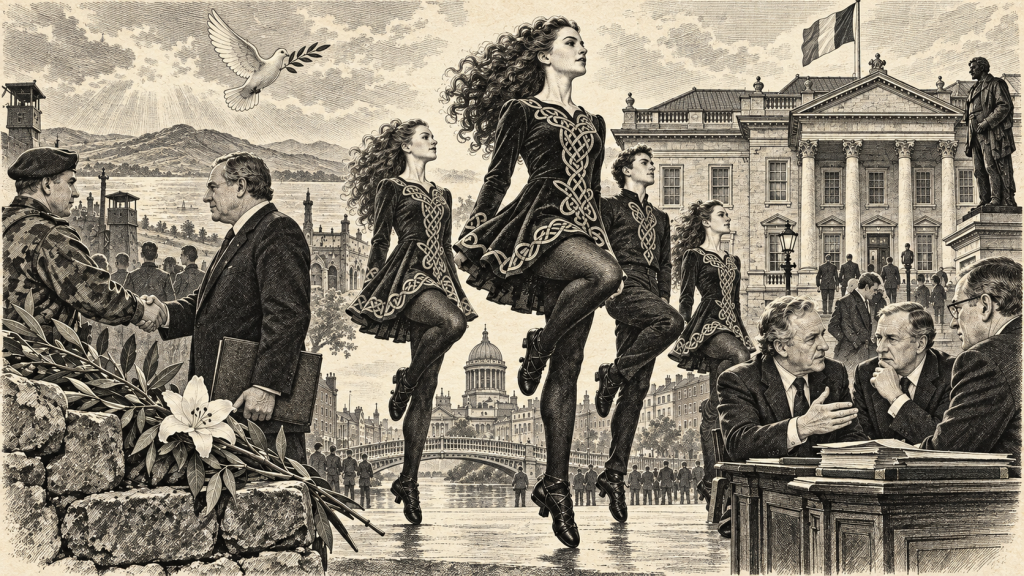
In 1994 Ireland experienced one of the most dramatic years of the decade. The peace process moved from cautious diplomacy to the first major paramilitary ceasefires, while political crisis in Dublin brought down Albert Reynolds’s government without a general election. At the same time, Riverdance exploded onto the international stage from the interval of the Eurovision Song Contest in Dublin, becoming one of the most recognisable cultural exports of modern Ireland.
The year was therefore marked by a striking mixture of hope, uncertainty and cultural confidence. The economy was improving, unemployment was beginning to fall and the mood of the country was changing. Yet the peace process remained fragile, and the collapse of the Fianna Fáil–Labour coalition demonstrated how quickly political trust could unravel.
Riverdance at Eurovision
On 30 April the Eurovision Song Contest was held at the Point Theatre in Dublin. Ireland won the contest for the third consecutive year, with Paul Harrington and Charlie McGettigan performing “Rock ’n’ Roll Kids”. The interval performance, however, became the event remembered far beyond the competition. Riverdance, composed by Bill Whelan and featuring dancers Jean Butler and Michael Flatley, combined traditional Irish dance with contemporary staging, music and choral performance.
The seven-minute piece was seen by a vast European television audience and received an immediate response. It was transformed into a full theatrical production the following year and became a worldwide commercial success. Riverdance arrived at a moment when Ireland was beginning to project a new international cultural image: modern, confident and capable of repackaging traditional forms without abandoning them.
The IRA Ceasefire
The central political breakthrough came on 31 August, when the IRA announced a “complete cessation of military operations”. The declaration followed years of contacts, the Hume–Adams dialogue, the Downing Street Declaration of December 1993 and sustained diplomacy involving the Irish and British governments. Taoiseach Albert Reynolds played a major role in creating the political environment in which the ceasefire became possible.
The statement did not settle the constitutional conflict and did not answer every question about the permanence of republican violence. Nevertheless, it transformed the political atmosphere. For the first time in many years, the possibility of a sustained peace process appeared realistic. Border roads began to reopen and the British government moved towards exploratory contacts with Sinn Féin.
Loyalist Ceasefire
On 13 October the Combined Loyalist Military Command, representing the principal loyalist paramilitary organisations, announced that it too would cease operational hostilities from midnight. Its statement made the ceasefire dependent on the continuation of the republican cessation, but it also expressed remorse for innocent victims and called for future political conflict to be conducted by democratic means.
The two ceasefires did not mean that Northern Ireland’s conflict was resolved. Questions of disarmament, policing, constitutional status, prisoners and political participation remained deeply contested. Yet the reduction in organised paramilitary violence altered daily life and allowed political negotiations to develop in a way that had previously been impossible.
Government Collapse in Dublin
The peace process might have strengthened Albert Reynolds politically, but his coalition with Labour collapsed late in the year. Relations between Fianna Fáil and Labour had already been damaged by disputes over the Beef Tribunal. The decisive crisis concerned the handling of the extradition case involving paedophile priest Brendan Smyth and the appointment of former Attorney General Harry Whelehan as President of the High Court.
Labour ministers resigned on 17 November and Reynolds stepped down as Taoiseach. Bertie Ahern succeeded him as leader of Fianna Fáil, but Fianna Fáil could not form a new government. Instead, a new coalition of Fine Gael, Labour and Democratic Left was assembled without a general election. On 15 December John Bruton became Taoiseach, with Dick Spring again serving as Tánaiste and Minister for Foreign Affairs.
Economic Change
The political turmoil occurred against an improving economic background. Central Statistics Office data show that unemployment fell from its 1993 peak, though it remained high at about 14.7 per cent. Export growth, European investment, foreign direct investment and a more stable fiscal environment were beginning to accelerate the recovery. The scale of the later Celtic Tiger boom was not yet obvious, but the direction of travel was becoming clearer.
The combination of economic improvement and the ceasefires helped create a stronger sense of possibility. Public discussion increasingly focused on what a peaceful and more prosperous Ireland might look like. The contrast with the pessimism of the 1980s was increasingly visible, even if the gains were uneven and many families were still affected by unemployment and emigration.
The Year in Perspective
By the end of 1994 Ireland had a new Taoiseach, two major ceasefires and a cultural phenomenon that would soon travel the world. Few years combine political and cultural change so clearly. The peace process remained reversible, and the ceasefires would later face serious strain, but the events of 1994 changed expectations about what was possible.
Riverdance symbolised an outward-looking cultural confidence, while the ceasefires opened space for negotiation and political inclusion. The fall of Reynolds’s government showed that domestic politics remained volatile, but the broader direction of the decade was unmistakable: Ireland was moving towards a different political, economic and cultural era.
Primary Sources
- RTÉ Archives: Eurovision Song Contest and Riverdance 1994
- RTÉ Archives: Riverdance debut at Eurovision
- RTÉ Archives: IRA announces ceasefire
- CAIN: Peace Process source documents 1994
- CAIN: Combined Loyalist Military Command ceasefire statement
- CAIN: Chronology of the Conflict 1994
- CAIN: Irish Peace Process key dates
- Department of the Taoiseach: Twenty-Seventh Dáil
- RTÉ: State Papers 1994–97
- Central Statistics Office: Historical unemployment rates