Paisley and McGuinness2007 CE
Dateline
Ireland in 2007 combined the confidence of an apparently prosperous island with two powerful signs that its political habits were changing. In the Republic, Bertie Ahern secured a third successive general-election victory and assembled a new coalition in Dublin. In Northern Ireland, devolved institutions returned after five years’ suspension, headed jointly by Ian Paisley of the Democratic Unionist Party and Martin McGuinness of Sinn Féin. Their partnership did not dissolve the constitutional divide, nor did it settle every legacy of the Troubles. It did, however, make power-sharing a working fact of daily government rather than a distant provision of the Belfast/Good Friday Agreement.
Two Elections, Two Governments
The Northern Ireland Assembly election of 7 March was the first decisive political event of the year. The DUP and Sinn Féin, the largest unionist and nationalist parties respectively, emerged dominant within their own communities. That result mattered because the St Andrews Agreement of 2006 had laid down a route back to devolution, but could not itself compel former antagonists to govern together. The negotiations and statutory arrangements that followed the election brought the parties into a common Executive.
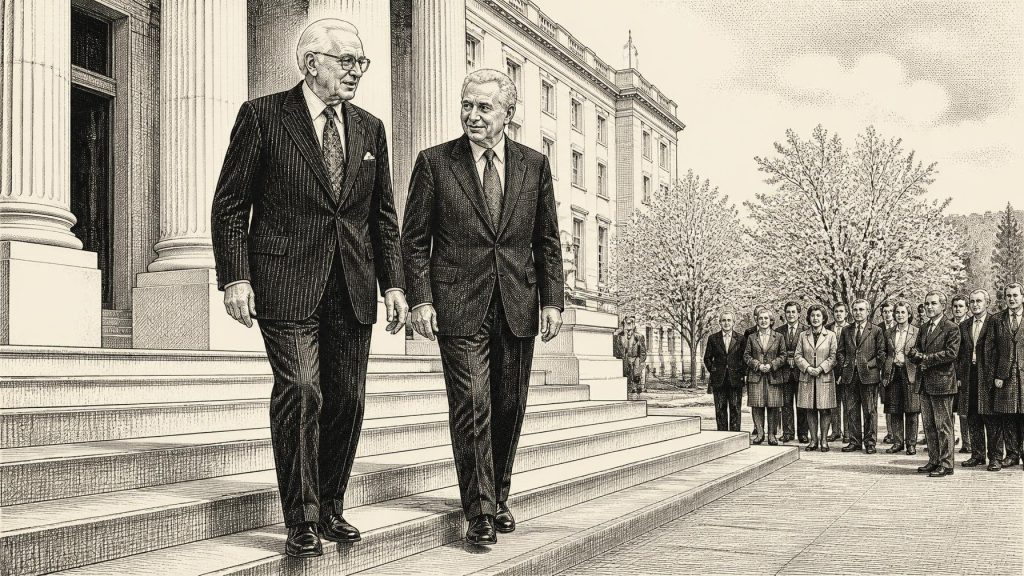
On 8 May, the suspension of the Assembly was lifted. Paisley became First Minister and McGuinness Deputy First Minister, offices deliberately designed to be held jointly and with equal authority in key decisions. The symbolism was extraordinary. Paisley had built a long career in uncompromising opposition to Irish republicanism; McGuinness was a senior republican who had become central to the peace process. Their cordial public manner soon prompted the press nickname ‘the Chuckle Brothers’, but the important point in 2007 was institutional: ministers from parties with sharply opposed constitutional ambitions now shared responsibility for departments, budgets and public services at Stormont.
For people across Northern Ireland, restoration promised more immediate things than ceremony. Locally accountable ministers could again take decisions on schools, hospitals, roads, agriculture and regional development. The Executive operated within the continuing framework of the United Kingdom, while the Belfast Agreement’s North/South bodies and the British-Irish intergovernmental relationship remained in place. Dublin had no governing role in Northern Ireland, but the restored institutions gave practical substance to the all-island and east–west relationships painstakingly created since 1998.
The Republic’s general election, held on 24 May, produced continuity rather than a transfer of power. Fianna Fáil remained the largest party in the 166-seat Dáil, winning 78 seats; Fine Gael won 51 and Labour 20. Ahern’s opponents had hoped that concern about housing, public services and his personal finances would end his decade as Taoiseach. Instead, Fianna Fáil retained enough strength to bargain from first place. The result also showed the persistence of a fragmented party system: independents, smaller parties and constituency-level loyalties still mattered within proportional representation.
The 30th Dáil first met on 14 June. Ahern formed the twenty-seventh Government with the Green Party and the Progressive Democrats. The Greens entered national government for the first time, acquiring ministries including Environment, Heritage and Local Government for John Gormley, and Communications, Energy and Natural Resources for Eamon Ryan. Brian Cowen remained Tánaiste and Minister for Finance. The alliance was politically revealing: Fianna Fáil sought a renewed mandate, the Progressive Democrats represented the market-oriented element of the outgoing coalition, and the Greens brought environmental priorities into the centre of government during a construction-led boom.
Prosperity and Its Exposed Edges
The election took place at the crest of the Celtic Tiger era. Employment was high, migration had transformed workplaces and neighbourhoods, consumer spending was buoyant, and cranes dominated Dublin and many provincial towns. Construction, property transactions and the credit that sustained them shaped both public revenues and private expectations. Contemporary conditions did not look like recession. Yet warning signs were visible within the year: the housing market was cooling, and economists at the Economic and Social Research Institute argued that prices were overvalued and that heavy dependence on housebuilding left the economy exposed to a sharp adjustment.
Later statistics underline why housing occupied such a large place in everyday conversation. The national residential-property series identifies 2007 as the boom peak, while the first declines in the rest-of-Ireland index appeared during that year. At the time, however, building still suggested growth and mobility: a first home, an investment apartment or a house in an expanding commuter belt was widely imagined as a route to security. The contrast between that confidence and the mounting structural vulnerability was one of the year’s defining tensions.
Government policy reflected both optimism and recognition of unfinished social needs. The National Development Plan for 2007–2013, launched in January, proposed exceptionally large capital investment in transport, education, health, housing, environmental services and regional infrastructure. In February, the National Action Plan for Social Inclusion 2007–2016 set long-term goals to reduce poverty and exclusion. These plans expressed a belief that the State could use boom-era resources to improve quality of life, not merely raise output. They also acknowledged that prosperity was unevenly shared and that childcare, disability, low income, educational disadvantage and rural isolation could not be solved automatically by growth.
A More Diverse Republic
The publication of the final principal results of the 2006 census on 29 March gave statistical form to changes already evident in streets, schools and workplaces. The State’s population stood at more than 4.2 million. Nearly 420,000 usual residents, about 10 per cent of the population, held non-Irish nationality, almost double the proportion recorded four years earlier. Polish nationals were the largest non-Irish group, followed by people with British and Lithuanian nationality. Immigration was no longer a marginal subject: it was a central fact of labour supply, urban life and the social character of the Republic.
The census also complicated older assumptions about family and faith. Cohabiting couples formed a growing share of family units, the number of divorced people had risen markedly since 2002, and urban flats and apartments had increased. Roman Catholicism remained overwhelmingly predominant, but its proportion of the population had fallen; Muslims were recorded as the third-largest religious category. The figures did not describe a single experience of modern Ireland, but they confirmed that a society long associated with emigration, large families and religious uniformity was becoming more varied.
Language provided a different kind of national assertion. On 1 January Irish became an official and working language of the European Union. The achievement had practical as well as symbolic importance: Irish could be used within the Union’s legal and institutional life. A temporary derogation, caused by limited translation capacity, restricted the range of material that had to be translated, so the change was not yet full parity in everyday administration. Still, 2007 placed Irish more visibly within a multinational Europe at the very moment when census results showed the Republic becoming more linguistically and culturally diverse at home.
Authority, Protest and Public Trust
Not all disputes could be accommodated by the language of national development. In north-west Mayo, the Corrib gas project remained a bitter conflict over the route and safety of a high-pressure pipeline and the location of the Bellanaboy refinery. Shell to Sea campaigners, local residents, Gardaí, Shell and the State each advanced sharply different accounts of risk, procedure and legitimate authority. Protests continued through 2007, including confrontations at the site in September. Complaints about policing were sufficiently serious for the Garda Síochána Ombudsman Commission to investigate cases arising from the dispute. Corrib exposed a gap between national energy ambitions and local consent in a rural community.
Questions of trust also reached the centre of government. During the election campaign and again in September, Ahern faced extensive scrutiny over personal financial transactions examined by the Mahon Tribunal, then investigating planning matters and payments. He denied having accepted money for improper purposes and publicly sought to explain his finances. The tribunal had not reached its eventual conclusions in 2007, so it would be wrong to treat later findings as if they were known that year. What was clear at the time was that the hearings damaged the ease with which political success and economic success could be presented as proof of clean, confident government.
Security remained another political concern. The Criminal Justice Act 2007, enacted in May, altered a range of rules concerning bail, detention, firearms, criminal assets and Garda powers. Ministers presented the legislation as a response to serious and organised crime; civil-liberties critics questioned both the scope of the powers and the speed of its passage. The Act belonged to a wider public mood in which economic expansion, visible wealth and anxiety about gangland violence could coexist.
Public Spaces and Shared Culture
Everyday life also registered change in less dramatic ways. From 30 April, smoke-free rules applied in enclosed workplaces and public places in Northern Ireland, extending a public-health transformation already familiar in the Republic after its 2004 ban. Pubs, offices and cafés became sites where law, health policy and sociability met. The measure was a small but tangible example of policy convergence across the island, achieved through separate jurisdictions rather than constitutional unity.
Dublin’s first Culture Night, held on 14 September, opened 82 venues for free events, drawing museums, libraries, theatres, churches, galleries and educational institutions into a shared evening programme. It offered a civic expression of the capital’s expanding cultural infrastructure, from the Book of Kells to contemporary music and community performance. Yet the year also revealed the fragility of that inheritance. After a limestone staircase collapsed at the National Museum of Ireland – Natural History in July, the Merrion Street museum closed for safety investigations and remained shut for the rest of the year.
Thus 2007 was neither simply the last carefree year of a boom nor merely a staging post in the peace process. It was a year in which the political architecture of Northern Ireland began functioning again under its most improbable partnership; the Republic renewed a government confident enough to plan on a grand scale; and census, language, protest and culture all recorded a country changing faster than its inherited stories could comfortably contain.
Primary Sources
- Dáil General Election May 2007: Election Results and Transfer of Votes
- Thirtieth Dáil
- Official Report: Tuesday 8 May 2007
- The 2007 Northern Ireland Assembly Election
- Ireland and the EU: Timeline of Key Events
- The Status of the Irish Language in the EU
- Census 2006: Principal Demographic Results
- 2006 Census of Population: Principal Demographic Results
- Census 2006 Reports
- Statistical Yearbook of Ireland 2007 Edition
- Residential Property Prices
- Quarterly Economic Commentary, Summer 2007
- On the Likely Extent of Falls in Irish House Prices
- Building for the Future? Interpreting an Irish Current Account Deficit
- Launch of Combat Poverty Agency Report ‘Tackling Poverty & Promoting Social Inclusion: Linking National & Local Structures’
- Social Inclusion Publications
- Criminal Justice Act 2007
- Gardaí Criticised Over Corrib Dispute
- Five Arrested After Clashes at Corrib Gas Line Protest
- Full Text of Ahern Statement
- Ahern Says False Claims, Leaks Meant to Harm Him
- Dublin Launches Culture Night 2007
- National Museum of Ireland Annual Report 2007
- Smoke-Free (Signs) Regulations (Northern Ireland) 2007
- The Smoking (Northern Ireland) Order 2006