St Andrews and the Port Tunnel2006 CE
Dateline
Ireland in 2006 appeared, at first glance, to be moving confidently through an era of prosperity and political normalisation. In the Republic, cranes, apartment blocks and new roads made the Celtic Tiger visible in concrete and steel; jobs were plentiful, immigration was reshaping towns and workplaces, and the State was investing on a scale that would have seemed remarkable a generation earlier. In Northern Ireland, however, devolved government remained suspended. The year’s decisive political work was therefore not an election or a restored administration, but the attempt by the Irish and British governments to bring the Democratic Unionist Party and Sinn Féin into a durable power-sharing settlement.
St Andrews and the Unfinished Settlement
The principal all-Ireland political development came in Scotland. From 11 to 13 October, the Irish and British governments held intensive talks with Northern Ireland’s parties at St Andrews. Their joint proposals, published on 13 October as the St Andrews Agreement, sought to complete a task left unresolved since the Belfast/Good Friday Agreement of 1998: restoring the Northern Ireland Assembly and Executive on terms that the parties then dominant within unionism and nationalism could accept.
The immediate difficulty was trust. Devolution had been suspended since October 2002. The Democratic Unionist Party, led by Ian Paisley, had displaced the more moderate Ulster Unionist Party as the largest unionist force, while Sinn Féin had become the largest nationalist party. Neither could simply inherit the arrangements of the late 1990s unchanged. The negotiations centred on two linked questions: whether all parties would support policing and the courts, and whether the DUP would enter an Executive alongside Sinn Féin under the rules of mandatory cross-community power-sharing.
Taoiseach Bertie Ahern was not a spectator. As head of the Irish government, co-guarantor of the Belfast Agreement and partner to Prime Minister Tony Blair in the British-Irish framework, he worked directly in the negotiations. The proposals gave the parties a timetable for answering, envisaged a transitional Assembly, and aimed at a restored devolved administration after a further election. They did not themselves restore devolution in 2006, and it is important not to read later success back into that autumn. Yet they created a practical route towards it.
Westminster gave legislative effect to elements of the plan in the Northern Ireland (St Andrews Agreement) Act, which received Royal Assent on 22 November. On 24 November a new Transitional Assembly met at Stormont. Its formal purpose was preparatory: the Northern Ireland Assembly remained suspended, and the body could not govern. The largest parties indicated their intention to nominate a First Minister and deputy First Minister after the required election and conditions had been met. This was a limited, procedural achievement, but in the context of repeated breakdowns it mattered. The year ended with the constitutional machinery pointed towards restoration rather than renewed collapse.
Counting a Changed Republic
On Sunday 23 April, households across the Republic completed the Census of Population. It was an unusually revealing national exercise. Some 4,400 enumerators had delivered forms to roughly 1.5 million dwellings, while publicity was broadcast not only in English and Irish but also in languages including Chinese, Polish, Russian, Swahili, Urdu and Yoruba. The campaign itself acknowledged a society transformed by inward migration and by the speed of housebuilding.
The full results were published after the census year, but they describe conditions on that April night and therefore provide the clearest demographic portrait of 2006. The population recorded was 4,239,848, an increase of 322,645 since 2002: the largest intercensal rise on record to that point. Natural increase contributed, but migration was central. Non-Irish nationals made up about one tenth of the population. Workers and families from Poland and other states that had joined the European Union in 2004 were especially visible, alongside longer-established communities and arrivals from Africa, Asia and elsewhere in Europe.
This was not merely a statistical change. New residents staffed building sites, hotels, restaurants, hospitals, shops and factories, and altered the linguistic and religious texture of everyday life. The census recorded Islam as the State’s third-largest religious category, after Catholicism and the Church of Ireland. Catholicism remained overwhelmingly the largest declared faith, but the figures demonstrated that religious belonging could no longer be imagined solely through the old Catholic–Protestant frame. The same returns recorded more flats and apartments, another indication of the increasingly urban and suburban form of the boom.
For many households, prosperity meant work, rising incomes and the possibility of buying a home. For others, it meant long commutes, intense pressure on rents and prices, and a rapidly changing neighbourhood. Ireland’s population growth made the demand for schools, health services, transport and local amenities immediate. The question was not whether the country was expanding, but whether public capacity and planning could keep pace.
Building the Boom
Construction sat at the centre of that question. During the middle years of the decade, house completions ran at extraordinarily high levels; 2006 would prove to be the peak year, with about 93,000 homes completed. The construction sector had become a major employer and a powerful engine of demand across the economy. Contemporary analysis already identified the vulnerability within the apparent success: housing investment and low interest rates were sustaining activity, while the scale of building drew labour and resources away from sectors exposed to international trade.
Employment remained strong. The unemployment rate was 4.3 per cent in 2006, low by the standards of recent Irish history, although higher than the exceptionally low rate recorded earlier in the decade. Employers reported shortages in skilled occupations, notably in construction and engineering. The Employment Permits Act 2006, enacted on 23 June, updated the legal framework governing work permits for foreign nationals and included protections against penalisation. It was both an administrative response to labour demand and a sign that migration had become a settled policy concern rather than a marginal one.
In June, government, employers, trade unions, farmers and voluntary-sector representatives agreed Towards 2016, the latest national social-partnership programme. It combined pay and policy bargaining with a stated long-term, ‘life-cycle’ approach to public services, addressing children, people of working age, older people and people with disabilities. Supporters saw partnership as a means of sharing the gains of growth and maintaining industrial peace; critics objected that important economic choices were being reached outside ordinary parliamentary contest. Either way, the agreement expressed the governing assumption of 2006: that growth would continue and that its social consequences could be managed through negotiated planning.
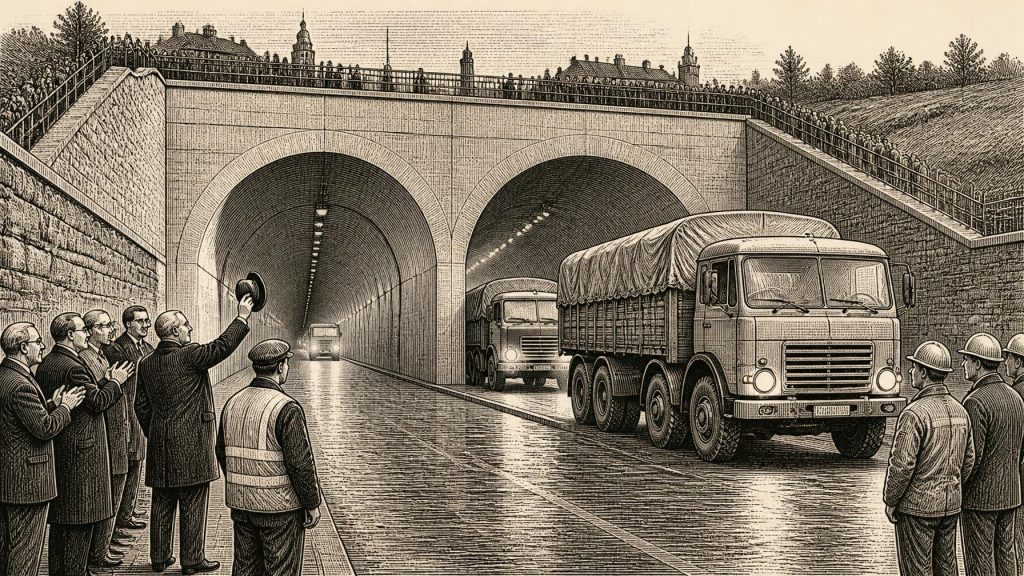
That confidence was embodied in the Dublin Port Tunnel. Officially opened on 20 December by Ahern, the 4.5-kilometre twin-bore route linked Dublin Port directly with the M1 and wider motorway network. Initially opened to heavy goods vehicles, it was designed to remove lorries from central city streets and speed the movement of freight from the State’s principal port. At roughly €750 million, following delays, disputes over cost and technical criticism, it also showed the price and complexity of trying to retrofit major infrastructure into a fast-growing capital. The Planning and Development (Strategic Infrastructure) Act, enacted in July, similarly sought to accelerate decisions on nationally significant schemes by directing certain applications to An Bord Pleanála.
Rights, Belonging and Public Culture
Economic modernisation did not automatically settle questions of personal status and equality. On 14 December, the High Court delivered judgment in Zappone and Gilligan v Revenue Commissioners. Katherine Zappone and Ann Louise Gilligan, an Irish couple married in British Columbia in 2003, had sought recognition of their marriage for Irish tax purposes. Ms Justice Elizabeth Dunne dismissed the claim. The ruling held that, in Irish constitutional and legal understanding at the time, marriage was between a man and a woman, and their Canadian marriage could not be recognised as an Irish marriage.
The decision was a setback for the couple, but the case brought the exclusion of same-sex couples from marriage into unusually clear public view. It also illustrated a broader tension within 2006 Ireland: a country often presented as socially liberal, European and globally connected still retained legal structures that treated many family relationships differently. Debate over civil partnership and legal recognition was therefore becoming harder to avoid.
Public culture projected a more celebratory image in September, when the Ryder Cup came to Ireland for the first time. From 22 to 24 September, the K Club at Straffan, County Kildare, hosted Europe against the United States. Europe won decisively, 18½ points to 9½. The event brought an international sporting audience to a prosperous, self-confident Ireland and placed Irish golfers, notably Padraig Harrington and Paul McGinley, before home crowds. Darren Clarke of Northern Ireland, playing shortly after the death of his wife Heather, became an especially emotional figure in the European victory.
A Year of Preparation
Thus 2006 was less a year of final settlement than of revealing preparations. St Andrews supplied a framework for the next stage of the Northern Ireland peace process, without yet bringing devolved rule back to Stormont. The census captured a Republic enlarged by migration and population growth. New legislation, social partnership and the Port Tunnel showed a State attempting to organise expansion. At the same time, dependence on construction, pressure on infrastructure and unresolved inequalities exposed the limits beneath the boom’s surface. Ireland was building, counting and negotiating for a future that still looked open.
Primary Sources
- Census through History
- Latest News Archive – 2006
- Census 2006 – Areas, Volume 1 Press Release
- Census 2006 Principal Demographic Results
- 2006 Census of Population – Volume 13 – Religion
- Census of Population of Ireland 2006: POWCAR User Guide
- Agreement at St Andrews: Joint Proposals by the British and Irish Governments
- Transcript of Press Conference with Tony Blair and Bertie Ahern, St Andrews, Scotland, 13 October 2006
- Northern Ireland (St Andrews Agreement) Act 2006: Explanatory Notes
- Transitional Assembly: Minutes of Proceedings, 24 November 2006
- Transitional Assembly: St Andrews Agreement Commentary
- Medium-Term Review: 2005–2012
- The Irish Labour Market and the Housing Boom
- Measuring Ireland's Progress, 2006
- Employment Permits Act 2006
- Planning and Development (Strategic Infrastructure) Act 2006
- Social Partnership Agreement: Seanad Debate, 21 June 2006
- Dublin Port Yearbook 2007
- Port Tunnel Opens After Last-Minute Delay
- Zappone and Gilligan v Revenue Commissioners, Ireland and Attorney General [2006] IEHC 404
- 2006 Ryder Cup