Rossport and the Last Arsenal2005 CE
Dateline
For Ireland, 2005 was a year in which apparently separate arguments exposed the pressures of a rapidly changing island. In the North, the Provisional IRA’s decision to end its armed campaign and decommission its weapons removed a central obstacle left by the conflict. In the Republic, extraordinary growth was transforming towns, workplaces and population patterns, while disputes at Rossport and Irish Ferries asked who bore the costs of development and global competition. Cork’s year as European Capital of Culture, meanwhile, projected a confident cultural Ireland outward. The year did not settle every contention, but it made the contrast between violence, prosperity and public accountability unusually stark.
A Crisis of Republican Credibility
The political atmosphere at the opening of the year was heavy with the consequences of events late in 2004, particularly the Northern Bank robbery in Belfast. On 10 February 2005, the Independent Monitoring Commission concluded that the Provisional IRA had been responsible for the robbery. Its assessment, rather than a criminal court verdict, had major political force: it reinforced unionist distrust of Sinn Féin and deepened the deadlock in devolved government. The Northern Ireland Assembly and Executive had already been suspended since October 2002, and direct rule from Westminster continued through 2005.
Then came the murder of Robert McCartney, a 33-year-old Belfast man, outside Magennis’s bar on 30 January. Brendan Devine was seriously injured in the same incident. McCartney’s sisters, fiancée and wider family mounted an unyielding public campaign for witnesses to co-operate with the Police Service of Northern Ireland. Their demand went to the heart of a post-agreement problem: could authority within republican communities be transferred from clandestine discipline to ordinary law? In its May report, the Monitoring Commission said it believed Provisional IRA members were involved and that subsequent intervention had obstructed investigation; it was careful not to prejudice possible criminal proceedings. The family’s campaign resonated far beyond Belfast, including in the Dáil, where a motion urged those with information to go to the PSNI.
The End of the Armed Campaign
Against that background, the Provisional IRA statement of 28 July was momentous. It declared an end to the organisation’s armed campaign, directed all units to dump arms, and said republican objectives would be pursued through exclusively peaceful and democratic means. The language was not a peace treaty in itself, nor did it immediately restore the Northern institutions. Unionist leaders, most notably the Democratic Unionist Party under Ian Paisley, remained unwilling to share devolved power with Sinn Féin until they were satisfied that the change was real and durable.
Verification followed. On 26 September, General John de Chastelain’s Independent International Commission on Decommissioning reported that it had observed and verified the decommissioning of the totality of the IRA arsenal. The commission had compared what it saw with security-force estimates and concluded that all IRA weapons had been put beyond use. The process was witnessed by Fr Alex Reid and the Methodist minister Rev Harold Good, whose presence was intended to provide reassurance without the photographs that republicans had rejected as humiliation. The act did not end paramilitarism across Northern Ireland, nor did it dissolve every fear created by decades of conflict. But it marked a decisive abandonment of the means by which the Provisional IRA had conducted its campaign since the late 1960s.
For the Irish Government led by Taoiseach Bertie Ahern, and for Tony Blair’s British Government, the development vindicated the patient, often frustrating architecture of the Belfast/Good Friday Agreement. Yet the constitutional promise of 1998 still awaited functioning local institutions. In 2005 the peace process therefore had a paradoxical character: the most consequential military step had been taken, but the political settlement remained incomplete.
State Services and Citizenship
Change in the Republic was also institutional. The Health Service Executive began operating on 1 January 2005, assuming responsibility for the management and delivery of health and personal social services. It replaced the older patchwork of health boards and other agencies with a single national body. Centralisation promised clearer responsibility and more consistent services; it also created an enormous new organisation whose success would depend on linking national management to hospitals, community care and local need.
The same day brought into effect the Irish Nationality and Citizenship Act 2004, implementing the constitutional change approved in the previous year’s referendum. Birth on the island no longer automatically conferred Irish citizenship in every case. The new law set conditions connected to a parent’s citizenship, entitlement to citizenship or reckonable residence. The measure was politically contentious, but its arrival in 2005 is inseparable from the country’s new migration reality. Ireland was no longer chiefly a place from which people departed; it had become a destination for workers, families and returning emigrants.
Population estimates for the year to April 2005 put the State’s population at about 4.13 million. Some 84,600 people were estimated to have immigrated during that period, against 29,400 emigrants, producing net inward migration of roughly 55,100. These figures describe a moving population rather than a single uniform experience. Newcomers were highly visible in construction, services, health care and urban neighbourhoods, while many Irish people still left for work or study. The practical questions of housing, employment rights, language and belonging acquired a sharper importance precisely because economic opportunity was drawing people in.
On 8 July the Oireachtas enacted the Disability Act 2005. Its provisions addressed assessment of need, access to public buildings and services, employment in the public service, and planning for disability services. Not every entitlement came into force immediately: commencement was staged, and the Act itself tied provision to available resources. Even so, the legislation signalled that disability policy was becoming more explicitly concerned with equality, access and social inclusion rather than discretionary welfare alone.
Concrete, Credit and New Settlements
Economic indicators made 2005 look buoyant. Preliminary national accounts recorded growth of 4.7 per cent in gross domestic product and 5.4 per cent in gross national product at constant prices. Personal consumption rose by 5.6 per cent and investment by 13.1 per cent. Such figures captured the continuing force of the Celtic Tiger, though the distinction between GDP and GNP mattered in a multinational economy where profits could flow abroad.
No sector altered the visible landscape more dramatically than construction. The Central Statistics Office estimated construction output at almost €32 billion in 2005. Around 242,000 people worked in the industry in the second quarter, approximately one in eight of those employed in the State. More than 86,000 dwellings were completed during the year by the CSO’s later estimate, an exceptionally high rate per head of population by European standards. Housing accounted for roughly two-thirds of building output.
The figures translated into cranes over Dublin and the regional cities, new estates on the edges of long-established towns, apartment schemes, roads and expanding commuter belts. Construction also depended increasingly on workers born outside Ireland: the CSO estimated that more than 25,000 non-Irish nationals were employed in the sector by the final quarter. The building surge supplied homes and jobs, but it also intensified worries about price, planning, infrastructure and the sustainability of settlement patterns. Those questions were present in 2005, even if the later financial crash was not yet known.
Ferries and Fair Employment
The Irish Ferries dispute brought the relationship between migration, labour standards and competition into unusually public view. The company proposed redundancies and the replacement of Irish-based crews with lower-paid agency workers from eastern Europe, alongside the reflagging of vessels. SIPTU, the Seamen’s Union of Ireland and other trade-union figures argued that the plan threatened agreed conditions and could establish a damaging precedent. The Labour Court found in November that Irish Ferries had not made a sufficiently compelling case to abandon its existing agreements unilaterally.
By early December, ferry services between Ireland, Britain and France had been severely disrupted. The dispute tested the social-partnership system that had shaped Irish wage and policy negotiations since 1987. A settlement was reached through the Labour Relations Commission in the early hours of 14 December. It allowed reflagging and change, but provided that new workers would receive at least the Irish minimum wage and protected the terms of a limited number of existing employees who remained. The compromise did not erase the anxieties exposed by the dispute. It demonstrated that the prosperous, outward-looking economy had to decide whether openness meant a race to the bottom in wages or enforceable common standards.
Rossport’s Uneasy Development
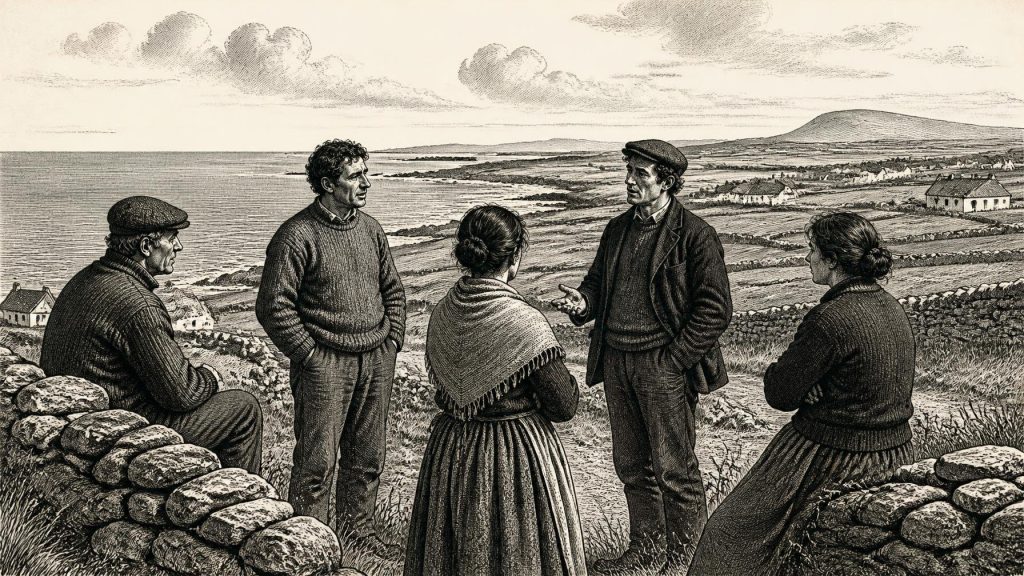
In north Mayo, the Corrib gas project produced a different argument about development: who had a voice when nationally significant energy infrastructure crossed a small community? Shell’s planned onshore pipeline and terminal works faced determined opposition in Rossport. Local residents raised safety concerns about the high-pressure pipeline route near homes and objected to the manner in which access to land was being secured. The company maintained that it was carrying out authorised preparatory work and that obstruction could not be allowed.
On 29 June, the High Court jailed Philip McGrath, Vincent McGrath, Willie Corduff, Brendan Philbin and Micheál Ó Seighin for contempt of court after they refused to comply with injunctions restraining obstruction of the works. Known nationally as the Rossport Five, they became symbols of resistance to the project and of the imbalance between a multinational company, the State and a rural community. Their imprisonment prompted demonstrations in Mayo, Dublin and elsewhere. They were released on 30 September after 94 days when the relevant injunction was discharged. The dispute did not end with their release; protests continued later in the year. Rossport showed that the language of national energy security could collide with local trust, environmental concern and property rights.
Cork, Irish and Europe
Amid these arguments, Cork held the title of European Capital of Culture for 2005. The designation placed a second Irish city, after Dublin in 1991, at the centre of a European cultural programme. Performances, exhibitions, community projects and debates about the city’s artistic identity made culture part of civic life as well as tourism and international presentation. The title was a recognition of Cork’s deep literary, musical, theatrical and visual-art traditions, but also of contemporary cultural production.
Ireland’s European place was strengthened in another way on 13 June, when the Council of the European Union adopted a regulation making Irish an official and working language of the EU institutions. The regulation was to apply from 1 January 2007 and included temporary practical derogations from full translation requirements. The decision did not transform daily usage of Irish overnight. It did, however, give the language a new institutional standing in Europe and connected cultural recognition to employment, translation, education and public administration.
Thus 2005 closed with an Ireland that was more peaceful but not politically settled, richer but newly conscious of uneven power, and more European while negotiating the meaning of its own language and citizenship. The final decommissioning of the IRA’s weapons was the year’s defining event. Yet Rossport, the ferry dispute and the pace of building ensure that 2005 is also remembered as a year when the practical terms of Ireland’s transformation were openly contested.
Primary Sources
- Reports and Statements by the Independent International Commission on Decommissioning (IICD)
- Irish Republican Army (IRA) Statement on Putting Arms Beyond Use, 26 September 2005
- Chronology of Provisional IRA Disarmament
- Peace Process: Key Events Since 1994
- IMC Reports – Reports by the Independent Monitoring Commission
- Fifth Report of the Independent Monitoring Commission
- Man Released Without Charge in McCartney Probe
- Dáil Backs Motion on McCartney Murder
- Health Service Executive Annual Report 2005
- Health Act 2004
- Irish Nationality and Citizenship Act 2004
- Twenty-Seventh Amendment of the Constitution Act 2004
- Disability Act 2005
- Disability Act 2005 (Commencement) Order 2005
- New Annual Population and Migration Estimates, April 2005
- Quarterly National Accounts: Quarter 4 2005 and Year 2005
- Construction and Housing in Ireland
- Rossport 5 Jailed
- Five Jailed Over Protests Against Corrib Gas Pipeline
- Rossport Five Released From Prison
- Shell Ireland Concerned Over Blockades
- The Labour Court 1946 to 2021
- Irish Ferries Rejects Labour Court Ruling
- Irish Ferries Sailings Resume After Dispute Resolution
- A City for Artists
- Council Regulation (EC) No 920/2005 of 13 June 2005
- Statistical Yearbook of Ireland 2005 Edition