The Two No Votes2024 CE
Dateline
Ireland in 2024 was marked by a striking concentration of public decisions: two constitutional referendums, local and European elections, a change of Taoiseach, and a general election before the year’s end. Each occurred against pressures that were intimate as much as political—housing scarcity, high living costs, overburdened public services, rapid population growth, migration and accommodation, and arguments about care, family and national identity. The result was not a simple verdict on one government or ideology. Rather, it revealed a society confident in using democratic institutions, but sceptical of proposals that seemed unclear, inadequate or disconnected from lived experience.
Constitutional Rebuff
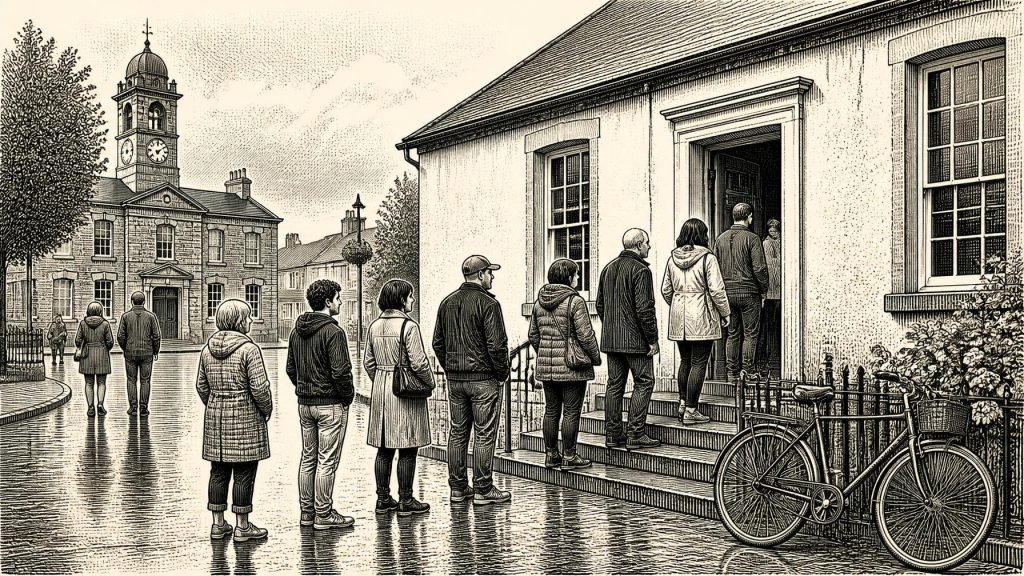
On 8 March, voters rejected both proposed amendments to Bunreacht na hÉireann concerning family and care. The Family Amendment would have widened the Constitution’s understanding of the family beyond one founded on marriage, while the Care Amendment would have replaced language referring to women’s duties in the home with a recognition of family care. Both proposals emerged from the wider process of constitutional reflection on gender equality. Yet the campaign exposed disagreement over the wording, the legal consequences of recognising care, and whether the proposed replacement language gave sufficient practical value to carers and disabled people.
The defeat was emphatic. The Family proposal was rejected by 67.7 per cent of valid votes and the Care proposal by 73.9 per cent. The latter was an especially severe repudiation of a constitutional amendment. Ministers accepted that the campaign and the drafting had failed to secure public confidence. The votes did not preserve the Constitution because voters had endorsed every existing phrase; rather, they left it unchanged because a majority did not wish to adopt these particular replacements. The episode demonstrated the high threshold of explanation and trust needed when changing the State’s foundational text.
Social policy nevertheless continued to develop through institutions less visible than a referendum campaign. Cuan, the new statutory agency for domestic, sexual and gender-based violence, was established from 1 January. Its remit included co-ordinating the State’s Zero Tolerance strategy, improving services and standards, and supporting expansion of refuge provision. In September, a new twelve-unit refuge opened in County Wexford, the first newly built refuge completed under the strategy. These developments reflected a growing insistence that safety in home and family life required material services, not constitutional symbolism alone.
A New Taoiseach
Political change came swiftly in the spring. Leo Varadkar announced on 20 March that he would resign as Fine Gael leader and Taoiseach; after the party chose Simon Harris unopposed as leader, Varadkar formally left office on 8 April. On 9 April the Dáil nominated Harris, and President Michael D. Higgins appointed him Taoiseach. At 37, Harris became the youngest person to hold the office. The Fine Gael–Fianna Fáil–Green Party coalition remained in place, but its public face changed substantially.
Harris presented his government as one focused on delivery in housing, health, disability services, security and economic opportunity. The need for delivery was palpable. The year brought evidence of a country expanding rapidly: the Central Statistics Office estimated a population of 5.38 million in April 2024, an increase of 98,700 in twelve months, the largest annual rise since 2008. Immigration was estimated at 149,200, while net migration was 79,300. Return migration by Irish citizens formed part of the movement, alongside arrivals from the European Union, the United Kingdom, Ukraine and elsewhere.
This demographic change enriched towns, workplaces and schools, but sharpened competition for homes and services. International Protection Accommodation Service figures showed that by September more than 32,000 applicants for international protection, including over 8,000 children, were being accommodated across more than 300 sites. In March the Government adopted a strategy intended to reduce reliance on private emergency accommodation and provide 14,000 State-owned beds by 2028. Ireland also opted into seven measures of the European Union’s new Asylum and Migration Pact. Migration thus became both a matter of everyday local concern and a major subject in electoral debate.
Ballots and Local Power
On 7 June, voters elected 949 councillors in the local elections and fourteen Members of the European Parliament. The same day, Limerick elected John Moran as the State’s first directly elected mayor, giving a newly designed city-and-county office a direct democratic mandate. Councils mattered greatly to the concerns dominating public discussion: they made decisions on planning, roads, recreation, environmental services and local development, while central government policy shaped the resources available to them.
The elections were also a test of the new Electoral Commission, An Coimisiún Toghcháin. Its voter-information campaign was followed by a notable reduction in spoiled ballots: provisional figures recorded 22,468 invalid votes in the local elections and 54,996 in the European contests, both lower than in 2019 despite higher numbers voting. Electoral competition, however, was increasingly unsettled. Housing, prices, health provision and migration gave independents and smaller parties opportunities, while the established parties faced a more fragmented electorate.
That fragmentation mattered when Harris asked President Higgins to dissolve the Dáil in November. Polling for the general election took place on Friday 29 November, returning the thirty-fourth Dáil. Fianna Fáil emerged with the largest number of seats, but no grouping commanded a majority. Fine Gael and Sinn Féin remained major parliamentary forces, while Social Democrats, Labour, independents and smaller parties added to a diverse chamber. The Dáil first met on 18 December, but government formation belonged to the opening weeks of 2025. It is therefore important not to project the later settlement backwards: 2024 ended with the electorate’s decision made but the executive question unresolved.
Homes, Work and Strain
Housing remained the dominant measure by which many people judged politics. There were 30,330 new dwelling completions during 2024, a substantial total by recent historical standards, though 6.7 per cent below 2023. More than half were in Dublin or the Mid-East, showing the continuing gravitational pull of the capital and its commuter belt. Apartments accounted for 28.9 per cent of completions, while scheme houses made up 53.4 per cent. New construction was real and visible; so too were high rents, homelessness, delayed household formation and the sense that supply had not caught up with need.
The wider economy was comparatively resilient, though headline Irish figures required caution because multinational activity can distort them. Later national accounts estimated that modified domestic demand, a measure designed to better describe activity at home, grew in 2024, as did consumption. Services exports were particularly strong. But aggregate performance did not remove the pressures felt by tenants, first-time buyers, carers and low-income households. Inflation had eased from its earlier peak, yet the accumulated cost of food, energy and housing remained central to household calculations.
Care was visible in other ways. The Healthy Ireland survey found that 14 per cent of respondents identified as unpaid carers in 2024, with women more likely than men to do so. Nearly a quarter of carers reported providing round-the-clock care for someone with whom they lived. Those figures gave social substance to the arguments raised by the March referendum: family care was not an abstract constitutional topic, but work performed daily in homes throughout the State.
Diplomacy and the North
Ireland’s most consequential foreign-policy act of the year came on 28 May, when the Government formally recognised the State of Palestine, in co-ordination with Spain and Norway. Dublin said that it recognised both Israel and Palestine and regarded a two-state solution as the only credible route to peace and security. The decision occurred amid the war in Gaza and was presented as an effort to sustain the possibility of Palestinian self-determination rather than await an indefinitely postponed peace settlement. It drew on a long Irish diplomatic tradition that connected international law, multilateral institutions and the experience of national independence.
Relations with the United Kingdom also retained a legacy dimension. On 17 January the Irish Government lodged an inter-State application against the United Kingdom at the European Court of Human Rights, challenging aspects of the Northern Ireland Troubles (Legacy and Reconciliation) Act 2023. Ireland argued that provisions on immunity, investigations, inquests and civil actions were incompatible with Convention rights. This was only the second inter-State case brought by Ireland against the United Kingdom before the Court, linking current debates about victims’ rights to the unfinished human consequences of the Troubles.
Northern Ireland’s devolved institutions returned on 3 February after a prolonged suspension, restoring an Executive led by First Minister Michelle O’Neill and deputy First Minister Emma Little-Pengelly. Yet uncertainty remained over shared civic infrastructure. In September the UK Government decided it would not fund redevelopment of Belfast’s Casement Park in time to host matches during UEFA Euro 2028, citing escalating costs and risk to the timetable. The decision disappointed advocates of the stadium, including the GAA, and underlined how sport, regeneration, public finance and communal symbolism remained intertwined in Belfast.
Culture, Learning and Weather
Irish culture had prominent international successes. On 10 March, the Cork-born actor Cillian Murphy won the Academy Award for Best Actor for Oppenheimer. Dublin-based Element Pictures also shared in the awards success of Poor Things, underlining the global reach of Irish production, performers and crews. Education policy looked forward as well: schools were invited to join the phased introduction of new Leaving Certificate subjects in Drama, Film and Theatre Studies and Climate Action and Sustainable Development from 2025–26. The planned subjects recognised changing cultural industries and the environmental knowledge expected of a new generation.
Climate was not only a subject for classrooms. Met Éireann recorded 2024 as Ireland’s fourth warmest year on record, with an annual mean temperature of 10.72°C in its island-wide series. The first half of the year was notably wet, while named storms—including Isha, Jocelyn, Kathleen, Ashley, Bert and Darragh—brought damaging winds, heavy rain and local flooding. The Environmental Protection Agency’s State of the Environment Report, published in 2024, warned that biodiversity, water, climate mitigation and land use remained areas of major challenge. Thus the ordinary experience of a mild, clouded and often stormy year sat within a longer, increasingly unavoidable environmental history.
By December, Ireland had renewed its institutions without resolving its deepest constraints. Voters had rejected constitutional wording they did not trust, elected new representatives, and produced a Dáil requiring further negotiation. The country remained prosperous in aggregate and culturally confident abroad, yet its accelerating population exposed shortages in homes, care and accommodation. 2024’s most durable historical significance may lie in that contrast: an active democracy repeatedly making choices while confronting the slower work of building enough security, shelter and capacity for the society it had become.
Primary Sources
- Referendums on Family and Care
- Report on the Referendums on Family and Care
- Thirty-ninth Amendment of the Constitution (The Family) Bill 2023
- Announcement of Formal Resignation of Taoiseach Leo Varadkar in Dáil Éireann
- Speech by the Taoiseach Simon Harris – Nomination of Members of Government, Dáil Éireann
- Former Taoisigh
- National Election and Democracy Study
- Post Electoral Event Review: European Parliament, Local and Limerick Mayoral Elections
- 29% Reduction in Local & Euro Election Spoilt Votes Welcomed By An Coimisiún Toghcháin
- General Election on 29 November 2024
- 34th Dáil General Election Results 29 November 2024
- Key Findings: Population and Migration Estimates, April 2024
- New Dwelling Completions Q4 2024
- Annual National Accounts 2024: Key Findings
- Healthy Ireland Survey 2024
- Government Agrees New Comprehensive Accommodation Strategy for International Protection Applicants
- International Protection Accommodation
- European Commission Confirms Ireland’s Opt-In to 7 Legislative Measures of EU Asylum & Migration Pact
- Minister McEntee Officially Establishes Cuan – New Domestic, Sexual and Gender-Based Violence Agency
- New State-of-the-Art Domestic Violence Refuge Opens in County Wexford
- Ireland Recognises the State of Palestine
- New Inter-State Application Brought by Ireland Against the United Kingdom
- Letter from the Secretaries of State for Northern Ireland and DCMS Concerning Casement Park
- Minister Martin Congratulates Irish Oscar Winner Cillian Murphy
- Minister Foley Invites Schools to Apply to Join the Rollout of the New Leaving Certificate Subjects on Drama and Climate Action
- Annual Climate Statement for 2024
- Ireland’s State of the Environment Report 2024