Water Meters and Stormont House2014 CE
Dateline
Ireland in 2014 was a country emerging from financial emergency but not from public anger. Economic indicators improved, employment began to recover and international confidence returned after the sovereign-debt crisis. Yet the year’s most visible domestic politics concerned an everyday necessity: water. The introduction of household water charges and the fitting of meters became a national argument about austerity, public ownership, fairness and trust in government. At the same time, severe Atlantic weather exposed the vulnerability of coasts and infrastructure, while negotiations at Stormont sought to steady Northern Ireland’s strained devolved institutions. The year joined material pressures, questions of accountability and unfinished constitutional relationships across the island.
Storms, Flooding and the Atlantic Coast
The opening weeks of 2014 were shaped by the exceptional storm sequence of the winter of 2013–14. Successive Atlantic depressions brought strong winds, prolonged rainfall, high tides and damaging seas. Met Éireann recorded storm-force winds on several days between January and February; the combination of saturated ground, storm surges and unusually large waves caused persistent flooding and serious coastal damage, particularly along the southern, western and north-western seaboards. Businesses, homes, roads and harbours all felt the effects. The weather was not merely a dramatic backdrop. It reinforced long-running concerns about coastal protection, drainage, insurance and the capacity of local services to respond to severe events.
On 12 February, the storm commonly known as Darwin crossed the country. Met Éireann recorded hurricane-force sustained winds at Mace Head in County Galway and a gust of 159 km/h at Shannon Airport. Fallen trees, damaged roofs and power failures disrupted ordinary life over a wide area. For communities dependent on fishing, farming, tourism and local transport, the winter’s repeated storms underlined how closely economic life remained tied to exposure to the Atlantic environment.
A Government Under Pressure
Enda Kenny’s Fine Gael–Labour coalition could point to recovery, but its political authority was weakened by controversies over policing and by the continuing social costs of austerity. In March, Garda Commissioner Martin Callinan retired amid a mounting dispute that included allegations raised by Sergeant Maurice McCabe. The episode was part of a wider public debate about Garda practices, whistleblowers and ministerial oversight.
On 7 May, Alan Shatter resigned as Minister for Justice and Equality and Minister for Defence after the Taoiseach received the report prepared by Seán Guerin SC on allegations connected with Garda matters. The immediate political significance was acute: Shatter had been a prominent reforming minister, and his departure exposed divisions between official assurances and public confidence in the administration of justice. Later legal findings qualified aspects of the Guerin report concerning Shatter; those later developments should not be read back as if they had settled the political crisis in May 2014. At the time, the resignation helped make accountability in the Garda Síochána one of the year’s central public concerns.
Parliament nevertheless produced institutional reforms with a longer life than the immediate controversy. The Protected Disclosures Act 2014 came into operation in July, establishing statutory protections for workers who made qualifying disclosures in the public interest. The Irish Human Rights and Equality Commission Act merged the Human Rights Commission and the Equality Authority, and the new Irish Human Rights and Equality Commission was established on 1 November. The Freedom of Information Act 2014 also renewed the statutory framework for access to records. Taken together, these measures reflected an official recognition that public administration required clearer rights, stronger scrutiny and more reliable channels through which wrongdoing could be raised.
Votes of Discontent
On 23 May, voters in the Republic elected local councillors and members of the European Parliament, alongside two Dáil by-elections. The contests gave a clear warning to the coalition parties. Fine Gael and Labour lost substantial local support, while Sinn Féin advanced strongly and independents and smaller parties benefited from a mood that was critical of austerity and established political authority. The elections did not remove the Government, but they altered the atmosphere in which it governed. They demonstrated that recovery measured in aggregate output or bond-market confidence did not automatically translate into approval among households still carrying debt, facing insecure work or dealing with reduced public services.
The results also showed the continuing importance of local government as a forum for national grievance. Councillors were closely associated in voters’ minds with planning, housing, roads, local amenities and the practical consequences of cuts. A Local Government Reform Act, passed in 2014, reorganised councils and abolished town councils, concentrating authority in larger municipal structures. This was a substantial change in the map of local representation, even as the election results revealed popular unease about the distance between citizens and decision-makers.
The Water-Charge Revolt
No issue expressed that unease more powerfully than Irish Water. The utility, created in the previous year to centralise public water services, proceeded with the installation of domestic meters in 2014 and with plans for charges. Ministers argued that Ireland required major investment after decades of underinvestment in water and wastewater infrastructure, and that charging would contribute to a sustainable system. Opponents regarded the policy as an unjust new household burden after years of austerity and feared that a public resource was being moved towards privatisation.
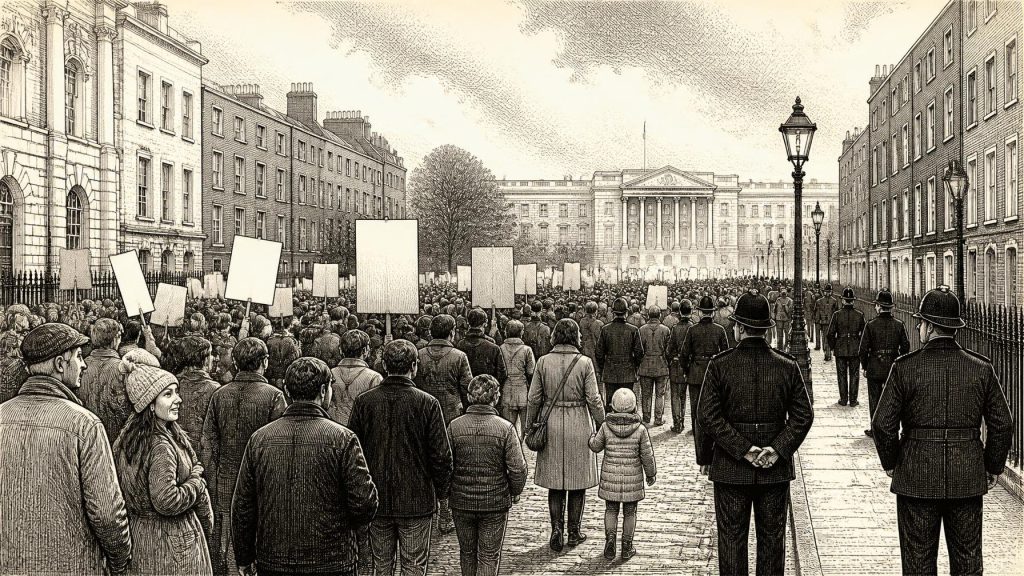
The dispute was not solely about payment levels. It concerned the legitimacy of the new body, the cost of its establishment, the handling of customer information, and whether metering would genuinely produce a fairer system. Protests occurred at meter-installation sites and in towns around the country. On 11 October, tens of thousands marched in Dublin in the first major Right2Water demonstration; further nationwide protests followed on 1 November and a major Dublin demonstration took place on 10 December. Most participants demonstrated peacefully, though particular confrontations and arrests ensured that policing and protest tactics also became contentious.
Under pressure, the Government revised its approach in November. It deferred the start of charging until 1 January 2015, introduced capped charges and announced a water-conservation grant. The Water Services Act 2014, enacted on 28 December, provided for maximum household charges, a grant, customer-dispute arrangements and a plebiscite requirement should the Government ever seek to dispose of the State’s shareholding in Irish Water. These concessions did not end opposition. Rather, the water movement became a durable force in Irish politics, helping to organise local networks and giving austerity fatigue a highly visible symbol.
Recovery With Uneven Relief
Behind the demonstrations, economic conditions were materially improving. The Central Bank’s contemporary assessment estimated growth in real gross national product of more than 3 per cent in 2014 and put average unemployment at 11.5 per cent, down from the much higher levels of the crisis years. Subsequent national-accounts releases also recorded strong GDP growth. Such figures marked a real shift from recession, supported by exports, improving domestic demand and a gradual revival in employment.
But recovery was unevenly experienced. Emigration remained a recent reality for many families; mortgage arrears, low incomes and housing insecurity had not disappeared. The apparent contrast between high-level growth and household discontent made political sense in this setting. The Companies Act 2014, enacted in December, consolidated and modernised much Irish company law, while the Government continued to present Ireland as a stable location for trade and investment. Yet the strongest political story was that economic repair had not restored consent for every reform associated with the crisis response.
Memory, Rights and Social Reckoning
2014 also brought a painful historical issue into national view. Research by the local historian Catherine Corless into the former Bon Secours mother-and-baby home in Tuam, County Galway, received wide public attention in May and June. Corless had identified death records for 796 infants and young children who died at the home between 1925 and 1961, while finding no corresponding burial records in the local graveyards. The site had long been associated locally with an unmarked burial ground.
Early reporting often used dramatic and imprecise language about a “septic tank” and the burial of hundreds of children. Responsible interpretation in 2014 required a distinction between firmly documented child deaths, the absence of identified burial records, eyewitness recollections and the still-unresolved question of precisely where and how all remains had been buried. Corless herself objected to claims that she had said children were “dumped” in a septic tank. Nevertheless, her research forced a broader reckoning with the treatment of unmarried mothers and children in institutions administered within the intertwined worlds of Church, State and local authority. Dáil debate in June showed that Tuam had become a national moral and historical question, not simply a local story.
Diplomacy and an Unsettled North
Relations between Ireland and the United Kingdom continued to develop in a more confident register. From 8 to 11 April, President Michael D. Higgins and Sabina Higgins made the first State Visit to Britain by an Irish head of state. Accompanied by Tánaiste Eamon Gilmore, Higgins addressed both Houses of Parliament and attended events at Windsor, London and Coventry. The visit built upon Queen Elizabeth II’s 2011 visit to Ireland and gave public ceremonial form to a relationship transformed by the peace process. It did not erase difficult history; rather, it demonstrated a willingness to address shared and contested inheritances through recognition and hospitality.
In Northern Ireland, however, the institutions created by the Good Friday Agreement remained under real strain. The failure at the turn of the year of the Haass–O’Sullivan talks left unresolved disputes over flags, parades and dealing with the past. Financial pressures, especially disagreement over welfare reform and the Executive budget, deepened tensions between the main parties. Fresh talks involving the British and Irish governments began at Stormont in the autumn.
On 23 December, the Stormont House Agreement was reached after weeks of negotiation. It addressed welfare and financial arrangements, proposed reforms to the Stormont institutions, and outlined mechanisms for legacy issues, including a Historical Investigations Unit, an Independent Commission on Information Retrieval and an Oral History Archive. It also envisaged work on flags, identity, culture and tradition, and potential devolution of responsibility for parades. The agreement was an important diplomatic achievement, but it was a framework rather than a final settlement: implementation and political consent remained uncertain. Its importance lay in preventing immediate institutional collapse and in acknowledging that the legacies of conflict still required structured, public attention.
Coast, Culture and Connection
Amid these arguments, the State promoted a more outward-looking regional economy. Fáilte Ireland launched the Wild Atlantic Way in spring 2014, presenting a roughly 2,500-kilometre touring route from County Donegal to Kinsale in County Cork. Signage, marketing and “discovery points” sought to turn the Atlantic coast into a coherent international destination. The initiative linked landscape, food, heritage, small businesses and rural employment, while the storms of the same year offered a reminder that the coast being marketed was also a working and vulnerable environment.
Thus 2014 did not fit a simple narrative of national recovery. Ireland was rebuilding employment and confidence, but its citizens demanded a more persuasive account of who would bear the cost of reform, how institutions would answer criticism and how difficult histories would be faced. Water meters, the Tuam revelations and the Stormont House negotiations each concerned, in very different ways, the relationship between public systems and human dignity.
Primary Sources
- State Visit to the United Kingdom
- President Higgins Departs on First State Visit to The United Kingdom
- Address to the Houses of Parliament, Westminster, London, 8th April 2014
- Irish Human Rights and Equality Commission Act 2014 – No. 25 of 2014
- Irish Human Rights and Equality Commission Act 2014
- S.I. No. 450/2014 – Irish Human Rights and Equality Commission Act 2014 (Establishment Day) Order 2014
- Protected Disclosures Act 2014
- Protected Disclosures Act 2014: Commencement
- Freedom of Information Act 2014, Section 1
- 7 May 2014 Dáil Debates: Termination of Ministerial Appointment
- Local Elections 2014 Results
- European Election Counts Are Under Way
- Thousands Protest Against Water Charges in Dublin
- Water Sector Reforms: Dáil Éireann Debate, 20 November 2014
- Water Services Act 2014
- Central Bank of Ireland Annual Report 2014
- National Income and Expenditure Annual Results 2014
- Companies Act 2014
- Tuam Mother and Baby Home: The Trouble With the Septic Tank Story
- 10 June 2014 Dáil Debates
- The Stormont House Agreement
- Stormont House Agreement – 23 December 2014
- Statement on Haass Talks: 8 January 2014
- Northern Ireland Peace Monitoring Report, No. 3
- Winter 2013/2014
- Fáilte Ireland to Spend €10m on Western Seaboard Tourism Initiative
- Wild Atlantic Way Vision