
Moss-Rich Mud at Derryvree
About 31,568 BCE, Ireland lay within the unstable Late Pleistocene, although evidence permits only broad chronological ranges. At Derryvree, Fermanagh, moss-rich freshwater deposits beneath later till record treeless, cold periglacial terrain, with sedges, shallow water and open vegetation. Southern caves, notably Castlepook, preserve Marine Isotope Stage 3 fauna including mammoth, giant deer, reindeer, hyaena and Arctic species, indicating intermittent connections beyond Ireland. Changing sea levels and ice margins shaped access routes. A cut-marked reindeer bone may indicate brief human activity, but no secure settlement evidence exists. Subsequent ice expansion likely destroyed earlier archaeology, leaving an environmental rather than social history.
View Record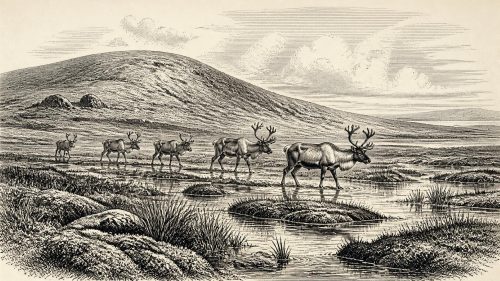
Derryvree’s Freshwater Witnesses
At 31,569 BCE, Ireland’s evidence belongs to a broad, climatically unstable Late Pleistocene interval, not a single year. Derryvree, County Fermanagh, preserves freshwater sediments between glacial tills, indicating an ice-free tundra-like wetland during later MIS 3. Castlepook Cave, County Cork, contains mammoth, reindeer, giant deer, bear and hyena remains, showing a diverse open-country fauna. A cut-like mark on a reindeer bone may indicate early human activity, but cannot demonstrate settlement. Approaching glacial maximum conditions, lower sea levels and uncertain routes shaped a changing landscape. Surviving sediments, bones and landforms reveal ecology and climate, but no political, cultural or social history.
View Record
Castlepook’s Hyena-Worked Fauna
Although 31,570 BCE cannot be treated as a recoverable Irish year, evidence from Marine Isotope Stage 3 reveals intermittent ice-free environments. At Derryvree, County Fermanagh, freshwater silts between glacial tills preserve plants and insects indicating cold, open, waterlogged terrain. Castlepook Cave, County Cork, yielded mammoth, reindeer, giant deer, bear, hyaena and other fauna, accumulated over time largely through natural and carnivore processes. A possible cut-marked reindeer bone may suggest human butchery, but proves neither settlement nor culture. Changing sea levels and ice affected animal dispersal. Renewed glaciation later erased much evidence, leaving a dynamic, fragmentary prehistoric landscape across the island.
View Record
Crag Cave Calcite Pulses
About 31,571 BCE is a modern approximation, not a recorded Irish date, indicating a fluctuating MIS 3 glacial environment. Derryvree sediments in Fermanagh demonstrate an ice-free freshwater interval between glacial advances, supporting cold, open wetland vegetation. Crag Cave calcite records milder interstadials, when groundwater circulated, amid temperature swings exceeding 10°C. Castlepook Cave's mixed fauna, including reindeer, mammoth and hyaena, confirms intermittent animal occupation of exposed grazing landscapes. A possibly tool-marked reindeer bone may indicate brief human presence, but lacks secure context. Later ice destroyed evidence; no settlements, polity, economy, ritual or culture can be established with confidence from present evidence.
View Record
The Derryvree Freshwater Archive
Around 31,572 BCE, Ireland lay within the climatically unstable Marine Isotope Stage 3, before maximum expansion of the British–Irish Ice Sheet. At Derryvree, County Fermanagh, freshwater sediments sealed between tills record an ice-free, treeless periglacial wetland of mosses, sedges, insects and shallow water, dated broadly rather than to a single year. Other deposits indicate intermittent milder conditions and regional environmental variation. Castlepook Cave fauna demonstrate cold-adapted animals, while a possibly tool-marked reindeer bone may suggest brief Upper Palaeolithic human contact, though this remains uncertain. No evidence establishes permanent settlement, society or polity. Only ecology survives: ice, habitats and chance preservation.
View Record
Hyaena Hall’s Mammoth Sands
Around 31,573 BCE, Ireland lay within the climatically unstable Late Pleistocene, but no evidence permits events to be dated to a single year. Derryvree, County Fermanagh, preserves an ice-free interval of treeless, wet tundra between glacial advances, while Crag Cave records changing conditions during interstadials. Castlepook Cave, County Cork, yielded mammoth, reindeer, giant deer, hyaena and cold-adapted fauna, demonstrating links with wider north-west Europe, though mixed cave deposits complicate interpretation. A marked reindeer bone may indicate human activity, but no Palaeolithic settlement is known. Later ice expansion erased or buried evidence, leaving dynamic ecological history rather than recoverable human narrative.
View Record
Derryvree’s Tundra Lake
Around 31,574 BCE, Ireland was entering an increasingly cold, unstable phase before the Last Glacial Maximum, not yet entirely ice-covered. Organic deposits beneath later glacial tills at Derryvree, County Fermanagh, preserve evidence of an ice-free freshwater tundra landscape, with sedges, mosses, Arctic-alpine plants and shallow pools. Greenagho provides comparable pre-glacial evidence. Southern caves, notably Castlepook in County Cork, contain remains of cold-stage mammals including reindeer, mammoth and hyaena, though their dates are not necessarily contemporary. A possibly cut-marked reindeer bone suggests an unconfirmed early human visit. Glacial erosion has severely limited surviving evidence, preventing detailed accounts of society or events.
View Record
Doneraile’s Palaeolithic Femur
31,575 BCE is a label for a late-Pleistocene interval, not a datable Irish event. Derryvree, County Fermanagh, preserves wetland deposits dated broadly to 36,900–31,700 cal BP, indicating treeless, cold, plant-rich terrain between glacial advances. Castlepook Cave, County Cork, contains MIS 3 remains of mammoth, reindeer, giant deer, predators and Arctic fauna, accumulated over time rather than contemporaneously. A cut-marked reindeer femur may indicate human butchery, but cannot establish settlement, chronology or continuous occupation. Lower seas may have aided movement, yet routes remain unknown. Ice expansion reshaped Ireland and destroyed sites, leaving evidence of habitats, animal movement and possible human presence.
View Record
Birm-166’s Wetland World
Around 33,500 years before present, the landmass later called Ireland experienced a volatile Late Pleistocene climate, rather than a dateable historical year. Derryvree, County Fermanagh, preserves freshwater silts between glacial tills, indicating cold, open tundra-like wetlands with mosses, sedges, herbs and seasonal liquid water. Other sites, including Crag Cave, reveal intermittent milder phases amid severe conditions. Cave fauna indicates episodic presence of reindeer, mammoth, giant deer, predators and other cold-adapted animals. No secure evidence establishes resident people, society or settlement, although disputed marks on a reindeer bone may suggest human butchery. Later ice expansion reshaped landscapes and erased much evidence.
View Record
The Castlepook Butchery Debate
At the modern filing date of 31,577 BCE, Ireland was a climatically unstable Ice-Age landscape, not a documented society. Derryvree, County Fermanagh, preserves evidence of a treeless, cold wetland existing between glacial advances, though its dated range cannot describe a single year. Castlepook Cave, County Cork, contains MIS 3 animal remains, including mammoth, reindeer, giant deer, hyaena and wolf, but its mixed cave deposits do not represent one community. A cut-marked reindeer femur, dated around 33,000 years ago, may indicate human butchery. It supports possible brief visits by hunter-gatherers, not continuous settlement, institutions or cultural traditions with certainty in Ireland.
View Record