

Castlepook’s Scavenger Cave31214 BCE
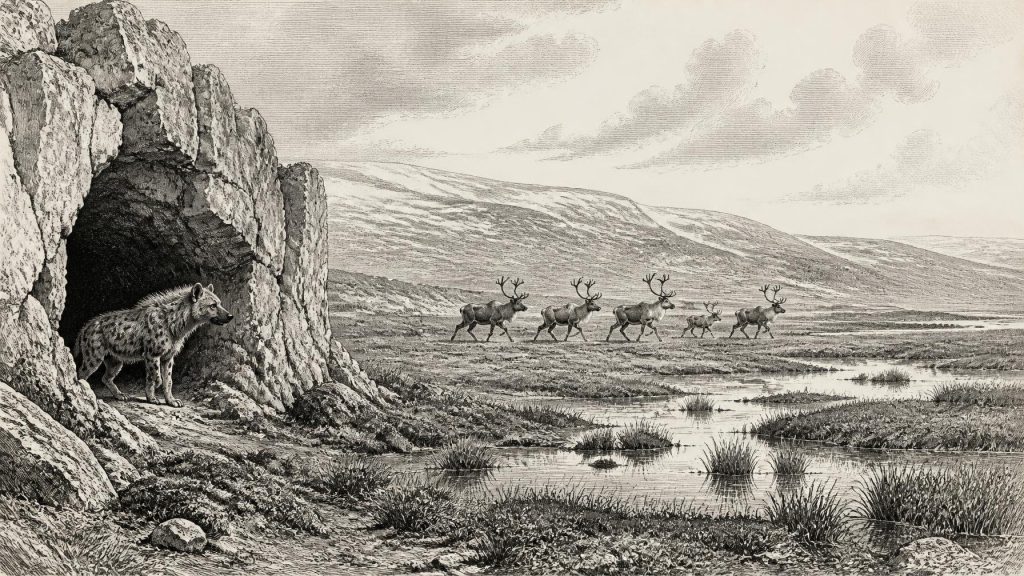
Around 31,214 BCE, Ireland experienced variable Ice-Age conditions during Marine Isotope Stage 3, with open tundra, freshwater habitats and cold-adapted wildlife. Derryvree deposits in Fermanagh preserve evidence of sedges, mosses, insects and specialised plants between glacial advances. Castlepook Cave, County Cork, contains over 2,000 bones accumulated across millennia, including mammoth, reindeer, giant deer, hyaena and Arctic fox. A reindeer femur dated to about 31,000 BCE bears a possible stone-tool cut mark, suggesting brief human carcass processing. However, no securely associated artefacts, hearths or occupation layers confirm settlement. Castlepook remains an exceptional palaeoenvironmental archive and tentative evidence of early human visitation.
Dateline
A date written as 31,214 BCE is a modern chronological coordinate, not a year that anyone in Ireland could have named, recorded or experienced by a shared calendar. There are no written sources, annual events, rulers, communities or precisely datable human sites for this point in the Late Pleistocene. In simple arithmetic it lies about 33,164 years before AD 1950, the reference year used for “before present” dating, but that is not itself a calibrated archaeological date. The responsible question is therefore not what happened in Ireland in this exact year, but what the best evidence can say about the island and its inhabitants—animal and possibly human—during the broader climatic interval around it.
A Cold-Stage Ireland
About 31,214 BCE, Ireland was in Marine Isotope Stage 3, part of the last Ice Age. This was not a single, unchanging freeze. Northern Atlantic climates oscillated sharply between colder and relatively milder phases, while ice masses expanded and contracted over long timescales. The later Last Glacial Maximum, when the Irish Ice Sheet was at or near its greatest extent, lay in the future: commonly cited calibrated ranges place that maximum broadly between about 26,500 and 19,000 cal BP. Around the date considered here, substantial parts of Ireland could support terrestrial animals, although conditions were far colder, more open and more variable than those of the modern island.
That conclusion must not be turned into a uniform map. Evidence from caves in the south and south-east, and from buried deposits beneath drumlins in the north, records particular places at particular stages in a complex glacial history. It does not prove that every valley was habitable at once. Nor did the coastline resemble Ireland’s present shore. Lower global sea levels exposed continental shelves and altered the Irish Sea basin, but a lower sea level alone does not demonstrate a simple, permanent pedestrian route between Ireland and Britain. Animal and possible human movement must be understood as a geographical problem still shaped by changing ice, water, coasts and seasons.
Derryvree’s Tundra Record
The clearest environmental evidence relevant to this broad period comes from Derryvree near Maguiresbridge, County Fermanagh. There, road works exposed a freshwater series of silts and fine sands trapped between two tills within a drumlin. Organic-rich layers produced a conventional radiocarbon determination of 30,500 +1,170/−1,030 BP. That is not an exact equivalent of 31,214 BCE, and it cannot date a single year; nevertheless, it places the deposit firmly within the middle part of the last cold stage and makes it an invaluable Irish comparison for the period.
Its plant and insect remains describe an open, periglacial landscape. Mosses, sedges and other herbaceous plants grew around freshwater, while the insect fauna had a distinctly northern, cold-adapted character. Fossils including bogbean, dwarf willow, mountain-avens and lesser clubmoss show that wet hollows and shallow water could sustain specialised vegetation even where dry ground was sparsely clothed. The important point is not that Ireland was a featureless snowfield. It was a mosaic: pools, sedge margins, wet ground, bare or thinly vegetated surfaces and open tundra-like terrain. Such places could offer forage and water, but their resources would have been seasonal and vulnerable to abrupt climatic deterioration.
Derryvree also demonstrates a larger geological truth. The organic bed lies between deposits left by ice. It records a period when this part of Fermanagh was not overridden by an ice sheet, yet it was later buried beneath renewed glacial activity. The survival of such a record is exceptional. Most evidence that may once have existed on exposed ground was eroded, reworked or sealed by later ice. Absence of camps, tools or hearths across much of Ireland is therefore meaningful but not straightforward: it reflects both the scarcity of people, if people were present, and the destructive power of subsequent glaciation.
The Cave Near Doneraile
Castlepook Cave, north of Doneraile in County Cork, is the crucial southern archive. Also known as Mammoth Cave, it is a limestone maze cave whose chambers acquired memorable excavation names, including Hyenahall and Elephant Hall. Excavations begun by Richard J. Ussher in 1904 and reported in 1918 recovered a remarkable animal assemblage. Later dating and reassessment have made Castlepook the richest known Irish site for vertebrate life in the run-up to the Last Glacial Maximum. Geological Survey Ireland reports more than 2,000 recovered bones and a long series of individual dates, spanning roughly 45,700 to 19,950 BP.
That impressive range is also a warning. Castlepook is an archive accumulated over many millennia, not a frozen instant. Mammoth, reindeer, giant deer, brown bear, wolf, Arctic fox, mountain hare, lemmings and spotted hyaena are represented, but they need not all have occupied the surrounding country in the same generation, still less on the same day. Carnivores altered the assemblage as well. Spotted hyaenas could drag or scavenge carcass material into a den, break bones and leave them mixed with sediment. Water movement, cave collapse, nineteenth- and twentieth-century excavation methods, and later disturbance further complicate the original associations.
Even so, the fauna establishes that Ireland during suitable MIS 3 intervals supported much richer large-animal communities than later historical experience would suggest. Reindeer imply cold open grazing country; mammoths and giant deer indicate extensive plant resources; predators and scavengers show an ecosystem with carcasses and prey sufficient to sustain them. This was not modern pastoral Ireland without farms, hedges, forests or villages. It was a shifting Ice-Age landscape in which the availability of grass-like vegetation, browse, shelter and unfrozen water mattered more than permanent fields or fixed boundaries.
A Reindeer Bone and a Question
A reindeer femur from Castlepook gives the year unusual historical significance. County Cork heritage material presents it as dating to about 31,000 BCE and identifies a deep linear mark as having been made by a sharp stone tool while fresh bone was butchered. Ruth Carden’s re-examination of old collections brought this specimen to wide attention. If the mark is correctly identified as anthropogenic, it is evidence that people processed a reindeer in Ireland during the Upper Palaeolithic, vastly earlier than the island’s well-established post-glacial settlement record.
The wording “if” is essential. The bone’s date establishes the antiquity of the animal, whereas the interpretation of its surface modification requires separate taphonomic judgement. It came from an old collection, not from a newly excavated, tightly documented occupation layer. No securely associated stone-tool assemblage, hearth, dwelling surface, human bone, burial or repeated sequence of occupation has yet been published for Castlepook at this age. The 2022 investigation found surviving cave sediments and sought just such evidence, but its recorded charcoal and hazelnut shell proved modern. The project therefore strengthened knowledge of the cave’s survival and complexity without supplying a confirmed Palaeolithic settlement.
Comparison must be equally careful. Directly dated red-deer remains from south-eastern Irish caves have calibrated ranges of 32,930–31,280 cal BP and 30,297–29,594 cal BP. These show that large cervids were present in Ireland during the wider pre-maximum interval, but they neither identify a human group nor date the Castlepook cut mark. The most defensible interpretation is modest: a possible, perhaps brief human visit or episode of carcass processing in an island landscape used by cold-adapted mammals. It is not evidence for an enduring colony, a “first Irish” people, or a continuous ancestry leading to later populations.
Life Without a Recorded Society
If people were present, their economy was necessarily foraging, not farming. Reindeer meat, fat, hide, sinew, antler and bone would all have been valuable resources to mobile hunter-gatherers elsewhere in Upper Palaeolithic Europe. A sharp stone edge capable of cutting fresh bone would imply practical skill in making or using lithic tools. Yet no Irish tool of this date is securely tied to the Castlepook specimen. It would be irresponsible to reconstruct a camp, hunting strategy, clothing style, language, kin group or seasonal route from one modified bone.
There is no evidence from Ireland around this date for political institutions, leaders, warfare, formal diplomacy, trade networks, monuments, ritual sites or organised religion. That is not proof that social rules, storytelling, cooperation, beliefs or exchange of knowledge did not exist among any visitors. Communities in Upper Palaeolithic Europe certainly possessed rich social lives and technical traditions. But Ireland’s evidence does not allow those wider patterns to be assigned confidently to a local group. Nor can cave deposits be assumed to be shrines: Castlepook’s value lies primarily in palaeontology, geology and the possible trace of butchery.
What This Date Can Mean
For Ireland, 31,214 BCE is best treated as a window onto a long interval rather than a date of national beginnings. The evidence supports an open, cold, water-dotted environment in places such as Derryvree; a southern fauna including reindeer, mammoth and hyaena at Castlepook across a lengthy span; and a provocative reindeer femur that may preserve Ireland’s earliest known sign of human action. It does not support a calendar-year event, permanent settlement or named prehistoric society.
The most important development, therefore, is methodological as much as historical. Old cave collections, modern radiocarbon methods, palaeoenvironmental analysis and renewed excavation are changing the range of possibilities for Ireland’s deep past. Castlepook suggests that the island may have been visited during an earlier window of the Ice Age. Whether that suggestion becomes securely demonstrated Palaeolithic archaeology depends on finding artefacts, features or further modified bones in reliable context. Until then, the cave should be read as an extraordinary record of an Ice-Age ecosystem—and as a carefully qualified question about people at Ireland’s western edge.
Primary Sources
- A reconsideration of the radiocarbon dating of the Marine Isotope Stage 3 fauna from southern Ireland
- The Irish Quaternary Fauna Project
- New insights on the fauna of Ireland's Younger Dryas and Early Holocene from Alice & Gwendoline Cave
- Phylogeographic, ancient DNA, fossil and morphometric analyses reveal ancient and modern introductions of a large mammal: the complex case of red deer (Cervus elaphus) in Ireland
- Castlepook Cave: Cork County Geological Site Report
- The Exploration of Castlepook Cave, County Cork
- Occurrence of mammalia relicts at site Castlepook Cave
- Archaeology Research Excavation Grant 2022: Final Report
- 2022:564 – Castlepook Cave, Castlepook South, Cork
- Heritage Artefacts of County Cork
- Early Midlandian–Middle Midlandian, Pleistocene, Northern Ireland
- Palaeoecology
- The Subdivision of the Quaternary Period in Ireland
- Freshwater organic deposits and stratified sediments between Early and Late Midlandian (Devensian) till sheets, at Aghnadarragh, County Antrim, Northern Ireland
- Quaternary deposits and glacial stratigraphy in Ireland
- Late Pleistocene chronostratigraphy and ice sheet limits, southern Ireland
- Dimensions and chronology of the last ice sheet in Western Ireland
- Last Glacial Maximum cirque glaciation in Ireland and implications for reconstructions of the Irish Ice Sheet
- Early deglaciation of western Ireland
- Deglaciation chronology of the Donegal Ice Centre, northwest Ireland
- Advances in Irish Quaternary Studies
- Quaternary