Derryvree’s Fossil Insects30255 BCE
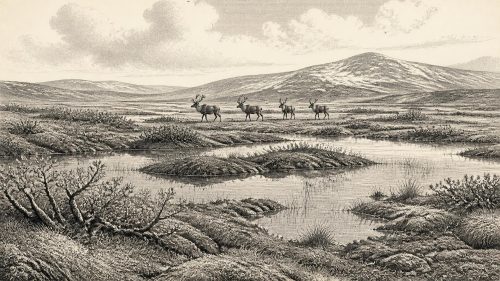
Thirty thousand years BCE is a modern label rather than a recorded Irish date. Derryvree, County Fermanagh, preserves freshwater organic sediments between glacial tills, radiocarbon dated broadly to a long Late Pleistocene interval encompassing this period. Its plants and insects reveal cold, treeless tundra wetland with mosses, sedges and shallow pools during an ice-free phase. Greenagho and Crag Cave likewise demonstrate climatic variability. Ice was developing unevenly before its later maximum, reshaping landscapes and obscuring evidence. Castlepook Cave’s fauna records cold-stage mammals; a possibly butchered reindeer bone suggests debated human activity. Permanent settlement, society and political history remain entirely unproven.
Dateline
A Modern Year in Deep Time
30,255 BCE is a modern label applied to a time far beyond the reach of Irish annals, calendars or year-by-year archaeology. It is approximately 32,204 years before AD 1950, the conventional reference point used in radiocarbon dating, but that arithmetic conversion must not be mistaken for a date recorded by people living in Ireland. No excavated settlement, grave, hearth, tool-making floor or written source allows scholars to identify an event in this particular year.
The responsible frame is a broader one: later Marine Isotope Stage 3, part of the Late Pleistocene, when north-west Europe experienced sharp climatic fluctuations and the British–Irish Ice Sheet was developing unevenly. At this timescale, even very useful scientific dates usually describe ranges of centuries or millennia. The evidence illuminates changing landscapes, animals and ice margins, not named communities or episodes of political history.
The closest important Irish environmental archive is the Derryvree deposit near Maguiresbridge, County Fermanagh. In 1969 roadworks cut through a drumlin and revealed organic silts and fine sands lying between two distinct tills: unsorted sediment deposited by glacier ice. The sequence records a simple but powerful order of events. Ice had affected the locality; thereafter fresh water and organic material accumulated in an ice-free interval; later glacial activity buried the deposit beneath another till. The material was preserved because it was sealed below that later glacial cover.
Organic sediment from Derryvree produced the radiocarbon determination BIRM-166: 30,500 radiocarbon years BP, with a substantial stated uncertainty of +1,170 and −1,030 years. Radiocarbon years are not calendar years. Because atmospheric carbon-14 has varied over time, measurements must be calibrated, and calibration becomes especially broad this far back. Later discussion places the deposit at roughly 36,900–31,700 calibrated years BP, or about 34,950–29,750 BCE. Thus 30,255 BCE falls within a relevant long interval, but not at a point that can be assigned to a particular layer, season or living organism.
Fresh Water Between the Ice
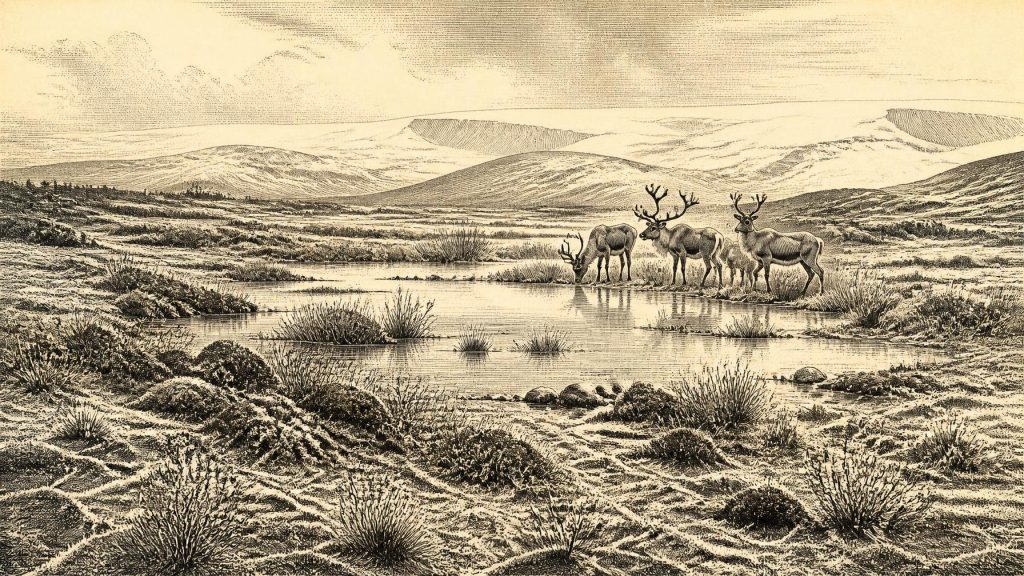
Derryvree is significant precisely because it contradicts a crude picture of an Ireland that was either wholly frozen or wholly open. The fossil plants and insects in its freshwater sediments indicate an open, cold, largely treeless landscape under periglacial conditions: ground shaped by intense frost, seasonal thaw and severe winters close to, or beyond, an ice margin. Mosses, sedges and cold-adapted herbaceous plants grew around shallow pools and wet ground. Aquatic plants show that there was standing or slowly moving fresh water. Insect evidence has been interpreted as indicating a mossy wetland, or muskeg, with open pools and rich plant matter.
That was not a benign refuge. The vegetation suggests tundra rather than woodland, with a short productive season and a climate unlike that of modern Fermanagh. Yet it was not a lifeless white desert. Wet hollows, sedge margins, moss beds and thinly vegetated open ground created a patchwork of habitats. Such places could support insects, small animals and grazing mammals, while their sediments kept a partial record of the plants that grew there. The Derryvree evidence therefore offers a local environmental portrait: not a map of the entire island, but proof that this part of Fermanagh experienced a non-glacial freshwater phase between episodes of ice deposition.
Other Irish sites reinforce the importance of regional variation. At Greenagho, near Belcoo in County Fermanagh, organic lacustrine deposits beneath till also point to ice-free conditions during an earlier part of the last cold stage. In south-west Ireland, uranium-thorium dating of speleothems from Crag Cave, County Kerry, shows that dripstone sometimes grew during Marine Isotope Stage 3. Since flowing water and temperatures sufficiently above freezing are required for such growth, the cave record supports the wider conclusion that climatic conditions repeatedly changed. Neither site permits a detailed national weather report for 30,255 BCE. Together, however, they show why Ireland must be understood as a changing mosaic rather than a single frozen landscape.
An Ice Sheet in Formation
The date lay before the fullest expansion of the last British–Irish Ice Sheet. The later Last Glacial Maximum, when ice extended far across the surrounding continental shelves, belongs broadly to the period after about 27,000 calibrated years BP, with maximum ice volume reconstructed at around 23,000 years ago. Around 32,000 years ago, ice was building in some regions, but its extent, thickness and connection between Irish, Scottish and marine sectors remain difficult to reconstruct. Modern syntheses stress that growth was asynchronous: different ice centres advanced and reached their maxima at different times.
This uncertainty matters for historical interpretation. It would be wrong to imagine the coastline, crossings to Britain, or routes through Ireland as fixed. Sea level was lower than today because vast quantities of water were stored in ice sheets, but lower sea level did not automatically produce a simple, dependable land bridge between Ireland and Britain. Ice, cold seas, shifting shorelines and the configuration of the Irish Sea basin all affected possible movement. The later landscape of counties, lakes, bogs and familiar coasts did not exist. Glaciers would subsequently erode, transport and bury much of the evidence that might otherwise have survived.
There was therefore no political map to describe. No evidence identifies territories, leaders, alliances, warfare or diplomacy in Ireland at this date. These are not merely missing details awaiting recovery from a historical record; they are categories for which no securely contemporary Irish human record has been found. The major development was environmental and regional: the formation, movement and later expansion of ice were repeatedly remaking the physical stage on which Ireland’s much later human history would unfold.
Animals and a Cave in Cork
Animal remains provide a second, unevenly dated window onto this world. Castlepook Cave, also called Mammoth Cave or Doneraile Cave, in north County Cork, has yielded one of Ireland’s most important Late Pleistocene faunal collections. Its accumulated remains include reindeer, woolly mammoth, giant deer, brown bear, wolf, Arctic fox, lemmings and spotted hyaena. This is not a single momentary assemblage. Cave deposits may collect bones over long periods, and nineteenth- and early twentieth-century excavations did not record every find to modern standards. More recent radiocarbon reassessment has also shown that some older determinations from Irish caves required revision.
Nonetheless, the fauna establishes that Ireland was reached by a changing array of cold-stage mammals during parts of Marine Isotope Stage 3. Reindeer are especially relevant to the open, cold habitats represented at Derryvree. Mammoth and giant deer indicate that sizeable herbivores could at times occupy, or enter, Irish landscapes; hyaenas and wolves reveal predators and scavengers within the wider ecological system. Their presence should not be converted into a claim that every one of these animals grazed the same field, or even occupied Cork and Fermanagh simultaneously. The evidence is a time-averaged record of an unstable Ice-Age fauna.
A reindeer femur from Castlepook has attracted particular attention because a deep linear mark has been interpreted as a stone-tool cut made while the carcass was butchered. County Cork heritage material assigns the specimen approximately to 31,000 BCE, close in broad terms to the period considered here. If that interpretation and date are upheld, it would be evidence for a brief Upper Palaeolithic human encounter with a reindeer in Ireland. It would not demonstrate a village, a permanent population or a hunting territory.
Caution is essential. The femur derives from an old cave collection, not a modern sealed camp context, and it has no securely associated tool assemblage, hearth, shelter, burial or sequence of repeated human activity. The National Museum of Ireland continues to state that clear evidence for Palaeolithic human presence has not yet emerged. The most accurate conclusion is therefore that Castlepook presents an important, debated possibility of human activity, while Derryvree remains primarily an environmental archive.
Society Beyond Recovery
If people did visit Ireland during this wider interval, they would have belonged to the Upper Palaeolithic world of north-western Europe, where Homo sapiens used stone technology, fire, tailored clothing and extensive social knowledge to live in cold seasonal environments. That comparison can explain what survival in such country would have required. It cannot prove that these practices took place in Ireland. No Irish evidence around 30,255 BCE identifies a language, family group, belief system, ritual, artwork, teaching tradition or system of authority.
For the same reason, there is no demonstrable Irish economy or trade network. There is no securely dated evidence for farming, herding, metalworking, pottery, sea travel, exchange goods or settled domestic life. Nor can archaeology responsibly identify conflict or diplomacy. Even ‘hunting’ must be carefully phrased: a potential butchered reindeer bone may suggest carcass processing, but it does not reveal whether an animal was killed locally, scavenged, shared among a group or carried to the cave by carnivores after people had cut it.
The absence of evidence is partly a product of preservation. Later ice sheets scoured landscapes, rivers and coasts; sea-level changes submerged or altered former lowlands; and many caves were excavated before modern methods. But preservation alone cannot turn a sparse record into proof of an established population. The sound historical balance is to acknowledge both possibilities: short-lived human visits are conceivable and perhaps signalled at Castlepook, whereas enduring occupation in Ireland at this date is unproven.
The Meaning of the Record
Ireland around 30,255 BCE was not yet a historical society in the conventional sense. It was a northern Atlantic landscape being repeatedly altered by climate, ice and ecological movement. At Derryvree, fresh water lay for a time between glacial episodes, supporting tundra vegetation and wetland life. At Castlepook, a cave accumulated the fragmentary remains of Ice-Age animals and perhaps one trace of human butchery. These are modest remnants, but they are historically valuable because they show that the island’s deep past was dynamic rather than empty.
The year label should consequently be treated as a doorway into a long calibrated range, not as an anniversary. The central Irish story is neither a king nor a battle but a buried Fermanagh wetland: BIRM-166, a sample whose uncertainty is part of its meaning. It records a world of frost, sedges, shallow pools, mobile animals and advancing ice, while also defining the limits of what can honestly be claimed about the first possible people in Ireland.
Primary Sources
- A Middle Midlandian Freshwater Series at Derryvree, Maguiresbridge, County Fermanagh, Northern Ireland
- Middle Midlandian Interstadial Deposits at Greenagho, Near Belcoo, County Fermanagh, Northern Ireland
- Irish Pleistocene Biostratigraphy
- The Irish Quaternary Fauna Project
- A Reconsideration of the Radiocarbon Dating of the Marine Isotope Stage 3 Fauna from Southern Ireland
- Episodic Speleothem Deposition Tracks the Terrestrial Impact of Millennial-Scale Last Glacial Climate Variability in SW Ireland
- Growth and Retreat of the Last British–Irish Ice Sheet, 31,000 to 15,000 Years Ago: the BRITICE-CHRONO Reconstruction
- Growth and Retreat of the Last British–Irish Ice Sheet, 31,000 to 15,000 Years Ago: the BRITICE-CHRONO Reconstruction
- The Timing and Magnitude of the British–Irish Ice Sheet Between Marine Isotope Stages 5d and 2
- Behavioural Tendencies of the Last British–Irish Ice Sheet Revealed by Data–Model Comparison
- Spatio-Temporal Dynamics of Speleothem Growth and Glaciation in the British Isles
- The Deglaciation of the Western Sector of the Irish Ice Sheet from the Inner Continental Shelf to Its Terrestrial Margin
- Timing and Pace of Ice-Sheet Withdrawal Across the Marine–Terrestrial Transition West of Ireland During the Last Glaciation
- Stratigraphic and Palaeo-Geomorphological Evidence for the Glacial-Deglacial History of the Last British-Irish Ice Sheet in the North-Western Irish Sea
- The IntCal20 Northern Hemisphere Radiocarbon Age Calibration Curve (0–55 cal kBP)
- Prehistoric Details
- Heritage Artefacts of County Cork
- Castlepook Cave, Castlepook South, County Cork
- Mammoth Cave
- Our Ancient Landscapes: Hunter-Gatherers in Ireland
- New Insights on the Fauna of Ireland's Younger Dryas and Early Holocene from Alice & Gwendoline Cave