
Castlepook’s Fractured Archive30204 BCE
Around 30,204 BCE, Ireland experienced increasing cold during Marine Isotope Stage 3, before Last Glacial Maximum. Advancing ice, periglacial activity, low sea levels and coastlines created unstable landscapes including open ground and freshwater refuges. Fragmentary evidence from tills, sediments and caves, particularly Castlepook in County Cork, records mammoth, reindeer, giant deer, lemmings, bears, wolves and hyaenas, indicating cold-adapted ecosystems. Derryvree preserves evidence of interstadial wetlands. Cave deposits are disturbed and cannot reconstruct a single moment. No evidence establishes human settlement or activity at this date; disputed modified bone may indicate only a brief visit. Environmental change restricted habitats and fauna.
Dateline
30,204 BCE cannot be treated as a date in the ordinary historical sense. No written record, settlement layer or securely dated event permits a narrative for that particular year. In calibrated terms, it falls roughly 32,150 years before 1950, within the later part of the Pleistocene and Marine Isotope Stage 3. At this depth of time, chronology is expressed in ranges, probabilities and correlations between deposits, rather than annual precision. The responsible question is therefore not what happened in Ireland in one named year, but what the surviving geological, faunal and archaeological evidence can reveal about the island during the broad climatic interval surrounding it.
A Landscape Entering Deep Cold
Ireland was moving into a markedly colder phase of the last glacial cycle. The great Last Glacial Maximum, when ice later reached its fullest extent across much of Ireland and the surrounding seas, still lay ahead; it was not a single island-wide moment, and different sectors of the British–Irish Ice Sheet reached their maxima at different times. Yet around 32,000 years ago ice was already growing rapidly in north-western Europe. Reconstructions suggest ice accumulation over northern Ireland and the high ground of Donegal, while smaller ice caps developed in south-western uplands. The exact margins remain uncertain because dated evidence is sparse, but this was an age of advancing rather than settled ice.
That distinction matters. Ireland was not simply a white, lifeless block beneath an unchanging ice sheet. Its conditions varied sharply by region, altitude and season. Some terrain was glaciated; other areas, especially in the south and in lower ground, may have remained open for at least part of this interval. Periglacial processes—repeated freezing and thawing, snow movement, wind-blown sediment and unstable ground—reshaped exposed land. Rivers carried meltwater and sediment, while cold conditions restricted woodland. The familiar wooded and enclosed Irish countryside belonged to a far later world.
Low global sea levels altered the geography of north-west Europe, extending the continental shelf and changing coastlines. They did not automatically make Ireland a landward extension of Britain or continental Europe. Water crossings remained a major barrier, and changing ice, sea ice, tides and channels would have made any passage difficult to reconstruct. Geography therefore shaped both animal movements and the possibility of human visits, but it does not prove either.
Evidence Beneath the Ground
The best Irish evidence for this older Ice Age landscape is fragmentary and unevenly distributed. It comes chiefly from caves, buried sediment sequences, pollen and plant remains, insect fragments, animal bones and the tills left by moving ice. Each class of evidence answers a different question. A till may show that ice crossed a location, but rarely identifies its exact date. A radiocarbon measurement dates the death of organic material, not necessarily the formation of the whole deposit. A bone in a cave may record an animal’s death, scavenging or transport by water, rather than a living population immediately outside.
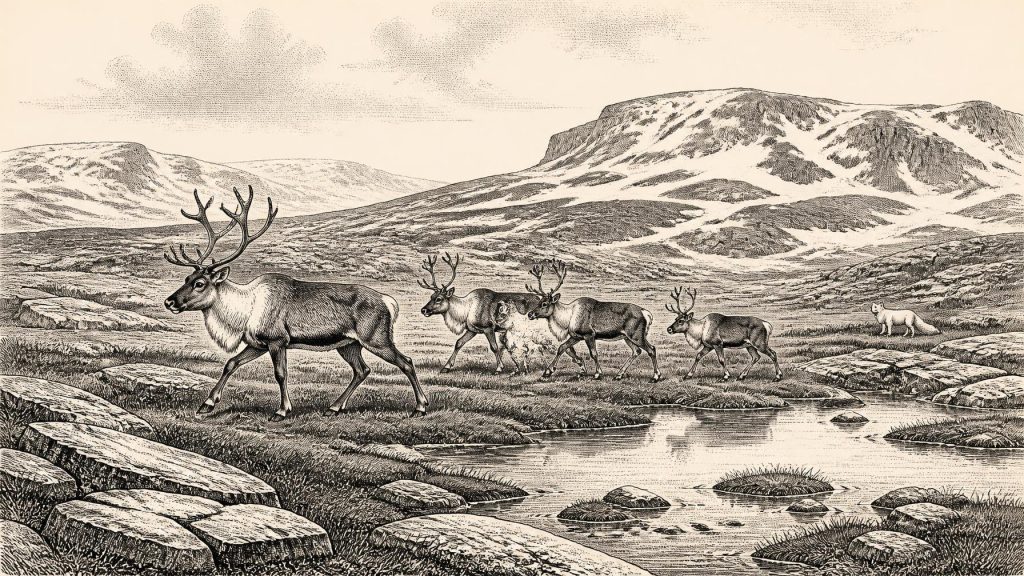
The old cave deposits at Castlepook, near Doneraile in County Cork, are especially important. Excavations there recovered a remarkable assemblage of Pleistocene fauna: woolly mammoth, reindeer, giant deer, brown bear, wolf, Arctic fox, spotted hyaena and lemmings. These animals did not necessarily occupy the cave together, nor does the list describe a single year or even a single century. Castlepook accumulated material over a long and disturbed history. Water, carnivores, early excavations and later contamination all complicate the archive. Modern redating has shown that some older radiocarbon determinations understated the true antiquity of specimens, and it has strengthened the case that elements of the fauna belong to Marine Isotope Stage 3, before the later glacial maximum.
Nevertheless, Castlepook establishes an essential point: Ireland could sustain, at intervals during the middle part of the last glacial cycle, a cold-adapted large-mammal community of a kind now absent from the island. The combination of reindeer, mammoth and lemmings indicates open, cold habitats; predators such as wolf and hyaena point to an ecological web with substantial herbivore biomass. The cave itself was not a village, hunting camp or political centre. In particular, the presence of hyaena means that some bone accumulations may be the result of carnivore activity. It is a palaeontological archive first, and only potentially an archaeological one.
A contrasting record was found at Derryvree near Maguiresbridge, County Fermanagh, where roadworks exposed organic freshwater sediments trapped between glacial tills. Plant macrofossils, mosses, insects and aquatic material indicate that a freshwater environment existed between episodes of ice advance. The deposit is valuable because it preserves local ecological evidence rather than only a regional ice signal. Its conventional radiocarbon result has a wide uncertainty and cannot be transformed into an exact calendar year; it should not be claimed as a diary entry for 30,204 BCE. But it demonstrates that cold-stage Ireland included short-lived wetlands and biologically productive refuges, not merely barren ground.
Animals, Not Assured Human Occupation
The most difficult issue is people. There is no securely excavated settlement, hearth, stone-tool assemblage or human burial from Ireland that can be assigned to around 30,204 BCE. It follows that there is no evidence for permanent population, named communities, households, leadership, territories or language at this date. Nor can political affairs, warfare, diplomacy, religion, trade or formal learning be reconstructed. Applying later Irish identities—or such labels as Gaelic, Celtic, tribal or prehistoric kingdom—to this period would be anachronistic.
There have been claims that a modified reindeer bone from Castlepook might indicate very early human handling, potentially far older than Ireland’s formerly accepted Late Upper Palaeolithic evidence. Such a possibility is important, but it remains insufficient to establish a settled human presence around this date. The cave’s deposits are disturbed, the object lacks the kind of secure excavation context that would settle the matter, and alternative processes must be excluded carefully. A single marked bone, even if confirmed as humanly cut, would show an episode of carcass processing or a brief visit, not a society occupying Ireland year-round.
The earliest published evidence generally accepted as direct human activity in Ireland is much later: cut marks on a brown-bear kneecap from Alice and Gwendoline Cave in County Clare, dated to approximately 10,800–10,500 BCE. More substantial evidence for enduring settlement belongs to the Mesolithic, from about 8000 BCE. These later findings do not prove that no person ever reached Ice Age Ireland earlier; absence of evidence is not proof of absence. They do, however, set the proper evidential standard. Around 30,204 BCE, human occupation remains unproven rather than merely poorly documented.
Everyday Life Without Households
For non-human life, the evidence permits more. Open grass-, herb- and sedge-rich ground, patches of dwarf shrub and mossy wetland, and a highly seasonal climate would have offered food to grazing and browsing animals. Reindeer could have moved through open country; giant deer and mammoth belonged to a wider mosaic whose details changed with temperature, snow cover and vegetation. Small mammals such as lemmings, together with Arctic fox, signal conditions far colder than modern Ireland. Brown bears, wolves and hyaenas would have competed, scavenged and hunted within the same broad landscape at different times.
This was an economy of ecosystems, not one that can yet be described as an Irish human economy. There is no evidence for crops, livestock, pottery, metalwork, monuments, boats, exchange networks or managed herds. Animal movement was the principal connection between regions; wind, water and advancing ice were the great agents of change. If people did make a short incursion, they would have entered an unstable and dangerous environment in which shelter, fuel and dependable food could not be assumed. That is an interpretation based on environmental constraints, not a fact demonstrated by an Irish campsite.
A Record of Change
The most important development around this point in time was environmental instability. Ice masses were expanding, and habitats that had supported the Castlepook fauna were becoming more restricted, rearranged or lost. Recent reassessment of Irish cave dates suggests that giant deer and spotted hyaena may have disappeared locally well before the later glacial maximum, although the timing and causes remain unresolved. Climate deterioration, changes in vegetation, fragmented routes into Ireland and small population sizes may all have mattered. None can yet be assigned exclusive responsibility.
What survives from this age is therefore not an annual chronicle but a fractured archive: cave bone, buried wetland mud, glacial sediment and the dating methods used to connect them. It gives Ireland a deep history older than its settlements, monuments and written traditions. Around 30,204 BCE, the island was being remade by cold, ice and ecological change. Animals certainly inhabited parts of that changing world. Whether people briefly shared it remains one of Irish archaeology’s most intriguing, but still unresolved, questions.
Primary Sources
- The Exploration of Castlepook Cave, County Cork
- The Irish Quaternary Fauna Project
- A reconsideration of the radiocarbon dating of the Marine Isotope Stage 3 fauna from southern Ireland
- Castlepook Cave, County Geological Site Report
- Castlepook Cave, Co. Cork, 2022 Excavation Report
- First Evidence of a Late Upper Palaeolithic Human Presence in Ireland
- New Insights on the Fauna of Ireland's Younger Dryas and Early Holocene from Alice & Gwendoline Cave
- A Middle Midlandian Freshwater Series at Derryvree, Maguiresbridge, County Fermanagh, Northern Ireland
- Growth and Retreat of the Last British–Irish Ice Sheet, 31,000 to 15,000 Years Ago: The BRITICE-CHRONO Reconstruction
- The Timing and Magnitude of the British–Irish Ice Sheet Between Marine Isotope Stages 5d and 2
- Deglaciation Chronology of the Donegal Ice Centre, North-West Ireland
- Timing and Pace of Ice-Sheet Withdrawal Across the Marine–Terrestrial Transition West of Ireland During the Last Glaciation
- Advance and Retreat of the Marine-Terminating Irish Sea Ice Stream into the Celtic Sea During the Last Glacial: Timing and Maximum Extent
- Radiocarbon Constraints on the Age of the Maximum Advance of the British–Irish Ice Sheet in the Celtic Sea
- Stratigraphic and Palaeo-Geomorphological Evidence for the Glacial-Deglacial History of the Last British-Irish Ice Sheet in the North-Western Irish Sea
- Maximum Extent and Readvance Dynamics of the Irish Sea Ice Stream and Irish Sea Glacier Since the Last Glacial Maximum
- Dimensions and Chronology of the Last Ice Sheet in Western Ireland
- The IntCal20 Northern Hemisphere Radiocarbon Age Calibration Curve (0–55 cal kBP)
- A Stratigraphic Framework for Abrupt Climatic Changes During the Last Glacial Period Based on Three Synchronized Greenland Ice-Core Records
- Pleistocene Vertebrates in the British Isles
- Occurrence of Mammalia Relicts at Site Castlepook Cave
- Archaeological Heritage of County Cork